



Exhaust System Muffler Market Size, Companies, Share, Vehicle Production Volume, Sales Performance, Export & Import Analysis, Technology Adoption, Competitive Positioning, and Demand Trends
Exhaust System Muffler Market (By Product Type: Standard Mufflers, Performance Mufflers, Noise Control Components; By Type (Acoustics): Reactive Mufflers, Absorptive Mufflers; By Material: Stainless Steel, Titanium/Advanced Alloys, Aluminized Steel, Composite Materials; By Vehicle Type: Passenger Cars, Commercial Vehicles, Motorcycles/Two-Wheelers; By Sales Channel: OEM (First Fit), Aftermarket; By Fuel Type: Gasoline, Diesel, Alternative Fuels (CNG/LPG/Hybrid)) - Global Industry Analysis, Size, Trends, Leading Companies, Regional Outlook, and Forecast 2026 to 2035
Source: https://www.precedenceresearch.com/exhaust-system-muffler-market
 Get a Sample
 Table Of Content


What is Exhaust System Muffler Market Size in 2026?
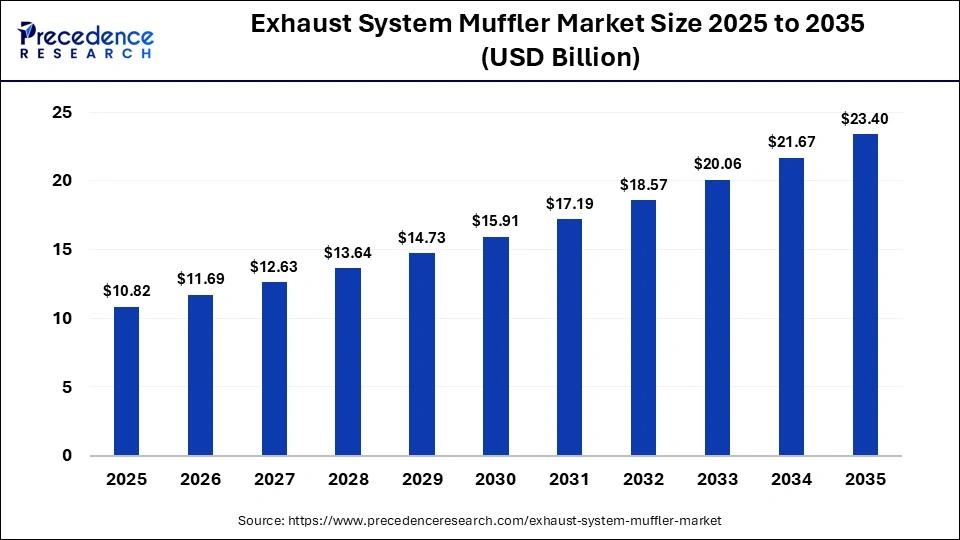
The global exhaust system muffler market size was calculated at USD 10.82 billion in 2025 and is predicted to increase from USD 11.69 billion in 2026 to approximately USD 23.40 billion by 2035, expanding at a CAGR of 8.02% from 2026 to 2035. The exhaust system muffler market is driven by strict emission and noise regulations and growing vehicle production.
Key Takeaways
- By region, Asia Pacific dominated the exhaust system muffler market with a share of 61% in 2025 and is expected to grow at a 7.9% CAGR throughout the forecast period.
- By region, North America is expected to grow at a significant rate during the forecast period.
- By product type, the standard mufflers segment held a dominant position in the market with a share of 65% in 2025.
- By product type, the performance mufflers segment is expected to grow at the fastest CAGR of 7.2% in the market between 2026 and 2035.
- By type, the reactive mufflers segment held a major share of 58% in the market in 2025.
- By type, the absorptive mufflers segment is expected to grow with the highest CAGR of 6.1% in the market in the studied years.
- By material, the stainless steel segment led the global market with a share of 45% in 2025.
- By material, the titanium/advanced alloys segment is expected to expand rapidly in the market with a CAGR of 10.2% in the coming years.
- By vehicle type, the passenger cars segment registered its dominance in the market with a share of 71% in 2025.
- By vehicle type, the commercial vehicles segment is expected to grow at the fastest CAGR of 9.4% over the forecast period.
- By sales channel, the OEM segment held a major share of 62% in the market in 2025.
- By sales channel, the aftermarket segment is expected to grow at the fastest CAGR of 8.4% over the forecast period.
- By fuel type, the gasoline segment dominated the global market with a share of 76% in 2025.
- By fuel type, the diesel segment is expected to grow at a significant rate between 2026 and 2035.
Market Overview
An exhaust muffler is a critical acoustic and emissions component designed to attenuate engine combustion noise and optimize exhaust backpressure. By utilizing chambers, baffles, and sound-absorbing materials, it ensures vehicles meet environmental noise regulations while maintaining engine performance and fuel efficiency across passenger and commercial transportation sectors. The exhaust system muffler market is experiencing robust growth due to the increasing global regulations on noise and emissions, rising automotive production, and the ongoing advances in automotive technologies.
Rising consumer demand for driving comfort and advanced vehicle acoustics is driving manufacturers to develop mufflers with improved sound-absorbing materials and optimized chamber designs. Growth in commercial vehicle production, particularly in emerging markets, supports market expansion by boosting logistics and transportation activities. Additionally, the popularity of sports and performance cars is creating opportunities for niche exhaust tuning products. Key growth drivers also include regulatory compliance, ongoing automotive industry development, and innovations in materials and design.
What are the Major Trends in the Exhaust System Muffler Market?
- The use of lightweight metals, such as aluminum, titanium, and advanced composites, is rising, as manufacturers aim to lower the overall vehicle weight, improve fuel efficiency, and durability. This is gradually replacing traditional heavy steel mufflers in both passenger cars as well as commercial vehicles.
- Mufflers are increasingly being integrated with high-tech emission control systems, including catalytic converters, diesel and gasoline particle filters, and selective catalytic reduction systems, to comply with stringent global emission standards.
- There is increasing demand for corrosion-resistant, long-lasting mufflers, especially in harsh weather conditions, which is driving the use of stainless-steel coatings and high-grade alloys, ensuring lower maintenance costs and greater reliability.
- The rise of hybrid and electric vehicles is prompting manufacturers to design compact, acoustically optimized muffler systems that maintain efficiency while addressing new noise management challenges.
Impact of AI on the Exhaust System Muffler Market
Artificial Intelligence is transforming the exhaust system muffler market through advanced design optimization, proactive maintenance, and intelligent production. The use of AI-powered simulation tools allows engineers to simulate the airflow dynamics, acoustic performance, and backpressure properties with great accuracy, which saves a lot of time on producing the prototype and enhances the effectiveness of the mufflers in general. AI quality inspection systems are used in the manufacturing process to identify flaws in welds, joints, and surface finishes that improve the accuracy of the manufacturing processes and minimize waste. Moreover, AI helps to create an active exhaust system, as it allows the active system to adjust the sound in real-time depending on the conditions under which the vehicle is driven.
Market Scope
| Report Coverage | Details |
| Market Size in 2025 | USD 10.82 Billion |
| Market Size in 2026 | USD 11.69 Billion |
| Market Size by 2035 | USD 23.40 Billion |
| Market Growth Rate from 2026 to 2035 | CAGR of 8.02% |
| Dominating Region | Asia Pacific |
| Fastest Growing Region | North America |
| Base Year | 2025 |
| Forecast Period | 2026 to 2035 |
| Segments Covered | Product Type, Type, Material, Vehicle Type, Sales Channel, Fuel Type, and region |
| Regions Covered | North America, Europe, Asia-Pacific, Latin America, and Middle East & Africa |
Segment Analysis
Product Type Insights
Why Did the Standard Mufflers Segment Hold the Largest Share in the Exhaust System Muffler Market?
The standard mufflers segment held the largest share of 65% in 2025 due to the fact that standard mufflers are increasingly integrated into the mass-produced passenger cars and light commercial cars. The demand for these mufflers increased further as governments in various regions began to impose strict noise and emission laws, and automakers focused on providing reliable and regulation-appropriate muffler systems. The segment's growth is also supported by the high vehicle production rates in emerging economies. Additionally, strong replacement demand for standard mufflers in the aftermarket, driven by wear and tear over a vehicle's lifespan, further boosts market expansion.
The performance mufflers segment is expected to grow at the fastest CAGR of 7.2% in the market between 2026 and 2035, driven by the rising consumer demand for car personalization and high engine performance. The increasing popularity of sports cars, luxury cars, and modified cars has also increased the demand for high-performance exhaust systems that enhance horsepower and produce a unique exhaust sound. The purpose of performance mufflers is to minimize backpressure and maximize the flow of exhaust, and this improves engine performance and efficiency. Product innovation is being further driven by advancements in lightweight materials and sophisticated design configurations, enabling more efficient, durable, and high-performance mufflers.
Type Insights
What Made Reactive Mufflers the Dominant Segment in the Exhaust System Muffler Market?
The reactive mufflers segment dominated the market with a major share of 58% in 2025 due to the increasing global concern about the management of noise pollution in cities, which boosted the adoption of reactive mufflers. These mufflers have a sequence of chambers and baffles that reflect and cancel sound waves and are very effective in reducing noise. They are the preferred choice of OEM installations in passenger and commercial cars because of their ability to comply with the high noise requirements of the vehicle. Also, reactive mufflers are cheap to produce and maintain as well, which makes them viable in the mass production of automobiles.
The absorptive mufflers segment is expected to expand at a CAGR of 6.1% between 2026 and 2035. This is mainly due to their ability to improve engine performance by reducing backpressure, and they are increasingly popular in performance vehicles. Unlike reactive mufflers, absorptive designs use sound-absorbing materials such as fiberglass or steel wool to dampen exhaust noise while allowing smoother airflow. The growth of the segment is also driven by rising demand for lightweight automotive parts to enhance fuel efficiency and meet emission reduction targets, while advancements in high-temperature sound-absorbing materials are boosting product reliability and durability.
Material Insights
Why Did the Stainless Steel Segment Lead the Exhaust System Muffler Market?
The stainless steel segment led the global market with a share of 45% in 2025 because it has great resistance to corrosion, strength, and the capacity to endure high temperatures produced by exhaust gases. Automotive products that are used in various climatic conditions need exhaust parts that are not prone to rust and other structural damage, and as a result, stainless steel is a perfect material selection. It is also cheaper than high-tech alloys, which facilitates mass production and deployment in mass vehicle designs. The strength and long service life of stainless-steel align with automakers' goals of enhancing product reliability and reducing maintenance frequency, making it the preferred choice of material.
The titanium/advanced alloys segment is expected to expand at the fastest CAGR of 10.2% over the forecast period. This is mainly due to their better strength-to-weight ratios, thermal resistance, and durability compared to conventional steel. With automotive companies progressively paying attention to reducing the weight of vehicles in order to achieve better fuel efficiency and comply with the regulations on emissions, the demand for lightweight exhaust parts is rising. Titanium mufflers are becoming popular, particularly in performance and luxury automobiles, because of their lightweight construction reduces overall vehicle mass, enhancing speed, handling, and driving dynamics.
Vehicle Type Insights
How Does the Passenger Cars Segment Lead the Exhaust System Muffler Market?
The passenger cars segment led the global market with the highest share of 71% in 2025 due to high production and sales volumes, particularly in rapidly urbanizing regions of Asia-Pacific and Latin America. Rising disposable incomes, a growing middle class, and increased preference for personal mobility have driven passenger car ownership. Strict government regulations on noise and emissions have also compelled manufacturers to install advanced noise-cancelling mufflers. Additionally, passenger vehicles require optimized exhaust systems for improved engine performance, fuel efficiency, and reduced vibration, supporting stable market demand.
The commercial vehicles segment is expected to expand at a CAGR of 9.4% in the coming years. The growth of the segment is driven by the rapid expansion of logistics, e-commerce, construction, and global infrastructure development. Rising demand for heavy-duty trucks, light commercial vehicles, and buses, which support goods transportation and passenger mobility, has increased the need for durable, high-capacity mufflers. Additionally, new government emission regulations for diesel-powered commercial fleets are compelling operators to upgrade to advanced exhaust systems that reduce noise and harmful emissions.
Sales Channel Insights
What Made OEM the Dominant Segment in the Exhaust System Muffler Market?
The OEM segment dominated the market, holding the largest share of 62% in 2025, driven by the fact that the muffler systems were highly integrated during the manufacturing process of the vehicle, and this guaranteed the maximum compatibility of design and compliance with the regulations. Car makers are keen on procuring exhaust systems through the original equipment suppliers to ensure that the exhaust systems comply with the strict emission and noise control requirements by the government. Increased vehicle production in the world, especially in Asia Pacific, is also a major factor behind the dominance of the segment. OEM mufflers offer better quality assurance, durability, and warranty; thus, they are adopted more by the automakers.
The aftermarket segment is expected to grow at a strong CAGR of 8.4% over the forecast period, driven by the regular replacement needs of mufflers that wear and corrode from heat, water, and road exposure. Consumers in price-sensitive markets often prefer aftermarket products for cost-effective repairs. Growing interest in vehicle customization and performance enhancement is also boosting demand for specialized aftermarket mufflers that improve sound quality and engine efficiency. Expanded distribution through online car parts platforms, local repair shops, and robust supply networks further supports segment growth.
Fuel Type Insights
Why Did the Gasoline Segment Hold the Largest Share of the Exhaust System Muffler Market?
The gasoline segment held the highest market share of 76% in 2025, driven by the widespread use of gasoline-powered passenger vehicles in both developed and emerging markets. Gasoline engines are preferred over diesel for their lower cost, smoother acceleration, and quieter operation. The high volume of gasoline vehicles has driven strong demand for integrated mufflers that reduce exhaust noise and comply with strict emission regulations. Stringent acoustic and pollution control standards in key automotive markets have further compelled suppliers to equip gasoline vehicles with advanced, intelligent exhaust systems.
The diesel segment is expected to expand at a significant CAGR in the coming years. This is mainly due to the increase in demand for diesel-powered commercial trucks in freight transportation, construction, mining, and long-haul logistics operations. Diesel engines are favored for their high torque, fuel efficiency, and the need for robust, large-capacity muffler systems. Advances in diesel engine technology and fuel quality are enabling cleaner combustion, which in turn requires innovative exhaust system designs to meet stringent regulations and enhance performance.
Region Insights
Asia Pacific Exhaust System Muffler Market Size and Growth 2026 to 2035
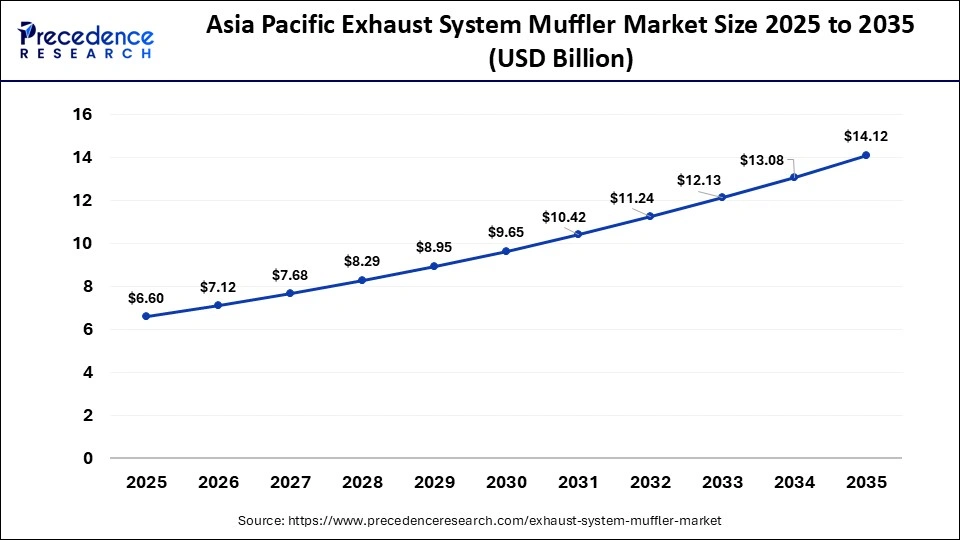
The Asia Pacific exhaust system muffler market size is expected to be worth USD 14.12 billion by 2035, increasing from USD 6.60 billion by 2025, growing at a CAGR of 7.90% from 2026 to 2035.
Why Did Asia Pacific Lead the Global Exhaust System Muffler Market?
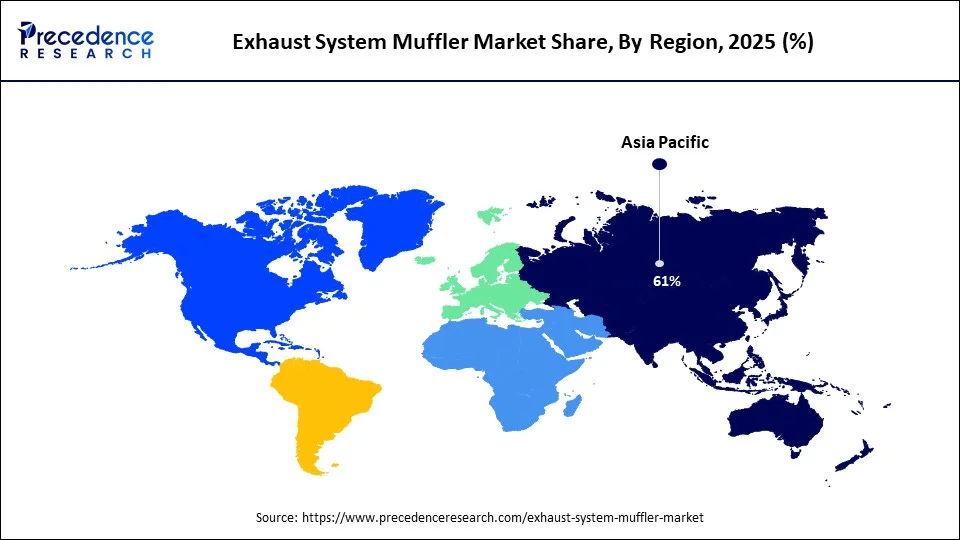
Asia Pacific led the exhaust system muffler market with a share of 61% in 2025 and is expected to grow at a 7.9% CAGR in the coming years, driven by the fact that the region is a global automotive manufacturing hub. The high rates of urbanization, increased population of middle-income people, and increased disposable income have contributed to the ownership of vehicles, including luxury and high-end models. Stringent emission regulations, such as China 6b and BS-VI standards, are compelling manufacturers to adopt advanced exhaust systems. Growth in commercial vehicle sales is further supported by infrastructure development, industrial expansion, and increased logistics operations, alongside strong supplier networks, low production costs, and rising foreign investment in the automotive sector.
India Market Trends
India is rapidly progressing toward a cleaner automotive future by implementing strict BS-VI emission standards alongside substantial support from the PLI scheme. This transformation is positioning the nation as a global hub for advanced exhaust systems and lightweight components. With innovation driven by leaders such as Faurecia and Norma Group, the automotive component sector is localizing high-tech manufacturing, solidifying its status as a powerhouse for exports.
How is the Opportunistic Rise of North America in the Exhaust System Muffler Market?
North America is expected to grow at a significant CAGR in the upcoming period, driven by steady vehicle production and strong replacement demand. The presence of established automakers and advanced manufacturing facilities further strengthens regional revenue. Rising demand for pickup trucks, SUVs, and light commercial vehicles drives the need for durable, high-performance exhaust mufflers. Additionally, a well-developed aftermarket, fueled by a large vehicle parc and aging fleet, ensures consistent replacement demand, while growing consumer interest in performance upgrades and personalized exhaust systems further boosts market growth.
U.S. Market Trends
The U.S. is anchoring the future of mobility by partnering with India through the India-U.S. Cooperative Energy Transfer (iCET) initiative. This collaboration aims to pioneer intelligent, lightweight, and cleaner automotive technologies. The strategic partnership combines American innovation in advanced exhaust systems with harmonized trade standards, expediting the global transition to a high-performance, sustainable, and secure automotive supply chain.
How is Europe Growing in the Exhaust System Muffler Market?
Europe is considered to be a significantly growing area, due to its strict regulatory landscape, the persistence of hybrid vehicles, and the increasing demand for advanced acoustic engineering. The European Union enforces some of the toughest emissions standards worldwide, prompting investment in advanced, high-efficiency exhaust systems and mufflers. The presence of leading automakers in Germany, France, and the UK creates a strong demand for premium, technologically advanced exhaust systems that comply with environmental regulations.
Germany Market Trends
Germany's premium automotive sector is at the forefront of developing future exhaust technology through high-performance, eco-friendly systems. Innovators like Eberspächer and Boysen are revolutionizing the market by integrating AI-driven smart mufflers and lightweight ceramic composites, setting the standard for Euro 7 compliance and sustainable, active noise-canceling performance.
Which Factors Drive the Exhaust System Muffler Market in Latin America?
Latin America is expected to grow at a considerable CAGR in the upcoming period. Governments in the region are implementing stricter emission norms, such as Brazil's PROCONVE L7/L8, which necessitate the adoption of advanced exhaust systems and mufflers to control pollutants. The expansion of vehicle manufacturing, particularly in Mexico and Brazil, is increasing the demand for OEM exhaust systems. Additionally, a large number of vehicles on the road, coupled with harsh driving conditions, fuels the demand for durable replacement mufflers in the aftermarket sector.
Brazil Market Trends
Brazil's aftermarket is booming, primarily driven by aging vehicle fleets and a passion for customization, particularly in cold-end exhaust systems. With Southeast manufacturing hubs and adherence to Proconve compliance, the industry is accelerating to meet the high demand for durable, corrosion-resistant, and performance-oriented muffler systems.
Will the Middle East and Africa Grow in the Exhaust System Muffler Market?
The Middle East and Africa are experiencing significant growth in the global market due to rising vehicle ownership, harsh driving conditions, and industrial localization. The extreme heat, high dust, and desert environments of the region cause rapid corrosion and wear on exhaust systems and mufflers. This results in more frequent maintenance, repairs, and the need for replacement parts, significantly boosting the aftermarket sector and driving demand for custom-tuned, durable exhaust systems and performance mufflers.
Saudi Arabia Market Trends
Saudi Arabia is actively transitioning from being an importer to becoming a localized powerhouse in the automotive and industrial exhaust sectors. Through initiatives like the Future Factories Programme at SPARK and a surge in lightweight, eco-friendly performance mufflers, the Kingdom is rapidly building a robust high-tech manufacturing ecosystem designed for extreme desert durability and luxury customization.
Value Chain Analysis of the Exhaust System Muffler Market
- Raw Material Sourcing: This stage involves sourcing essential materials such as stainless steel, aluminum, titanium, and sound-absorbing composites used in mufflers.
Key players: Outokumpu, Thyssenkrupp, Alcoa. - Component Manufacturers: At this stage, raw materials are converted into muffler components, including shells, baffles, resonators, and heat shields.
Key players: Eberspächer (Purem), Faurecia, Tenneco. - OEMs / Vehicle Manufacturers: OEMs integrate mufflers into new vehicles during production, often adopting high-performance, lightweight, and emission-compliant designs.
Key players: Toyota, Volkswagen, Ford, Hyundai. - Aftermarket Suppliers & Distributors: Aftermarket suppliers provide replacement mufflers and upgrade systems for existing vehicles, catering to repair, maintenance, and performance customization.
Key players: MagnaFlow, Bosal, Walker Exhaust Systems.
Recent Developments
- In July 2025, Suzuki Motorcycles released its flagship motorcycle, the GSX-R1000 and GSX-R1000R. The power distribution front is the largest alteration done to the motorcycle, and there are slight electronic modifications. The motorcycle will now be sold in European nations like the UK, and this time around, it will be offered in the Euro 5-compliant version, beginning in 2026. (Source: https://www.carandbike.com)
- In October 2024, Flowmaster, a brand of Holley Performance Brands, announced the introduction of a new line of exhaust in its brand, named the Flowmaster Signature Series, which will be the key line in the brand. The next generation exhaust system, designed with a more powerful and higher performance, gives the system a well-tuned sound; with brushed stainless steel to give the exhaust a high-end appearance that does not rust away easily. (Source: https://www.businesswire.com)
- In August 2023, Finland-based Outokumpu partnered with Germany-based producer of mufflers, catalytic converters, and other exhaust system components, Purem by Eberspächer, to supply Circle Green recycled-content stainless steel. Thyssenkrupp Materials Processing Europe will process the master coils into slit strips and deliver them directly to Purem for use in mufflers, catalytic converters, and other exhaust components.
Exhaust System Muffler Market Companies
- FORVIA (Faurecia) (France)
- Tenneco Inc. (USA)
- Eberspächer Group (Germany)
- BENTELER International (Austria)
- Futaba Industrial Co., Ltd. (Japan)
- Sango Co., Ltd. (Japan)
- Yutaka Giken Company Limited (Japan)
- Sejong Industrial Co., Ltd. (South Korea)
- Bosal International N.V. (Belgium)
- Friedrich Boysen GmbH & Co. KG (Germany)
- Marelli Holdings Co., Ltd. (Japan/Italy)
- Continental AG (Germany)
- Akrapovic d.d. (Slovenia)
- Klarius Products Ltd. (UK)
- Johnson Matthey (UK - Integrated After-treatment/Muffler units)
Segments Covered in the Report
By Product Type
- Standard Mufflers
- Performance Mufflers
- Noise Control Components
By Type (Acoustics)
- Reactive Mufflers
- Absorptive Mufflers
By Material
- Stainless Steel
- Titanium/Advanced Alloys
- Aluminized Steel
- Composite Materials
By Vehicle Type
- Passenger Cars
- Commercial Vehicles
- Motorcycles/Two-Wheelers
By Sales Channel
- OEM (First Fit)
- Aftermarket
By Fuel Type
- Gasoline
- Diesel
- Alternative Fuels (CNG/LPG/Hybrid)
By Region
- North America
- Europe
- Asia-Pacific
- Latin America
- Middle East & Africa
For inquiries regarding discounts, bulk purchases, or customization requests, please contact us at sales@precedenceresearch.com
Frequently Asked Questions





Ask For Sample
No cookie-cutter, only authentic analysis – take the 1st step to become a Precedence Research client
 Get a Sample




 sales@precedenceresearch.com
 Schedule a Meeting
