



Exhaust Manifolds and Downpipes Market Size, Companies, Share, Vehicle Production Volume, Sales Performance, Export & Import Analysis, Technology Adoption, Competitive Positioning, and Demand Trends
Exhaust Manifolds and Downpipes Market (By Material Type: Cast Iron, Stainless Steel, Other; By Sales Channel: First Fit (OEM), Aftermarket; By Application: Passenger Cars, Light Commercial Vehicles, Heavy Commercial Vehicles; By Engine Type: ICE, HEV; By Component Type: Exhaust Manifold, Downpipe) - Global Industry Analysis, Size, Trends, Leading Companies, Regional Outlook, and Forecast 2026 to 2035
Source: https://www.precedenceresearch.com/exhaust-manifolds-and-downpipes-market
 Get a Sample
 Table Of Content


What is the Exhaust Manifolds and Downpipes Market Size in 2026?
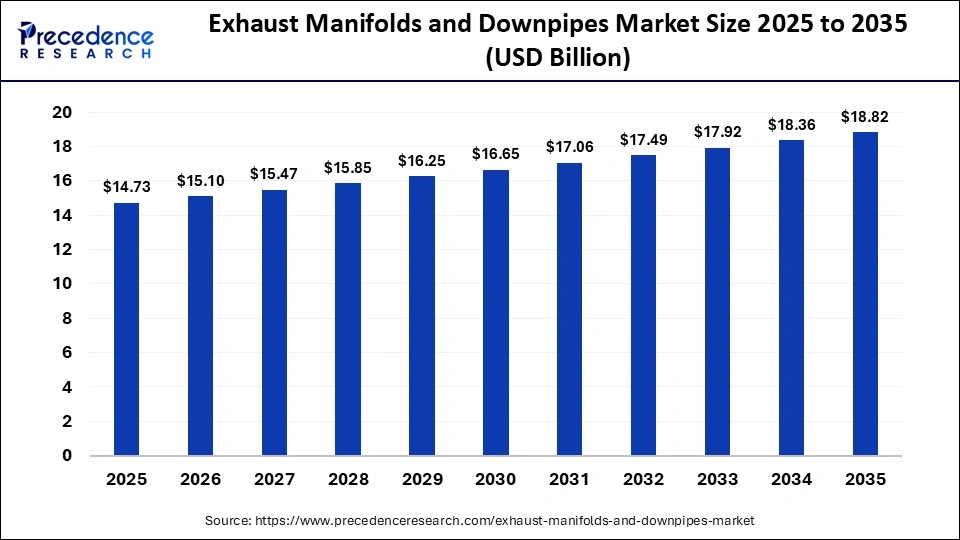
The global exhaust manifolds and downpipes market size was calculated at USD 14.73 billion in 2025 and is predicted to increase from USD 15.10 billion in 2026 to approximately USD 18.82 billion by 2035, expanding at a CAGR of 2.48% from 2026 to 2035.market is rapidly growing due to the implementation of tighter emission standards, forcing manufacturers to innovate with advanced manifolds and downpipes, increased demand for turbocharged engines, and increased production volumes of vehicles.
Key Takeaways
- Asia-Pacific held the largest market share in 2025.
- North America is expected to grow at the fastest CAGR during the foreseeable period.
- By material type, the cast iron segment held the largest exhaust manifolds and downpipes market share in 2025.
- By material type, the stainless steel segment is expected to grow at the fastest CAGR during the forecast period.
- By sales channel, the first fit (OEM) segment held the largest market share in 2025.
- By sales channel, the aftermarket segment is expected to grow at the fastest CAGR during the foreseeable period.
- By application, the passenger cars segment held the largest market share in 2025.
- By application, the heavy commercial vehicles segment is expected to grow at the fastest CAGR between 2026 and 2035.
- By engine type, the ICE segment held the largest market share in 2025.
- By engine type, the HEV segment is expected to grow at the fastest CAGR during the foreseeable period.
- By component type, the exhaust manifolds segment held the largest market share in 2025.
- By component type, the downpipes segment is expected to grow at the fastest CAGR during the foreseeable period.
What are Exhaust Manifolds and Downpipes?
The global exhaust manifolds and downpipes market comprises a critical vertical within the automotive sector, dedicated to optimizing the flow of combustion byproducts towards sophisticated emission control systems. Utilizing high-grade cast iron and stainless steel, these components are engineered while ensuring compliance with stringent Euro 7 and global regulatory frameworks. The market growth is driven by the proliferation of turbocharged and hybrid powertrains that require high-performance thermal management. The advanced material science aims to balance the dual demand of reduced carbon footprints and enhanced fuel economy across the global automotive landscape.
How is AI Influencing the Exhaust Manifolds and Downpipes Market?
The integration of AI, specifically machine learning (ML), is accelerating product design through generative AI, which creates complex, lightweight geometries that maximize flow efficiency while reducing prototyping time. In manufacturing, AI-powered computer vision and machine learning optimize welding processes and detect casting defects in real-time, significantly improving quality control and reducing material waste. AI facilitates the development of "smart exhausts" for hybrids by analyzing driving patterns to preheat catalysts, optimizing emission control. Predictive maintenance models also utilize sensor data to detect potential cracks or failures in these components before they occur, enhancing durability and service life.
Exhaust Manifolds and Downpipes Market Trends
- The shift towards high-performance alloy and integrated thermal management to align with aggressive management decarbonization targets.
- Integration of advanced emission control technology drives the need for complex, integrated systems that combine exhaust manifolds with advanced after-treatment devices, such as diesel particulate filters and selective catalytic reduction.
- The rising turbocharged and hybrid-compatible systems boost efficiency, and the demand for sophisticated exhaust manifolds designed to optimize exhaust gas flow and reduce backpressure.
- Growth of the performance aftermarket and customization, where enthusiasts seek high-flow manifolds and downpipes to improve horsepower and engine sound.
- Increasing digitalization and smart manufacturing are adopting advanced simulation tools, optimizing design, and minimizing pressure drops. Technologies, such as 3D printing and additive manufacturing, are being utilized to create complex geometries that enhance exhaust efficiency and durability.
Market Scope
| Report Coverage | Details |
| Market Size in 2025 | USD 14.73 Billion |
| Market Size in 2026 | USD 15.10 Billion |
| Market Size by 2035 | USD 18.82 Billion |
| Market Growth Rate from 2026 to 2035 | CAGR of 2.48% |
| Dominating Region | Asia Pacific |
| Fastest Growing Region | North America |
| Base Year | 2025 |
| Forecast Period | 2026 to 2035 |
| Segments Covered | Material Type, Sales Channel, Application, Engine Type, Component Type, and region |
| Regions Covered | North America, Europe, Asia-Pacific, Latin America, and Middle East & Africa |
Segmental Insights
Material Type Insights
Why Did the Cast Iron Segment Lead the Exhaust Manifolds and Downpipes Market?
The cast iron segment led the market in 2025. This is because the industrial benchmark for exhaust manifolds is offering superior thermal stability, heat retention, and durability under extreme operating conditions. Its high castability and cost-effectiveness ensure it remains the primary OEM standard for mass-market vehicles, providing optimal performance and longevity.
The stainless steel segment is expected to show the fastest growth over the forecast period, due to the mandate for vehicle lightweighting, offering a significant 30%-40% weight reduction over traditional cast iron. This material shift is critical for meeting Euro 7 and BS-VI standards, as stainless steel maintains superior structural integrity and oxidation resistance at temperatures exceeding 900°C. Its inherent corrosion resistance and design flexibility allow for optimized tubular geometries that enhance scavenging and turbocharger efficiency.
Sales Channel Insights
Which Sales Channel Segment Dominated the Exhaust Manifolds and Downpipes Market?
The first fit (OEM) segment contributed the biggest revenue share of the market in 2025, as an "initial installation advantage," where component volumes are intrinsically tied to global vehicle production. Through deep technical collaboration with Tier-1 suppliers, OEMs ensure that exhaust manifolds are precision-engineered to integrate seamlessly with advanced sensor arrays and proprietary ECUs for real-time emission monitoring. The critical need to meet EPA and Euro 7 mandates, which require high-precision integration of catalytic converters that generic aftermarket parts often cannot replicate.
The aftermarket segment is expected to grow at the fastest CAGR during the foreseeable period due to rising demand for cost-effective replacements for corroded or cracked exhaust components. By offering a diverse range of performance-oriented upgrades, aftermarket suppliers cater to enthusiasts seeking enhanced engine acoustics and volumetric efficiency through high-flow downpipes. The necessity to maintain emission compliance for roadworthiness inspections compels owners to seek readily available, budget-friendly alternatives to premium OEM systems.
Application Insights
Why Did the Passenger Cars Segment Hold the Highest Market Share?
The passenger cars segment dominated the exhaust manifolds and downpipes market in 2025, as rapid integration of turbocharged and hybrid systems, which require precision-engineered components to satisfy increasingly stringent international emission mandates. As consumers prioritize vehicle longevity, they increasingly prefer stainless steel and high-performance alloys to prevent corrosion and improve thermal management. The combination of high initial output and a robust aftermarket replacement cycle ensures that passenger vehicles remain the primary revenue driver for the exhaust industry.
The heavy commercial vehicles segment is expected to gain the highest market share between 2026 and 2035, due to global e-commerce and infrastructure projects, which intensify the demand for high-durability long-haul transportation. To satisfy rigid Euro VI and BS-VI emission mandates, these vehicles are increasingly equipped with robust, heat-resistant cast stainless steel components designed to withstand the extreme pressures of modern diesel engines. The burgeoning aftermarket, where aging fleets require high-performance replacements to maintain roadworthiness and operational efficiency.
Engine Type Insights
How Did the ICE Segment Lead the Exhaust Manifolds and Downpipes Market?
The ICE segment accounted for the highest revenue share of the market in 2025 due to the mandatory integration of advanced emission control modules and thermal management systems. The manufacturers' shift towards low-thermal-mass materials, such as stainless steel, to meet stringent Euro 7 and EPA standards, and the surge in R&D investment for turbocharged and hybrid architecture. The massive installed base of high-mileage commercial and passenger fleets ensures a robust, recurring revenue stream through the aftermarket replacement of critical components.
The HEV segment is expected to witness the fastest growth in the market over the forecast period. This is mainly due to these systems being increasingly close-coupled catalytic converters and gasoline particulate filters; the unique thermal stress of intermittent high-heat cycles necessitates a shift toward advanced stainless steel alloys to prevent structural fatigue and cracking in high-volume models like hybrid SUVs. The transition to complex parallel-series powertrains is driving a sophisticated market for tailored, durable exhaust components that balance urban fuel efficiency with rigorous regulatory compliance.
Component Type Insights
Which Component Type Segment Dominated the Exhaust Manifolds and Downpipes Market?
The exhaust manifolds segment registered its dominance over the market in 2025 due to the integration of turbocharger technology, which necessitates specialized, high-performance manifold designs to optimize exhaust gas flow. To meet stringent Euro VI and EPA mandates, manufacturers are transitioning from traditional cast iron toward lightweight, high-durability alloys that enhance fuel efficiency and thermal management.
The downpipes segment is expected to expand rapidly in the market in the coming years. This is mainly due to stringent emissions mandates that require the integration of advanced, high-flow catalytic converters directly into the downpipe architecture for rapid light-off. Beyond OEM production, the segment thrives on a robust aftermarket where enthusiasts utilize stainless steel upgrades to achieve performance gains of up to 100 HP and improved turbo responsiveness.
Regional Analysis
Why Asia-Pacific Dominated the Exhaust Manifolds and Downpipes Market?
Asia-Pacific held a major revenue share of the market in 2025. This is mainly due to a robust manufacturing ecosystem in China, India, and Japan, where record vehicle production and a shift towards hybrid powertrains ensure a steady demand for high-performance ICE components. The aftermarket, a burgeoning trend toward vehicle personalization, and the necessity of replacing components in an aging fleet are driving market growth.
There is a convergence of stricter China 6 and BS-VI emission mandates with localized R&D for lightweight alloys, solidifying the region as the central hub for both high-volume output and next-generation exhaust innovation.
India Market Analysis
The market in India is growing due to BS-VI and upcoming BS-VII standards, which mandate the integration of sophisticated emission control systems. While cast iron retains its position as the cost-effective baseline, manufacturers are increasingly pivoting toward stainless steel and advanced alloys to achieve critical lightweighting and thermal efficiency targets. The rapid adoption of turbocharged engines necessitates precision-engineered manifolds capable of managing high-heat cycles and optimizing gas flow.
Why is North America Rapidly Expanding in the Exhaust Manifolds and Downpipes Market?
North America is expected to host the fastest-growing market in the coming years due to stringent regulatory frameworks, high demand for advanced, heat-resistant materials, and lightweight, modular designs that enhance fuel efficiency and reduce emissions, encouraging investment in R&D. Growing production of passenger cars and light commercial vehicles, and growing popularity of hybrid powertrains necessitate specific, high-performance exhaust drive market growth.
U.S. Market Analysis
In the U.S., the market is evolving due to driving record demand for advanced stainless-steel downpipes that minimize turbo lag and enhance volumetric efficiency. Strategic material innovation is further accelerated by the industry's focus on lightweighting, with Tenneco and Forvia pivoting toward high-grade alloys to improve fleet-wide fuel economy. The robust aftermarket segment, where thermal fatigue and corrosion in aging vehicle fleets ensure a consistent, high-margin replacement cycle.
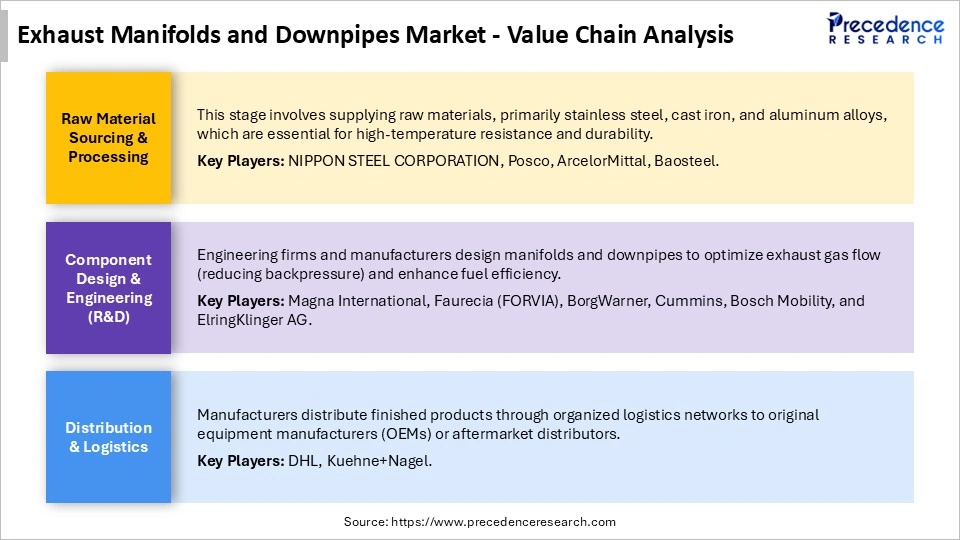
Exhaust Manifolds and Downpipes Market Value Chain Analysis
Exhaust Manifolds and Downpipes Market Companies
- Tenneco, Inc.
- Eberspächer Group GmbH & Co. KG
- Faurecia S.A. (FORVIA)
- Bosal International N.V.
- MagnaFlow Group, Inc.
- Benteler International Austria GmbH
- Friedrich Boysen GmbH & Co. KG
- Sejong Industrial Co., Ltd.
- SANGO Co., Ltd.
- Dinex A/S
Recent Developments
- In February 2026, Tenneco (Clean Air) Modular Downpipes introduced a modular downpipe system in India designed for compact turbocharged engines. It features integrated Gasoline Particulate Filters (GPF) and a heat-shielded design to prevent engine bay overheating in small passenger cars.(Source: https://auto.economictimes.indiatimes.com)
- In February 2026, European Exhaust and Catalyst (EEC) expanded its emissions control range with 15 new part numbers, introducing 74 exhaust systems, 72 DPFs, 15 catalytic converters, and 3 SCR applications. This update covers over 164 vehicle fitments, enhancing the UK manufacturer's range of type-approved aftermarket products for improved market coverage.(Source: https://eurocats.co.uk)
- In April 2025, Tenneco LLC officially announced the completion of a major strategic investment from Apollo Fund X, with American Industrial Partners (AIP) joining as a co-investor. This capital infusion marks a pivotal transition for the Northville-based manufacturer, specifically aimed at scaling its Clean Air and Powertrain divisions within the global mobility sector.(Source: https://www.tenneco.com)
Segments Covered in the Report
By Material Type
- Cast Iron
- Stainless Steel
- Other
By Sales Channel
- First Fit (OEM)
- Aftermarket
By Application
- Passenger Cars
- Light Commercial Vehicles
- Heavy Commercial Vehicles
By Engine Type
- ICE
- HEV
By Component Type
- Exhaust Manifold
- Downpipe
By Region
- North America
- Europe
- Asia-Pacific
- Latin America
- Middle East & Africa
For inquiries regarding discounts, bulk purchases, or customization requests, please contact us at sales@precedenceresearch.com
Frequently Asked Questions





Ask For Sample
No cookie-cutter, only authentic analysis – take the 1st step to become a Precedence Research client
 Get a Sample




 sales@precedenceresearch.com
 Schedule a Meeting
