



Gene Amplification Technology Market Trends, Companies, Revenue / Sales Performance, Subscriber Growth, Pricing Strategies, Cloud Adoption, Infrastructure Expansion, Competitive Landscape, and Industry Outlook
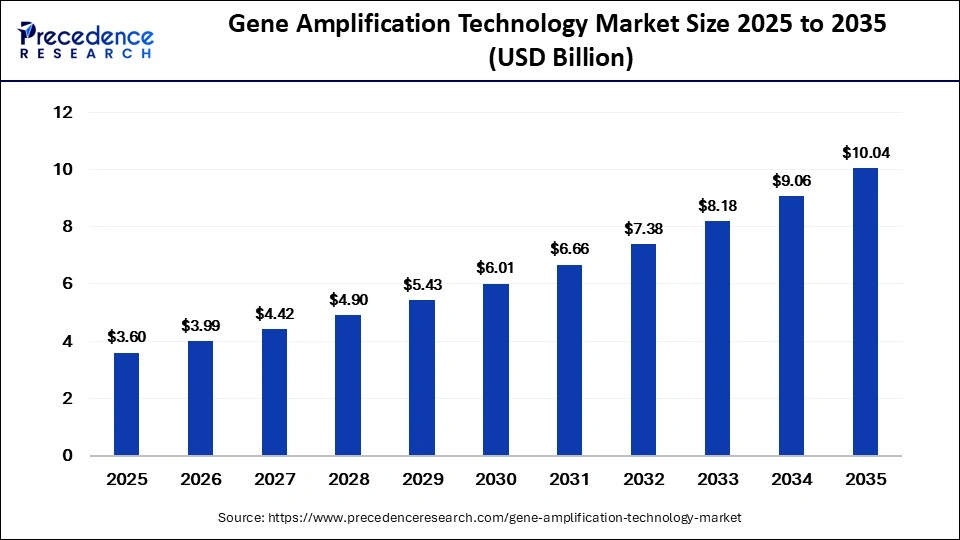
ICT industry specialist Shivani Zoting estimates the gene amplification technology market at USD 3.99 billion in 2026, with continued technology adoption expected to take the market to USD 10.04 billion by 2035 at a CAGR of 10.80%. Leading gene amplification technology market providers such as Thermo Fisher Scientific Inc, F. Hoffmann-La Roche Ltd, QIAGEN N.V., Agilent Technologies, Inc. are expanding their capabilities across segments including By Technology, By Product Type, By Application, By End-Use.
Source: https://www.precedenceresearch.com/gene-amplification-technology-market
 Get a Sample
 Table Of Content


What is the Gene Amplification Technology Market Size in 2026?
The global gene amplification technology market size was calculated at USD 3.60 billion in 2025 and is predicted to increase from USD 3.99 billion in 2026 to approximately USD 10.04 billion by 2035, expanding at a CAGR of 10.80% from 2026 to 2035. The gene amplification technology market is driven by growing demand for genetic diagnostics and advances in molecular technologies.
Key Takeaways
- North America dominated the global gene amplification technology market with a share of 38% in 2025.
- Asia Pacific is expected to grow at the fastest CAGR of 13.5% during the forecast period.
- By technology, the polymerase chain reaction segment held a dominant position in the market, accounting for 45% market share in 2025.
- By technology, the isothermal amplification technologies segment held the second-largest market share in 2025 and is expected to grow at a 13.5% CAGR between 2026 and 2035.
- By product type, the reagents & kits segment held a 50% share of the market in 2025.
- By product type, the instruments segment held the second-largest market share of 30% in 2025.
- By application, the clinical diagnostics segment led the global market with a share of 40% in 2025.
- By application, the research & academic applications segment is the second-largest shareholder and is expected to grow at a 10% CAGR between 2026 and 2035.
- By end-use, the hospitals & diagnostic laboratories segment held a share of 40% in the market in 2025.
- By end-use, the academic & research institutes segment is the second-largest shareholder and is expected to grow at a 9.5% CAGR between 2026 and 2035.
Market Overview
Gene amplification technology comprises a set of molecular protocols used to replicate specific RNA or DNA sequences, enabling precise detection and analysis of genetic material for diagnostic and therapeutic studies. Amplification and detection methods have been refined to optimize the diagnosis and treatment of infectious diseases. The most widely used of these is the polymerase chain reaction, which has commercial kits and is typically used to diagnose a wide range of conditions, such as tuberculosis and infections caused by Chlamydia trachomatis. The rate of innovation in the field of DNA amplification is high, and it has a significant impact on the market. Some of the new technologies are recognized as isothermal methods of DNA analysis.
How is AI Integration Impacting the Gene Amplification Technology Market?
The integration of artificial intelligence has emerged as a key trend in the gene amplification technology market, enabling streamlined workflows and more efficient data analysis. Machine learning combined with genomics allows laboratories to automate complex analytical tasks, improve the accuracy of genetic variation detection, and accelerate diagnostic results. AI-powered applications are particularly effective in processing large datasets generated through amplification techniques, ultimately supporting faster and more informed clinical decision-making.
Gene Amplification Technology Market Trends
- There is a rising use of isothermal amplification technologies, such as LAMP and NASBA, which are altering the diagnostics landscape through faster, cheaper testing without thermal cyclers.
- The growing demand for fast and accurate molecular diagnostics is driving the advancement of PCR technologies, including real-time and digital PCR. These innovations enhance sensitivity and enable precise quantification, supporting the detection of infectious and genetic diseases.
- Technological advancements, combined with automation and AI-driven analysis, are streamlining workflows and improving accuracy in PCR processes. This reduces human error and enhances the efficiency and reliability of gene amplification techniques in both research and clinical applications.
Market Scope
| Report Coverage | Details |
| Market Size in 2025 | USD 3.60 Billion |
| Market Size in 2026 | USD 3.99 Billion |
| Market Size by 2035 | USD 10.04 Billion |
| Market Growth Rate from 2026 to 2035 | CAGR of 10.80% |
| Dominating Region | North America |
| Fastest Growing Region | Asia Pacific |
| Base Year | 2025 |
| Forecast Period | 2026 to 2035 |
| Segments Covered | Technology, Product Type, Application, End-Use, and Region |
| Regions Covered | North America, Europe, Asia-Pacific, Latin America, and Middle East & Africa |
Market Dynamics
Drivers
Growing Demand for Precision Medicine
The growing demand for precision medicine is a significant factor driving the growth of the gene amplification technology market. Gene amplification techniques enable highly accurate and personalized diagnostics and treatment approaches. Advances in real-time amplification technologies and automated systems have improved the speed, sensitivity, and reliability of genetic testing. As a result, gene amplification methods are becoming more accessible and increasingly used across a wide range of clinical applications.
Restraint
High Cost and Regulatory Complexities
The high cost of advanced equipment, specialized reagents, and maintenance limits adoption, particularly among smaller laboratories and healthcare facilities in developing regions. These financial barriers restrict access to advanced genetic testing technologies. In addition, stringent regulatory requirements and lengthy approval processes delay the commercialization of innovations. Ethical concerns related to genetic data privacy, consent, and potential misuse of sensitive information further add to market challenges.
Opportunity
Laboratory Automation Unlocks New Growth
Automation is enabling high-throughput processing, which is essential to meet the growing demand for genetic testing in clinical diagnostics and research. It enhances consistency, reproducibility, and overall quality of laboratory results. As demand increases for faster and more reliable diagnostics, especially in infectious disease detection and oncology, automated gene amplification systems are becoming increasingly critical.
Segment Insights
Technology Insights
Gene Amplification Technology Market Share, By Technology, 2025-2035 (%)
| Technology | 2025 | 2035 | CAGR (%) |
| Polymerase Chain Reaction (PCR) | 45.00% | 42.00% | 9.50% |
| Isothermal Amplification Technologies | 20.00% | 23.00% | 13.50% |
| Digital PCR (dPCR) | 15.00% | 17.00% | 12.50% |
| Rolling Circle Amplification (RCA) | 10.00% | 9.00% | 8.00% |
| Multiple Displacement Amplification (MDA) | 10.00% | 9.00% | 9.00% |
The PCR Segment Held a 45% Share of the Market in 2025
The polymerase chain reaction (PCR) segment dominated the gene amplification technology market with a major share of 45% in 2025, driven by its widespread applications in molecular biology, diagnostics, and research. PCR is the gold standard of gene amplification due to its high sensitivity, specificity, and reproducibility. Its applications in the identification of infectious diseases, cancer diagnostics, forensic studies, and genetic studies reinforced its leadership position.
The isothermal amplification technologies segment held a 20% share of the market in 2025 and is expected to grow at the fastest CAGR of 13.5% during the projection period. This is mainly due to the increasing need for rapid, convenient, and low-cost diagnostic solutions. These technologies are highly suitable for point-of-care testing and working in resource-limited settings due to their ease of use and high efficiency.
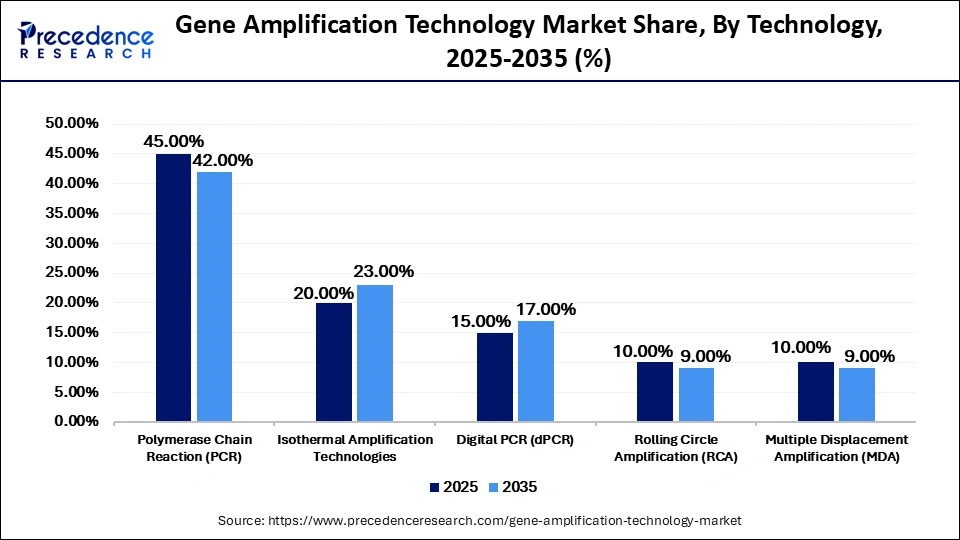
The digital PCR (dPCR) segment held a 15% share of the market in 2025 and is expected to grow at a CAGR of 12.5% during the projection period, driven by the accelerating need to get accurate and quantifiable genetic analysis. Digital PCR is sensitive and accurate since it is able to measure nucleic acids in an absolute manner without the need for a standard curve. Its ability to recognize low targets is encouraging its application in sophisticated research and diagnostic methods in the clinical field.
The rolling circle amplification (RCA) segment held a 10% market share in 2025 and is expected to grow at a CAGR of 8% during the projection period, driven by its application in special molecular diagnostics and DNA sequencing. RCA is optimally adapted to the amplification of circular DNA templates and has been widely used to generate niche research. It has advantages such as being highly specific, simple to use, and the development of long strands of DNA, which make it suitable for achieving specific diagnostics and biosensing.
Product Type Insights
Gene Amplification Technology Market Share, By Product Type, 2025-2035 (%)
| Product Type | 2025 | 2035 | CAGR (%) |
| Instruments | 30.00% | 28.00% | 8.50% |
| Reagents & Kits | 50.00% | 53.00% | 12.50% |
| Consumables | 20.00% | 19.00% | 9.50% |
The Reagents & Kits Segment Held a 50% Market Share in 2025
The reagents & kits segment held a dominant position in the gene amplification technology market by capturing a share of 50% in 2025, driven by recurring demand in diagnostics and research applications. Reagents and kits are regularly and intensively used in the molecular testing procedures. Increasing testing demands, particularly when it comes to infectious diseases and genetic diseases, significantly increase the demand for reagents and ready-to-use kits.
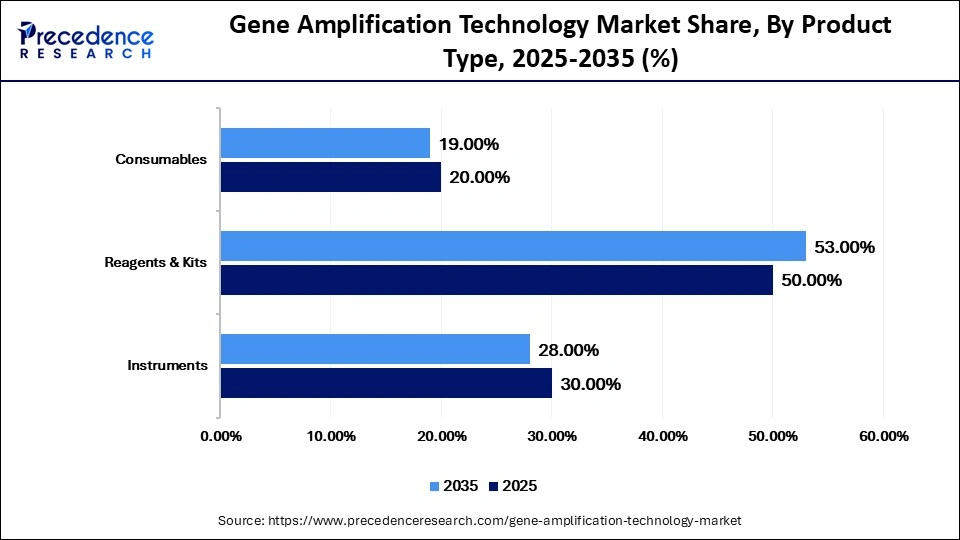
The instruments segment held a 30% share of the market in 2025 and is expected to grow at a CAGR of 8.5% during the projection period, driven by the need to have amplification devices to conduct molecular tests. Some of the instruments that are required in the laboratories during gene amplification are thermal cyclers and automated PCR systems.
The consumables segment held a 20% market share in 2025 and is expected to grow at a CAGR of 9.5% during the projection period, driven by the omnipresent running laboratory work and the rise in the usage of molecular diagnostics. Consumables include tubes, tips of pipettes, enzymes, and other materials, which are required to facilitate day-to-day amplification processes. The rapid increase in genetic testing, research, and screening of infectious diseases significantly contributes to the increased demand for consumables.
Application Insights
The Clinical Diagnostics Segment Led the Gene Amplification Technology Market in 2025
The clinical diagnostics segment dominated the global market with a share of 40% in 2025, driven by the growing demand for tests for infectious diseases, cancer, and genetic disorders. Precise and early identification of diseases is possible through gene amplification techniques and may lead to early clinical intervention and improved patient outcomes. The growing prevalence of chronic and infectious diseases and the demand for personalized medicine are also contributing to segmental growth.
The research & academic applications segment held a 25% share of the market in 2025 and is expected to grow at a CAGR of 10% during the projection period, driven by the increasing studies in genomics and molecular biology. Gene amplification technologies are popular in scientific institutions and educational facilities for studying genetic data, modeling the disease, and experimentation. The segment is being fueled by growing academic collaborations and investment in an increased number of studies in life sciences.
Gene Amplification Technology Market Share, By Application, 2025-2035 (%)
| Application | 2025 | 2035 | CAGR (%) |
| Clinical Diagnostics | 40.00% | 42.00% | 11.50% |
| Research & Academic Applications | 25.00% | 24.00% | 10.00% |
| Drug Discovery & Development | 15.00% | 16.00% | 11.00% |
| Forensic Testing | 10.00% | 9.00% | 9.00% |
| Agricultural & Food Testing | 10.00% | 9.00% | 10.50% |
The drug discovery & development segment held a 15% share of the market in 2025 and is expected to grow at a significant CAGR of 11% during the projection period, driven by the increasing research and development efforts in the pharmaceutical and biomarker discovery. Pharmaceutical and biotechnology companies heavily use gene amplification technologies to accelerate the development cycles and increase the effectiveness of drugs.
The forensic testing segment held a 10% market share in 2025 and is expected to grow at a CAGR of 9% during the projection period. This growth is driven by the rising need for accurate DNA profiling and identity verification in criminal investigations, paternity testing, and legal identification cases. Increasing adoption by law enforcement agencies and the expanding use of forensic genetics are further supporting steady growth in this segment.
End-Use Insights
What Made Hospitals & Diagnostic Laboratories the Dominant Segment in the Market in 2025?
The hospitals & diagnostic laboratories segment dominated the gene amplification technology market with a major share of 40% in 2025. This is because of the high usage of gene amplification technologies in hospitals and diagnostic laboratories for disease detection, monitoring, and screening. Some of the reasons that contribute to high adoption are high inflow of patients, growing prevalence of infectious diseases, and the demand for early disease diagnostics.
The academic & research institutes segment held a 25% share of the market in 2025 and is expected to grow at a CAGR of 9.5% during the projection period, driven by expanding genomics research, scientific advancements, and increased government funding in life sciences. Rising focus on innovation and molecular biology research is further accelerating the adoption of gene amplification technologies in academic and research settings worldwide.
Gene Amplification Technology Market Share, By End-Use, 2025-2035 (%)
| End-Use | 2025 | 2035 | CAGR (%) |
| Hospitals & Diagnostic Laboratories | 40.00% | 42.00% | 11.50% |
| Academic & Research Institutes | 25.00% | 23.00% | 9.50% |
| Pharmaceutical & Biotechnology Companies | 20.00% | 22.00% | 12.00% |
| Forensic Laboratories | 10.00% | 8.50% | 8.50% |
| Others | 5.00% | 4.50% | 9.00% |
The pharmaceutical & biotechnology companies segment held a 20% market share in 2025 and is expected to grow at the fastest CAGR of 12% during the projection period. This growth is supported by increasing R&D investments and the rising focus on precision medicine. Gene amplification technologies are widely used in drug discovery, biomarker identification, and clinical trials, driven by the shift toward targeted and personalized therapies.
The forensic laboratories segment held a 10% share of the market in 2025 and is expected to grow at a CAGR of 8.5% during the projection period, driven by the rising need for accurate DNA testing in criminal investigations and identity verification. Gene amplification techniques are widely used for DNA profiling and forensic analysis, with sustained demand supported by the growing reliance on molecular evidence in legal proceedings and advancements in forensic science.
Regional Insights
North America Gene Amplification Technology Market Size and Growth 2026 to 2035
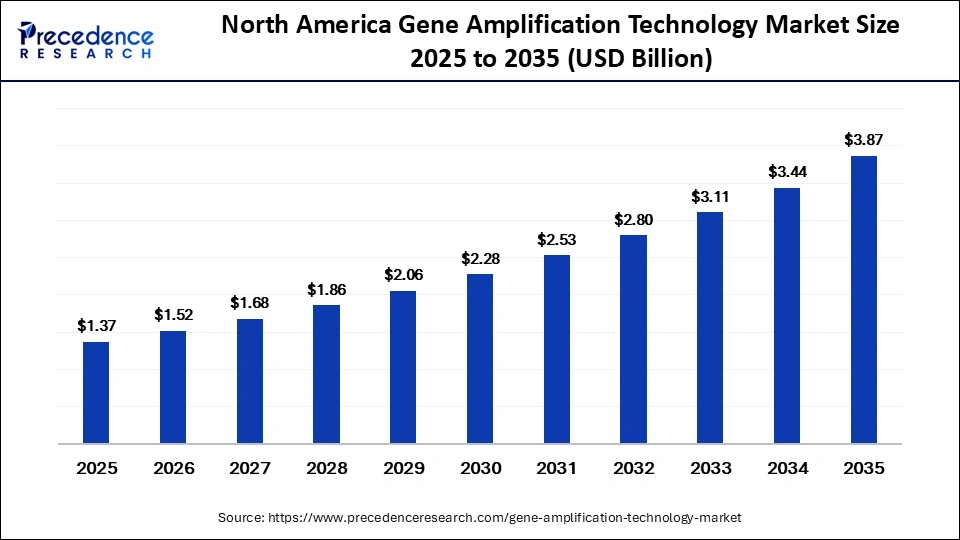
The North America gene amplification technology market size is estimated at USD 1.37 billion in 2025 and is projected to reach approximately USD 3.87 billion by 2035, with a 10.94% CAGR from 2026 to 2035.
North America Led the Gene Amplification Technology Market in 2025
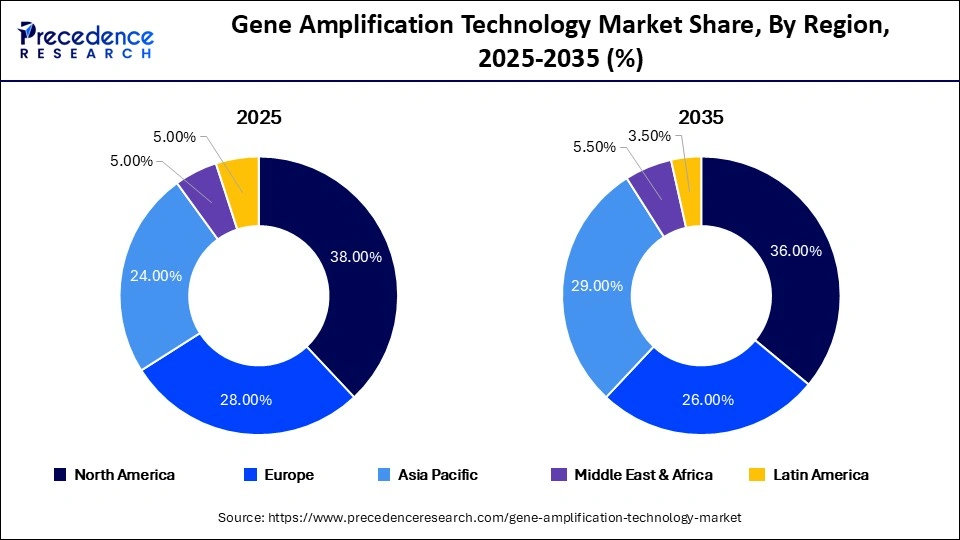
North America dominated the global gene amplification technology market with a share of 38% in 2025. This is because of its well-established healthcare system, high investments in R&D, and the presence of leading biotechnology companies. The widespread adoption of molecular diagnostics in clinical and research settings further strengthens market growth. Additionally, strong government support for genomics and biotechnology, along with rising demand for personalized medicine and precise diagnostics, continues to accelerate adoption.
U.S. Gene Amplification Technology Market Size and Growth 2026 to 2035
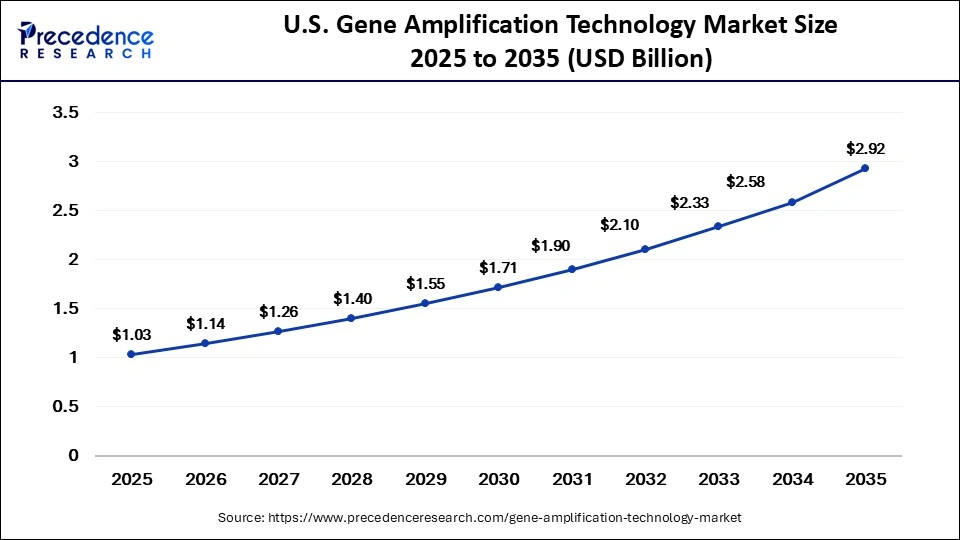
The U.S. gene amplification technology market size is calculated at USD 1.03 billion in 2025 and is expected to reach nearly USD 2.92 billion in 2035, accelerating at a strong CAGR of 10.98% between 2026 and 2035.
U.S. Gene Amplification Technology Market Analysis
The US is a major contributor to the North American gene amplification technology market, led by extensive use of molecular diagnostics, particularly in cancer detection, and a highly developed healthcare infrastructure. Increased government funding for medical research and genomics is further fueling growth. Moreover, a strong network of laboratories and high testing volumes reinforce the country's leadership in molecular diagnostics.
Europe: The Second-Largest Market
Europe is the second-largest market for gene amplification technology, holding a 28% share in 2025, and is expected to grow at a CAGR of 10% during the projection period, by increased integration of molecular diagnostics, a strong biotechnology base, and favorable regulatory frameworks. Government funding and initiatives in life sciences, along with rising demand for personalized medicine and advanced diagnostics, are further boosting the market.
UK Gene Amplification Technology Market Analysis
The UK plays a key role in the European market, supported by advancements in DNA sequencing and a strong research ecosystem. The country is home to leading universities and research institutions that are driving innovation in genomics and biotechnology. Government support and high diagnostic demand within the National Health Service (NHS) are further encouraging the adoption of advanced gene amplification technologies.
How is the Opportunistic Rise of Asia Pacific in the Gene Amplification Technology Market?
Asia Pacific held a 24% share of the gene amplification technology market in 2025 and is expected to grow at the fastest CAGR of 13.5% during the projection period. This growth is driven by expanding healthcare infrastructure, rising demand for diagnostics, and increasing genomics research activities. Greater awareness of early disease detection, along with government support for healthcare modernization and biotechnology development, is accelerating adoption across the region.
China Gene Amplification Technology Market Analysis
The market in China is expanding, driven by rising demand for genetic research and increasing disease prevalence. Advanced molecular diagnostic techniques, including whole genome amplification, are being widely adopted. Strong government investments, expanding laboratory capacity, and growing clinical testing volumes are key factors driving consistent market growth.
Gene Amplification Technology Market Companies
- Thermo Fisher Scientific Inc
- F. Hoffmann-La Roche Ltd
- QIAGEN N.V.
- Agilent Technologies, Inc.
- Bio-Rad Laboratories
- Illumina, Inc.
- Danaher Corporation (Cepheid)
- Takara Bio Inc.
- Promega Corporation
- Merck KGaA
- PerkinElmer, Inc.
- New England Biolabs, Inc.
- LGC Limited
- Oxford Nanopore Technologies plc
- Abbott Laboratories
Recent Developments
- In April 2026, Finnish deep-tech startup Proteins.1 launched with €4.7 million in pre-seed funding led by Lifeline Ventures and Cloudberry Ventures, with support from VTT and Business Finland. The company is developing an enzyme-free, PCR-like ultra-sensitive amplification platform for single-molecule protein detection.(Source: https://www.genengnews.com)
- In July 2025, Stilla Technologies was acquired by Bio-Rad Laboratories, which launched four new droplet digital PCR platforms, including the QX Continuum system. The action consolidates its leadership in the higher-level gene amplification and digital PCR solutions with high diagnostic accuracy.(Source: https://investors.bio-rad.com)
- In June 2025, QIAGEN and GENCURIX collaborated to create oncology assays on the QIAcuityDx digital platform. The partnership will enable the company to further develop the diagnostics of cancer by offering more precision of assays and expanding the clinical applications of digital PCR technology.(Source: https://corporate.qiagen.com)
Segments Covered in the Report
By Technology
- Polymerase Chain Reaction (PCR)
- Isothermal Amplification Technologies (LAMP, NASBA, RPA)
- Digital PCR (dPCR)
- Rolling Circle Amplification (RCA)
- Multiple Displacement Amplification (MDA)
By Product Type
- Instruments (Thermal Cyclers, PCR Systems, dPCR Systems)
- Reagents & Kits (Enzymes, Master Mixes, Primers, Probes)
- Consumables (Tubes, Plates, Microfluidic Chips)
By Application
- Clinical Diagnostics (Infectious Diseases, Oncology, Genetic Disorders)
- Research & Academic Applications
- Forensic Testing
- Agricultural & Food Testing
- Drug Discovery & Development
By End-Use
- Hospitals & Diagnostic Laboratories
- Academic & Research Institutes
- Pharmaceutical & Biotechnology Companies
- Forensic Laboratories
- Others
By Region
- North America
- Latin America
- Europe
- Asia-pacific
- Middle and East Africa
For inquiries regarding discounts, bulk purchases, or customization requests, please contact us at sales@precedenceresearch.com
Frequently Asked Questions





Ask For Sample
No cookie-cutter, only authentic analysis – take the 1st step to become a Precedence Research client
 Get a Sample




 sales@precedenceresearch.com
 Schedule a Meeting
