



Contactless Biometrics Technology Market Trends, Leading Companies, Company Revenue / Sales Performance, Subscriber Growth, Pricing Strategies, Cloud Adoption, Infrastructure Expansion, Competitive Landscape, and Industry Outlook
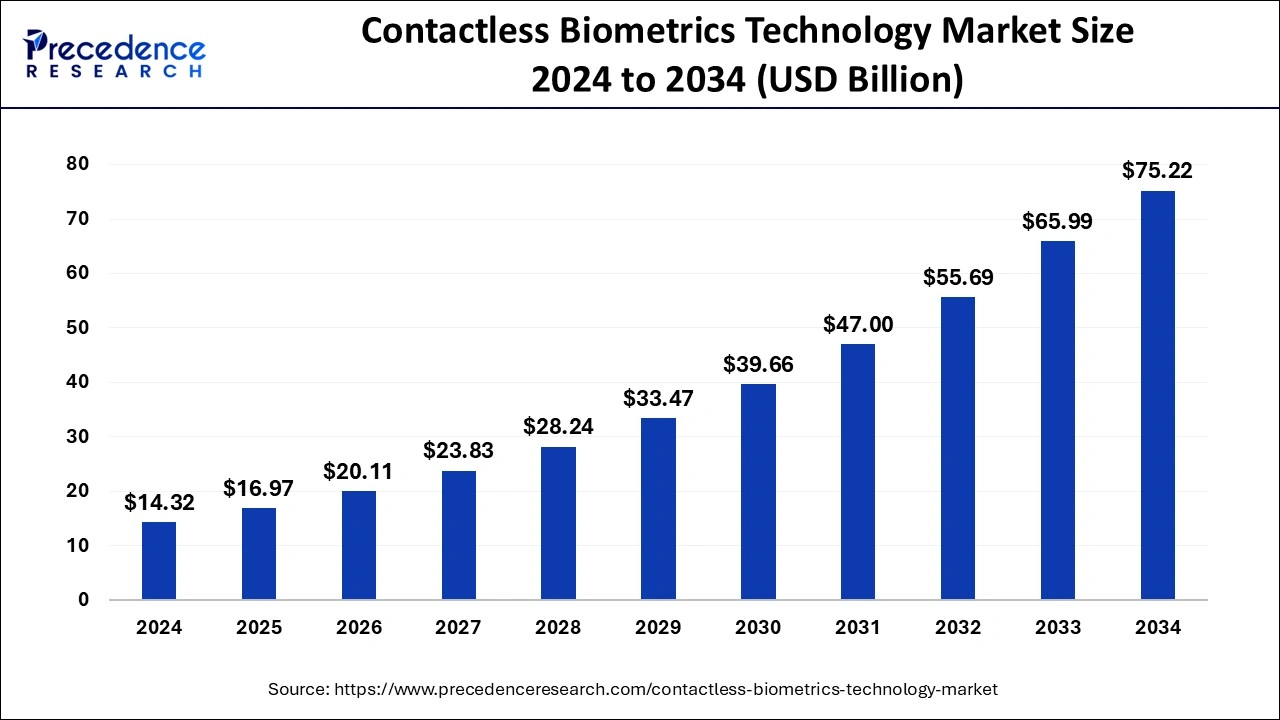
The global contactless biometrics technology market is projected to grow from USD 20.11 billion in 2026 to USD 85.16 billion by 2035, registering a CAGR of 17.5%. Growth is driven by increasing demand for secure and touchless authentication, rapid adoption of AI-powered biometric recognition, expanding digital identity initiatives, and rising deployment across government, banking, healthcare, and smart devices. North America leads the market due to strong technology adoption and security investments, while Asia Pacific is expected to witness the fastest growth, fueled by smartphone penetration, digital transformation, and government-backed biometric identity programs.
Source: https://www.precedenceresearch.com/contactless-biometrics-technology-market
 Get a Sample
 Table Of Content


What is the Contactless Biometrics Technology Market Size?
The global contactless biometrics technology market size is accounted at USD 16.97 billion in 2025 and predicted to increase from USD 20.11 billion in 2026 to approximately USD 85.16 billion by 2035, representing a CAGR of 17.5% from 2026 to 2035. Rising security concerns, the demand for convenient authentication methods, and the adoption of biometrics in government, defense, healthcare, and consumer electronics sectors are driving the market.
Key Takeaways
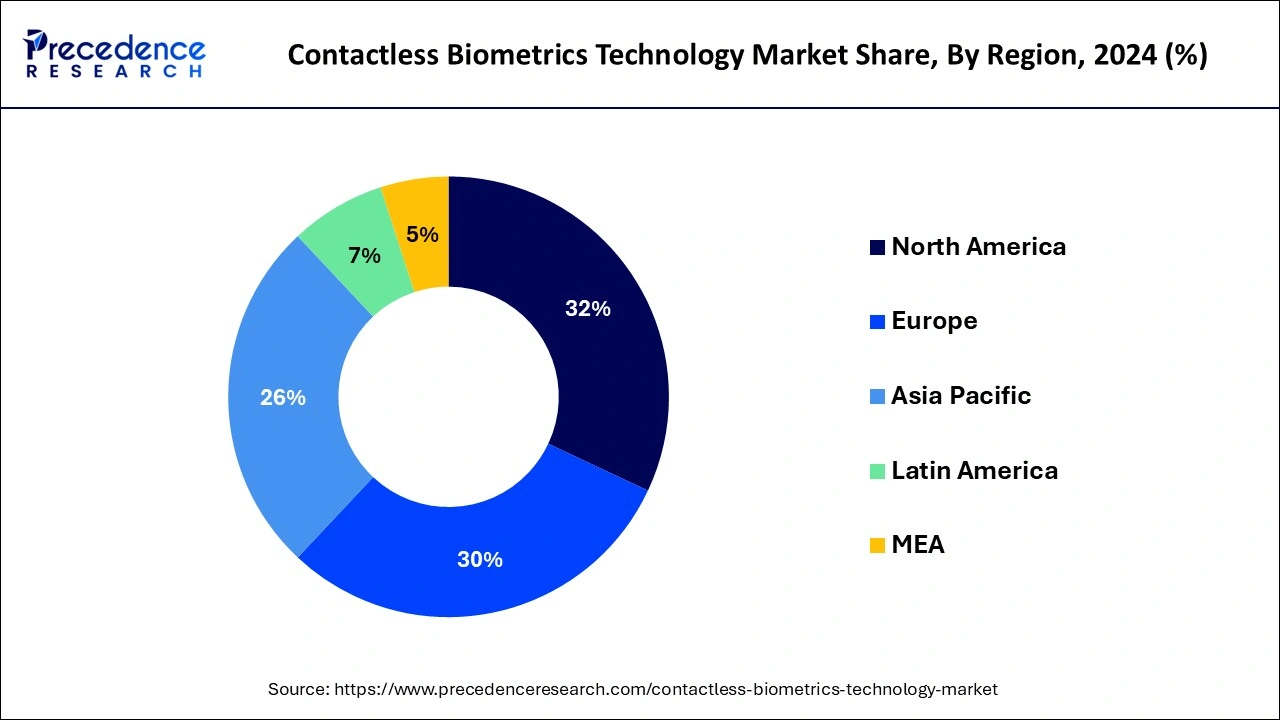
- North America contributed more than 32% of revenue share in 2025.
- By Component, the software segment had the biggest market share of 46% in 2025.
- By End-use, the government segment has held the highest market share of 31% in 2025.
- By Application, the iris segment has held the biggest revenue share in 2025.
What is Contactless Biometrics Technology?
Contactless biometrics is defined as advanced technologies to verify a person's identity without requiring any physical touch or contact with a device. Contactless biometrics uses unique physiological or behavioral characteristics, such as iris patterns, facial features, voice, or palm vein structures, to authenticate individuals seamlessly. The shift toward touchless methods reflects rising demand for hygienic, frictionless authentication solutions.
Implementation of AI in Contactless Biometric Technology
Artificial intelligence (AI) integration can significantly enhance the contactless biometric technology industry by improving accuracy, efficiency, and adaptability while expanding its applications. AI-driven machine learning models can identify subtle patterns and improve the accuracy of biometric recognition, even in challenging scenarios like low light or partial obstructions. AI minimizes false positives and negatives, ensuring more reliable authentication.
AI-powered systems analyze and authenticate biometric data in real-time, enabling seamless access control and security checks. AI handles large datasets efficiently, making it ideal for high-traffic environments like airports or stadiums. AI systems helps to learn and adapt to changing user appearances, such as aging, hairstyles, or facial expressions, ensuring long-term usability. AI can adapt to diverse demographics, enhancing accuracy across different populations.
Market Trends
- Technological advancements like the integration of AI and machine learning in sensor technology help the market to grow.
Integration of smart technology in sensor enhancement and development of an authentic and secure system accelerates the growth of the market. - Integration of contactless biometrics in smartphones and other devices helps in enhancing security and privacy, which is a key trend in the market that supports the growth.
- Application of contactless biometrics in various industries like healthcare, corporate and BFSI, and retail to improve customer identification while maintaining hygiene increases the adoption and helps in wider growth.
Contactless Biometrics Technology Market Growth Factors
- Growing demand for high security levels in public, commercial and private sectors is anticipated to drive market growth. There has been an increase in the use of contactless biometrics in financial institutions that ensures the secured financial transactions, are the attribute that will fuel market growth.
- The surge in demand for Automatic Identification and Data Capture (AIDC) technology in diverse industry verticals such as BFSI, e-commerce and retail industry, and border control applications contributes significantly towards the market growth.
- Rise in demand for smartphones with face recognition software is estimated to foster the market growth. In 2024, the number of smartphone users worldwide is 4.88 billion, which means 60.42% of the world's population owns a smartphone.
- The rise in the number of air travelers in recent years has increased, and this has generated huge demand for contactless biometrics to be used as advanced identification solutions at airports. For instance, Dubai-based UAE flag carrier Emirates has invested a grand total of some AED 85 million ($23.1 million) into its new biometrics initiative.
Future Outlook and Strategic Recommendation
- Long-Term Industry Outlook: The growing adoption of digital identity programs, smart cities, e-government initiatives, and remote consumer onboarding accelerates market expansion. Additionally, advancements in edge AI, cloud computing, and multimodal biometrics will improve authentication accuracy while reducing fraud and identity theft. In the future outlook, privacy-preserving technologies such as on-device biometric processing, federated learning, decentralized digital identities, and encrypted biometric templates will become standard as governments implement stricter data protection regulations.
- Emerging Business Models: Biometrics-as-a-Service platforms enable organizations to deploy facial, iris, and voice recognition without investing in expensive hardware. Multimodal Identity Platforms are integrating facial recognition, iris scanning, voice authentication, behavioral biometrics, and liveness detection into unified platforms. Financial institutions, telecom providers, and government agencies are increasingly partnering with biometric solution providers to deliver remote customer onboarding, electronic Know Your Customer, and digital identity verification services. Companies are combining contactless biometrics with AI-driven risk analytics, behavioral monitoring, and continuous authentication to offer real-time fraud detection and identity assurance for financial transactions and digital services.
Market Scope
| Report Coverage | Details |
| Market Size in 2026 | USD 20.11 Billion |
| Market Size in 2025 | USD 16.97 Billion |
| Market Size by 2035 | USD 85.16 Billion |
| Market Growth Rate from 2026 to 2035 | CAGR of 17.5% |
| Largest Market | North America |
| Fastest Growing Market | Asia Pacific |
| Base Year | 2025 |
| Forecast Period | 2026 to 2035 |
| Segments Covered | By Component, By End use Industry, and By Application |
| Regions Covered | North America, Europe, Asia-Pacific, Latin America, and Middle East & Africa |
Segment Insights
Component Insights
Why Did the Software Segment Dominate the Contactless Biometrics Technology Market in 2025?
The software segment dominated the market in 2025 and is estimated to grow significantly during the forecast period. This is attributed to an increase in the usage of artificial intelligence, cloud-based services, and Machine Learning for contactless biometrics solutions. Rising demand for fast and secure access controls, seamless border crossing, queue-less passenger checks, and quick identification of individuals for better convenience and security is driving the demand for software.
End-use Insights
How Did the Government Segment Dominate the Contactless Biometrics Technology Market in 2025?
The Government segment held the largest share in 2025 and is expected to grow at the fastest rate during the forecast period, driven by demand to improve immigration control and for the security of government buildings. To minimize criminal activities, governments across the globe adopted contactless biometrics technology. This factor will contribute significantly to market growth. Adopting biometric systems for government offices enables efficient workforce management solutions. These systems aid HR departments in planning rosters, tracking leave, and monitoring performance using real-time data from automated attendance tracking systems.
The healthcare segment is growing significantly during the forecast period, due to the rapid technological advancements and AI-powered face and iris identification systems used in hospitals to trace patients without using physical tracking devices. Moreover, the development of a real-time emotion detection system, which is an application of face recognition in healthcare, helps in identifying the emotions of the patients during their stay in the healthcare facility. This assists the doctors in determining the patient's feelings and also in identifying the area where more attention needs to be given. All these attributes are expected to drive the growth of the contactless biometrics technology.
Application Insights
Which Application Segment Dominated the Contactless Biometrics Technology Market in 2025?
The iris segment held the dominant share and is anticipated to grow at the fastest rate during the forecast period, owing to its accuracy, fast, and convenient scanning method. Payroll fraud such as buddy punching is also eliminated. The rise in the use of iris biometrics systems within organizations to process payroll and compute other benefits such as health, disability, and vacation is predicted to drive the iris application segment's growth. Iris identification is used in national and civil ID schemes, access control, time attendance, and a variety of other applications. In addition, the contactless biometrics technology market is expected to rise due to the increasing usage of iris technology by state and local authorities for border security.
The face segment is growing significantly during the forecast period, due to its versatility, cost-effectiveness, and seamless incorporation into existing security infrastructure. Advanced AI and machine learning algorithms have enhanced facial recognition accuracy. Facial recognition eliminates the need for users to touch any surface or manually input information. It is integrated across various platforms, such as e-commerce websites, mobile applications, and self-service kiosks.
Regional Insights
Why Does North America Dominate the Global Contactless Biometrics Technology Market?
North America leads the market contributing a revenue share of more than 32% in 2025 and will continue to grow significantly over the forecast period owing to the presence of major market players such as M2SYS Technology, HID Global, nVIAsoft Corporation and BioConnect in this region. The surge in payment solution providers are requesting contactless biometrics solution s that ensures safe transaction to the customers is expected to fuel the growth of the contactless biometrics technology market in this region.
The increase in contactless biometrics systems being adopted in defense and government application accelerates the market growth in North America. Additionally, the Government regulations to install the contactless biometrics solutions to track the travelers and to boost the security at airport are anticipated to boost the market growth. For instance, on 15th July 2021, HID Global, a worldwide leader in trusted identity solutions, announced that the Arcos Bosques Torre 1 (Tower 1) has deployed its access control solutions to increase the security and better manage visitor entry. It is located in the Bosques de las Lomas neighborhood of Mexico City, the center is comprised of six buildings. The complex included two skyscrapers and is home to high-profile law firms, mining, industrial, media and technology companies, and one of the city's most recognized shopping centers.
What is the U.S. Contactless Biometrics Technology Market Size?
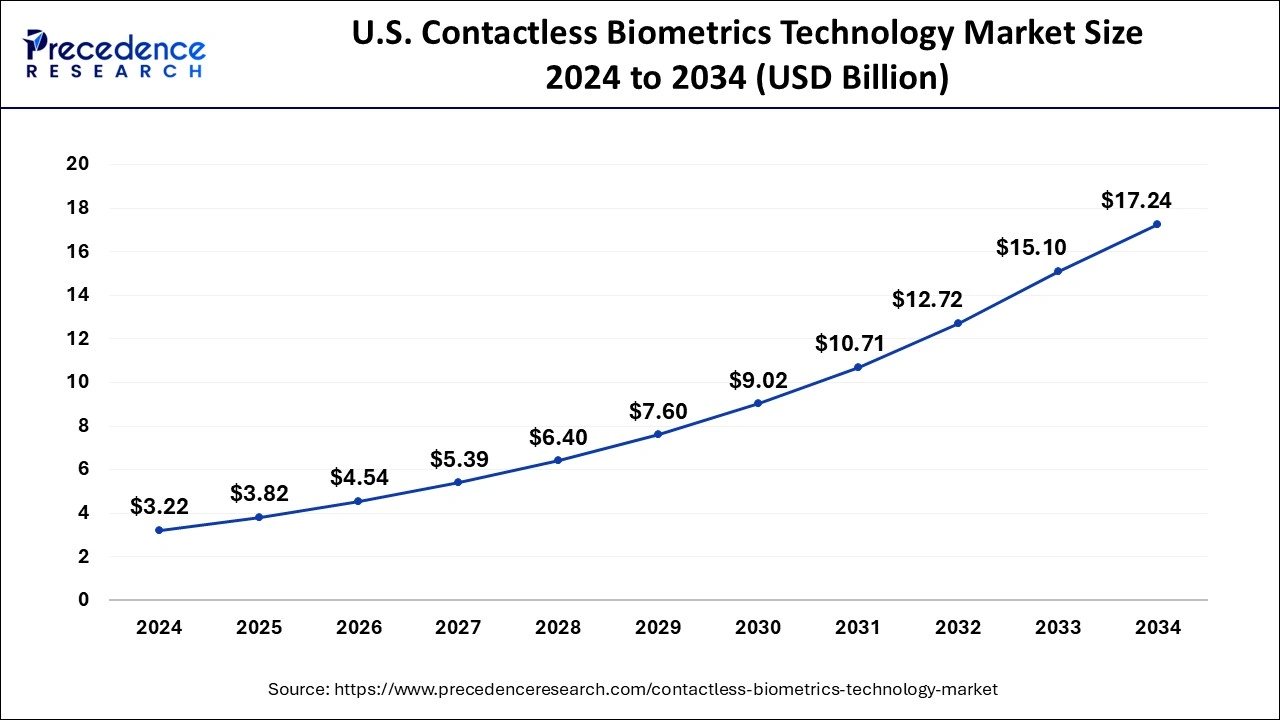
The U.S. contactless biometrics technology market size is estimated at USD 3.82 billion in 2025 and is predicted to be worth around USD 19.38 billion by 2035, at a CAGR of 17.63% from 2026 to 2035.
U.S. Contactless Biometrics Technology Market Trends
The us contactless biometric technology market has seen a significant growth and the growth is driven by the wider and diverse applications of the system by various industries like health, to maintain hygiene, in government offices to maintain security and in other sectors to maintain authentication which helps in the growth of the market in the region.
Increased adoption of biometric systems for authentication, fraud prevention, and secure transactions also contributes to the growth of the market and increases the demand. Major companies in the contactless biometrics market, like Aware Inc., Fingerprint Cards AB, Fujitsu Limited, Gemalto N.V., HID Global, and IDEMIA, play a crucial role in the growth and expansion of the market.
What are the Key Trends in the Contactless Biometrics Technology Market in Asia-Pacific?
Asia-Pacific is expected to witness significant market growth during the forecast period, due to its dense population, the proliferation of smartphones, and the initiatives undertaken by governments to develop digital identities. The region is seeing airports, metros, and border crossings employing contactless biometric techniques like facial and iris recognition after the COVID-19 pandemic. There is an important trend shaping the market is that of linking contactless biometrics to mobile payments and e-KYC services in banks and telecom organizations.
China Market Trends
China witnessed notable market growth in the Asia-Pacific owing to the extensive adoption of facial recognition technology in payment services, subways, and hotels. The massive amount of surveillance and digital IDs being deployed by the Chinese government has fueled innovation in anti-spoofing and low-light recognition technology. Chinese companies excel in thermal-visible cameras for integrated fever detection with biometric identification. The market growth in this country is further driven by significant investment in research and development, supportive regulations, and the development of chips for edge AI.
Europe Contactless Biometrics Technology Market Trends
Europe has seen a steady growth in the contactless biometric technology market, the growth is driven by technological advancement in the regio like edge computing which helps in faster processing and reduces latency in real time application, multi modal biometrics which enhances security and reduce false rejection rates, integration of AI and Machine learning helps improve accuracy, speed, and the ability to detect spoofing attempts this drives and boosts the growth of the market in the region. A wide range of applications in healthcare, the government sector, financial institutions, and transportation further help in the growth and expansion of the market in the region.
France Market Analysis
France is a significant contributor to the European market, owing to IDEMIA, the world's largest player that specializes in facial recognition, iris scan recognition, and fingerprints. The country enjoys significant government support for border protection and identification purposes in relation to both border control and national ID cards, as well as passport and airport e-gate technology. This country benefits from innovative efforts in relation to palm vein recognition and voice verification systems.
Securing the Future: How Latin America Is Scaling Biometric Technology
Latin America is witnessing significant growth, driven by increasing security concerns and the need for efficient identification systems. Countries such as Brazil, Mexico, and Argentina are leading the adoption of these technologies due to their large populations and urbanization rates. Governments are investing in advanced biometric systems for various sectors, including border control, banking, and healthcare.
Moreover, the rise of digital transformation initiatives has further propelled the demand for contactless solutions in both public and private sectors.
Brazil Contactless Biometrics Technology Market Trends
In Brazil, the government has implemented biometric voter registration to enhance electoral security, which has positively influenced public perception of the technology. The banking and fintech sectors are also accelerating demand, using facial recognition and contactless authentication to enhance security and improve customer experience. Growing digital transformation and mobile penetration are further supporting the shift towards touchless solutions in both public and private sectors.
Security Meets Innovation: Why MEA Is Embracing Contactless Biometrics
In the Middle East and Africa, the contactless biometrics technology industry is rapidly expanding, fuelled by increasing security demands and technological advancements. Countries such as the UAE, Saudi Arabia, and South Africa are at the forefront of integrating biometric systems into various sectors, including finance, travel, and public safety. The growing emphasis on smart city initiatives in the region has encouraged the adoption of innovative technologies to improve urban environments.
Moreover, the region's young, tech-savvy population is driving the acceptance and utilization of contactless biometric solutions. Despite certain challenges, such as varying regulatory frameworks and the need for public education, the overall outlook for the market is optimistic.
The UAE and South Africa Contactless Biometrics Technology Market Trends
The UAE has emerged as a leader in contactless biometrics, utilizing these technologies in airports and public services to enhance security and efficiency. Saudi Arabia is investing heavily in biometric solutions as part of its Vision 2030 initiative, aiming to diversify its economy and enhance citizen services. In South Africa, the integration of contactless biometrics in the banking sector is becoming increasingly common to combat fraud and improve customer security.
Competitive Landscape
The contactless biometrics technology market is fragmented to semi-consolidated, featuring many startups along with established security companies. Fragmentation implies lower entry barriers for niche players developing iris and voice recognition; however, stiff competition and lack of standardization hinder growth. Major companies include IDEMIA, HID Global, and NEC, with upcoming players such as FaceFirst that focus on retail analytics, while niche providers provide palm vein and gait recognition. The factors that decide competitive advantage are algorithmic accuracy, liveness detection, and integration with access control platforms.
Strategic actions involve the acquisition of vision-based startups and partnerships with airports and banking institutions for touchless authentication. The latest innovations in the market include multi-factor identification technology, low-latency edge processing, and thermal imaging systems aimed at thwarting spoofing. The entry barriers faced by new players include privacy regulations (GDPR, BIPA), costly research and technological investment to prevent spoofing attacks. Market consolidation is expected to grow because privacy legislation flavors large companies, but niche modality experts will persist.
Contactless Biometrics Technology Market Companies
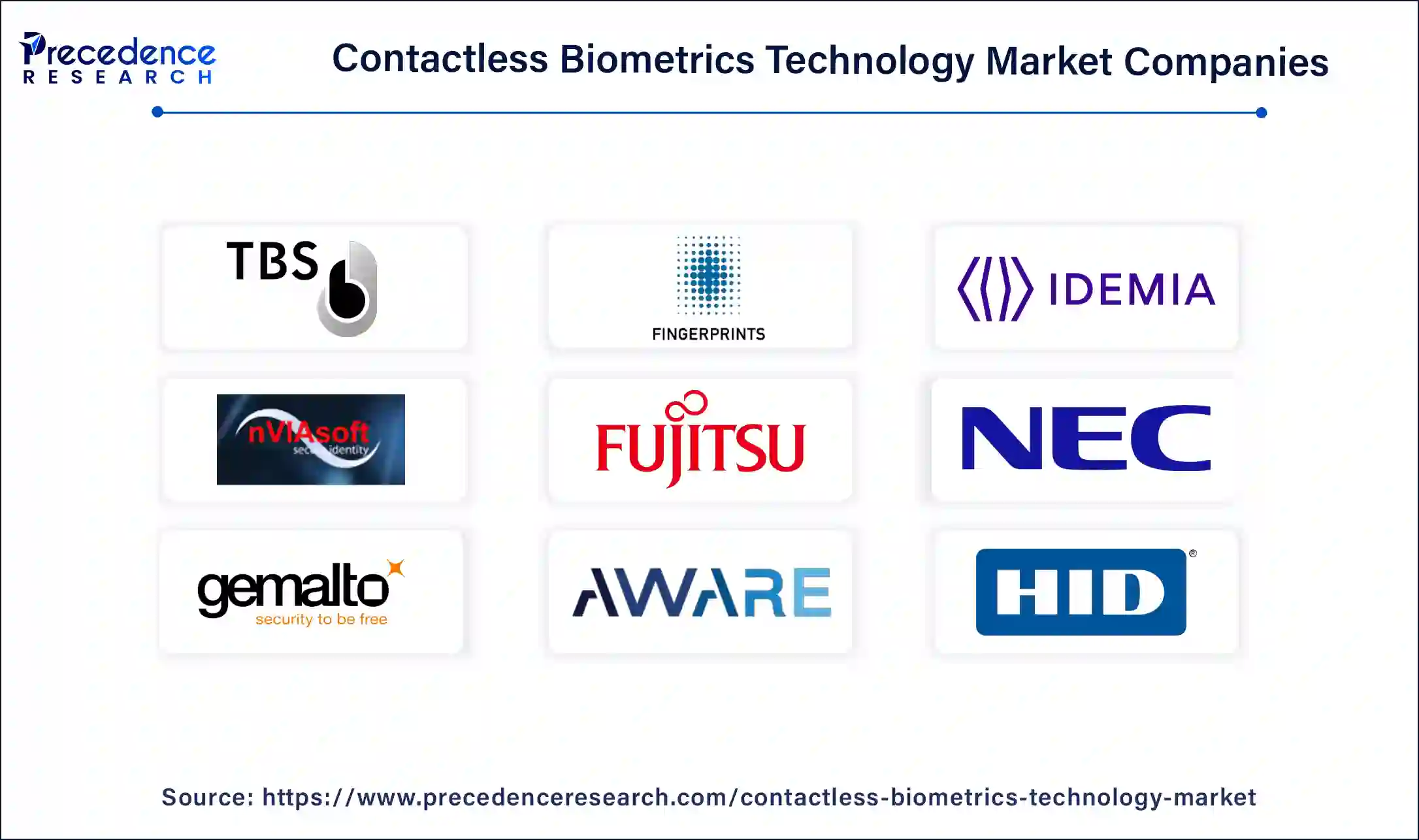
- Touchless Biometric Systems AG
- Fingerprint Cards AB
- IDEMIA
- nViaSoft
- Fujitsu Limited
- NEC Corporation
- Gemalto N.V.
- Aware Inc.
- HID Global
- M2SYS Technology
Latest Announcements by Contactless Biometric Technology Industry Leaders:
- In July, 2024, Adam Philpott, CEO of Fingerprint Cards AB, remarks: the company are promoting the worldwide use of safe, practical, and superior biometric payment cards through ongoing partnership with IN Groupe and its SPS brand. The introduction of contactless biometric payment cards to the market reaffirms Fingerprints' leadership in biometrics and dedication to offering cutting-edge solutions that enhance daily lives.
Recent Investments
- In August 2025, a startup began to emerge in the biometric payment sector, which is projected by Goode Intelligence to generate over $11 billion in revenue by the close of the decade. The Latvian fintech startup Handwave was in the process of securing regulatory certifications for its palm-scanning devices, with plans to initiate pilot projects in third-party retail environments. The scanner utilizes hand shape and vein biometrics to assess blood flow, thereby enabling liveness detection.
- In March 2026, deepidv, a Toronto-based biometric identity verification startup, successfully closed a seed funding round, securing $1 million. The company plans to expand its operations to San Francisco and has launched a suite of advanced fraud detection tools. The funds will be allocated toward ongoing product development and the enhancement of its market entry efforts across the United States.
Recent Developments
- In February 2026, Navi Mumbai International Airport launched the DigiYatra facility, almost two months after the commencement of its commercial operations in December 2025. This contactless and paperless passenger processing system employs facial recognition technology, allowing travelers to navigate airport checkpoints without the need to present physical boarding passes or identity documents.
- In January 2026, the Central Bank of the United Arab Emirates (CBUAE) introduced the region's first biometric payment solution, integrating facial and palm recognition technologies to bolster the country's Digital Economy Agenda. This initiative was unveiled through the CBUAE's Sandbox Programme and Innovation Hub in collaboration with Network International, a prominent fintech enterprise active across the Middle East and Africa.
- In September 2024, with the use of biometric authentication technology, NEC Corporation will introduce a new system that can swiftly authenticate numerous individuals at once, even while they are moving. It is anticipated that the technology will speed up admissions and ease traffic for crowded venues and infrastructure. In September 2024, NEC will start offering the system all across the world, with an initial emphasis on Singapore, Japan, and the U.S.
- In January 2025, Chennai Airport will use a biometric immigration system that will reduce processing times by 60%. In January 2025, Chennai Airport will introduce a new biometric immigration clearance system that will drastically cut down on processing times for visitors from abroad.
Segments Covered in the Report
By Component
- Hardware
- Software
- Service
- Professional Services
- Managed Services
By End use Industry
- Government
- Banking & Finance
- Consumer Electronics
- Healthcare
- Transport & Logistics
- Defense & Security
- Others
By Application
- Face
- Fingerprint
- Hand Geometry
- Iris
- Voice
- Others
By Geography
- North America
- Asia Pacific
- Europe
- Latin America
- Middle East and Africa
For inquiries regarding discounts, bulk purchases, or customization requests, please contact us at sales@precedenceresearch.com
Frequently Asked Questions





Ask For Sample
No cookie-cutter, only authentic analysis – take the 1st step to become a Precedence Research client
 Get a Sample




 sales@precedenceresearch.com
 Schedule a Meeting
