



Healthcare Electronic Data Interchange Market Revenue, Leading Companies, Company Technology / Innovation, Diagnostic Testing Volume, Adoption Rates, Pricing Metrics, Supply Chain Performance, Competitive Positioning, and Industry Trends
Healthcare Electronic Data Interchange Market (By Component: Services, Solutions; By Delivery Mode: Web and Cloud-based EDI, EDI Value Added Network (VAN), Direct (Point-to-Point) EDI, Mobile EDI; By End-Use: Healthcare Payers, Healthcare Providers, Pharmaceutical & Medical Device Industries, Others) - Global Industry Analysis, Size, Trends, Leading Companies, Regional Outlook, and Forecast 2026 to 2035
Source: https://www.precedenceresearch.com/healthcare-electronic-data-interchange-market
 Get a Sample
 Table Of Content


What is the Healthcare Electronic Data Interchange Market Size?
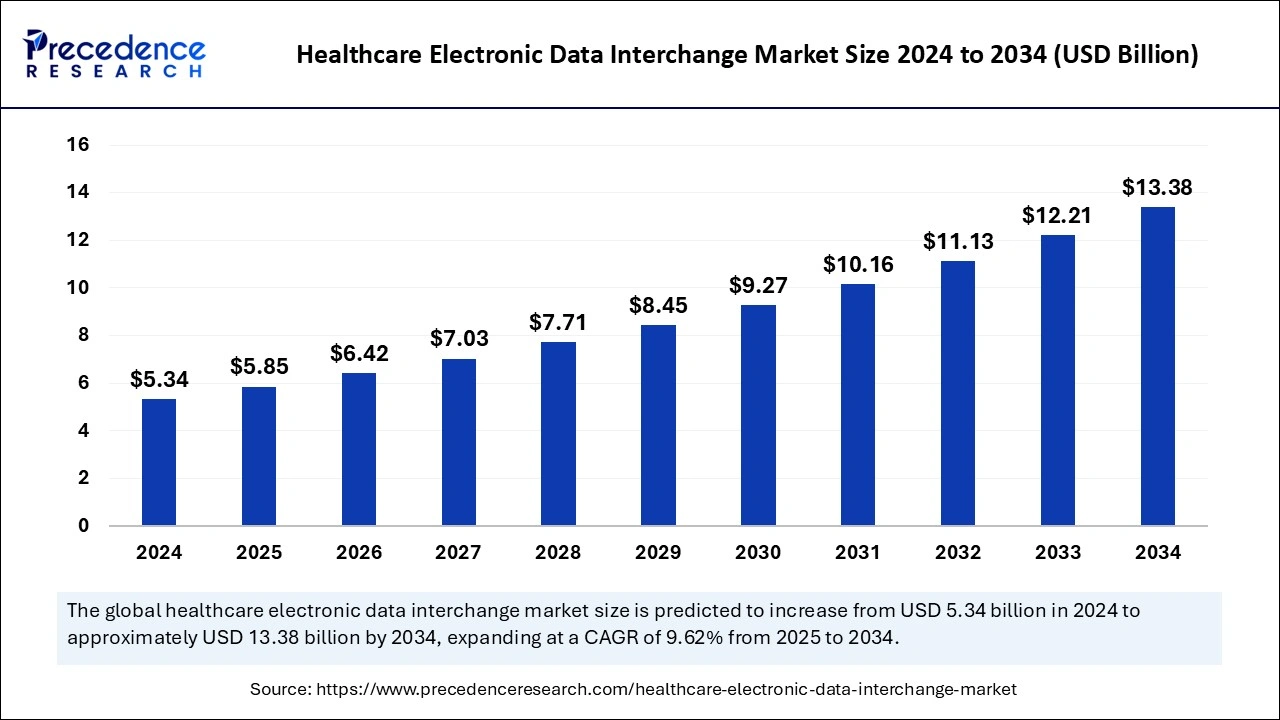
The global healthcare electronic data interchange market size accounted for USD 6.42 billion in 2026 and is expected to exceed around USD 14.49 billion by 2035, growing at a CAGR of 9.49% from 2026 to 2035. The expanding legal requirements for the interchange of electronic data drive the healthcare electronic data interchange market.
Healthcare Electronic Data Interchange Market Key Takeaways
- North America dominated the healthcare electronic data interchange market with the largest market share of hare of 45% in 2025.
- Asia-Pacific is projected to grow at a notable CAGR of 9.94% during the forecast period.
- By component, the services segment dominated the healthcare electronic data interchange market in 2025.
- By component, the solutions segment is observed to be the fastest-growing in the market during the forecast period.
- By delivery mode, the web and cloud-based EDI segment held the largest share of 48% in 2025.
- By delivery mode, the mobile EDI segment is predicted to grow at a CAGR of 10.7% during the forecast period.
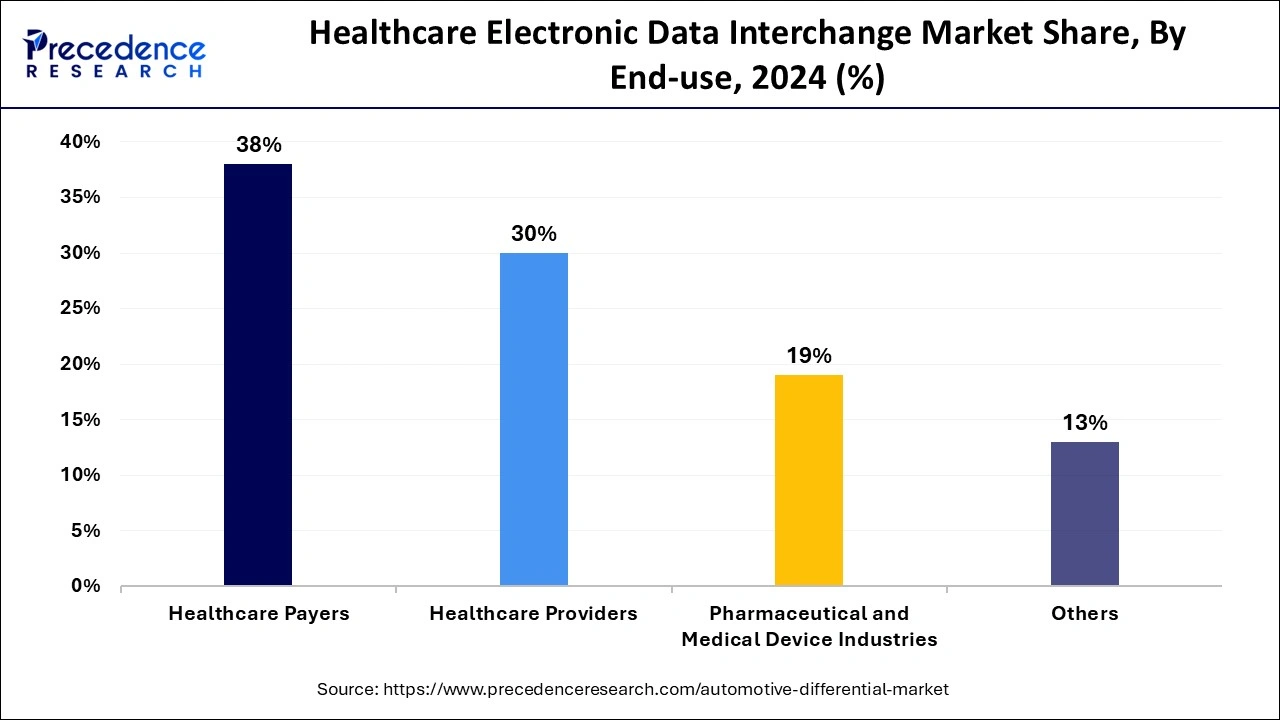
- By end-use, the healthcare payers segment contributed the biggest market share of 38% in 2025.
- By end-use, the healthcare providers segment is expanding at a notable CAGR of 10.11% during the forecast period.
What is the Healthcare Electronic Data Interchange?
In the healthcare industry, electronic data exchange refers to a safe method of sending information between patients, insurers, and healthcare facilities using pre-established communication formats and standards. Because of this, implementing EDI is essential to providing high-quality medical treatment. It makes the smooth data flow between patients, payers, and healthcare providers possible.
Faster and more transparent billing procedures, speedier claims processing, and accurate medical records are all made possible via EDI, which enhances the patient's experience. Patients gain from shorter wait times and less trouble when interacting with insurance and medical professionals.
- The United Health Group (UHG) subsidiary Change Healthcare was affected by a cyber security problem, as the U.S. Department of Health and Human Services (HHS) is aware. HHS acknowledges this attack's effect on the nation's healthcare system. Helping to coordinate efforts to prevent care disruptions across the healthcare system is HHS' top goal.
How is AI helping the healthcare electronic data interchange process?
Compared to traditional EDI tools, Artificial Intelligence-driven systems can process vast volumes of healthcare data more quickly, cutting down on administrative delays. Machine learning algorithms can increase accuracy and lower expensive billing errors or rejections by identifying and fixing data processing flaws. By examining patient information and preferences, it can provide personalized billing communications, making the billing process more accessible to use. Natural language processing-powered automated chatbots can help patients comprehend their bills, enhancing the patient experience.
- In February 2025, the World Economic Forum (WEF) launched the India Digital Health Activator, a new initiative to accelerate digital health adoption, interoperability, and innovation through public-private partnerships. The India Digital Health Activator is created to complement the government's ongoing efforts in digital health by testing innovations through the hub.
Healthcare Electronic Data Interchange Market Growth Factors
- The requirement for smooth data transfer between various systems is fueled by the extensive use of EHRs in healthcare institutions. This compatibility is made possible by EDI systems, which allow for accurate and efficient data transfer.
- Strict laws and directives are being put in place by numerous governments across the globe to encourage the use of electronic data interchange in healthcare. The need for EDI solutions to guarantee compliance and expedite administrative procedures is fueled by these laws.
- Improving interoperability standards is becoming increasingly important to the healthcare sector in order to improve patient care and cut administrative expenses. EDI is essential to facilitate data transmission between payers, providers, and healthcare systems.
- More complex and approachable EDI solutions are made possible by technological developments like cloud computing and artificial intelligence. Increased scalability, flexibility, and cost-effectiveness provided by cloud-based EDI systems propel industry expansion.
Market Scope
| Report Coverage | Details |
| Market Size in 2035 | USD 14.49 Billion |
| Market Size in 2025 | USD 5.85 Billion |
| Market Size by 2026 | USD 6.42 Billion |
| Market Growth Rate from 2026 to 2035 | CAGR of 9.49% |
| Dominating Region | North America |
| Fastest Growing Region | Asia Pacific |
| Base Year | 2025 |
| Forecast Period | 2026 to 2035 |
| Segments Covered | Component, Delivery Mode, End-Use, and Regions |
| Regions Covered | North America, Europe, Asia-Pacific, Latin America, and Middle East & Africa |
Market Dynamics
Drivers
Increased data accuracy
Better clinical decision-making is facilitated by accurate data. To offer adequate care, healthcare professionals depend on accurate information regarding patient histories, diagnoses, and treatment plans. Rapid and precise transmission of patient data via EDI systems lowers the possibility of mistakes that can result in ineffective therapies. Accountability is enhanced by the audit trails that EDI systems frequently offer. A clear record of transactions is ensured by accurate data, which makes it simpler for businesses to prove compliance in audits.
- In June 2024, Oracle launched the Oracle Health Insurance Data Exchange Cloud Service, a new solution designed to help healthcare insurers easily onboard evolving data formats and simplify complex data exchange needs. This solution has the ability to create custom data mapping and validation rules, enabling insurers to speed up the process of new and proprietary data formats.
Restraint
High implementation costs
To effectively use the new EDI system, healthcare staff must get training. This training may require substantial time and expense commitment, particularly in larger firms. It can be difficult to precisely measure the expected advantages (such as increased communication, fewer errors, and higher productivity) against the implementation expenses.
Opportunity
Adoption of cloud technologies
Large volumes of data can be safely stored and accessed by healthcare companies at any time and from any location due to cloud technologies. This functionality makes sharing health information more accessible for payers, consumers, and providers. By offering a centralized communication hub, cloud-based EDI platforms improve provider collaboration. It is easier for various healthcare providers to collaborate on patient care plans. Errors in data transmission and interpretation are reduced when communication is improved.
- In October 2024, Oracle announced to launch of a new artificial intelligence-backed electronic health record next year, the technology giant said. The EHR will allow clinicians to use voice for navigation and search. It will also integrate the company's clinical AI agent and tools for data analysis and tracking patient flow through the hospital.
Segment Insights
Component Insights
The services segment dominated the healthcare electronic data interchange market in 2025. Instead of keeping in-house solutions, many healthcare organizations and providers would outsource EDI activities to specialist service providers. This enables companies to benefit from the experience of outside suppliers knowledgeable about data security, regulatory standards, and compliance procedures like HIPAA in the United States. Healthcare companies can lessen the workload on their internal IT teams and concentrate more on patient care by outsourcing EDI.
The solutions segment is observed to be the fastest growing in the healthcare electronic data interchange market during the forecast period. Providers and payers must exchange patient data across many platforms and systems as the healthcare sector grows more integrated. To solve this, EDI solutions standardize communication protocols and data formats, facilitating smooth system integration. This is particularly important in complicated healthcare networks where real-time access to reliable patient data enhances clinical decision-making and operational efficiency. EDI solutions are rapidly incorporating AI and ML technology to improve predictive capabilities, automate data processing, and improve data analytics.
Delivery mode Insights
The web and cloud-based EDI segment dominated the healthcare electronic data interchange market in 2025. Web-based EDI is a cutting-edge solution that uses contemporary technology to automate the sharing of information and business documents between trading partners. When using cloud-based EDI, the EDI platform is accessible online and housed in the cloud. Numerous advantages come with this, including reduced expenses, simplicity in setup and upkeep, automatic upgrades, and scalability. The EDI requires healthcare businesses to increase their size. Cloud-based EDI can readily accommodate larger data quantities and more complicated procedures, enabling firms to modify their usage according to their requirements. Data and transaction volumes might fluctuate significantly in the healthcare industry, so this flexibility is essential for managing these variations.
The mobile EDI segment is observed to be the fastest growing in the healthcare electronic data interchange market during the forecast period. Mobile EDI sends and receives EDI messages in a client-specific format via a mobile phone application. It enhances productivity and customer satisfaction by enabling companies to share electronic data interchange (EDI) documents on mobile devices. By facilitating safe communication between insurance companies, healthcare providers, and other stakeholders, mobile EDI improves data exchange process efficiency and minimizes the paperwork and delays of more conventional approaches. Healthcare providers can process claims and other transactions more rapidly and precisely with the help of mobile EDI systems, which lessen administrative constraints. This effectiveness speeds up reimbursements, lessens human entry, and lowers the likelihood of error, all of which add up to decreased operating expenses.
End-use Insights
The healthcare payers segment dominated the healthcare electronic data interchange market in 2025. Processing claims from healthcare providers is a direct responsibility of healthcare payers, which include insurance companies, governmental organizations, and other third-party payers. These payers can automate claims processing through Electronic Data Interchange, which lowers administrative expenses, speeds up adjudication, and reduces errors.
Payers are positioned as essential consumers of EDI systems because of this efficiency, which is crucial for high claims volumes. Healthcare payers can increase operational efficiency, decrease manual intervention, and automate repetitive operations with EDI. By reducing the administrative burden, this technology enables payers to make significant cost reductions.
The healthcare providers segment is observed to be the fastest growing in the healthcare electronic data interchange market during the forecast period. The number of patients and the need for data management are growing exponentially for healthcare providers, such as hospitals and clinics. It offers a simplified method of handling this data, reducing the time and effort required for manual processing and allowing providers to send information effectively and securely. To minimize paper records and facilitate remote data sharing, the COVID-19 epidemic hastened the implementation of digital solutions in the healthcare industry, including electronic data interchange (EDI). The necessity of effective digital systems to improve responsiveness and resilience, especially in times of crisis, has been more widely acknowledged by healthcare professionals.
Regional Insights
What is the U.S. Healthcare Electronic Data Interchange Market Size?
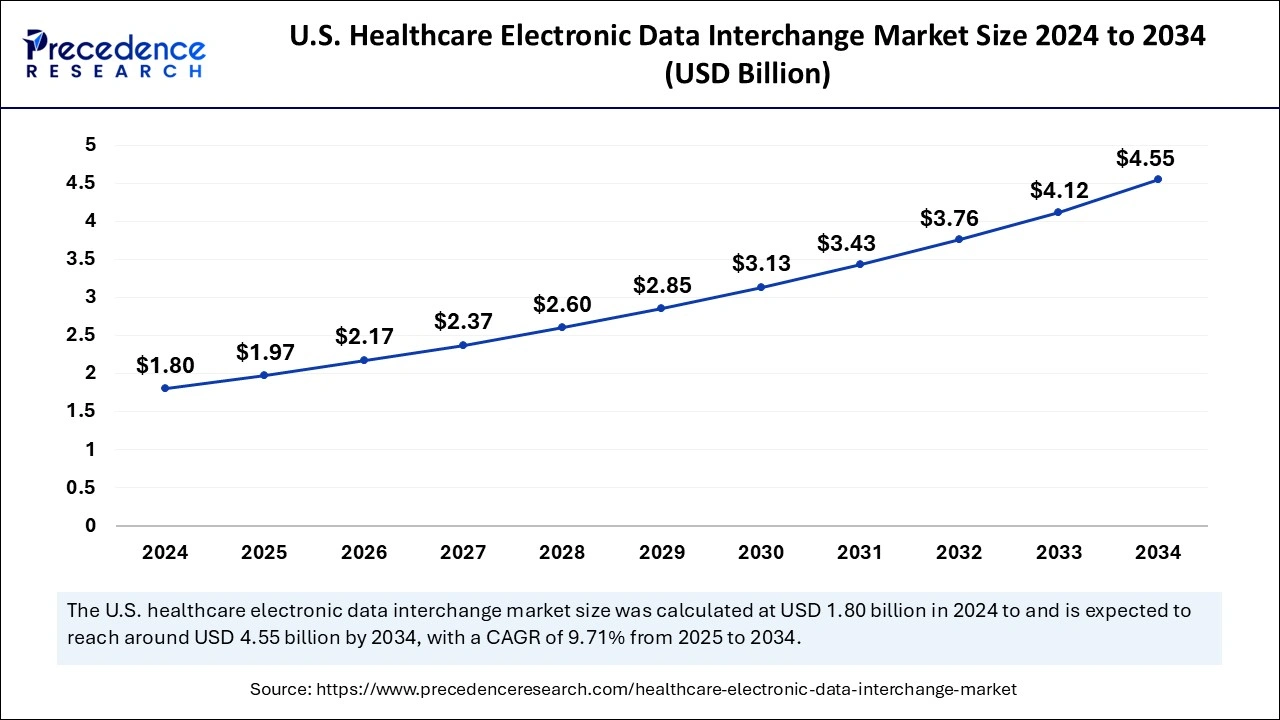
The U.S. healthcare electronic data interchange market size was exhibited at USD 2.17 billion in 2026 and is projected to be worth around USD 4.93 billion by 2035, growing at a CAGR of 9.61% from 2026 to 2035.
North America dominated the healthcare electronic data interchange market in 2025. The use of electronic health records (EHRs), which seamlessly interact with EDI systems, is among the highest in North America. Integrating EDI with EHR systems makes faster and more accurate cross-platform data interchange possible. Major North American clearing houses, insurance companies, and hospitals have made significant investments in EDI to automate processes, increase billing accuracy, and save operating costs. EDI has established industry standards and is supported by major companies such as Anthem, UnitedHealth Group, and other insurers.
- Most individuals, 305.2 million, or 92.0 percent, had health insurance in 2024, either for part of the year or the entire year.
- With 65.4 percent and 36.3 percent respectively, private health insurance coverage remained higher than public coverage in 2024.
U.S. Healthcare Electronic Data Interchange Market Trends
The U.S. has powerful interoperability models that promote the adoption of seamless data exchange. Regulatory push drives integration among healthcare systems. TEFCA permits national information sharing outside claims. AI agents digitize the revenue cycle processes that minimize administrative load. With emphasis on compliance, security investments increase. The ecosystem is forging towards linked patient records and safe digital infrastructure among providers and payers.
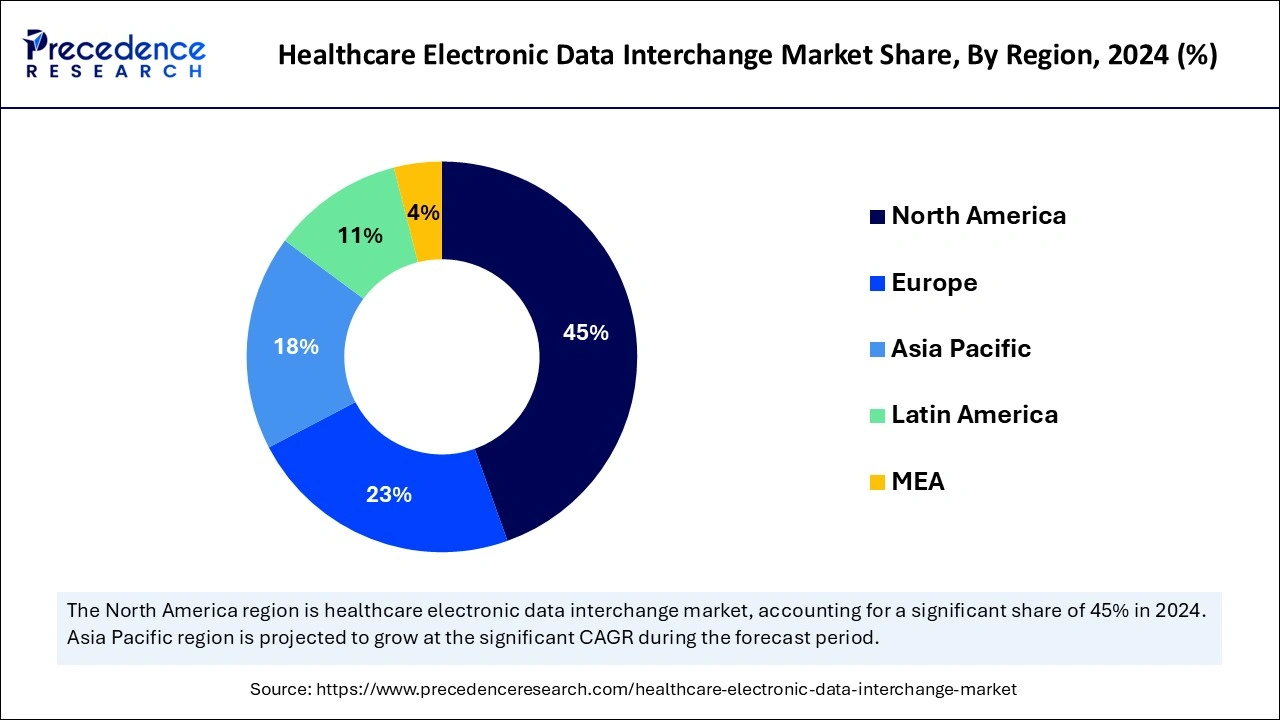
Asia-Pacific is observed to be the fastest growing in the healthcare electronic data interchange market during the forecast period. Many healthcare providers in Asia-Pacific are implementing automated systems, and digital patient records to improve operational efficiency. This trend supports the expansion of EDI solutions, which enable safe and easy data transfers between different healthcare organizations. Efficient solutions that can securely and swiftly handle massive amounts of patient data are becoming increasingly necessary as healthcare needs rise, particularly during COVID-19. Efficient management of healthcare data, lower administrative expenses, and fewer data exchange errors are all made possible via EDI.
China Healthcare Electronic Data Interchange Market Trends
China is growing fast and has a solid policy backing the development of digital healthcare systems. Connected healthcare ecosystems are fuelled by integrated systems. The AI agents perform complex clinical processes to enhance coordination of care. Multimodal models improve the prediction of diseases with various datasets. Hospitals, pharmacies, and insurers are linked through national initiatives.
Healthcare Electronic Data Interchange Market Companies
- OSP: Creates artificial intelligence-based healthcare software, such as telehealth EHR systems and HIPAA licensed RCM systems.
- MCKESSON CORPORATION: Offers pharmaceutical distribution and health IT solutions such as the supply chain management system and pharmacy automation system.
- NXGN Management, LLC: Offers combined EHR practice management cloud services, RCM solutions, and patient engagement tools.
- Optum, Inc.: Provides smarter EDI solutions that allow claims processing and eligibility of claims based on claims and guarantee a safe provider-payer connection.
Other Major Key Players
- Epicor Software Corporation
- SSI Group LLC
- Cleo
- Oracle
- Effective Data
- DataTrans Solutions
Healthcare Electronic Data Interchange Market Announcements
- In May 2024, The Secretary of the Department of Health and Human Services (HHS), Xavier Becerra, received a letter from the Workgroup for Electronic Data Interchange (WEDI) outlining concerns and suggestions for reducing the possible effects of a cyberattack on patient safety and healthcare operations. Cybercriminals frequently target healthcare businesses. Hackers often keep health information systems hostage until they have recovered the maximum amount of ransom payments because they view health information as a valuable commodity.
Recent Developments
- In January 2026, Veradigm and Meperia formed a strategic partnership to develop a next-generation Electronic Data Interchange (EDI) solution tailored for healthcare. The solution leverages innovative technology and AI-driven supply chain management capabilities. (Source: https://finance.yahoo.com )
- In October 2025, Humana Inc. and Providence launched an initiative to enhance data exchange between payers and providers, utilizing FHIR standards and modern APIs to improve interoperability. This aims to provide actionable insights, reduce administrative burdens, and safeguard patient privacy. (Source: https://www.businesswire.com )
- In October 2025, Rhapsody launched Rhapsody API Guardian, an API management solution designed for healthcare organizations. The solution securely manages APIs, simplifies integration, and enhances data infrastructure for future AI applications. (Source: https://www.prnewswire.com )
- In June 2024, Oracle unveiled the Oracle Health Insurance Data Exchange Cloud Service to facilitate the onboarding of emerging data formats and streamline complicated data exchange requirements for healthcare insurers.
- In September 2024, Fleet Enable declared it would start providing freight carriers with free electronic data interchange (EDI), the intercompany sharing of business documents in a standardized format. This would eliminate manual involvement by enabling haulers to receive digital orders and respond to returns.
- In November 2022, to promote innovation and create new goods and services, Zuellig Pharma Digital & Data introduced the digital health exchange (DHEX) platform, which allows participants in the healthcare sector to exchange private information with sufficient security.
- In February 2025, Edifecs, Inc., a global health information technology solutions company, announced its Healthcare Interoperability Cloud, which enables payers to take a strategic approach to interoperability and address compliance, including with CMS-9115-F and CMS-0057-F, and non-compliance use cases.
- In October 2024, Oracle Life Sciences was named a ‘Leader' in the Everest Group Electronic Data Capture (EDC) Products PEAK Matrix Assessment 2024. Oracle is recognized for its comprehensive EDC capabilities and ease of integration. Oracle's EDC capabilities enable pharmaceutical companies and CROs to collect data from any source, harmonize it in a single place, and apply analytics to draw out valuable clinical insights from the data across multiple studies.
- In October 2024, Edifecs, Inc., a global health information technology solutions company, participated in multiple sessions at the Workgroup for Electronic Data Interchange (WEDI) 2024 National Conference in Washington, DC.
Segments covered in the report
By Component
- Services
- Solutions
By Delivery Mode
- Web and Cloud-based EDI
- EDI Value Added Network (VAN)
- Direct (Point-to-Point) EDI
- Mobile EDI
By End-Use
- Healthcare Payers
- Healthcare Providers
- Pharmaceutical & Medical Device Industries
- Others
By Region
- North America
- Asia Pacific
- Europe
- Latin America
- Middle East and Africa
For inquiries regarding discounts, bulk purchases, or customization requests, please contact us at sales@precedenceresearch.com
Frequently Asked Questions





Ask For Sample
No cookie-cutter, only authentic analysis – take the 1st step to become a Precedence Research client
 Get a Sample
.webp)



 sales@precedenceresearch.com
 Schedule a Meeting
