



Hybrid AI Deployment Market Trends, Companies, Revenue / Sales Performance, Subscriber Growth, Pricing Strategies, Cloud Adoption, Infrastructure Expansion, Competitive Landscape, and Industry Outlook
Hybrid AI Deployment Market (By Component: Hardware, Software, Services; By Application: Machine learning, Generative AI, Natural language processing; By End User: IT and telecom, BFSI, Healthcare, Government and defense) - Global Industry Analysis, Size, Trends, Leading Companies, Regional Outlook, and Forecast 2026 to 2035
Source: https://www.precedenceresearch.com/hybrid-ai-deployment-market
 Get a Sample
 Table Of Content


What is the Hybrid AI Deployment Market Size in 2026?
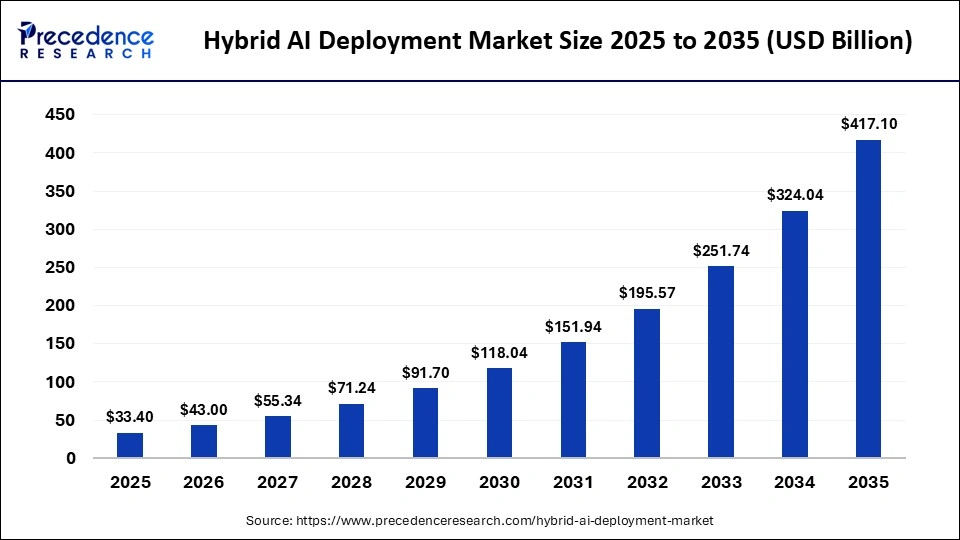
The global hybrid AI deployment market size was calculated at USD 33.40 billion in 2025 and is predicted to increase from USD 43.00 billion in 2026 to approximately USD 417.10 billion by 2035, expanding at a CAGR of 28.72% from 2026 to 2035. The market is rapidly growing due to the rising need for flexible AI solutions, which can incorporate cloud, on-premise, and edge computing to process massive amounts of data in a secure and efficient manner.
Key Takeaways
- North America led the hybrid AI deployment in 2025.
- Asia Pacific is expected to grow at the highest CAGR during the forecast period.
- By component type, the software segment led the market in 2025.
- By component type, the services segment is expected to grow at the highest CAGR during the forecast period.
- By application type, the machine learning segment led the hybrid AI deployment market in 2025.
- By application type, the generative AI segment is expected to expand at the highest CAGR from 2026 to 2035.
- By end user type, the BFSI segment led the market in 2025.
- By end user type, the IT and telecom segment is expected to expand at the highest CAGR from 2026 to 2035.
What is the Hybrid AI Deployment Market?
The market is defined as a market where solutions for deploying artificial intelligence technologies across different platforms, especially servers and cloud services, are offered. Traditionally, businesses use either cloud services or local servers for deploying AI. However, hybrid AI deployment is becoming more popular as it offers a balance between deploying AI and ensuring the security of business data. For instance, business data is stored locally, and AI workloads are deployed on cloud services. This approach is helpful for reducing latency and ensuring cost-effectiveness for computing services.
Technological Shifts in the Hybrid AI Deployment Market?
In the market, there are several technological developments affecting the way AI solutions are delivered. Some of these developments include the integration of cloud, on-premise, and edge computing, which enable AI solutions to operate on platforms where they are most efficient. Another trend is the use of containerization and orchestration technologies, which enable AI solutions to be easily transferred from one platform to another. There is a growing trend of using specialized hardware, which is efficient in the deployment of AI solutions. Advanced technologies such as automated deployment, monitoring, and scaling are being integrated into the software platforms.
The adoption of data privacy and security technologies facilitates data to be stored locally while at the same time being able to operate on cloud platforms. Another development in the market is the use of AI model optimization, which enables AI solutions to operate on smaller on-premise platforms. There is a rising trend towards the use of interoperability technologies, which enable AI solutions running on different platforms and frameworks to operate seamlessly.
Hybrid AI Deployment Market Trends
- Collaborations and Partnerships: Technology companies are collaborating with each other to leverage expertise in cloud computing, AI platforms, and on-premises infrastructure. These partnerships help to deliver flexible and efficient hybrid AI solutions. For instance, Microsoft partnered with NVIDIA to develop AI tools that can be used across hybrid environments.
- Government Initiatives: Government are promoting the adoption of hybrid AI solutions by investing in AI, favorable policies, and the development of digital infrastructure. These initiatives facilitate organizations to innovate in AI technologies while maintaining the privacy and security of their data. For instance, the U.S Department of Energy is investing in AI technologies that leverage hybrid computing to deliver energy management.
- Business Expansions: Companies are expanding their hybrid AI technology portfolios to reach new markets and industries. This helps them to capitalize on the increasing demand for hybrid AI platforms. For instance, IBM is expanding its hybrid cloud and AI offerings to reach diverse business segments around the world.
Market Scope
| Report Coverage | Details |
| Market Size in 2025 | USD 33.40 Billion |
| Market Size in 2026 | USD 43.00 Billion |
| Market Size by 2035 | USD 417.10 Billion |
| Market Growth Rate from 2026 to 2035 | CAGR of 28.72% |
| Dominating Region | Asia Pacific |
| Fastest Growing Region | North America |
| Base Year | 2025 |
| Forecast Period | 2026 to 2035 |
| Segments Covered | Component, Application, End User , and region |
| Regions Covered | North America, Europe, Asia-Pacific, Latin America, and Middle East & Africa |
Segmental Insights
Component Type Insights
Why Did the Software Segment Dominate the Hybrid AI Deployment Market?
The software segment dominated the market in 2025. The market growth of this segment is due to the fact that it offers the necessary tools for managing, orchestrating, and deploying AI workloads. Software platforms offer integration for cloud, on-premises, and edge environments, making it easy for companies to move AI models and data from one platform to another. This segment also offers features such as monitoring, security, and scaling, which are necessary for the operation of AI applications. The fact that companies receive necessary updates and platforms from this segment makes it beneficial for them, thus accelerating the market adoption of this segment.
The services segment is expected to expand at the highest CAGR in the hybrid AI deployment market from 2026 to 2035. The market growth of this segment is because businesses increasingly require expert assistance in the deployment and management of hybrid AI systems. This is because organizations are not equipped with the required expertise to manage the integration of these technologies. Services like consulting, implementation, integration, and maintenance are essential in facilitating organizations to improve the performance and security of these systems. This segment helps to optimize the operational risks related to data privacy and security. The market growth of this segment is further driven by the increasing adoption of AI in various industries, which generates the need to implement and manage sophisticated AI models.
Application Type Insights
Why Did the Machine Learning Segment Dominate the Hybrid AI Deployment Market?
The machine learning segment dominated the market in 2025. The market growth of this segment is because most businesses use hybrid environments for training, deploying, and scaling machine learning(ML) applications. ML applications need heavy computation, large amounts of data, and timely updates, making them suitable for hybrid deployment where on-premise and cloud solutions are used together for large-scale computation and storage. Machine learning applications are used for various purposes across different industries, including finance, healthcare, and manufacturing.
The generative AI segment is expected to grow at the highest CAGR during the forecast period. The market growth of this segment is due to increasing demand for AI-generated content, designs, and simulations. Organizations are adopting generative AI for applications such as text generation, image creation, coding, and product design, where hybrid deployment is essential for the effective and efficient operation of large models. Hybrid AI deployment allows generative AI models to operate partially on cloud infrastructure for computation and partially on local servers for secure storage of confidential information.
End User Type Insights
Why Did the BFSI Segment Dominate the Hybrid AI Deployment Market?
The BFSI segment dominated the market in 2025. The market growth of this segment is because this segment handles massive amounts of data, which demands both high performance and security. Hybrid AI helps BFSI companies store sensitive customer and financial data on-premises while utilizing cloud services for analytics and AI services. This segment uses AI for credit scoring, algorithmic trading, customer support, and regulatory compliance, making the hybrid AI solution quite useful for the companies. This segment faces stringent data regulations, requires high computational capabilities, and also needs real-time analytics, which accelerates the market growth of this segment.
The IT and telecom segment is expected to grow at the highest CAGR during the forecast period. The market growth of this segment is due to increasing adoption of hybrid AI for cloud services, network optimization, and analytics. Telecom companies and IT providers require hybrid AI deployments due to the increasing need for handling massive data traffic and analytics. Hybrid AI facilitates the deployment of latency-critical applications on-premises while utilizing the cloud for massive processing and training. The market growth of this segment is further driven by rising demand for 5G, cloud services, and AI services.
Regional Insights
North America Hybrid AI Deployment Market Size and Growth 2026 to 2035
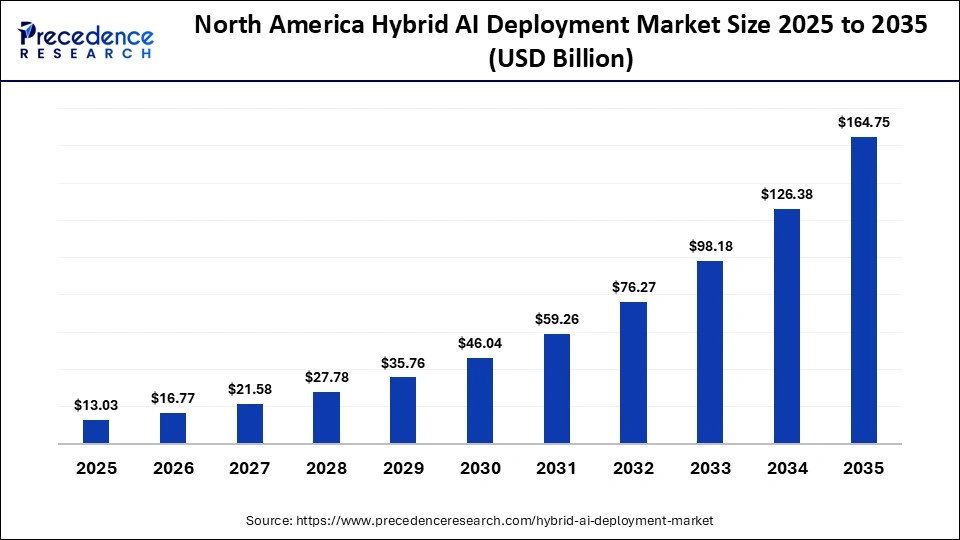
The North America hybrid AI deployment market size is estimated at USD 13.03 billion in 2025 and is projected to reach approximately USD 164.75 billion by 2035, with a 28.88% CAGR from 2026 to 2035.
What Made North America the Leading Region in the Hybrid AI Deployment Market?
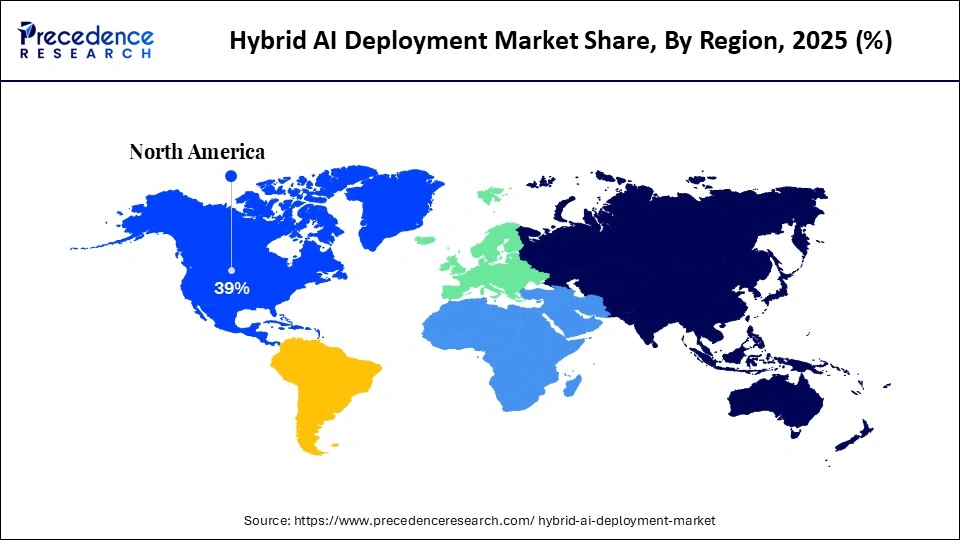
North America dominated the hybrid AI deployment in 2025. The market growth in this region can be attributed to its robust infrastructure base, high rate of cloud adoption, and the early adoption of AI in various industries. Governments in this region have significantly invested in the research and development of artificial intelligence, which boosts innovation and market adoption. The market growth in North America is further driven by the presence of major technology firms and high-end data centers.
U.S. Hybrid AI Deployment Market Size and Growth 2026 to 2035
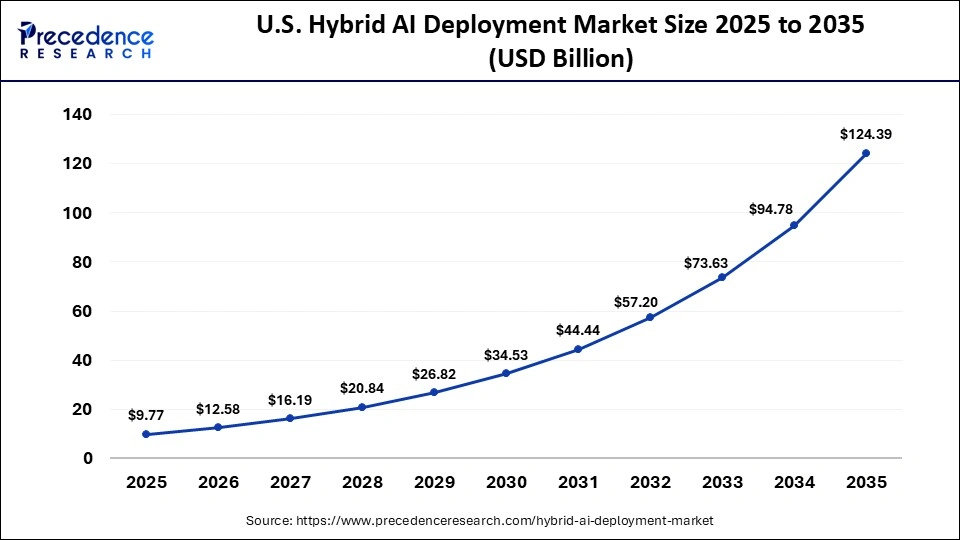
The U.S. hybrid AI deployment market size is calculated at USD 9.77 billion in 2025 and is expected to reach nearly USD 124.39 billion in 2035, accelerating at a strong CAGR of 28.97% between 2026 and 2035.
U.S Hybrid AI Deployment Market Analysis
In North America, the U.S is leading the market due to its robust technology market and high adoption of AI technology across various sectors. Organizations based in the U.S are leading the way in developing hybrid AI platforms, utilizing cloud, on-premises, and edge computing for executing complex workloads. This country is home to many technology giants and offers robust data infrastructure and government support for AI research and deployment. The market growth in this country is further driven by widespread adoption in industries such as finance, healthcare, and IT.
What Made Asia Pacific the Fastest Growing Region in the Hybrid AI Deployment Market?
Asia Pacific is expected to grow at the highest CAGR from 2026 to 2035. The market growth in this region is due to rapid digital transformation, increased adoption of AI, and expansion of cloud infrastructure in emerging markets. Companies in this region are increasingly using hybrid AI technologies to manage large amounts of data, increase operational efficiency, and ensure data security. Government initiatives, such as smart cities, are also contributing to market growth in the Asia Pacific. Furthermore, the presence of technology startups and investments in industries like IT and telecom is boosting the market growth in this region.
China Hybrid AI Deployment Market Trends
China leads the market growth in the Asia Pacific because of significant investments in research and development of AI, cloud infrastructure, and smart technologies. The companies in this country have widely adopted hybrid AI deployment to process large amounts of data effectively, enhance manufacturing productivity, and support healthcare, finance, and government initiatives. The Chinese government has implemented initiatives in the field of AI, such as the New Generation AI Development Plan, which provides financial, infrastructure, and regulatory support to AI innovation.
Hybrid AI Deployment Market Companies
- Amazon Web Services Inc.
- Canonical Ltd.
- Cisco Systems Inc.
- Cloudera Inc.
- Databricks Inc.
- DataRobot Inc.
- Dell Technologies Inc.
- Google Cloud
- H2O.ai Inc.
- Hewlett Packard Enterprise Co.
- Intel Corp.
- International Business Machines Corp.
- Microsoft Corp.
- NVIDIA Corp.
- Oracle Corp.
Recent Developments
- In December 2025, SUSE rolled out the latest version of SUSE AI at KubeCon 2025. This latest version of SUSE AI is designed for scalable and secure hybrid AI workloads. The SUSE AI platform helps organizations to efficiently run AI workloads on hybrid infrastructures that include on-premises environments, cloud environments, and edge environments. (Source: https://www.suse.com)
- In August 2025, Hewlett Packard Enterprise(HPE) launched Greenlake Intelligence, which is a hybrid cloud solution that combines AI agents in cloud and on-premise environments. This solution enables businesses to automate their workload management, monitor their AI models in real-time, and optimize their performance in different environments. (Source: https://www.hpe.com)
- In May 2025, Infosys unveiled over 200 AI agents as a part of their Topaz AI suite, in collaboration with Google Cloud. This solution facilitates firms to automate complex workflows, analyze massive data sets, and manage hybrid cloud environments. These AI agents provide greater flexibility in artificial intelligence adoption while maintaining data security and control. (Source: https://www.business-standard.com)
Segments Covered in This Report
By Component
- Hardware
- Software
- Services
By Application
- Machine learning
- Generative AI
- Natural language processing
By End User
- IT and telecom
- BFSI
- Healthcare
- Government and defense
By Region
- North America
- Latin America
- Europe
- Asia-pacific
- Middle and East Africa
For inquiries regarding discounts, bulk purchases, or customization requests, please contact us at sales@precedenceresearch.com
Frequently Asked Questions
Tags





Ask For Sample
No cookie-cutter, only authentic analysis – take the 1st step to become a Precedence Research client
 Get a Sample




 sales@precedenceresearch.com
 Schedule a Meeting
