



Industrial Biomanufacturing Market Size, Segmentation, Regional Analysis, Regional and Country Intelligence, Company and Competitive Intelligence
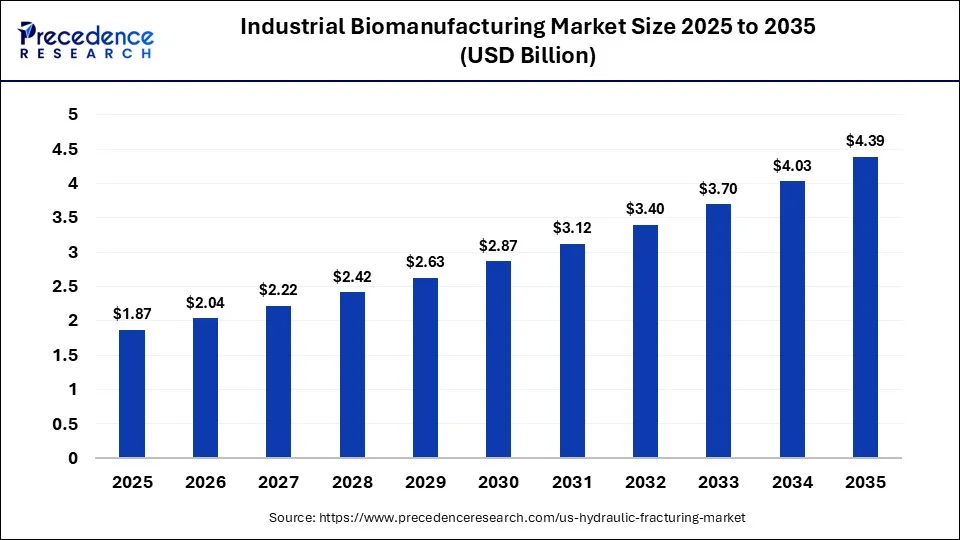
The industrial biomanufacturing market accounted for USD 1.87 billion in 2025. The market growth is being driven by advancements in bio-based techniques, government initiatives to facilitate infrastructure expansion, and innovation in engineered biological pathways to manufacture increasingly sophisticated molecules at production scale. These trends were evaluated by our Senior Research Analyst, Vidyesh Swar, to curate this well-researched report. His analysis benefits chemical manufacturers, distributors, industry researchers, and stakeholders in conducting competitive analysis and making well-informed decisions.
Source: https://www.precedenceresearch.com/industrial-biomanufacturing-market
 Get a Sample
 Table Of Content


Industrial Biomanufacturing Market Size, Share, Trends, and Growth Forecast 2035
The industrial biomanufacturing market is forecasted to expand from USD 2.04 billion in 2026 to USD 4.39 billion by 2035, growing at a CAGR of 8.91% from 2026 to 2035. The advancement in synthetic biology-enabled manufacturing techniques, waste commercialization, bio-based polymers, specialty ingredients, and carbon-based manufacturing is benefiting the market. Vidyesh Swar, our Senior Research Analyst, has over five years of experience in the chemical and materials industry. According to him, the development of novel carbon-based manufacturing methods is helping companies move away from predominantly fossil-based production operations, thus helping them march towards their sustainability goals and decreasing their reliance on imports of fossil fuels.
Key Takeaways
- By product type, the bio-based chemicals segment led the market with a 28.65% share in 2025.
- By technology, the fermentation segment dominated the market with a 38.85% share in 2025.
- By feedstock, the sugar and starch feedstocks segment accounted for the major revenue share of 31.85% in 2025.
- By end user, the chemical manufacturers segment led the market with a 25.65% share in 2025.
- By region, North America dominated the market with a 34.85% share in 2025.
- Novonesis noted a 7% growth in organic sales in 2025, with an adjusted EBITDA margin of 37.1%.
- The food and health business of Novonesis grew 8% organically, and its Planetary Health business grew by 6%.
- Corbion reported total sales of €1.2674 billion in 2025. The company reported 3.4% volume/mix growth in 2025, and its Health and Nutrition business noted 8.9% volume/mix growth.
- 28% of Corbion's net raw material expenditure was for sugar, 7% on energy, and 6% on dextrose/corn.
- LanzaTech reported USD 18.298 million through contracts with customers and grants and USD 14.625 million from the sales of CarbonSmart products in 2025.
What was the Size of the Industrial Biomanufacturing Market in 2025?
The industrial biomanufacturing market accounted for USD 1.87 billion in 2025, is expected to expand at a CAGR of 8.91% during the forecast period, and is expected to account for USD 4.39 billion by 2035. The market involves the commercial manufacture of chemicals, materials, ingredients, fuels, pharmaceuticals, and other products by making use of engineered microorganisms, enzymes, cells, fermentation, and other biological systems. The market is expanding from laboratory-scale biotechnology to commercial fermentation, synthetic biology-enabled manufacturing, waste commercialization, bio-based polymers, specialty ingredients, and carbon-efficient production.
Expert Analyst Insights
The market growth is being increasingly influenced by the shift from biological identification to consistent industrial-scale manufacturing. Fermentation is the most dominant technology category, but synthetic biology is expected to grow at the fastest rate, and waste-derived feedstocks, cell-free production, and large-scale manufacturing are gaining market share. This shows a transition from traditional fermentation towards engineered biological systems that can manufacture increasingly sophisticated molecules and materials. The OECD gave an approximate figure of USD 4 to 5 trillion for the current global bioeconomy, which has the potential to grow up to USD 30 trillion by 2050, and also emphasized the financing and scaling gaps in biomanufacturing.
Which Product Type Accounted for the Major Revenue Share in 2025?
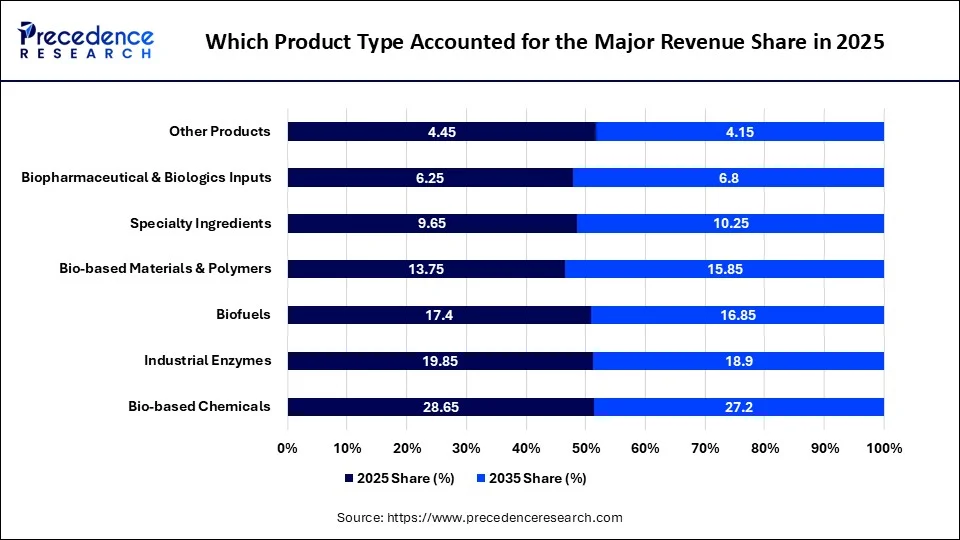
The bio-based chemicals segment led the market with a 28.65% share in 2025 and is expected to grow at a CAGR of 8.35% from 2026 to 2035. The industrial enzymes and biofuels segment held the second- and third-largest shares of 19.85% and 17.4%, respectively, in 2025. The bio-based materials and polymers segment is expected to expand at the highest CAGR of 10.45% during the forecast period, propelling its market share from 13.75% in 2025 to 15.85% in 2035. This growth can be attributed to a rapid rise in the demand for sustainable materials.
Product Type Insights by Expert Analysts
The market share increase of bio-based materials is significant because commercial biomanufacturing is being increasingly assessed not just for sustainability, but also for molecular performance, feedstock adaptability, and supply chain diversification. The BioPreferred framework by the USDA covers commercial and industrial products developed mainly from biological materials, along with renewable chemicals and intermediates which identifying applications such as bioplastics, lubricants, detergents, and fertilizers.
Which Technology Type Held the Largest Share in 2025?
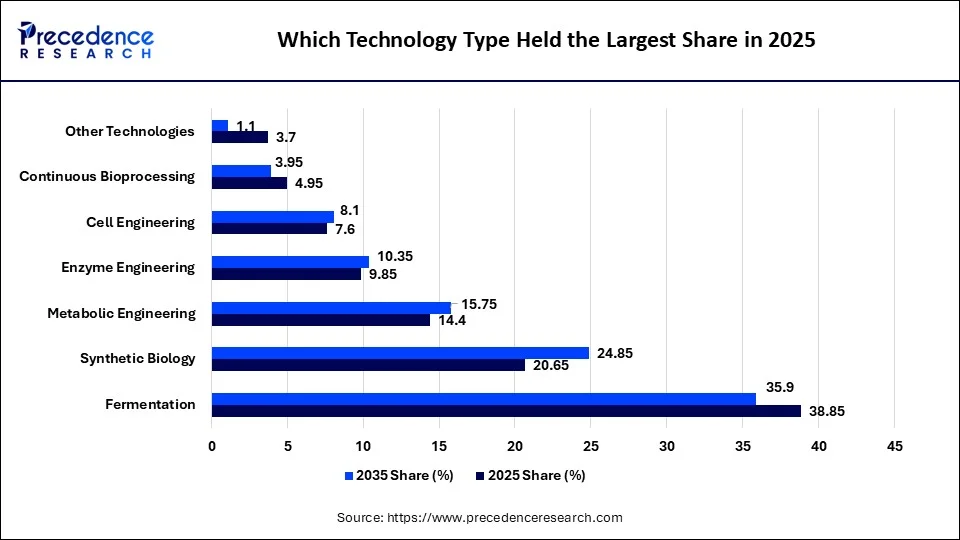
The fermentation segment dominated the market with a 38.85% share in 2025 and is expected to grow at a CAGR of 8.05% during the forecast period. This segment benefits from a well-established base for large-scale biological production. The market share of this segment is expected to decrease to 35.9% by 2035 because the synthetic biology segment is expected to expand at the highest CAGR of 11.05% from 2026 to 2035, taking its share from 20.65% in 2025 to 24.85% in 2035.
Expert Analyst Insights
Synthetic biology is increasingly bridging the gap between biological research and development and industrial manufacturing. This technology allows companies to renovate metabolic pathways, optimize host organisms, and enhance product yields rather than depending on just naturally occurring biological processes. The 2025 work program of Horizon Europe especially recognizes industrial biomanufacturing, synthetic biology, gene editing, and AI-based biological identification and optimization as areas of development.
How Much Market Share Did the Sugar and Starch Feedstocks Segment Hold in 2025?
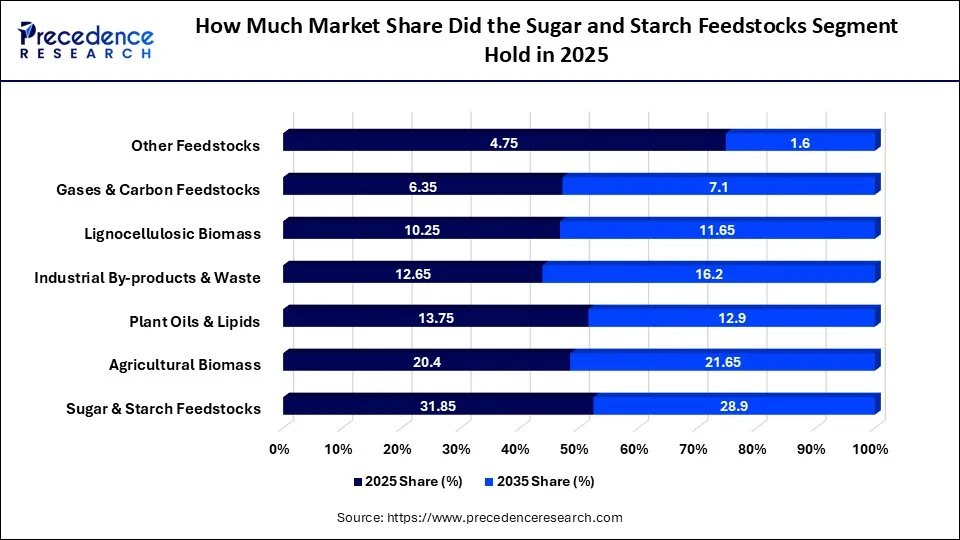
The sugar and starch feedstocks segment led the market with a 31.85% share in 2025 and is expected to grow at a CAGR of 7.85% during the forecast period. The market share of this segment is expected to decrease to 28.9% as the agricultural biomass, industrial byproducts and waste, and lignocellulosic biomass segments are expected to gain share. The industrial by-products and waste segment is expected to expand at the highest CAGR of 11.75% from 2026 to 2035, taking its share from 12.65% in 2025 to 16.2% in 2035.
Feedstock Insights by Expert Analysts
Feedstock finances are becoming one of the most important factors in the determination of commercial feasibility. The transition towards industrial waste, agricultural residues, and carbon-based feedstocks can decrease reliance on purpose-grown inputs and generate extra value from previously underutilized resources. The 2025 Bioeconomy Strategy of the EU explicitly focuses on the supply of sustainable biomass, circular resource usage, and the deployment of bio-based materials, biochemicals, biomanufacturing, and advanced fermentation.
Which Production Platform Led the Market in 2025?
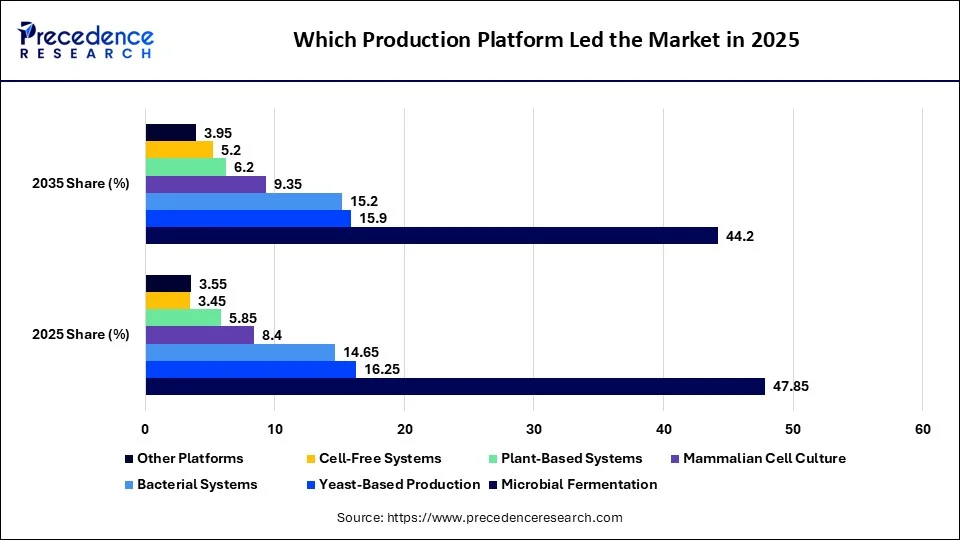
The microbial fermentation segment held the largest market share of 47.85% in 2025 and is expected to grow at a CAGR of 8.05% during the forecast period. The yeast-based production and bacterial systems segments also held significant shares of 16.25% and 14.65%, respectively, in 2025. Yeast-based production facilitates flexibility in terms of industrial fermentation. The cell-free systems segment is expected to expand at the highest CAGR of 13.85% from 2026 to 2035.
Expert Analyst Insights
Cell-free systems is an important upcoming category due to the fact that it can eliminate certain obstacles that come with the maintenance of living production organisms and can increase the pace of pathway testing and product development. The commercial landscape is still influenced by microbial fermentation owing to its mature reactor infrastructure, operating knowledge, downstream processing capabilities, and demonstrated scalability.
Which Process Stage Accounted for the Major Revenue Share in the Market in 2025?
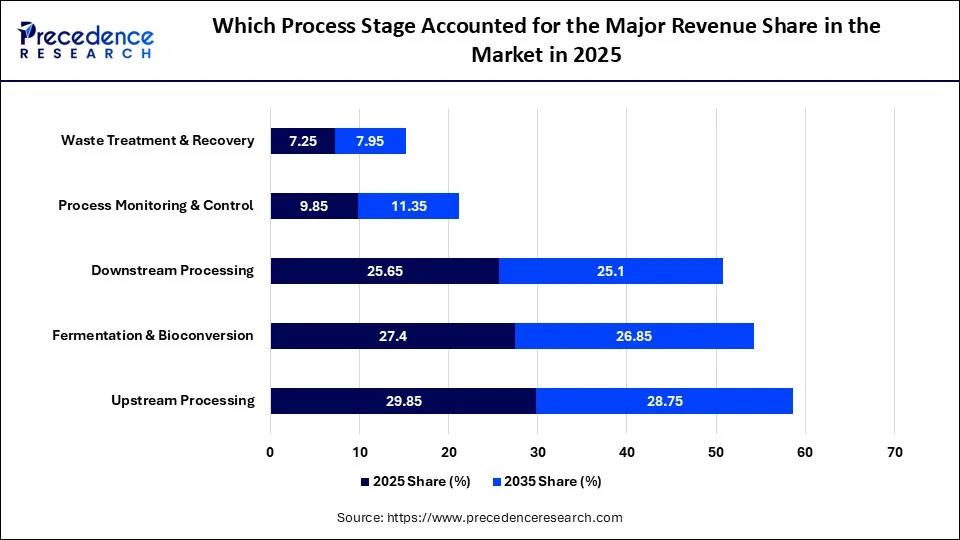
The upstream processing segment dominated the market with a 29.85% share in 2025 and is expected to grow at a CAGR of 8.5% during the forecast period. The fermentation and bioconversion and downstream processing segments also held significant shares of 27.4% and 25.65%, respectively, in 2025. The process monitoring and control segment is expected to expand at the highest CAGR of 10.55% from 2026 to 2035, driven by digitalization and the growing demand for process optimization.
Process Stage Insights by Expert Analysts
According to our Senior Researcher Aditi Shivarkar, Digital process monitoring is becoming increasingly crucial as companies shift towards higher fermentation titers, tighter process control, and larger production volumes. Next-generation sensors, process analytical technology, modeling, AI-based optimization, and automated control can enhance batch consistency while decreasing process fluctuations and resource usage.
Which Application Led the Market in 2025?
The chemicals and intermediates segment dominated the market with a 25.85% share in 2025 and is expected to expand at a CAGR of 8.15% from 2026 to 2035. The food and beverages, pharmaceuticals and biologics, and biofuels segments also held significant market shares of 18.65%, 16.40%, and 15.25%, respectively, in 2025. The materials and polymers segment is expected to grow at the fastest CAGR of 10.55% during the forecast period.
Expert Analyst Insights
According to our Senior Researcher Aman Singh, an increasing number of sectors are finding involvement in industrial biomanufacturing. The similar biological engineering capabilities can be adjusted for chemicals, food ingredients, materials, fuels, agricultural inputs, and pharmaceutical products. This diversification decreases reliance on a single end market and improves investment in common biological platforms, fermentation assets, and downstream-processing infrastructure.
Which End User Accounted for the Largest Market Share in 2025?
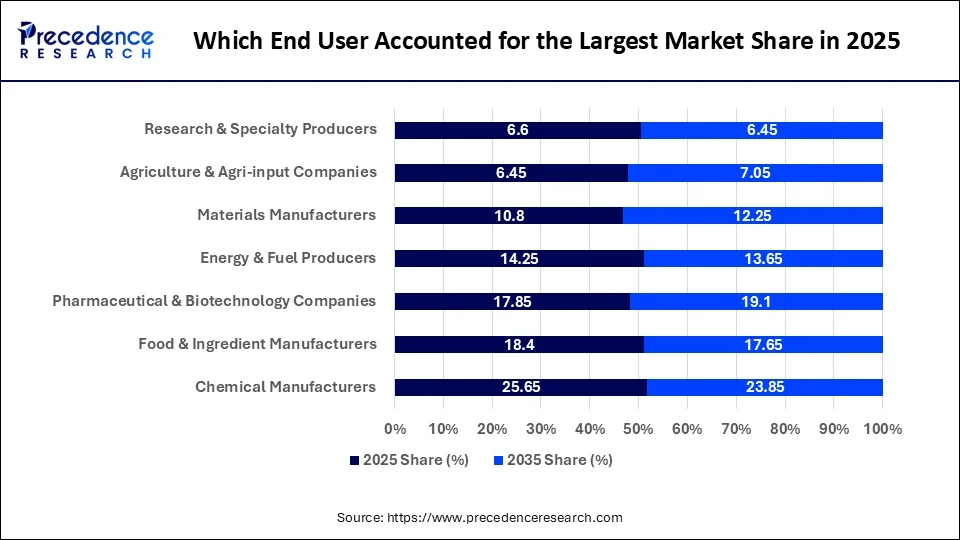
The chemical manufacturers segment led the market with a 25.65% share in 2025 and is expected to expand at a CAGR of 8.10% during the forecast period. The food and ingredient manufacturers and the pharmaceutical and biotechnology companies segments held significant market shares of 18.40% and 17.85%, respectively, in 2025. The materials manufacturers segment is expected to grow at the highest CAGR of 10.35% from 2026 to 2035, boosting its market share from 10.80% in 2025 to 12.25% in 2035.
End User Insights by Expert Analysts
The involvement of technology in end-user demand is increasing continuously. Chemical and materials companies increasingly require biological routes that can achieve efficient yield and persistent quality. Pharmaceutical and biotechnology companies are needing more and more intricate cell, fermentation, and purification systems. There is a significant overlap between these ecosystems, which generates opportunities for shared production infrastructure and specialty CDMO platforms.
Which Scale of Production Held the Largest Market Share in 2025?
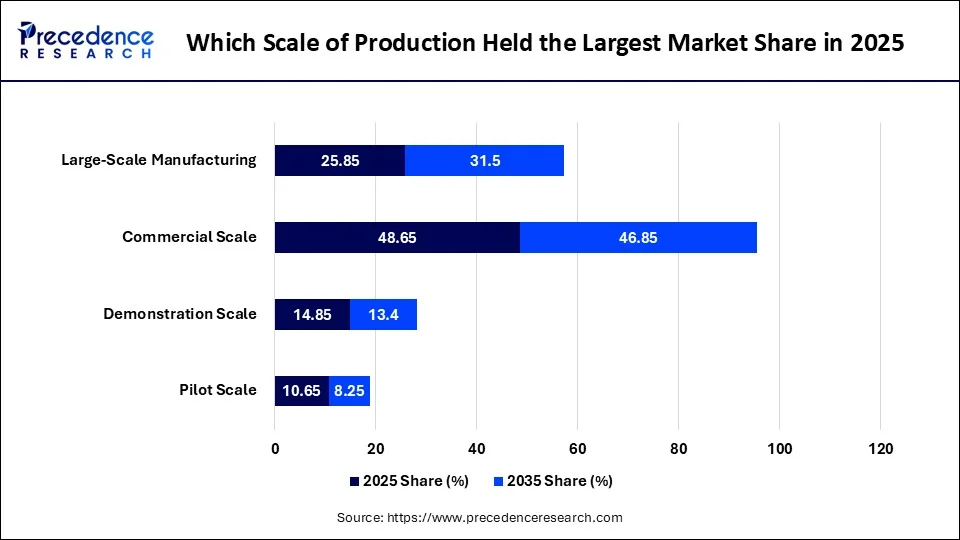
The commercial scale segment accounted for the major revenue share of 48.65% in the market in 2025 and is expected to expand at a CAGR of 8.50% during the forecast period. The large-scale manufacturing segment is expected to grow at the highest CAGR of 11.05% from 2026 to 2035, increasing its share from 25.85% in 2025 to 31.50% in 2035. The pilot-scale and demonstration-scale segments are expected to lose some market share percentage points during the forecast period owing to the technology transition towards commercial deployment.
Expert Analyst Insights
The rapid growth of large-scale manufacturing infrastructure represents one of the most crucial structural changes in the market. The primary constraint for various synthetic-biology companies is not just biological identification; it is fermentation scale-up, downstream processing, capital availability, offtake commitments, and cost-efficient manufacturing. The European Union's 2025 strategy explicitly emphasizes scaling innovation, investment, and lead markets, and its Bioeconomy Investment Deployment Group intends to mobilize €10 billion in corporate offtake commitments by 2030.
Which Region Dominated the Market in 2025?
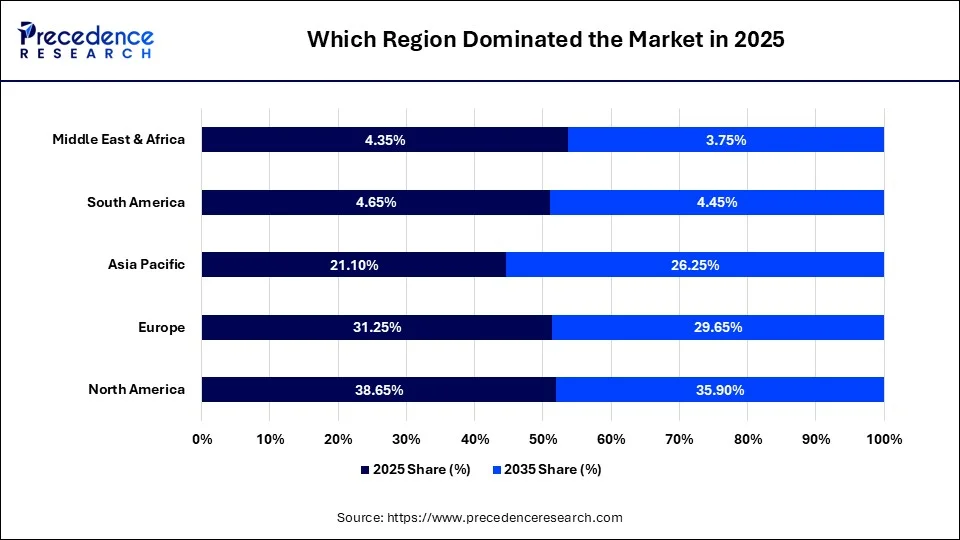
North America led the market with a 34.85% share in 2025 and is expected to grow at a CAGR of 8.30% during the forecast period. Europe and Asia Pacific also held significant market shares of 28.40% and 27.15%, respectively, in 2025. The market share of North America is expected to decrease to 32.95% by 2035 because Asia Pacific is expected to expand at the highest CAGR of 10.25% from 2026 to 2035, increasing its share from 27.15% in 2025 to 30.65% in 2035.
North America
North America has the largest market share owing to its mature biotechnology ecosystem, availability of ample venture capital, industrial fermentation infrastructure, and strong participation from technology development organizations. The U.S. Department of Energy (DOE) has previously allotted a significant amount of resources for bioproducts, biomaterials, renewable chemicals, and fuels, including investment in biotechnology scale-up and biorefineries. The U.S. DOE invested USD 220 million in biomanufacturing research and development and scale-up operations and towards a broader effort of commercializing biomass-derived fuels and chemicals.
Expert Analyst Insights
The market growth potential in the U.S. increasingly centers on the gap between engineered biological systems and industrial manufacturing. The demand for fermentation capacity, process optimization, downstream purification, and scale-up services is expected to increase alongside synthetic biology development.
Europe
Europe benefits from a combination of a robust fermentation and specialty chemicals environment and an increasingly clearly stated biotechnology and bioeconomy policy. The 2025 Bioeconomy Strategy of the EU recognizes bio-based materials, biomanufacturing, biochemicals, advanced fermentation and biorefineries as priority areas and intends to build lead markets for these technologies.
The EU also noted that biomass manufacturing and conversion sectors generated €863 billion in 2023, which is around 5% of the GDP of the European Union, and supported over 17 million jobs. In May 2026, the Commission introduced a specific call for evidence on industrial biotechnology and biomanufacturing as preparation for Biotech Act 2, with an emphasis on boosting the business case, demand generation, and investment anticipatability.
Expert Analyst Insights
The market growth in Europe is being increasingly influenced by industrial deployment rather than just laboratory innovation. This region has significant biochemical and fermentation prowess, but scaling manufacturing, securing biomass, enhancing project finance, and decreasing regulatory fragmentation are important to convert research and development into production capacity.
Asia Pacific
China is proactively developing synthetic-biology production infrastructure. The current measures of the Beijing Economic-Technological Development Area target over 20 prominent synthetic-biology enterprises by 2028, at least 2 new listed companies, 5 proof-of-concept platforms and 2 biomanufacturing pilot-service platforms. The policy especially recognizes high-efficiency strain construction, gene editing, metabolic regulation, AI-based synthesis, and enzyme engineering. The BioE3 policy of India recognizes 6 biomanufacturing areas, which are: bio-based chemicals/bioplastics/APIs/enzymes; functional foods and smart proteins; precision biotherapeutics; climate-resilient agriculture; biofuels and carbon capture; and next-generation marine/space applications.
Expert Analyst Insights
The main market growth benefit for Asia Pacific is increasingly tied to cost-optimized manufacturing, massive indigenous markets, biomass availability, government-supported industrial bases, and enhancing synthetic-biology capabilities. The importance of this region is expected to increase in terms of commercial fermentation and large-scale biological manufacturing rather than just being a hub for downstream production.
What Sales Figures did the Companies Report Relevant to the Market?
Novonesis
Novonesis noted 7% growth in organic sales in 2025, with an adjusted EBITDA margin of 37.1%. The company's Food and Health business achieved 8% growth organically, and its Planetary Health business grew by 6%. Novonesis unveiled 33 new products in 2025, and one-fourth of the revenue was secured from the solutions developed in the preceding 5 years. Its 2025 lineup included biosolutions such as food, human health, agriculture, energy, and technology, showing how industrial fermentation and biological solutions can cater to multiple end markets from a common production base.
Expert Analyst Insights
Novonesis demonstrates the commercial value of bringing together industrial fermentation prowess, patented biological strains, application knowledge, and global manufacturing scale. Its strategy also shows how enzyme and microbial technologies can have a presence beyond conventional food applications into energy, agriculture, and industrial processing.
Corbion
Corbion achieved total sales of €1.2674 billion in 2025. The company's Functional Ingredients & Solutions segment includes Food, Biochemicals, and Lactic Acid/PLA operations, with fermentation and next-generation ingredient techniques at the core of various businesses. Corbion noted 3.4% volume/mix growth in 2025, and its Health and Nutrition business achieved 8.9% volume/mix growth. Sugar constituted 28% of net raw material expenditures, energy constituted 7%, and dextrose/corn constituted 6%.
Expert Analyst Insights
Corbion shows the importance of feedstock finances and fermentation-derived intermediates in commercial biomanufacturing. Raw-material exposure, manufacturing efficiency, and the capability to transition from basic fermentation products to high-value applications directly affect production economics.
LanzaTech
LanzaTech achieved USD 18.298 million through contracts with customers and grants and USD 14.625 million from the sales of CarbonSmart products in 2025, while related-party transactions provided USD 20.497 million. The company utilizes gas fermentation for the conversion of gases that contain carbon into products, offering a different pathway from traditional sugar/starch fermentation towards gases and carbon feedstocks.
Expert Analyst Insights
LanzaTech is especially relevant to the gases and carbon feedstocks segment. The company's business model shows how industrial biomanufacturing can expand beyond biomass-derived sugars towards gases that contain carbon as biological feedstocks, and has the potential to broaden the feedstock base available to future biorefineries.
Ginkgo Bioworks
Ginkgo Bioworks noted a total revenue of USD 170.2 million in 2025, including USD 132.7 million from cell engineering and USD 37.4 million in Biosecurity service revenue. Cell Engineering revenue decreased from USD 174.0 million in 2024, which demonstrates program rationalization and restructuring. Ginkgo Bioworks' research and development revenue was USD 243.8 million in 2025, which shows the need for significant investment in the development and commercialization of biological engineering platforms.
Expert Analyst Insights
Ginkgo Bioworks emphasizes a different part of the industrial biomanufacturing supply chain: designing and engineering biological manufacturing systems rather than operating a conventional large-scale commodity fermentation business. The commercial constraint is the conversion of engineered biological capability into persistent customer programs and eventually scaled production.
Company Sales and Growth Figures in 2025
| Company | 2025 Reported Revenue / Sales | Relevant Indicator |
| Novonesis |
Not directly comparable in supplied source format |
7% organic sales growth |
| Corbion | €1,267.4M | 3.4% volume/mix growth |
| LanzaTech | $55.8M* | $14.6M CarbonSmart product sales |
| Ginkgo Bioworks | $170.2M | $132.7M Cell Engineering revenue |
Novonesis reported 7% organic sales growth in 2025. Corbion reported €1,267.4 million in revenue in 2025 and 3.4% volume/mix growth. LanzaTech noted USD 55.8 million in revenue in 2025, including USD 14.6 million in sales from CarbonSmart products. Ginkgo Bioworks achieved USD 170.2 million in revenue in 2025, including revenue of USD 132.7 million from cell engineering.
Company Sales Insights by Expert Analysts
According to our Senior Researcher Aditi Shivarkar, some of the important competitive indicators include product launches, biological-platform capabilities, fermentation capacity, feedstock adaptability, research and development intensity, commercial collaborations, and the transition from pilot to commercial manufacturing.
Industrial Biomanufacturing Investment and Policy Trends
| Region | Recent Policy/Investment Signal | Strategic Relevance |
| United States | DOE biomanufacturing R&D and scale-up programs | Commercialization and domestic production |
| European Union | 2025 Bioeconomy Strategy | Bio-based markets and industrial deployment |
| European Union | Biotech Act II preparation in 2026 | Industrial biotech investment and scale-up |
| China | Beijing synthetic-biology measures through 2028 | Manufacturing clusters and industrial platforms |
| India | BioE3 biomanufacturing hubs and biofoundries | Chemicals, materials, fuels, agriculture and pharma |
The U.S. DOE biomanufacturing research and development and scale-up programs will boost commercialization and indigenous production. The 2025 Bioeconomy Strategy of the EU will benefit bio-based markets and industrial deployment. The Beijing synthetic-biology measures in China will propel the development of production clusters and industrial platforms.
Expert Analyst Insights
Government assistance is increasingly shifting from basic biotechnology research to industrialization infrastructure. This includes pilot facilities, biofoundries, demonstration plants, financing mechanisms, offtake commitments, regulatory frameworks, and production clusters. This policy shift is crucial because biological innovation typically needs significant capital and technical prowess to transition from laboratory proof-of-concept to commercially competitive manufacturing.
What Factors are Considered by the Buyers When Purchasing Market-Relevant Products?
| Buyer Group | Primary Purchasing Priorities | Relevant Market Areas |
| Chemical Manufacturers | Cost per kg, yield, purity, feedstock flexibility | Bio-based chemicals |
| Food & Ingredient Producers | Food-grade compliance, consistency, sensory performance | Enzymes, ingredients |
| Pharmaceutical Companies | GMP, purity, reproducibility, scalability | Biologics, APIs |
| Materials Manufacturers | Material performance, cost, carbon profile | Bio-polymers |
| Fuel Producers | Feedstock cost, conversion efficiency, lifecycle emissions | Biofuels |
| Agriculture Companies | Biological efficacy, shelf life, field performance | Bioproducts |
| CDMOs / Contract Producers | Fermentation capacity, flexibility, downstream capability | Cross-sector |
| Industrial Biotechnology Startups | Pilot capacity, scale-up economics, technology transfer | Synthetic biology |
Cost, yield, purity, and feedstock adaptability are some of the important considerations for chemical manufacturers during the purchase of bio-based chemicals. Food and ingredient manufacturers prioritize food-grade compliance, consistency, and sensory performance when buying enzymes and bio-based ingredients. The decision of pharmaceutical companies when buying biologics and APIs is influenced by GMP, purity, reproducibility, and scalability. Fuel producers consider feedstock cost, conversion efficiency, and lifecycle emissions when purchasing biofuels.
Buyer Intelligence Insights by Expert Analysts
The buying decision is transitioning from just asking if a biological route works to asking if it can achieve commercially competitive unit economics at scale. Buyers increasingly assess titer, yield, productivity, downstream recovery, batch consistency, feedstock cost, energy usage, waste generation, regulatory needs, and long-term supply reliability.
What are Some of the Important Factors Driving Market Growth?
Synthetic Biology and Metabolic Engineering
Engineered biological pathways enable companies to manufacture molecules that are difficult or inefficient to produce through traditional fermentation.
fIndustrial-Scale Fermentation Current fermentation infrastructure offers the foundation for expanding biological manufacturing across chemicals, food ingredients, enzymes, and materials.
Bio-Based Chemical Substitution
Companies are increasingly looking out for biological routes for chemicals traditionally manufactured from fossil-based feedstocks.
Sustainable Materials
Bio-based polymers and next-generation materials are expanding at a CAGR of 10.45% during the forecast period.
Waste Valorization
The industrial by-products and waste segment is growing at a CAGR of 11.75% from 2026 to 2035, which shows growing use of waste streams as low-cost biological feedstocks.
Process Digitalization
The digital monitoring and control segment is expected to expand at a CAGR of 10.55% during the forecast period, facilitating better consistency and operations optimization.
Carbon Feedstocks
Gas fermentation offers a route for biological conversion of industrial gases that contain carbon into chemicals and materials.
Expert Analyst Insights
The development of advanced technologies is allowing the manufacturers to shift from fossil-based feedstocks to biological routes. The adoption of digital workflows will enhance persistence and optimize the industrial processes in terms of various parameters. Engineered biological pathways will help producers to seamlessly scale manufacturing operations of intricate molecules.
Key Market Restraints
| Challenge | Commercial Impact |
| High scale-up capital requirements | Slows transition from demonstration to commercial production |
| Feedstock price volatility | Directly affects production economics |
| Low biological yields | Can make bio-based products uncompetitive |
| Downstream processing costs | Often represents a major portion of total manufacturing cost |
| Regulatory complexity | Delays commercialization |
| Limited fermentation capacity | Creates scale-up bottlenecks |
| Skilled workforce shortages | Limits industrial deployment |
| Uncertain offtake | Makes large-capacity investments harder to finance |
| Product qualification cycles | Extends time to commercial adoption |
| Competition with petrochemical products | Requires competitive cost and performance |
The scaling of manufacturing operations requires significant capital investment, which throttles the pace of shift from demonstration to commercial production. Feedstock costs can be volatile, which directly impacts manufacturing economics. Intricacies in regulations can delay commercialization timelines, and limited fermentation capacity can be a restraint on scaling operations. Bio-based products need to be efficient in terms of cost and performance in order to compete with petrochemical products.
Market Restraints Insights by Expert Analysts
The primary market restraint is offering quality products at a competitive cost at scale. A biological manufacturing pathway has a lucrative environmental profile but can struggle commercially if feedstock, fermentation, downstream purification, and capital costs remain steep. This shows why there is a growing focus on industrial clusters, shared pilot facilities, long-term offtake agreements, and large-scale production.
Strategic Market Outlook 2026 to 2035
The standout structural change is the shift from traditional fermentation to engineered biological manufacturing systems. The market share of the synthetic biology segment is expected to increase, and that of fermentation is expected to decrease. The production model is also transitioning towards bigger facilities, with the large-scale manufacturing segment expected to gain market share percentage points during the forecast period.
Feedstock diversification is another major shift. Sugar and starch are still dominant, but industrial waste, lignocellulosic biomass, and carbon feedstocks are expected to gain market share. This generates opportunities for integrated biorefineries that bring together waste collection, preprocessing, biological conversion, fermentation, and downstream purification. Asia Pacific is expected to expand at the highest CAGR during the forecast period. China and India are both undertaking specialized policy and infrastructure initiatives for synthetic biology and biomanufacturing. Europe is increasingly placing a significant emphasis on scaling its bioeconomy and developing industrial biotechnology policy.
Experts Insights
The industrial biomanufacturing market is transitioning into a scale-up and commercialization stage. The competitive environment is not just defined only by the capability to engineer biological pathways, but also by the ability to combine string engineering, feedstock economics, fermentation capacity, downstream processing, automation, regulatory readiness, and customer offtake into a commercially feasible manufacturing system. The best market potential lies in technologies and business models that resolve the following industrial bottlenecks: synthetic biology, metabolic engineering, waste valorization, advanced fermentation, process monitoring, bio-based polymers, carbon-feedstock conversion, and large-scale production.
The policy landscape aligns with this transition. Europe is explicitly focusing on industrial deployment and lead markets for biomanufacturing, and its 2026 initiative for Biotech Act II is assessing ways to enhance investment and demand predictability. China is developing specialized synthetic-biology manufacturing infrastructure, and India's BioE3 program covers bio-based chemicals, bioplastics, enzymes, fuels, carbon capture, and other industrial applications. The market is not just defined by biological alternatives, but by the advent of industrial-scale biological manufacturing as a new production framework.
Our Experts
- The primary market research process was carried out by Vidyesh Swar, Senior Research Associate, who also designed the methodology and did market segmentation, regional trend analysis, buyer intelligence, competitive analysis, and forecasts, laying the foundation for the analytical part of the report.
- Aman Singh, Head of Research, has gathered and checked regulatory policies, company financial information, bio-based pathways information, production information, commodity price information, and various other quantitative information sources, which were obtained independently, thereby increasing the quality of evidence supporting the calculations of the market values.
- Aditi Shivarkar, VP Research, has validated and refined the research material, verified facts, corrected inconsistencies, and completed the research document, making it accurate and to the point.
Industrial Biomanufacturing Market Segments List
By Product Type
- Bio-based Chemicals
- Industrial Enzymes; Biofuels
- Bio-based Materials & Polymers
- Specialty Ingredients
- Biopharmaceutical and Biologics Inputs
- Other Products
By Technology
- Fermentation
- Synthetic Biology
- Metabolic Engineering
- Enzyme Engineering
- Cell Engineering
- Continuous Bioprocessing
- Other Technologies
By Feedstock
- Sugar & Starch Feedstocks
- Agricultural Biomass
- Plant Oils & Lipids
- Industrial By-products & Waste
- Lignocellulosic Biomass
- Gases & Carbon Feedstocks
- Other Feedstocks
By Production Platform
- Microbial Fermentation
- Yeast-Based Production
- Bacterial Systems
- Mammalian Cell Culture
- Plant-Based Systems
- Cell-Free Systems
- Other Platforms
By Process Stage
- Upstream Processing
Fermentation & Bioconversion
Downstream Processing
Process Monitoring & Control
Waste Treatment & Recovery
By Application
- Chemicals & Intermediates
- Food & Beverages
- Pharmaceuticals & Biologics
- Biofuels
- Materials & Polymers
- Agriculture
- Cosmetics & Personal Care
- Other Applications
By End User
- Chemical Manufacturers
- Food & Ingredient Manufacturers
- Pharmaceutical & Biotechnology Companies
- Energy & Fuel Producers; Materials Manufacturers
- Agriculture & Agri-input Companies
- Research & Specialty Producers
By Production Scale
- Pilot Scale
- Demonstration Scale
- Commercial Scale
- Large-Scale Manufacturing
By Region
- North America
- Europe
- Asia Pacific
- Latin America
- Middle East & Africa
For inquiries regarding discounts, bulk purchases, or customization requests, please contact us at sales@precedenceresearch.com
Frequently Asked Questions





Ask For Sample
No cookie-cutter, only authentic analysis – take the 1st step to become a Precedence Research client
 Get a Sample




 sales@precedenceresearch.com
 Schedule a Meeting
