


Inhaled Drugs Contract Manufacturing Market Trends, Leading Companies, Company Revenue / Sales Performance, Procedure Volume, Healthcare Spending, Technology Adoption, Reimbursement Analysis, Competitive Landscape, and Growth Outlook
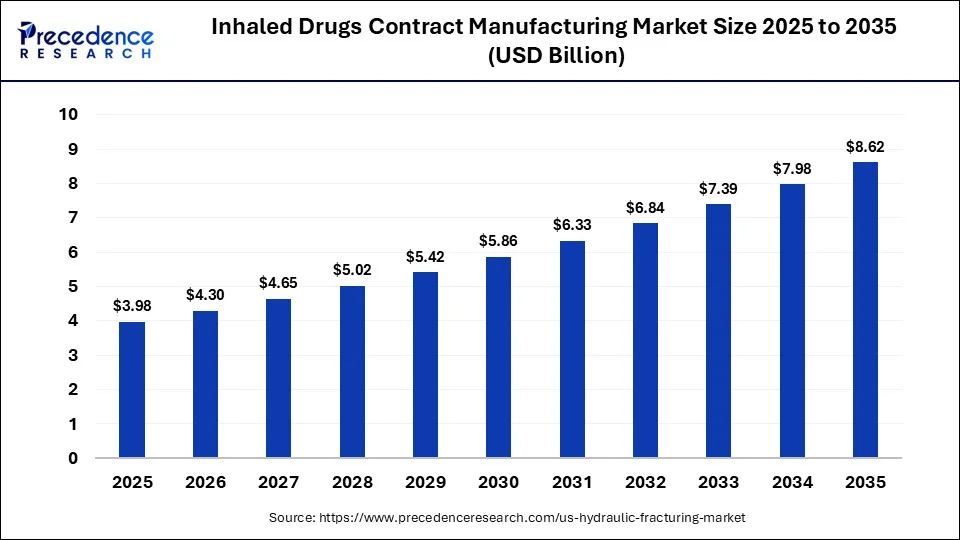
The inhaled drugs contract manufacturing market was valued at USD 4.30 billion in 2026, reaching USD 8.62 billion by 2035. Growing requirement for inhaled therapies, increasing pharmaceutical outsourcing, and rising demand for specialized drug-device manufacturing capabilities are driving market growth globally.
Source: https://www.precedenceresearch.com/inhaled-drugs-contract-manufacturing-market
 Get a Sample
 Table Of Content


Inhaled Drugs Contract Manufacturing Market Size, Share, Trends, and Forecast Analysis 2035
The inhaled drugs contract manufacturing market is forecasted to expand from USD 4.30 billion in 2026 to USD 8.62 billion by 2035, growing at a CAGR of 8.04% from 2026 to 2035.
 Key Takeaways
- Outsourcing is accelerating as pharmaceutical firms seek specialized inhaled drug manufacturing capabilities and even flexible production capacity.
- Inhaler technologies remain central, with growing need for metered-dose inhalers, dry powder inhalers, and nebulizer-based products.
- Respiratory disease burden supports demand, increasing the need for scalable manufacturing of inhaled therapies.
- Formulation expertise is a key differentiator, mainly for complex drug-device combinations and advanced inhalation formulations.
- Regulatory and quality requirements remain critical, thus favoring contract manufacturers with validated facilities and strong compliance capabilities.
- Technology and capacity expansion are anticipated to create new opportunities as drug developers increasingly depend on specialized CDMOs.
Specialized Manufacturing Complexity is Expanding the Outsourcing Pool
The opportunity is being shaped less by simple manufacturing volume and more by the technical complexity of inhaled products, where particle engineering, aerosol performance, dose uniformity, containment, device compatibility, and regulatory validation must operate as one manufacturing system.
North America accounted for nearly 48.4% of global revenue in 2026, making it the largest regional market for inhaled drugs contract manufacturing. Its leading position reflects a mature pharmaceutical ecosystem, advanced regulatory infrastructure, strong concentration of drug developers, and established capabilities in formulation, analytical testing, drug-device integration, and even commercial-scale production.
Asia Pacific is the fastest-growing region, supported by expanding pharmaceutical manufacturing capacity, improving technical capabilities, competitive production costs, and rising outsourcing by global and even regional drug developers. Our assessment is that Asia Pacific will become increasingly important as pharmaceutical firms diversify manufacturing footprints and seek additional capacity and supply-chain flexibility.
By service stage, commercial manufacturing accounted for nearly 64.9% of 2026revenue, highlighting the substantial contribution of large-scale production activities after inhaled drug products reach commercialization. This indicates that outsourcing needs are increasingly tied to recurring manufacturing programs rather than being concentrated solely in early development. API-related services represented roughly 88.8% of revenue, underscoring the significance of active pharmaceutical ingredient capabilities within the outsourcing value chain. The high share reflects the specialized technical, quality, and even regulatory requirements associated with APis used in inhaled formulations, where purity, particle characteristics, consistency, and process control can directly influence product performance.
From the customer perspective, pharmaceutical companies accounted for approximately 53.5% of 2026 revenue, making them the largest customer group. Their reliance on external manufacturers reflects the demand to access specialized capabilities while limiting investments in dedicated facilities, technical personnel, equipment, and regulatory infrastructure.
Our analysis indicates that suppliers capable of combining commercial-scale manufacturing with formulation capabilities, API expertise, quality systems, and flexible production networks are positioned to capture higher-value outsourcing programs. The growing emphasis on supply-chain resilience, scalability, and specialized manufacturing is likely to strengthen the need for integrated contract manufacturing partners across the inhaled drugs value chain.
The market therefore has a distinctive structure: mature commercial programs generate the largest revenue pool, while development, formulation, device integration, particle engineering, and complex inhaled biologics provide the higher-growth areas.
Key Coverage
- Service, product, end-use, technology, formulation, device, and regional segmentation.
- Commercial manufacturing versus clinical or development revenue pools.
- API, finished-dose, MDI, DPI, nebulized and emerging inhalation formats.
- CDMO capacity, utilization, pricing, technology and regulatory barriers.
- Competitive ranking, market-share estimates and company-level benchmarking.
The growth of this market is supported by rising outsourcing of technically difficult inhalation programs, growth of respiratory-drug pipelines, generic and lifecycle-management opportunities, and rising interest in pulmonary delivery for molecules that are difficult to administer via conventional routes.
The full analysis further models base, upside and downside scenarios around respiratory pipeline productivity, commercial outsourcing rates, inhaled-biologic approvals, propellant transition costs, regional capacity additions and even macroeconomic pressure on pharmaceutical R&D budgets.
Key Coverage
- Regional and country-level forecasts.
- Base/upside/downside scenarios.
Why Commercial Manufacturing Leads, While Complex Clinical Work is the Growth Engine?
Commercial manufacturing captured approximately 64.9% of 2026 market revenue, reflecting the recurring nature of marketed inhalation products. Clinical manufacturing, development, analytical, and formulation services represent a smaller revenue base but provide stronger growth potential because every new inhaled product demand formulation optimization, scale-up, device compatibility, and regulatory testing before commercialization.
By product, API-related activities accounted for approximately 88.8% of 2026 revenue, demonstrating the economic importance of drug-substance processing, particle engineering, along with specialized API manufacturing within the outsourcing ecosystem.
The market is also segmented by MDI, DPI, nebulized products, and a few finished inhalation formats. MDis remain economically significant because of their established commercial base, while DPis benefit from propellant-free delivery and continued formulation innovation. Nebulized and soft-mist systems provide an attractive growth pocket for biologics, high-dose therapies, and also patients unable to generate sufficient inspiratory flow.
Key Coverage
- Service revenue and CAGR.
- MDI, DPI, nebulizer and emerging formats.
- API versus finished-drug services.
- Pharmaceutical, biopharmaceutical and device customers.
- Formulation and particle-engineering exposure.
- Clinical versus commercial programs.
- Geographic segment contribution.
Market Dynamics: Outsourcing is Moving From Capacity Purchase to Technical Partnership
The central structural shift is from basic contract manufacturing toward integrated inhalation development and manufacturing. Sponsors increasingly demand a partner capable of combining API processing, spray drying, formulation, device compatibility, micronization, filling, analytical characterization, packaging, and even regulatory support.
Respiratory disease burden remains a fundamental demand catalyst. Global prevalence across asthma, COPD, along with interstitial lung disease is measured in hundreds of millions of patients, creating a large installed therapeutic base. However, CDMO need is increasingly influenced by the growth of inhalation beyond traditional respiratory products into systemic delivery, peptides, biologics, and reformulated therapies.
The principal restraint is capital intensity. Specialized aerosol facilities demand controlled environments, precision filling equipment, containment, inhalation analytical laboratories, and validated device-manufacturing infrastructure. The result is a market where qualification history and technical know-how create meaningful barriers to switching.
Key Coverage
- Outsourcing penetration.
- Respiratory disease burden.
- Generic and lifecycle opportunities.
- Inhaled biologics pipeline.
- CAPEX requirements.
- Regulatory and supply-chain risks.
- Qualification and switching barriers.
Tentative Leading Company Universe - 20 Companies Shaping the Market
| Company | Headquarters | Market Position | Core Strength | Major Applications/Segments |
| Hovione | Portugal | Inhalation specialist | API, particle engineering, DPI | DPI, API, formulation |
| Lonza | Switzerland | Global CDMO leader | Particle engineering, formulation | DPI, complex inhalation |
| Catalent | U.S. | Global integrated CDMO | Spray drying, DPI manufacturing | DPI, nebulized products |
| Kindeva Drug Delivery | U.S. | Inhalation specialist | pMDI, formulation, devices | MDI, respiratory |
| Bespak | UK | Drug-device specialist | Valves, pMDI, DPI devices | MDI, DPI |
| Recipharm | Sweden | Global CDMO | Commercial pharma manufacturing | Drug products |
| Aptar Pharma | U.S./France | Delivery technology leader | Devices, formulation, clinical supply | OINDP, nasal |
| Siegfried | Switzerland | Specialty drug-product CDMO | HPAPI, DPI capsules | DPI |
| CordenPharma | Germany | Integrated CDMO | API and drug product | Complex molecules |
| PCI Pharma Services | U.S. | Clinical/commercial CDMO | Packaging and clinical supply | Inhaled drug products |
| Vectura | UK | Inhalation technology specialist | Formulation and device technology | DPI |
| Iconovo | Sweden | DPI technology challenger | Proprietary inhaler platforms | DPI |
| HCmed Innovations | Taiwan | Nebulizer specialist | Mesh nebulization | Nebulized therapies |
| Arcinova | UK | Specialty CDMO | Formulation and development | Complex drug products |
| Bend Bioscience | U.S. | Formulation specialist | Spray drying | Inhaled formulations |
| Ritedose | U.S. | Respiratory manufacturer | Unit-dose respiratory products | Nebulized solutions |
| Unither Pharmaceuticals | France | Liquid-dose specialist | BFS technology | Inhalation liquids |
| Cambrex | U.S. | Small-molecule CDMO | API/process development | Complex APIs |
| Stevanato Group | Italy | Drug-delivery specialist | Devices and containment | Inhalation components |
| Nemera | France | Device specialist | Drug-delivery devices | DPI/MDI platforms |
Which Competitive Capabilities Will Determine Leadership in the Inhaled Drugs Contract Manufacturing Market?
Competition is increasingly shaped by technical specialization rather than manufacturing scale alone. The leading competitive pools span API manufacturing, spray drying, particle engineering, DPI and pMDI formulation, nebulization, analytical testing, device integration, and commercial-scale filling. Our analysis states that providers capable of combining multiple stages of the inhalation value chain are better positioned to capture higher-value programs and then retain customers as products progress from development to commercialization.
Our analysis indicates that competitive differentiation is changing toward integrated inhalation capabilities and validated commercial capacity. Commercial manufacturing represented nearly 66.9% of 2026 market revenue, while API-related services accounted for roughly 88.8%, highlighting the significance of both recurring production and technically demanding drug-substance capabilities. We believe this structure favors providers that can support sponsors across formulation development, device compatibility, particle-size control, GMP scale-up, analytical characterization, and even commercial supply rather than competing mainly on manufacturing price.
In our view, the strongest competitive opportunity lies at the intersection of inhalation technology, manufacturing scale, and drug-device expertise. Large integrated CDMOs benefit from global infrastructure and commercial capacity, while specialized providers can defend attractive niches via proprietary particle-engineering platforms, pMDI expertise, DPI technologies, nebulization capabilities and complex formulation know-how. The competitive risk for less differentiated producers is increasing commoditization and pricing pressure, mainly where services can be transferred between qualified suppliers. Conversely, inhaled biologics, low-GWP pMDI conversion, high-potency formulations and advanced DPI systems are creating new areas where specialized technical capabilities can command greater strategic value.
Which Technologies are Most Likely to Strengthen Inhaled Drug Manufacturing Differentiation?
Inhaled drug contract manufacturing is becoming increasingly technology-intensive as customers demand capabilities that extend beyond conventional pharmaceutical production. The market is shifting toward spray drying, particle engineering, micronization, high-payload dry-powder formulations, nebulization technologies, advanced metered-dose inhalers, and integrated drug-device development. Spray drying is mainly important because it enables control over aerodynamic performance, particle morphology, solubility, and stability, while advanced DPI platforms are expanding the range of molecules that can potentially be delivered to the lungs. Low-global-warming-potential propellants are also creating a significant technology transition for pMDis, with HFO-1234ze and HFA-152a emerging as alternatives to higher-impact propellants.
Our analysis indicates that technology leadership in this market is changing from individual manufacturing processes toward integrated formulation-and-device capabilities. The main competitive question is no longer simply whether a CDMO can manufacture an inhaled product, but whether it can reliably move a formulation from particle engineering and device selection via analytical characterization, scale-up, clinical supply, and even commercial production. This favors providers with spray-drying, specialized inhalation laboratories, and milling infrastructure, device-engineering expertise, and established scale-up processes. Our assessment is that complex molecule delivery, high-payload DPI development, and sustainable pMDI technologies represent mainly important areas because they combine technical complexity with relatively high barriers to qualified manufacturing capacity.
In our view, the most significant strategic implication is that investment in specialized technology can create greater customer stickiness along with pricing power than incremental conventional manufacturing capacity. Providers able to demonstrate reproducible aerosol performance, aerodynamic particle-size control, dose uniformity, and device compatibility can become embedded earlier in customers' development programs, increasing the probability of transitioning from development work into clinical and commercial manufacturing. Conversely, manufacturers that lack device-integration, particle-engineering, or next-generation propellant capabilities risk being concentrated in lower-value, price-sensitive production activities as users increasingly outsource technically demanding inhalation programs.
Which Manufacturing Capabilities, along with Capacity Positions, Will Determine Supply Reliability and Competitive Advantage?
Inhaled drug contract manufacturing is increasingly shaped by the availability of specialized production infrastructure rather than capacity alone. Manufacturing requirements span formulation development, micronization, spray drying, blending, filling, analytical testing, clinical-scale production, device assembly, and commercial-scale manufacturing, with capacity needs varying significantly by formulation and device type. The combination of specialized equipment, process controls, containment requirements, and inhalation-specific analytical capabilities means that nominal facility capacity does not necessarily translate into readily available production capacity.
Our analysis indicates that manufacturing competitiveness is changing toward the quality, specialization, and scalability of installed capacity. Providers with capabilities that fund the transition from laboratory and clinical batches to larger commercial volumes can decrease technology-transfer complexity and supply interruptions for customers. Our assessment is that utilization, development-to-commercial continuity, batch-size flexibility, geographic footprint, and specialized inhalation infrastructure are therefore more meaningful competitive indicators than total capacity in isolation.
Which Strategic Positions Will Separate the Strongest Inhaled Drug Contract Manufacturers from the Rest?
The competitive landscape is increasingly defined by the breadth of capabilities that providers can combine across particle engineering, inhalation-device integration, formulation development, analytical testing, clinical manufacturing, along with commercial-scale production. Providers with end-to-end capabilities can fund customers across multiple development stages, while more specialized producers may compete through expertise in specific device platforms, complex formulations, or high-containment production. This creates meaningful differences in addressable customer segments, scalability, program complexity, and potential revenue capture.
Our analysis indicates that competitive strength in this market is better measured by capability depth and eventually development-to-commercial continuity than by manufacturing scale alone. Providers able to handle complex inhaled products while maintaining reproducibility during scale-up are positioned to become more deeply embedded in customer programs. Our assessment is that technical specialization, facility infrastructure, regulatory experience, geographic reach, technology ownership, and the ability to fund multiple product-development stages are increasingly important differentiators as pharmaceutical firms outsource more specialized activities.
In our view, the most significant strategic implication is that firms with differentiated technical platforms can defend stronger positions even without leading the market in absolute manufacturing capacity. Moreover, the competitive advantage increasingly comes from combining specialized know-how with reliable execution, thus enabling providers to compete for higher-complexity programs rather than predominantly volume-driven contracts. This also highlights potential capability gaps where producers may need targeted investments, partnerships, facility expansion, or acquisitions to broaden their inhalation offering.
Key Strategic Questions
- Which service categories generate the highest revenue and margins?
- Why does commercial manufacturing account for nearly two-thirds of revenue?
- How much of the market is captured by API-related manufacturing?
- Which inhalation formats, MDI, DPI, nebulized, or emerging systems, offer the strongest growth?
- Where are the largest capacity and supply-chain constraints?
- How are low-GWP propellants changing pMDI manufacturing economics?
- Which particle-engineering technologies create the strongest competitive advantage?
- Which CDMOs are best positioned for inhaled biologics and complex formulations?
- How concentrated is the competitive landscape among the leading providers?
- Which companies combine API, formulation, device, and commercial capabilities most effectively?
- Where are the largest geographic white spaces, particularly across Asia Pacific?
- Which recent investments, partnerships, and acquisitions are changing competitive positioning?
- Which technologies, applications, and customer segments are likely to create the next major inhalation CDMO profit pools?
Inhaled Drugs Contract Manufacturing Market Segments
By Service Type
- Contract Development
- Formulation Development
- Analytical & Testing Services
- Clinical Manufacturing
- Commercial Manufacturing
- Packaging & Labeling
- Device Development & Integration
- Regulatory Support
By Drug/Formulation Type
- Dry Powder Inhalers (DPis)
- Metered-Dose Inhalers (MDis)
- Nebulized Formulations
- Soft Mist Inhalers (SMis)
- Nasal Inhalation Products
- Other Inhaled Formulations
By Molecule Type
- Small Molecules
- Biologics
- Peptides
- Combination Products
- High-Potency / Highly Potent Compounds
By Therapeutic area
- Respiratory Diseases
- Asthma
- COPD
- Cystic Fibrosis
- Pulmonary Infections
- Pulmonary Hypertension
- Diabetes
- Neurological Disorders
- Other Therapeutic Applications
By Development Stage
- Preclinical
- Phase I
- Phase II
- Phase III
- Commercial
By Manufacturing Scale
- Laboratory / R&D Scale
- Clinical Scale
- Pilot Scale
- Commercial Scale
By Technology
- Spray Drying
- Micronization
- Particle Engineering
- Hot-Melt / Solvent-Based Processing
- Encapsulation & Powder Blending
- Sterile Manufacturing
- Other Specialized Technologies
By Device Integration
- Drug-Only Manufacturing
- Drug + Device Development
- Drug + Device Manufacturing
- Integrated Combination-Product Manufacturing
By Customer Type
- Large Pharmaceutical Companies
- Specialty Pharmaceutical Companies
- Biotechnology Companies
- Generic Drug Manufacturers
- Emerging / Virtual Pharma Companies
By eRgion
- North America
- U.S.
- Canada
- Europe
- Germany
- U.K.
- France
- Italy
- Spain
- Rest of Europe
- Asia-Pacific
- China
- Japan
- India
- South Korea
- Australia
- Rest of Asia-Pacific
- Latin America
- Middle East & Africa
For inquiries regarding discounts, bulk purchases, or customization requests, please contact us at sales@precedenceresearch.com
Frequently Asked Questions





Ask For Sample
No cookie-cutter, only authentic analysis – take the 1st step to become a Precedence Research client
 Get a Sample
.webp)



 sales@precedenceresearch.com
 Schedule a Meeting