






 Request Consultation
Automatic bending machines enhance precision, speed, and efficiency in metal fabrication, enabling complex component production with minimal manual intervention in modern smart factories.
Metal fabrication plays a crucial role in modern industrial development. Metal forming and shaping processes are essential to manufacturing, from building materials and industrial machinery to automobile parts and aerospace structures. One of the most popular methods for producing intricate shapes and structural elements is metal bending.
In the past, operator-controlled systems and manual press brakes were largely used in metal bending operations. These devices aided manufacturers in producing necessary parts, but they frequently had issues with accuracy, speed, reliance on labor, and consistency. Manufacturers are searching for more automated and efficient solutions as industrial production keeps growing, and consumer demand for customized metal parts rises.
This is where the future of metal fabrication is being reshaped by automatic bending machines. Automatic bending machines are revolutionizing traditional manufacturing processes by incorporating computer numerical control (CNC) systems, sophisticated automation technologies, and intelligent software. With the help of these contemporary devices, producers can create intricate metal parts with little manual intervention, guaranteeing higher productivity and consistent product quality. The use of automated bending technologies is assisting industries in meeting the rising demand for high-performance metal products from small fabrication workshops to large industrial plants.
This blog explores how automatic bending machines are transforming metal fabrication industries, the technologies driving this shift, and the role these systems will play in the future of smart manufacturing.
Why is Metal Fabrication Evolving Rapidly?
Metal fabrication is evolving rapidly due to increasing demand for precision, efficiency, and automation across industries such as automotive, aerospace, construction, and electronics. The push toward Industry 4.0, growing production demands, and technological innovation are all causing a rapid transformation of the global manufacturing landscape. There is growing pressure on metal fabrication businesses to produce high-quality goods while preserving productivity and cutting expenses.
What is the Automatic Bending Machine Market Size in 2026?
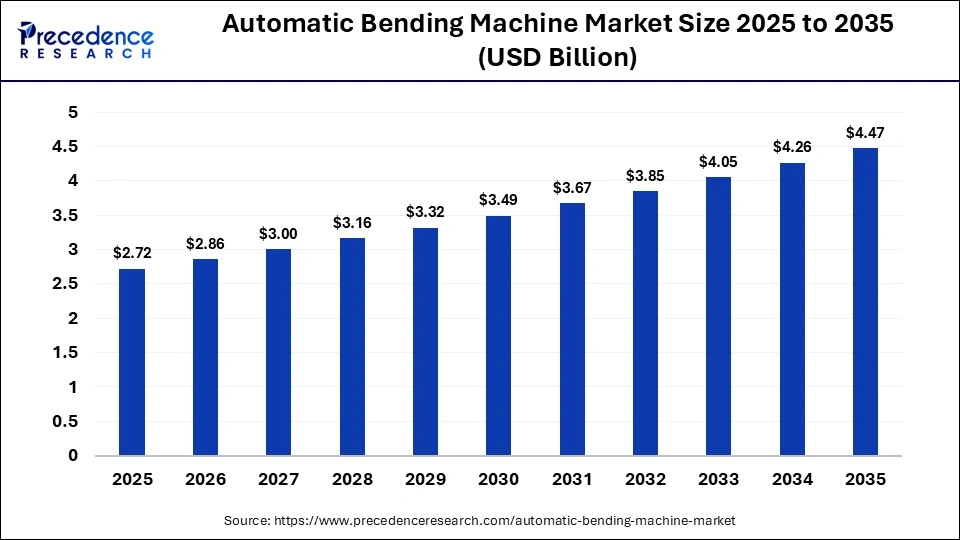
The global automatic bending machine market size was calculated at USD 2.72 billion in 2025 and is predicted to increase from USD 2.86 billion in 2026 to approximately USD 4.47 billion by 2035, expanding at a CAGR of 5.10% from 2026 to 2035.
Key Factors Driving the Evolution of the Metal Fabrication Industry
- Rising Demand for Precision Components: Components with extremely tight tolerances and complex geometries are needed in modern industries like electronics, renewable energy, automotive, and aerospace. Conventional bending techniques frequently have trouble maintaining reliable accuracy, especially when creating complex designs or large quantities of parts. By employing CNC-controlled processes that guarantee exact angles, consistency, and repeatability throughout each production cycle, automatic bending machines overcome this difficulty.
- Increasing Production Volumes: As global infrastructure projects, electric vehicle production, and industrial machinery manufacturing grow, manufacturers are seeing an increase in demand for metal components. Both production capacity and human error risk can be increased by manual bending operations. Manufacturers are able to scale production effectively because automation allows for continuous operation and faster production speeds.
- Shorter Product Development Cycles: In today’s highly competitive industrial landscape, manufacturers are under pressure to reduce time-to-market and accelerate product development. The ability to rapidly adapt to design changes and produce customized parts without lengthy setup processes has become essential. Automatic bending machines address this need by enabling flexible manufacturing, allowing operators to quickly program multiple bending configurations through intuitive digital interfaces, improving efficiency and responsiveness in modern production environments.
Why Traditional Bending Methods Can’t Meet Today’s Industrial Demands?
For many years, the foundation of metal fabrication facilities consisted of many operated bending machines and traditional press brakes. These devices are still useful tools, but they have a number of drawbacks that limit their accuracy and productivity. Operator dependency is one of the main problems. Skilled technicians are needed for manual bending; they must carefully monitor the bending process and modify machine settings. Inconsistencies in the finished product can arise from even minor changes in operator techniques.
Longer setup times are another drawback of traditional systems, particularly when switching between product designs. This increases operational downtime and decreases manufacturing efficiency. The limited scalability of production is another drawback. Large-scale manufacturing operations can be slowed down by manual processes, making it challenging for businesses to satisfy rising consumer demand. Manufacturers are moving more toward automated and digitally controlled bending technologies to address these issues.
From Manual to Automated: The Revolution in Metal Bending
One of the biggest technological developments in metal fabrication is automatic bending machines. These devices automate the bending process by combining sophisticated mechanical systems with digital control technologies. Automatic bending machines employ computer-controlled programs that precisely regulate the movement of bending tools, material positioning, and pressure application in contrast to conventional systems. This guarantees excellent accuracy and constant bending angles throughout each production run.
To maintain optimal performance, bending parameters are automatically adjusted by sensors and real-time monitoring systems found in many contemporary machines. These capabilities drastically cut down on material waste and production errors. Furthermore, complex bending operations that would be challenging or time-consuming with manual machines can be handled by manufacturers thanks to automation.
Key Technologies Driving Adoption of Automatic Bending Systems
|
Technology Area |
Strategic Importance in Modern Fabrication |
Long-Term Industrial Impact |
|
CNC Control Systems |
Enable precise control of bending angles and tool movements |
Improved product accuracy and repeatability |
|
Robotic Material Handling |
Automates the loading and unloading of metal sheets |
Faster production and reduced labor dependency |
|
AI-Based Process Optimization |
Analyzes bending parameters to improve efficiency |
Reduced errors and enhanced production performance |
|
IoT-Enabled Machine Monitoring |
Provides real-time machine diagnostics and performance data |
Predictive maintenance and minimized downtime |
|
Digital Simulation Software |
Allows virtual testing of bending processes before production |
Reduced material waste and faster product development |
These technologies are transforming bending operations into highly intelligent manufacturing systems capable of adapting to different production requirements.
The Rise of Smart Metal Fabrication Facilities
Automatic bending machines are increasingly becoming a necessary part of digital manufacturing environments and smart factories. Digital networks like the machines in Industry 4.0 production systems allow for automated decision-making and real-time data sharing. Bending machines can interact with other manufacturing devices like laser cutting machines, welding robots, and quality inspection systems in these kinds of settings. Manufacturers can build fully automated production lines with little human intervention thanks to this integration.
For example, metal sheets can be automatically cut, transferred to bending machines, and processed into finished components within a continuous production workflow. These integrated systems significantly improve manufacturing efficiency while reducing production delays.
Applications of Automatic Bending Machines Across Industries
Automatic bending machines are widely used across various industrial sectors that require precise metal forming processes.
- Automotive ManufacturingAutomated bending systems play a major role in the production of body panels, exhaust systems, chassis parts, and structural components for automakers. To guarantee product quality and safety, high precision and repeatability are crucial.
- Aerospace IndustryComponents used in the production of aircraft must adhere to stringent performance and safety requirements. The production of intricate aerospace components and lightweight metal structures with remarkable accuracy is made possible by automatic bending machines.
- Construction and Infrastructure Metal bending is widely used in the construction sector for structural beams, architectural elements, and steel frameworks. Automated systems improve production efficiency for large-scale infrastructure projects.
- Electrical and Electronics IndustryMetal enclosures, cabinets, and electronic component housing require precise bending operations. Automated bending machines help manufacturers maintain consistency and meet strict design specifications.
From Manual to Intelligent: AI and Automation in Metal Bending
Automated bending machines are increasingly incorporating artificial intelligence and advanced data analytics. These technologies enable real-time bending process optimization and the analysis of massive amounts of operational data by machines. Bending pressure can be automatically adjusted by AI-powered systems that recognize changes in material properties. This guarantees a constant level of product quality regardless of the type or thickness of metal used.
To increase productivity and shorten cycle times, machine learning algorithms can also examine previous production data. Over time, manufacturing performance can continuously improve thanks to these systems. Before production starts, operators can also simulate bending operations thanks to digital automation. This reduces materials waste and aids in the identification of possible design problems.
Emerging Innovations in Automatic Bending Technologies
Bending technologies are still evolving. The next generation of automatic bending machines is being shaped by a number of emerging trends. The incorporation of robotic bending systems that can carry out several tasks in a single automated workstation is one noteworthy advancement. These systems increase overall production speed while reducing the need for manual handling.
Adaptive bending technology, in which machines automatically modify their settings in response to material feedback during the bending process, is another innovation. This feature improves accuracy and lowers production errors. Platforms for cloud-based monitoring are also growing in popularity. Manufacturers can use these systems to schedule predictive maintenance, evaluate production data, and monitor machine performance remotely. Furthermore, before actual production starts, manufacturers are using sophisticated simulation software to create more effective bending processes.
How Manufacturers and Technology Providers Can Capitalize on Emerging Trends
Manufacturers of machinery, suppliers of automation technology, and businesses that develop industrial software are all benefiting greatly from the increasing need for automated manufacturing solutions. To increase operational effectiveness and maintain their competitiveness in international markets, metal fabrication businesses are investing in cutting-edge bending equipment. Automation helps manufacturers meet tight quality standards while also improving production capabilities. To incorporate bending machines into larger digital manufacturing ecosystems, technology companies are also creating new software. These systems enhance overall production coordination by facilitating smooth communication between various machines.
Governments and industrial organizations are encouraging the adoption of advanced manufacturing technologies as part of broader Industry 4.0 initiatives. These investments are expected to accelerate the adoption of automatic bending machines in the coming years.
Building the Future of Smart Metal Manufacturing
A new phase of digital transformation is about to begin in the metal fabrication sector. This shift is being facilitated by automatic bending machines, which make manufacturing processes quicker, more accurate, and extremely effective. These devices are assisting manufacturers in producing intricate metal components with increased consistency and reduced operating costs by fusing sophisticated automation, intelligent software, and real-time monitoring capabilities. Automatic bending machines will become crucial tools for increasing productivity and improving product quality as industries continue to adopt smart manufacturing technologies.
Businesses that invest in cutting-edge bending technologies now will be better equipped to handle manufacturing demands in the future and maintain their competitiveness in an increasingly automated industry environment. The extensive use of automatic bending machines will eventually spur innovation in the metal fabrication industry, fostering the growth of more intelligent factories, more effective production systems, and more robust worldwide manufacturing capabilities.
About the Authors

Aditi Shivarkar
Aditi, Vice President at Precedence Research, brings over 15 years of expertise at the intersection of technology, innovation, and strategic market intelligence. A visionary leader, she excels in transforming complex data into actionable insights that empower businesses to thrive in dynamic markets. Her leadership combines analytical precision with forward-thinking strategy, driving measurable growth, competitive advantage, and lasting impact across industries.



Aman Singh
Aman Singh with over 13 years of progressive expertise at the intersection of technology, innovation, and strategic market intelligence, Aman Singh stands as a leading authority in global research and consulting. Renowned for his ability to decode complex technological transformations, he provides forward-looking insights that drive strategic decision-making. At Precedence Research, Aman leads a global team of analysts, fostering a culture of research excellence, analytical precision, and visionary thinking.

Piyush Pawar
Piyush Pawar brings over a decade of experience as Senior Manager, Sales & Business Growth, acting as the essential liaison between clients and our research authors. He translates sophisticated insights into practical strategies, ensuring client objectives are met with precision. Piyush’s expertise in market dynamics, relationship management, and strategic execution enables organizations to leverage intelligence effectively, achieving operational excellence, innovation, and sustained growth.