






 Request Consultation
Extracellular matrix patches are revolutionizing regenerative medicine by enabling biologically active tissue repair. This blog explores their applications, material innovations, and clinical benefits across multiple surgical fields. Discover how ECM-based scaffolds are shaping the future of advanced healing technologies.
Modern medicine is undergoing a fundamental shift from replacement-based treatments toward biologically driven tissue regeneration strategies. Conventional surgical resources were produced to offer only mechanical assistance without being directly involved in healing mechanisms. On the other hand, new biomaterials are transforming the way clinicians deal with the repair of tissues, particularly in complicated surgical scenarios.
One of the most revolutionary solutions in the regenerative medicine application has been extracellular matrix patches. These patches are based on biological tissues and are designed to save structural proteins, signaling molecules, and biochemical cues important to cell regeneration. Contrary to synthetic implants, extracellular matrix patches are dynamic in their interactions with the host environment to facilitate tissue integration and functional restoration.
Existing trends in clinical adoption of cardiovascular, orthopedic, and soft tissue repair procedures have shown an increasing tendency towards the utilization of biologically active scaffolds. Surgeons are becoming more attracted to materials that not only provide strength to damaged structures but also direct cellular behavior in the healing process. This reversal represents a larger change to more specific regenerative treatments that can go along with the natural repair processes of the body.
What is the Extracellular Matrix Patches Market Size in 2026?
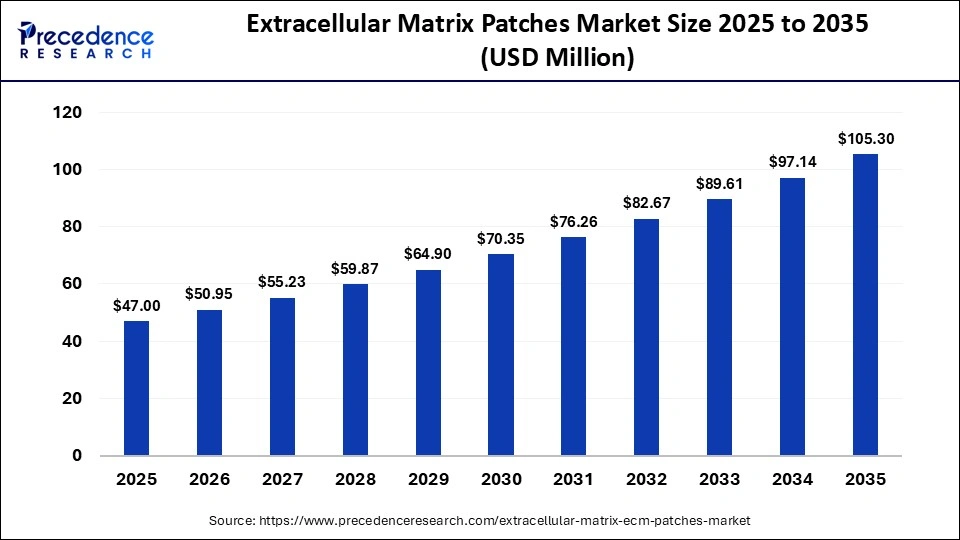
The global extracellular matrix patches market was valued at USD 47.00 million in 2025 and is projected to grow from USD 50.95 million in 2026 to approximately USD 105.30 million by 2035, registering a CAGR of 8.40% during the forecast period from 2026 to 2035. This growth is driven by increasing surgical volumes, rising prevalence of chronic wounds, and growing adoption of regenerative biomaterials for advanced tissue repair.
Get a Free Sample Report with Key Market Trends: https://www.precedenceresearch.com/sample/8224
Beyond Structural Support: The Biological Intelligence of Matrix-Based Implants
Traditional surgical patches were mainly tested on tensile strength, durability, and compatibility with surrounding tissues. These qualities are still significant, but they are not sufficient to consider the intricacies of biological healing. Tissue repair is a complex process that is characterized by interactions between cells and extracellular structures, which cannot be imitated by inert material.
This is further enhanced by the introduction of a new dimension, which is the extracellular matrix patches. They present a biologically active framework that facilitates the migration and differentiation of cells. The patches conserve elements, such as collagen, elastin, and glycosaminoglycans, which are important in the anatomy and functioning of tissues. Further, cellular reactions can be affected by retained growth factors in the matrix, which accelerate healing and minimize inflammation.
Recent laboratory experiments show how progenitor cells are recruited to the locations of injuries using matrix-based scaffolds. Such cells are involved in tissue regeneration by differentiating into different types of cells that are essential in repair. This process is a difference between extracellular matrix patches and conventional implants, and it makes them active parts of the healing process and not mere supports.
Material Origins are Defining Clinical Performance Outcomes
Extracellular matrix materials are a significant source that determines their structural and biological characteristics. The majority of commercially produced patches are made based on porcine, bovine, or human tissue undergoing decellularization to eliminate immunogenic substances. This is done to maintain the structural integrity of the matrix, and it lowers the chances of any adverse immune reaction.
Latest developments in decellularization methods are enhancing the reliability and safety of matrix-based implants. Scientists are also improving chemical and enzymatic techniques to make sure that the cellular material is totally removed without destroying the required proteins. Such advances are increasing biocompatibility and decreasing variability in clinical outcomes.
Another emerging trend involves the development of tissue-specific extracellular matrix patches tailored for surgical applications. One such example is the cardiac patches, which are designed to replicate the mechanical and biological characteristics of myocardial tissue. The dermal matrices are optimized to aid skin regeneration, which means that they provide the proper structural support and hydration properties. These advancements underscore the evolution of material science. This is becoming highly specialized, such that it allows greater accuracy in matching the characteristics of the implants with the clinical needs.
Surgical Applications are Expanding across Multiple Disciplines
Extracellular matrix patches are being adopted across a wide range of surgical specialties due to their versatility and regenerative capabilities. These patches are applied in cardiovascular surgery to repair defects in the heart. Strengthening vascular structures and aiding in the healing of tissue following the surgical operation. Their integrative capacity with native tissue makes them especially useful in dynamic devices like the heart.
Extracellular matrix patches are employed in general and reconstructive surgery for repairing hernias, wound healing, and tissue reconstruction. The advantages of these applications are that they make use of the capability of the patches to decrease inflammation and enhance vascularization. According to the latest reports in clinical practice, healing rates and complication rates are significantly better than those reported with traditional materials. The increase in the application of matrix-based implants is an indication of the growing confidence that clinicians have in the performance and reliability of the implant.
Regenerative Microenvironments are Being Engineered at Implant Sites
The capability of the extracellular matrix patches to form a localized regenerative microenvironment is one of the greatest benefits of the patches. These conditions sustain the cellular activity and coordinate the repair of tissues. Unlike synthetic materials, which can stimulate foreign body responses, the matrix patches stimulate positive remodeling.
Other innovation opportunity is the application of matrix patches as delivery vehicles of therapeutic agents. Controlled release systems can be used to deliver drugs or signaling molecules at the site of the injury in a controlled manner. This clinical and therapeutic method enhances the effectiveness of treatment by reducing systemic side effects. Such developments reflect the process of transitions of extracellular matrix patches into multifunctional platforms with an expansion beyond the conventional surgical context.
Manufacturing Precision is becoming a Competitive Differentiator
The formation of extracellular matrix patches involves advanced manufacturing technologies that strike a balance between biological performance and scaffoldability. It is a problem that requires attention because any changes in the material of the source and the processing technique can influence the performance.
Sterilization techniques are also being designed in such a way that it preserves the biological activity of the matrix materials. Conventional methods of sterilization can damage structural proteins, decreasing the efficacy of the patch. New strategies are being worked out to produce sterility without destroying the matrix structure. Such advances are making extracellular matrix patches more reliable and thus more appropriate for clinical use in large-scale applications.
Clinical Decision-Making is Becoming More Data-Driven
The emergence of extracellular matrix patches is starting to be influenced by clinical evidence indicating that the extracellular patches are effective in different applications. Surgeons are depending on evidence provided by clinical trials, observational studies, and real-world outcomes to make material choices.
Data analytics is also contributing to the optimization of surgical results by determining patterns in the success rates of treatment. This knowledge can be used by health practitioners to perfect surgical procedures and enhance patient care. The application of extracellular matrix patches is likely to be more specific and accurate as an increasing amount of data is available.
Regulatory Pathways are Shaping Innovation Trajectories
Regulatory frameworks that regulate medical devices and biologics influence the development and commercialization of extracellular matrix patches. These laws are used to guarantee the safety and effectiveness of products before they are introduced in the market. They offer obstacles to manufacturers who want to introduce new technology.
Recent regulatory trends indicate a growing emphasis on demonstrating long-term clinical outcomes and biological performance. Manufacturers are expected to submit extensive information that can prove the safety and effectiveness of their products. This is necessitating an investment in clinical research and post-market surveillance. Furthermore, it is hoped that these endeavors will further develop the extracellular matrix technologies.
Challenges That Continue to Influence Adoption
Despite their advantages, extracellular matrix patches face several challenges that impact their adoption and utilization. There is the question of cost since the biologically developed materials may need sophisticated processing and quality control measures. Healthcare providers have to weigh these costs and the possible patient outcome benefits.
Immune response issues are also a factor in decisions that are made in adoption, especially on the xenogeneic materials of animal origin. Despite the fact that decellularization drives down immunogenicity, there are still certain risks. There are ongoing advances in processing methods that are taking care of these issues and improving safety profiles.
The Future of Matrix-Based Regenerative Therapies
The future of extracellular matrix patches is directly connected with the overall progress of regenerative medicine and tissue engineering. New technologies can allow the development of next-generation scaffolds with improved biological functionality. Such innovations will increase the number of clinical applications and enhance patient outcomes.
The development of bioengineered cells into matrix scaffolds to produce living implants is one of the potential opportunities. The other trend is the application of advanced imaging and modelling techniques to shape individualized matrix patches of patients. These technologies allow a strict correspondence between the features of the implants and patient needs. Custom-made remedies will be a major consideration in the future of regenerative medicine.
Conclusion: From Repair Materials to Regenerative Platforms
Extracellular matrix patches are redefining the role of surgical materials by transitioning from passive supports to active regenerative platforms. Their capability to communicate with biological systems and encourage the process of natural healing can be considered an important breakthrough in medical science. Moreover, with the ongoing improvement of research and technology, these materials will become part of the current surgical practice.
Innovation in biomaterials science is happening due to the continued convergence of biomaterials science and high-end manufacturing. Biologically active implants are getting more recognition among healthcare providers as a way of enhancing patient outcomes. While challenges remain, the trajectory of development suggests a future where regenerative therapies become standard practice.
Extracellular matrix patches represent a wider change to precision medicine, where therapy is made personalized to the needs and biological mechanisms. This method can change the state of healthcare by making it more effective, efficient, and sustainable in terms of treatment.
Expert Advise
According to Precedence Research, extracellular matrix patches are undergoing a revolution to expand their clinical applications for a wide range of conditions. The development of biodegradable patches, along with personalized biological functionality, improves clinical outcomes. Advancements in tissue engineering and regenerative medicine promote the development of innovative patches, offering superior benefits over conventional patches. Researchers primarily focus on indication-specific patches, decellularization, sterility, and costs.
About the Authors

Aditi Shivarkar
Aditi, Vice President at Precedence Research, brings over 15 years of expertise at the intersection of technology, innovation, and strategic market intelligence. A visionary leader, she excels in transforming complex data into actionable insights that empower businesses to thrive in dynamic markets. Her leadership combines analytical precision with forward-thinking strategy, driving measurable growth, competitive advantage, and lasting impact across industries.



Aman Singh
Aman Singh with over 13 years of progressive expertise at the intersection of technology, innovation, and strategic market intelligence, Aman Singh stands as a leading authority in global research and consulting. Renowned for his ability to decode complex technological transformations, he provides forward-looking insights that drive strategic decision-making. At Precedence Research, Aman leads a global team of analysts, fostering a culture of research excellence, analytical precision, and visionary thinking.

Piyush Pawar
Piyush Pawar brings over a decade of experience as Senior Manager, Sales & Business Growth, acting as the essential liaison between clients and our research authors. He translates sophisticated insights into practical strategies, ensuring client objectives are met with precision. Piyush’s expertise in market dynamics, relationship management, and strategic execution enables organizations to leverage intelligence effectively, achieving operational excellence, innovation, and sustained growth.