






 Request Consultation
This blog explains the fundamentals of tensiometers and how they function in measuring soil moisture. It also explores their historical development and future advancements shaping modern agricultural and scientific applications.
Tensiometers serve as a fundamental instrument for measuring moisture tension or matric potential, offering a clear window into how water behaves within a substrate. At its core, the device is elegantly simple: a tube fitted with a porous ceramic tip at one end and a pressure or suction gauge at the other, filled with water, sealed, and carefully positioned within the root zone. It captures the delicate balance of moisture conditions with notable precision.
What adds to its versatility is its flexibility in installation, whether placed vertically, horizontally, or at an angle. Its effectiveness remains intact if the ceramic tip holds its position at the lowest point. Over the years, soil moisture tensiometers have established themselves as one of the most reliable and widely adopted tools for measuring soil water tension, particularly in unsaturated soils, where they reflect the equivalent negative pressure through a porous cup and vacuum gauge mechanism.
Their continued relevance lies in their practicality: they are relatively cost effective, easy to operate, and consistently accurate, with minimal sensitivity to variations in soil temperature and salinity. This balance of simplicity and performance has ensured their widespread use in soil moisture monitoring, extending across industries such as chemical, pharmaceutical and biopharmaceutical, food and beverages, cosmetics and personal care, and agriculture.
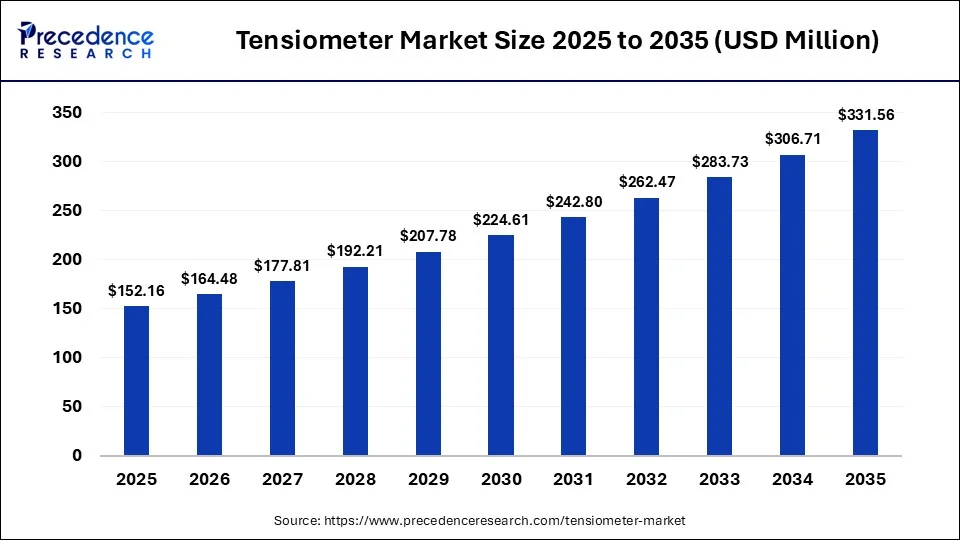
What is the Tensiometer Market Size in 2026?
The global tensiometer market was valued at USD 152.16 million in 2025 and is projected to grow from USD 164.48 million in 2026 to approximately USD 331.56 million by 2035, registering a CAGR of 8.10% during the forecast period from 2026 to 2035. Market growth is driven by improved measurement precision, real-time data acquisition, broad application versatility, and the advantages of non-destructive testing.
Key Takeaways
- A tensiometer is a device used to measure moisture tension or metric potential, helping to understand how water behaves within a substrate.
- Next-generation tensiometers integrate transducers, IoT sensors, and microcontrollers to enable real-time digital monitoring. They measure a wider range of tension values, support high-suction applications, and facilitate automated data collection and sub-irrigation control.
- In 2025, North America dominated the tensiometer market, due to favorable government support, growing research activities, and the rising adoption of advanced technology.
- Asia-Pacific is projected to be the fastest-growing region over the forecast period, driven by a vast agricultural landscape, increasing investments, and the presence of a suitable manufacturing infrastructure.
Next-Gen Advancements in Tensiometer Technology
While the foundation remains strong, tensiometers are steadily evolving with the integration of modern technologies into automated systems. Conventional gauges are increasingly being enhanced or replaced by transducers that convert suction into electrical signals, enabling seamless interaction with computers and electronic controllers.
Advancement continues with osmotic tensiometers, which have demonstrated strong capabilities in measuring high soil suctions. High capacity tensiometers are being proposed for more advanced applications, such as soil–water characteristic curve (SWCC) measurement.
The shift becomes even more pronounced with IoT-enabled tensiometers, where sensors like the BMP180 barometric pressure sensor are embedded within the system and connected to microcontrollers such as the ESP32. This integration allows precise, real-time digital monitoring, with prototypes already capable of detecting tension across a wide operating range from 0 to -80 kPa.
Complementing these innovations, the rise of 3D printing has made prototyping and automated data collection significantly more accessible. This progress has also enabled the successful automation of sub-irrigation systems based on substrate water content, reflecting a gradual yet definitive move toward smarter, data-driven moisture management.
The Origin of Tensiometry
A tensiometer is a device used to measure soil matric potential by assessing the water retention in soil through a water-filled porous cup and a vacuum gauge. Originating from Jacques Babinet's 1848 atmidoscope, the first notable advancement was in 1908 by Burton Edward Livingston, who implemented a similar device. The design and application of tensiometers were refined through various contributions: Lynde and Dupre (1913) investigated capillary lift, Pulling and Livingston (1915) quantified soil's water-supplying power, and Livingston & Hawkins clarified principles of water movement. Major developments continued with Livingston's improvements in 1918 and the comprehensive tensiometer design presented by Willard Gardner in 1922. Although later works often credit Gardner or Lyman A. Richards (1928) with its invention, historical evidence suggests Livingston's earlier contributions mark the true origin of the tensiometer.
Exploring the Different Types of Tensiometers
- Contact Angle Goniometer/Tensiometer: A powerful tool in surface science, this instrument measures the contact angle between a liquid droplet and a solid surface. This angle provides valuable insight into the material’s wettability and surface tension, making it a crucial parameter in both scientific and industrial applications.
- Wilhelmy Plate Tensiometer: This method is used to measure the surface tension (SFT) of a liquid, the interfacial tension (IFT) between two liquids, and the contact angle between a liquid and a solid. It operates by measuring the force acting on a vertically immersed plate.
- Du Nouy Ring Tensiometer: The Du Noüy ring method utilizes the interaction of a platinum ring with the surface of a liquid to measure both the surface tension of the liquid and the interfacial tension between two liquids.
- Du Nouy-Padday Method Tensiometer: This platinum rod technique measures surface tension at the air–liquid interface. First introduced by Padday and team in 1974, it uses a platinum rod as the force probe instead of the platinum ring typically used in the Du Noüy method.
- Bubble Pressure Tensiometer: An instrument designed to determine dynamic surface tension by measuring the maximum internal pressure of a gas bubble formed in a liquid as it passes through a capillary.
- Optical Tensiometer: It enables precise measurement of the contact angle of water or other liquids on a solid surface, helping to better characterize material surface properties such as wettability, adhesion, roughness, and printability, as well as supporting troubleshooting.
- Force Tensiometer: A new-generation tensiometer for liquid and solid surfaces, enabling precise characterization of material surface and interfacial properties for both quality control and R&D.
- Drop volume Tensiometer: Used for analyzing emulsions under dynamic conditions. It evaluates time-dependent processes from very fast to very slow with high precision and automation. The measurement results support the optimisation and formulation of emulsions and emulsifiers.
- Spinning Drop Tensiometer: It measures interfacial tension with a high degree of accuracy and is particularly effective across a wide range, including very low values.
Industrial Pioneering: The Concept of the Tensiometer
- Dyne Testing has introduced the Sigma 702 force tensiometer from Violin Scientific, a standalone instrument designed for accurate surface and interfacial tension measurements. It is equipped with a precision balance, a motorised sample stage, and an intuitive interface. The system ensures ease of operation while maintaining high performance across industries, including chemicals, coatings, food and beverages, pharmaceuticals, energy, and environmental applications.
- In the biomedical space, the narrative deepens with skin tensiometers developed to overcome historical technical limitations. These instruments are designed to be less user-dependent and more reliable across different body sites, supported by computational optimization that enhances the understanding of skin biomechanics and surgeons’ tension lines.
- Research efforts from UW-Madison and Harvard have further advanced the field with a wearable shear-wave tensiometer, a non-invasive device that enables direct assessment of tendon force by analyzing vibrational changes during movement.
- Droplet Lab has also introduced an educational instrument combining contact angle and surface tension measurements, while innovations such as freestanding lipid bilayer tensiometers continue to expand applications, making this technology increasingly impactful across scientific and industrial domains.
Harnessing Global Momentum
As industries such as healthcare, automotive, aerospace, and electronics continue to evolve, the demand for high performance materials is rising.
- North America continues to hold a leading position in the tensiometer market, driven by its strong research and development efforts consistently supported by government funding and favorable policies that encourage technological progress. At the same time, rising investments in the oil and gas sector are further reinforcing the region’s growth trajectory.
- In the United States, this momentum is clearly reflected in sustained demand from the pharmaceutical, medical device, and oil and gas industries, backed by substantial R&D spending and the widespread adoption of advanced laboratory instruments. The market here continues to move forward with steady confidence.
- This growth story is closely supported by key industry players. Companies like KRÜSS USA, a subsidiary of Germany’s KRÜSS GmbH, deliver high end force and optical tensiometers for industrial R&D and quality control. Alongside this, companies such as Environmental Sensors Inc., based in California, have long established their presence in soil moisture measurement since 1951 with industry standard instruments. Adding to this ecosystem, Checkline contributes as a major manufacturer and distributor of tensiometers for wire, cable, and textiles, collectively strengthening the region’s technological backbone.
- On the other hand, the Asia Pacific is rapidly emerging as the fastest growing region. This surge is being driven by an expanding chemical manufacturing base, growing electronics production, and a continuously developing academic research infrastructure.
- Here too, the momentum is shaped by a strong network of companies. Kyowa Interface Science Co., Ltd. in Japan, a pioneer in interfacial science since 1947, continues to lead with high precision instruments such as Wilhelmy plate and Du Noüy ring tensiometers and pendant drop tensiometers. Meanwhile, KINO Industry Co. Ltd. in China has established itself as a leading manufacturer specializing in automated surface tension and contact angle measurement instruments for industrial R&D. In India, Apex Instruments Co. Ltd. further strengthens the regional landscape by offering a wide range of force and optical tensiometers widely used in petroleum and chemical quality control.
With cost effective manufacturing and rising quality standards supporting wider adoption across AsiaPacific, and with North America and Europe steadily deepening their market presence, the global tensiometer market is set on a strong growth path. In a world where precision defines progress, the tensiometer market is not just growing, it is quietly becoming the force that measures the future.
Expert Advise
Our research suggests that the demand for tensiometers is rising exponentially, with their widespread use across multiple sectors. Tensiometers play a vital role in improving crop yields and ensuring quality control for paints/coatings and in pharmaceutical formulations. The selection of appropriate tensiometers is essential to obtain meaningful outcomes based on the type of conditions. Tensiometers must undergo regular maintenance tests to enable long-term reliability. The future of tensiometers is promising, driven by the integration of AI into tensiometers, facilitating digital monitoring and improved functionality.
About the Authors

Aditi Shivarkar
Aditi, Vice President at Precedence Research, brings over 15 years of expertise at the intersection of technology, innovation, and strategic market intelligence. A visionary leader, she excels in transforming complex data into actionable insights that empower businesses to thrive in dynamic markets. Her leadership combines analytical precision with forward-thinking strategy, driving measurable growth, competitive advantage, and lasting impact across industries.



Aman Singh
Aman Singh with over 13 years of progressive expertise at the intersection of technology, innovation, and strategic market intelligence, Aman Singh stands as a leading authority in global research and consulting. Renowned for his ability to decode complex technological transformations, he provides forward-looking insights that drive strategic decision-making. At Precedence Research, Aman leads a global team of analysts, fostering a culture of research excellence, analytical precision, and visionary thinking.

Piyush Pawar
Piyush Pawar brings over a decade of experience as Senior Manager, Sales & Business Growth, acting as the essential liaison between clients and our research authors. He translates sophisticated insights into practical strategies, ensuring client objectives are met with precision. Piyush’s expertise in market dynamics, relationship management, and strategic execution enables organizations to leverage intelligence effectively, achieving operational excellence, innovation, and sustained growth.