



Lab Analytical Instrumentation Market Size, Companies, Share, Patient Volume, Treatment Adoption Rates, Pricing Analysis, Regulatory Landscape, Competitive Positioning, and Demand Forecast
Lab Analytical Instrumentation Market (By Type: Element Analysis, Separation Analysis, Molecular Analysis; By End-User: Hospitals, Diagnostic Laboratories, Pharmaceutical, Biotechnology) - Global Industry Analysis, Size, Trends, Leading Companies, Regional Outlook, and Forecast 2026 to 2035
Source: https://www.precedenceresearch.com/lab-analytical-instrumentation-market
 Get a Sample
 Table Of Content


What is Lab Analytical Instrumentation Market Size in 2026?
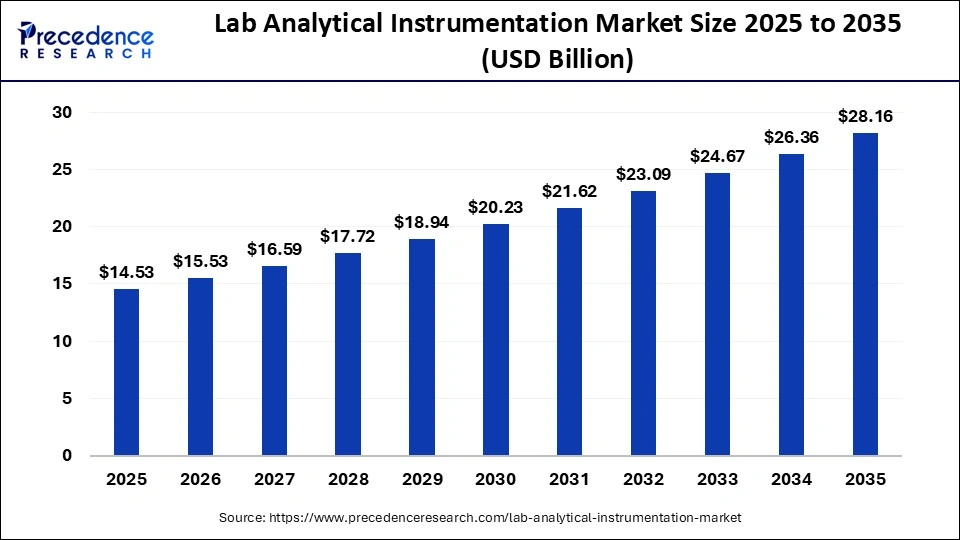
The global lab analytical instrumentation market size was calculated at USD 14.53 billion in 2025 and is predicted to increase from USD 15.53 billion in 2026 to approximately USD 28.16 billion by 2035, expanding at a CAGR of 6.84% from 2026 to 2035. The market is experiencing robust growth because of the growing demand for accurate high-throughput analysis in the healthcare, pharmaceutical, and environmental testing arenas. The development is promoted by technological innovations and the increase in universal attention to quality assurance and the observance of all rules and regulations.
Key Takeaways
- North America dominated the global lab analytical instrumentation market in 2025.
- Asia-Pacific is expected to grow at the fastest CAGR in the market during the forecast period.
- By type, the separation analysis segment held a dominant position in the market in 2025.
- By type, the molecular analysis segment is expected to grow at the fastest CAGR in the market between 2026 and 2035
- By end-user, the pharmaceutical segment led the global market in 2025. 
- By end-user, the diagnostic laboratories segment is expected to grow with the highest CAGR in the market during the studied years.
Lab Analytical Instruments: Precision Tools Powering Progress
The lab analytical instrumentation market is a branch that includes instruments to analyze, detect, and measure chemical and biological samples in laboratories. These tools aid in research, diagnostics, quality control, and product development in industries. Due to increased investments in life sciences and environmental monitoring, there is increased adoption. Also, modernization of healthcare systems, tough policies, and the need for quick data delivery are enhancing market expansion.
What are the government initiatives in the Lab Analytical Instrumentation Market?
- USA - FDA improved standards of laboratory quality and provided funds to adopt sophisticated analytical instrumentation in pharmaceutical and biotechnology laboratories.
- Germany developed laboratories of the Industry 4.0 era through investments in automation and the development of precision analytical instruments.
- China developed laboratory modernization projects under its Made in China 2025 initiative for improving domestic manufacturing of analytical instruments.
- India established PLI programs and research funding initiatives to develop scientific laboratory facilities and analytical instrument production facilities.
- Japan made investments in advanced healthcare diagnostics laboratories and semiconductor research laboratories where sophisticated analytical instrumentation system is required.
- South Korea invested in smart laboratory projects and biotechnology innovation centers utilizing advanced analytical testing instruments.
- The UK provided increased investments for public research laboratories in the area of life sciences and advanced analytical testing techniques.
- The UAE developed smart healthcare laboratories and research centers by establishing national innovation programs in advanced technology.
Trade Analysis on the Lab Analytical Instrumentation Market?
- Globally, there have been 22 lab equipment exportations from May 2024 to April 2025 as per Volza's Global Export Database.
- The international trade of lab equipment witnessed a fall of -39% compared to the previous year in the analyzed period.
- Amongst the countries in the world, the top importers of lab analytical instruments were the United States, Uganda, and Sri Lanka.
- The United States was the topmost exporter of lab analytical instruments with 5,277 shipments globally.
- China was the second-highest exporter with 400 lab equipment exportations.
- The United Kingdom was ranked third amongst the top exporters, recording 253 shipments of global lab equipment.
- Laboratory research and healthcare spending are fueling the growth of international trade in lab instruments.
- Laboratory analysis devices have a high demand owing to the rising pharmaceutical, biotech, and environmental testing industries.
- Volza database comprises trade data of 203 countries and above 3.5 billion shipments recorded in the database.
- Matchmaker, Global Partner Finder, and Profit Maximizer are some of the trade intelligence tools for locating buyers and profitable exports destinations.
What is the Role of AI in the Lab Analytical Instrumentation Industry?
Artificial intelligence is changing the tools of analysis, as it allows automatic interpretation of the data and recognition of patterns. AI-based systems are more precise, minimize human error, and decrease the time spent making decisions in sophisticated analyses. Predictive maintenance and workflow optimization are improved by machine learning (ML) algorithms. AI and ML algorithms can assist researchers in analyzing complex data. They also enable simultaneous estimation of multiple samples. Altogether, the development of AI is transforming the functioning of instruments and efficiency in laboratories.
Lab Analytical Instrumentation Market Trends
- AI and ML Implementation: Processing of large data volumes, improvement of signal interpretation, and automated reporting are increasingly a part of analytical systems that use AI/ML.
- Miniaturization and Smallness: Small, mobile devices make it possible to test on the spot and in the field, facilitating the speed of decision-making. Miniaturized instruments eliminate the need for sending samples to a central laboratory, saving time and costs.
- Cloud and IoT Connectivity: Remote monitoring, centralized access to data, and real-time collaboration are made possible with the help of cloud platforms and IoT-related connected gadgets.
- Robotics in Process: Sample handling, throughput, and manual error are all being automated through robots, which are facilitating the easing of work.
Market Scope
| Report Coverage | Details |
| Market Size in 2025 | USD 14.53 Billion |
| Market Size in 2026 | USD 15.53 Billion |
| Market Size by 2035 | USD 28.16 Billion |
| Market Growth Rate from 2026 to 2035 | CAGR of 6.84% |
| Dominating Region | North America |
| Fastest Growing Region | Asia Pacific |
| Base Year | 2025 |
| Forecast Period | 2026 to 2035 |
| Segments Covered | Type, End-User, and region |
| Regions Covered | North America, Europe, Asia-Pacific, Latin America, and Middle East & Africa |
Market Dynamics
Driver
Rising Demand for Sustainable and Energy-Efficient AI Infrastructure
The rapid digital transformation across industries has intensified the need for green computing systems to address the significant energy consumption associated with complex AI models. As businesses align their technology investments with Environmental, Social, and Governance (ESG) objectives, there is a growing demand for energy-efficient infrastructure and qualified green data centers to support low-carbon operations.
Restraint
High Initial Capital Investment and Deployment Costs
The adoption of sustainable AI faces challenges due to substantial upfront expenditures, particularly for advanced hardware like next-generation GPUs and Tensor Processing Units. Small and medium-sized enterprises often struggle with these high costs and the expensive, complex engineering modifications needed to implement infrastructure upgrades, such as direct-to-chip liquid cooling.
Opportunity
Expansion of Green Financing and Long-Term Cost Efficiency
The market is poised for growth, supported by emerging green financing initiatives, including government subsidies, tax incentives, and programs from international organizations that encourage renewable-powered infrastructure. These financial frameworks, combined with the long-term operational savings of energy-efficient technologies, create significant opportunities for adoption.
Segmental Insights
Type Insights
Which Type Segment Dominated the Lab Analytical Instrumentation Market?
The separation analysis segment held the largest revenue share of the market in 2025 because of its heavy use in pharmaceutical, environmental testing, food safety, and materials science. Techniques that are commonly used to detect trace metals include atomic absorption spectroscopy (AAS), inductively coupled plasma (ICP), and X-ray fluorescence (XRF). Constant demand is promoted by regulatory proceedings on quality control and safety testing. Elemental analysis is used in industries to make them compliant with international standards. Sensitivity and automation are continuously enhanced, further enhancing the segment's dominance.
The molecular analysis segment is expected to be the fastest-growing segment in the forecast period, due to the development of genomics, proteomics, and biomarker studies. PCR, mass spectrometry, and next-generation sequencing (NGS) are the technologies that are driving the growth. High-throughput molecular testing platforms are in more demand by research institutions and clinical laboratories. Molecular testing enables accurate and actionable results that can enhance the quality of patient care and shape the future of healthcare practices.
End-User Insights
Which End-User Segment Dominated the Lab Analytical Instrumentation Market?
The pharmaceutical segment accounted for the highest market share in 2025, driven by drug discovery, formulation development, and quality assurance, which cannot be completed without analytical instruments. Companies need precision tools in impurity profiling and stability testing. Developing biologics and biosimilars production lines drives up the need for sophisticated analytical platforms. Regulatory compliance requirements will make sure that the instrumentation will be sustained in investment. The increasing competition among pharmaceutical companies promotes the demand for advanced lab instruments, strengthening their market position.
The diagnostic laboratories segment is expected to show the fastest growth over the forecast period, supported by the increase in disease incidence and the need for sophisticated testing services. There is an augmenting instrumentation requirement as more cases are embraced in molecular diagnostics and point-of-care testing. Clinical labs become more efficient and faster through automation. Government programs that encourage early detection of diseases augment the segment's growth. Private labs expand their networks across diverse geographical locations, fostering the segment's growth.
Regional Insights
Why North America Dominated the Lab Analytical Instrumentation Market?
North America held a major revenue share of the market in 2025, because of the presence of a robust healthcare infrastructure and high expenditure on R&D. Large numbers of pharmaceutical and biotechnology industries enhance the need to have high-tech instruments. Strong regulatory mechanisms facilitate the sustained investment in quality testing equipment.
Academic research institutions also play a great role in technology adoption. Technological innovation trends and early adoption strengthen regional dominance. North American countries are at the forefront of healthcare innovations through extensive research and widespread availability of advanced analytical instruments.
Country-Level Analysis
The U.S. leads the region because of the intensive drug development process and well-developed clinical research systems. Major biotech centers enhance the need for high-end systems of molecular and elemental analysis. Canada can help in terms of the expansion of research activities and healthcare modernization programs.
Both nations focus on regulatory compliance and accreditation standards of laboratories. Investments in the precision medicine program potentiate the demand for instrumentation. The highly developed market structure in North America helps in maintaining its leadership.
Why is Asia-Pacific Growing in the Lab Analytical Instrumentation Market?
Asia-Pacific is expected to witness the fastest growth during the predicted timeframe, due to the growth in pharmaceutical production and the development of healthcare infrastructures. Market expansion is helped by greater government investment in research laboratories. The increasing speed of industrialization increases the need for environmental and food safety testing equipment. Increasing clinical research processes improves the uptake of molecular analysis technologies. The increased sensitivity to quality standards also contributes to market growth.
Country-Level Analysis
The growth of China in the Asia-Pacific is rapid because the country has a solid foundation of pharmaceutical manufacturing and rising investments in research and development. The instrumentation demand is driven by the emerging generic drug industry in India and the presence of contract research organizations. Japan continues to be one of the pioneering countries in cutting-edge analytical systems.
South Korea and the Southeast Asian nations are developing diagnostic laboratory networks. Government policies favoring biotech innovation are a major contribution. Asia-Pacific has a vibrant healthcare ecosystem that drives unrelenting growth.
Will Europe Grow in the Lab Analytical Instrumentation Market?
Europe is expected to grow at a considerable CAGR in the upcoming period, with the aid of high regulations and well-developed pharmaceutical sectors. The area focuses on indirect measurement and monitoring of quality and the environment. The demand for innovative analytical systems is enhanced by growing research funds. The growth of biotechnology start-ups leads to innovation. Implementation of automation in the laboratories increases efficiency. Modern instrumentation upgrades are also motivated by sustainability initiatives.
Country-Level Analysis
France made a significant contribution to the performance of the regional market. It has a high industrial and pharmaceutical base that leads to the demand for elemental analysis systems. The UK pays much attention to life sciences research and molecular diagnostics research.
Germany is a country that invests in modernization programs in its public health laboratories. Nordic nations are developing testing capacities regarding the environment. The cooperative research environment in Europe contributes to the stable growth of the market.
Laurels Forged in Meticulousness: In 2025, the noble prize chemistry celebrated the pioneering brilliance of Prof. Omar Yaghi, whose laboratory redefined the frontiers of material science. Amid this intellectual efflorescence, NETZCH instruments served as steadfast sentinels of exactness, enabling the extraction of thermal and structural characterization that quietly undergirded the discovery of the highest scientific eminence.
How will Latin America grow in the Lab Analytical Instrumentation Market?
Latin America is expected to grow at a considerable CAGR in the upcoming period, primarily due to swift industrialization, increased investment in healthcare infrastructure, and stringent regulatory standards for quality control, particularly in Brazil and Argentina. The rising investments in drug discovery, biologics, vaccines, and personalized medicine require advanced analytical instruments for molecular characterization and stability testing. There is a heightened focus on clinical diagnostics and laboratory automation, especially in Brazil and Colombia, to meet increasing healthcare demands and reduce manual errors.
Brazil Market Trends
Brazil is solidifying its position as a leader in laboratory automation and clinical diagnostics within the region, prompted by a fast-paced modernization of healthcare to address the needs of an aging population. Major initiatives, such as the implementation of Inpeco FlexLab at Hermes Pardini and accelerated ANVISA regulatory pathways for devices, are moving towards advanced molecular diagnostics to enhance self-reliance.
How will the Middle East and Africa Emerge in the Lab Analytical Instrumentation Market?
The Middle East and Africa are emerging as significant growth areas in the global market. This growth is attributed to a rapid shift away from oil dependence, substantial investments in healthcare infrastructure, and the expansion of local pharmaceutical and biotechnology sectors. Countries in the Gulf Cooperation Council, particularly Saudi Arabia and the UAE, are making large investments in non-oil sectors under initiatives like Saudi Vision 2030. There is a strong regional emphasis on enhancing local drug manufacturing, with countries such as Egypt, South Africa, and Saudi Arabia aiming to reduce reliance on imports.
UAE Market Trends
The UAE is evolving into a premier hub for advanced diagnostics and positioning itself as a global powerhouse for medical tourism. This transformation is fueled by substantial government investment and the swift adoption of AI-driven laboratories, robotic systems, and precision genomics. With advanced analytical instrumentation, the country is rapidly upgrading its healthcare infrastructure to be more intelligent and automated, promoting data-driven patient care.
Value Chain Analysis – Lab Analytical Instrumentation Market
- R&D: This stage involves the development of sensor innovation, AI integration, and precision analytics in analytical instrumentation.
Key Players: Thermo Fisher Scientific, Agilent Technologies, Shimadzu Corporation. - Clinical Trials and Regulatory Approvals: Instrument safety and performance are verified through clinical trials and subsequently approved by regulatory authorities.
Key Players: Roche Diagnostics, PerkinElmer, and Abbott Laboratories. - Packaging and Sterilization: Sterile packaging solutions are essential as they guarantee the protection and sterility of the instrument.
Key Players: Sartorius, Steris, and Millipore Sigma. - Distribution to Hospitals and Pharmacies: The equipment is shipped to labs through distributors and wholesalers to health care systems.
Key Players: GE Healthcare, Siemens Healthiness, and Cardinal Health.
Top Companies Financial Report
EBITDA: Revenue-operating Expenses
| Company | Latest Revenue | EBITDA |
| Thermo Fisher Scientific | $42,879M | Est$14,000M |
| Agilent technologies | $6,948M | $1,710M |
| Danaher corporation | $23,900M | $7,840M |
| Bruker Corporation | $3,366M | $253M |
Above Diagram Explanation
The EBITDA comparison of top companies in laboratory analytical instruments shows that there is high profitability among major international players. The strongest earnings scale is shown by Thermo Fisher Scientific and Danaher Corporation, which are diversified in terms of their portfolio and global presence in the operational field. Bruker Corporation and Agilent Technologies have stable mid-range EBITDA owing to the stable demand in life sciences and applied markets. Carl Zeiss Meditech presents stable profits propelled by accuracy technologies and imaging solutions of high caliber. Recent years have shown restructuring and optimization of the portfolio, which are reflected in the reported EBITDA of PerkinElmer. Molecular Devices has not published stand-alone EBITDA by itself since it is part of Danaher, with its financial performance being amalgamated in the segment outcome of Danaher.
Top Companies and their offerings
- Thermo Fisher Scientific - Offers analytical instrumentation, laboratory products, chromatography, and life sciences solutions for both research and industrial uses.
- Agilent Technologies - Provides services relating to chromatography, spectroscopy, diagnostics, and software for laboratories working in pharmaceuticals, environment, and food industries.
- PerkinElmer - Offers analytical instruments, imaging solutions, and diagnostic tools for use in healthcare, environmental, and industrial laboratories.
- Danaher Corporation - Provides precision instruments, biotechnology, diagnostics, and water quality solutions through various scientific divisions.
- Bruker Corporation - Offers mass spectrometry, nuclear magnetic resonance, X-ray, and molecular solutions for research and industrial testing laboratories.
Top Companies in the Lab Analytical Instrumentation Market
- Thermo Fisher Scientific
- Agilent Technologies
- PerkinElmer
- Danaher Corporation
- Bruker Corporation
- JEOL
- Zeiss
- Molecular Devices
- Waters
- Becton, Dickinson and Company
- Cytiva
- Sartorius
- VWR International
- Thermo Scientific
- Agilent Technologies
- PerkinElmer
- Danaher Corporation
- Bruker Corporation
- JEOL
- Zeiss
Recent Developments
- In February 2026, Monash Innovation Labs announced a collaboration with Agilent Technologies Australia to adopt advanced analytical instrumentation within Monash University's innovation ecosystem. The collaboration aims to strengthen applied research capabilities and expand collaborative opportunities across industry and academia. (Source: https://www.monash.edu)
- In August 2025, Astrotech Corporation launched its EN-SCAN series of ultra-portable and ruggedized environmental testing devices, which incorporates mass spectrometry and rugged gas chromatography to enable immediate on-site analysis of the soil, air, and water. EN-SCAN aims to enhance decision-making processes in critical environmental scenarios, providing users access to a vast library of chemical signatures for rapid analysis.
- In May 2025, Innovative Lab Services LLC announced the acquisition of Compco Analytical, Inc., a well-established provider of analytical instrument maintenance and repair services based in New Jersey. The acquisition strengthens ILS's position as a national leader in comprehensive lab instrumentation services. (Source: https://www.businesswire.com)
Segments Covered in the Report
By Type
- Element Analysis
- Separation Analysis
Molecular Analysis
By End-User
- Hospitals
- Diagnostic Laboratories
- Pharmaceutical
- Biotechnology
By Region
- North America
- Europe
- Asia-Pacific
- Latin America
- Middle East & Africa
For inquiries regarding discounts, bulk purchases, or customization requests, please contact us at sales@precedenceresearch.com
Frequently Asked Questions





Ask For Sample
No cookie-cutter, only authentic analysis – take the 1st step to become a Precedence Research client
 Get a Sample
.webp)



 sales@precedenceresearch.com
 Schedule a Meeting
