



Laser Cladding Market Trends, Companies, Revenue / Sales Performance, Manufacturing Yield, Fab Capacity, Export & Import Dynamics, Supply Chain Analysis, Competitive Landscape, and Growth Forecast
Laser Cladding Market (By Type: Diode Laser, Fiber Laser, YAG Laser, CO2 Laser; By Revenue: Laser Revenue, System Revenue; By Material: Cobalt-Based, Nickel-Based, Iron-Based Alloys) - Global Industry Analysis, Size, Trends, Leading Companies, Regional Outlook, and Forecast 2026 to 2035
Source: https://www.precedenceresearch.com/laser-cladding-market
 Get a Sample
 Table Of Content


What is the Laser Cladding Market Size in 2026?
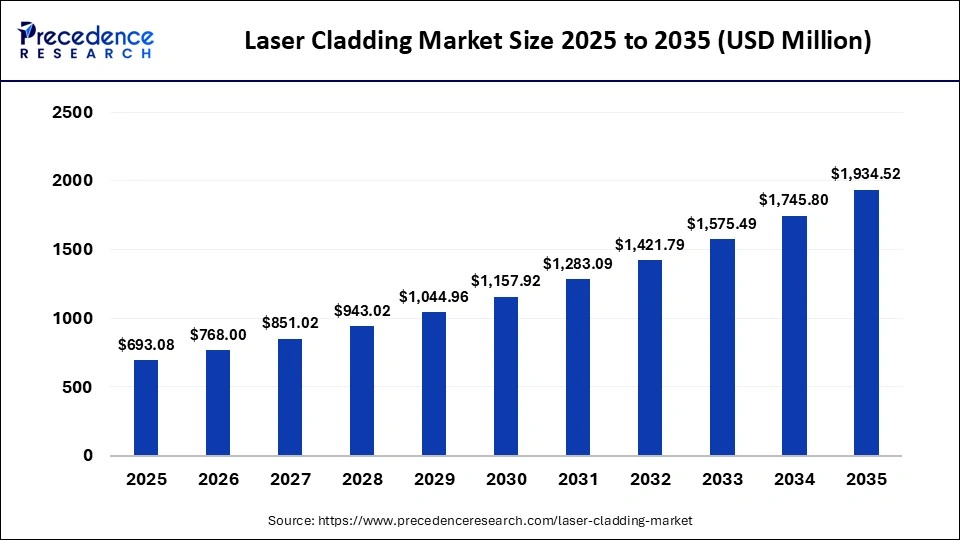
The global laser cladding market size accounted for USD 693.08 million in 2025 and is predicted to increase from USD 768.00 million in 2026 to approximately USD 1,934.52 million by 2035, expanding at a CAGR of 10.81% from 2026 to 2035. The market is experiencing robust growth, driven by its increased use in aerospace, automotive, and heavy machinery domains. It enhances surface properties and fortifies vital components, prompting manufacturers to pursue cost-effective, better-performing options.
Key Takeaways
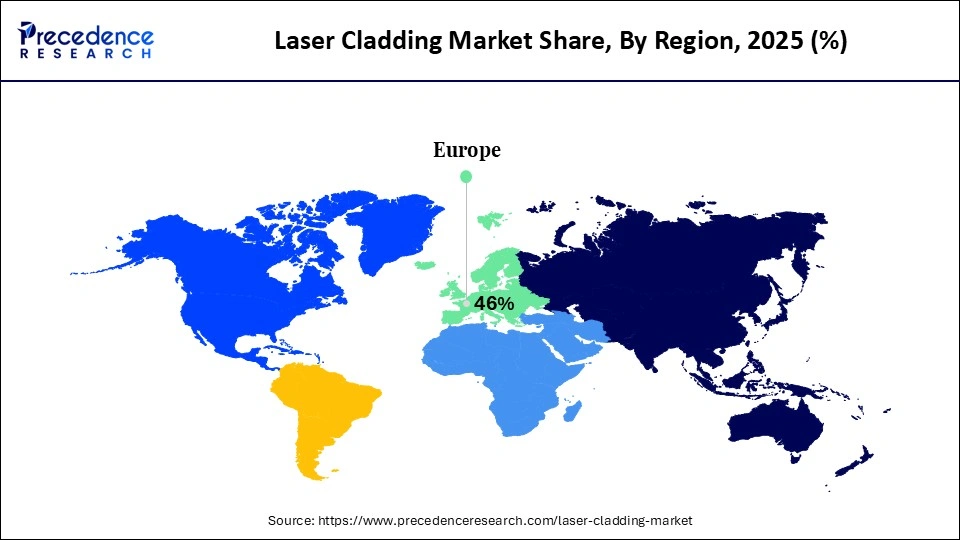
- Europe dominated the global market, holding more than 46% of market share in 2025.
- Asia-Pacific is expected to grow at the fastest CAGR in the market during the forecast period.
- By type, the fiber laser segment accounted for a considerable revenue share in the market in 2025.
- By type, the diode laser segment is expected to grow at the fastest CAGR in the market between 2026 and 2035.
- By revenue, the laser revenue segment accounted for the highest revenue share in the market in 2025.
- By revenue, the system revenue segment is expected to expand rapidly in the market in the coming years.
- By material, the cobalt-based segment accounted for a considerable revenue share in the market in 2025.
- By material, the nickel-based material segment is expected to grow at the fastest CAGR in the market between 2026 and 2035.
What is the Laser Cladding Market?
The laser cladding industry involves new processes that apply a focused laser beam to the surfaces of components, which results in a solid metallic coating on the surface that binds the metal structure into a metallurgical bond to provide an even greater resistance to wear, corrosion, and overall structural integrity. Laser cladding positions material with remarkable precision and reduces thermal distortion, unlike conventional coatings.
In other industries such as aerospace, oil & gas, mining, and power generation, where repair is an excellent time-saving option rather than replacement, this is taking its place as a viable solution. As production trends continue to shift towards efficiency and sustainability objectives, laser cladding is a major element in improving product lifespan, diminishing material wastage, and integrating advanced additive manufacturing processes in modern industry.
Impact of AI in the Laser Cladding Market
The use of artificial intelligence (AI) is beginning to revolutionize the laser cladding industry, as this industry has relied on operators to produce parts in a very human-centric manner. AI-based measurement systems are able to see melt-pool interactions, powder flow rates, and temperature fluctuations in real time. This information allows machines to automatically modify laser intensity or speed of deposition on demand. As a result, this advancement would result in superior reliability and lower defects in the coated parts.
In addition, using AI-driven monitoring of laser processing equipment facilitates the identification of anomalies during metal deposition processes. These developments are, in their own right, allowing the efficiency, predictability, and scalability of laser cladding to become considerably more efficient and predictable, particularly in areas where precision and reliability are critical.
Trends Influencing the Laser Cladding Market
- Convergence with Additive Manufacturing: Laser cladding is gradually becoming part of additive manufacturing processes. It went from a mere repair process to allowing layering and configuration of components. This evolution expands manufacturers' control over high-dimensional curvature design, while enhancing surface properties, such as corrosion and wear resistance.
- Increased Use of Automation and Automation-based Robotic Operations: Production of laser cladding is being influenced by industrial robots and automation of deposition systems. These computer-based solutions offer improved accuracy with homogeneous coating thickness and high-duty safety in the environment of industry under high-constraint manufacturing environments. With industries gradually moving to digital manufacturing, robotic cladding technologies play an essential role in modern production lines.
- Integration of AI and IoT: Laser cladding equipment is increasingly equipped with sensors, AI analytics, and connectivity to the Internet of Things (IoT). Real-time monitoring of temperature, melt pool flow, and rates of material deposition are intelligently implemented, with automatic adjustment of the machine's operating system to prevent defects during the process, resulting in improved coating quality and an increase in production efficiency.
- Advanced Alloys and Powder Materials Development: Advances in materials technology are greatly expanding the possibilities of laser-cladding applications. Novel powder structures, such as those in metal-ceramic composites and high-entropy alloys, are also in development for their high hardness and excellent corrosion and thermal resistance. These advanced materials guarantee the reliability of the laser cladding under demanding operating conditions.
Market Scope
| Report Coverage | Details |
| Market Size in 2025 | USD 693.08 Million |
| Market Size in 2026 | USD 768.00 Million |
| Market Size by 2035 | USD 1,934.52 Million |
| Market Growth Rate from 2026 to 2035 | CAGR of 10.81% |
| Dominating Region | Europe |
| Fastest Growing Region | Asia Pacific |
| Base Year | 2025 |
| Forecast Period | 2026 to 2035 |
| Segments Covered | Type, Revenue, Material, and Region |
| Regions Covered | North America, Europe, Asia-Pacific, Latin America, and Middle East & Africa |
Segmental Insights
Type Insights
Why Did the Fiber Laser Segment Dominate the Laser Cladding Market?
The fiber laser segment held a dominant position in the market in 2025, largely owing to a growing preference for better beam quality, more energy-efficient materials, and uniform performance in deposition. With its use all over fields including aerospace, automobiles, and heavy machinery, fiber laser applications range from accurate coating applications on surfaces to instrument repair. The technology achieved its unique role in the development of advanced manufacturing systems that are concerned with the reliability and longevity of components through reliable metallurgical bonding and minimized thermal distortion.
The diode laser segment is expected to show the fastest growth over the forecast period, due to its small size, economic value, and improved energy conversion efficiency. In such a scenario, industrial operators are getting to grips with the fact that they are appropriate for large-area cladding and high deposition processes. The diode laser is now expected to be adopted far beyond the mining sector as manufacturing facilities look for scalable and versatile laser processing solutions (e.g., mining, oil & gas equipment maintenance, and heavy engineering).
Revenue Insights
What made the Laser Revenue Segment Dominate the Laser Cladding Market?
The laser revenue segment held the largest revenue share in the market in 2025, due to massive investments made by enterprises in high-performance laser sources to perform exact metal deposition. Industrial manufacturers aimed for advanced laser tools offering stable power output and efficient thermal control. Increased use of fiber laser technologies and automated cladding systems led to substantial revenue growth in this sector in sectors such as aerospace, defense, and energy equipment manufacturing.
The system revenue segment is expected to gain the highest market share between 2026 and 2035, due to the growing need for integrated laser cladding platforms that incorporate lasers, robotics, sensors, and digital monitoring capabilities. Manufacturers are moving towards joined-up solutions that streamline installation processes and enhance operational performance. In terms of smart manufacturing environment adoption, this is expected to accelerate, and fully integrated cladding systems will help in more automation, predictive maintenance, and advanced surface engineering tasks.
Material Insights
Which Material Segment Led the Laser Cladding Market?
The cobalt-based segment led the market in 2025, due to its excellent thermal, corrosion, and wear resistance at high temperatures and under specific conditions. These alloys contributed significantly to turbine components, aerospace parts, and equipment for the oil and gas industries that required performance at extreme temperatures. Cobalt-based powders were chosen due to their metallurgical durability and their robust hardness, which was beneficial in industrial cladding applications that required longevity performance by the material used.
The nickel-based material segment is expected to witness the fastest growth in the market over the forecast period, as industries drive towards coatings that offer the combination of corrosion resistance and mechanical strength. These metals particularly have applications for power generation, chemical processing, and marine equipment. As advanced alloy formulations in combination with affordable powder production approaches are being explored by manufacturers, it is anticipated that nickel-based cladding materials will gain significant ground in modern industrial surface engineering applications.
Regional Insights
Europe Laser Cladding Market Size and Growth 2026 to 2035
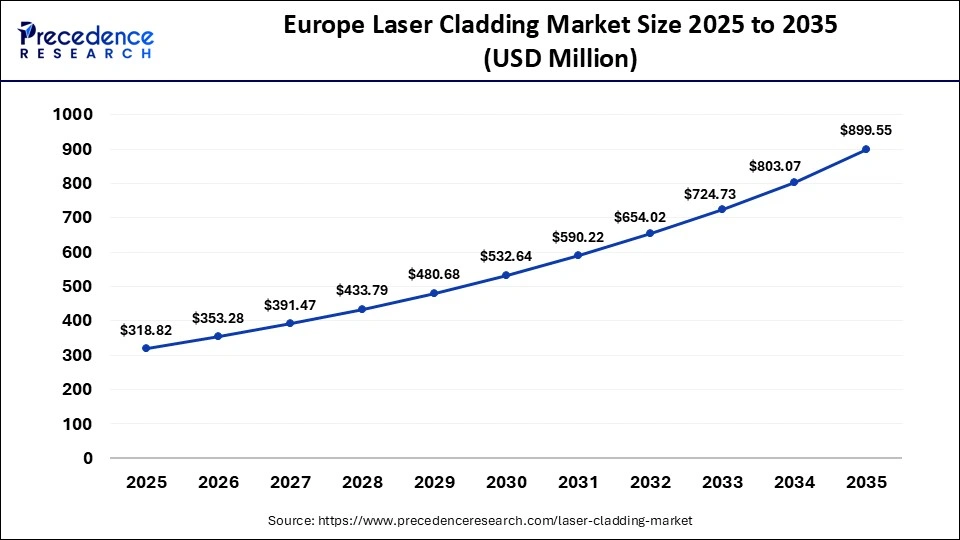
The Europe laser cladding market size has grown strongly in recent years. It will grow from USD 318.82 million in 2025 to USD 899.55 million in 2035, expanding at a compound annual growth rate (CAGR) of 10.93% between 2026 and 2035.
Why Europe Dominated the Laser Cladding Market?
Europe held a major revenue share in the market in 2025, as it was also underpinned by a very strong set of industrial production systems, early adoption with cutting-edge surface engineering technologies, and technological progress. To keep parts longer while not incurring maintenance costs, the aerospace, automotive, and heavy machinery industries in this part of the world primarily rely on laser cladding.
Ongoing investments in automation and precision manufacturing have also accelerated market expansion. Furthermore, leading firms working in the fields of laser technology and research have made metal deposited forms more advanced in Europe, and so help keep it ahead as an emerging leader in the global laser cladding industry.
Germany Market Trends
Germany is the dominant country in the European market because of its established machine tool sector and precision manufacturing expertise. The high level of automotive engineering, aerospace, and industrial machinery industry participation in the country means there is an ongoing need for advanced surface coating applications. Laser cladding techniques from German manufacturers have been employed by many German manufacturers to improve the repair of high-value components and extend the product's life.
Moreover, because many of the largest companies focusing on laser technology are located in Germany and scientific research institutions are well-established there, the need for continuous innovation is strongly encouraged to ensure Germany's strategic positioning within this regional area.
Why is Asia-Pacific Experiencing the Fastest Growth in the Laser Cladding Market?
Asia-Pacific is expected to experience the fastest growth during the predicted timeframe, as the world continues to industrialize, and we move a little closer to manufacturing revolution trends. States are adopting state-of-the-art manufacturing technologies for the purpose of improving equipment performance and extending the life span of components. Rapid development in certain industries, including aerospace production, automotive assembly, and heavy engineering, is stimulating the demand for surface engineering services.
China Market Trends
The Chinese market is growing rapidly in the Asia-Pacific. Rapid industrialization, increasing manufacturing capacity, and growth in investment in high-end equipment fabrication are driving the widespread implementation of high-end surface engineering techniques. Chinese industries are increasingly utilizing laser cladding for refurbishing components of heavy machinery and increasing their productivity. Moreover, strong government backing for high-tech manufacturing initiatives and innovation might lead to a breakthrough in the development of laser cladding systems for use in various industries, including automotive, aerospace, and energy.
Laser Cladding Market Value Chain Analysis
- Raw Material Sourcing
The raw material is obtained by sourcing metal powders and alloy substances like nickel, cobalt, stainless steel, and carbide alloys. These materials play a crucial role in determining the quality and life of the coating.
Key Players: Hoganas AB, Oerlikon Metco, etc.
- Testing and Certification
Metallurgical bonding, coating thickness, and durability are evaluated during testing on laser cladding. In aerospace or energy systems applications, these assessments are necessary.
Key Players: TUV Rheinland, ASTM International, etc.
- Product Lifecycle Management
This includes using digital monitoring platforms that can help to predict the performance and how long laser-clad components will last over a period of time.
Key Players: Siemens AG, Aras Corporation, etc.
Laser Cladding Market Companies
- IPG Photonics Corporation
- TRUMPF
- OC Oerlikon Management AG
- Höganäs AB
- Coherent Corp
- Jenoptik
- Hayden Corp
- Titanova, Inc.
- Swanson Industries
- American Cladding Technologies, Inc.
- Alabama Laser
- Kondex Corporation
- Hornet Laser Cladding
- TopClad BV
- Laserline GmbH
Recent Developments
- In October 2025, Hornet Laser Cladding BV launched the Hive laser cladding system, which is space-efficient and easy to install. As demand to use fast and safe laser deposition has grown in modern manufacturing spaces, this enclosed compact platform has been specially designed for high-resolution industrial surface material application.(Source: https://www.hornetlasercladding.com)
- In July 2025, TRUMPF SE + Co. KG from Germany announced plans to sell its metal additive manufacturing unit to the Lenbach Equity Opportunities III fund. That's a substantial realignment of its business because the company is now focusing on solidifying best practices in industrial laser technologies, which aid various activities, such as laser metal deposition and cladding.(Source: https://www.metal-am.com)
Segments Covered in the Report
By Type
- Diode Laser
- Fiber Laser
- YAG Laser
- CO2 Laser
By Revenue
- Laser Revenue
- System Revenue
By Material
- Cobalt-Based
- Nickel-Based
- Iron-Based Alloys
By Region
- North America
- Latin America
- Europe
- Asia-pacific
- Middle and East Africa
For inquiries regarding discounts, bulk purchases, or customization requests, please contact us at sales@precedenceresearch.com
Frequently Asked Questions
Tags





Ask For Sample
No cookie-cutter, only authentic analysis – take the 1st step to become a Precedence Research client
 Get a Sample




 sales@precedenceresearch.com
 Schedule a Meeting
