



Lateral Flow Assay Components Market Size, Companies, Share, Patient Volume, Treatment Adoption Rates, Pricing Analysis, Regulatory Landscape, Competitive Positioning, and Demand Forecast
Lateral Flow Assay Components Market (By Product Type: Test Strips, Cassettes, Microfluidic Devices; By Application: Clinical Testing, Veterinary Diagnostics, Food Safety Testing, Environmental Testing; By End-User: Hospitals & Clinics, Diagnostic Laboratories, Research Institutions, Pharmaceutical Companies) - Global Industry Analysis, Size, Trends, Leading Companies, Regional Outlook, and Forecast 2026 to 2035
Source: https://www.precedenceresearch.com/lateral-flow-assay-components-market
 Get a Sample
 Table Of Content


What is Lateral Flow Assay Components Market Size in 2026?
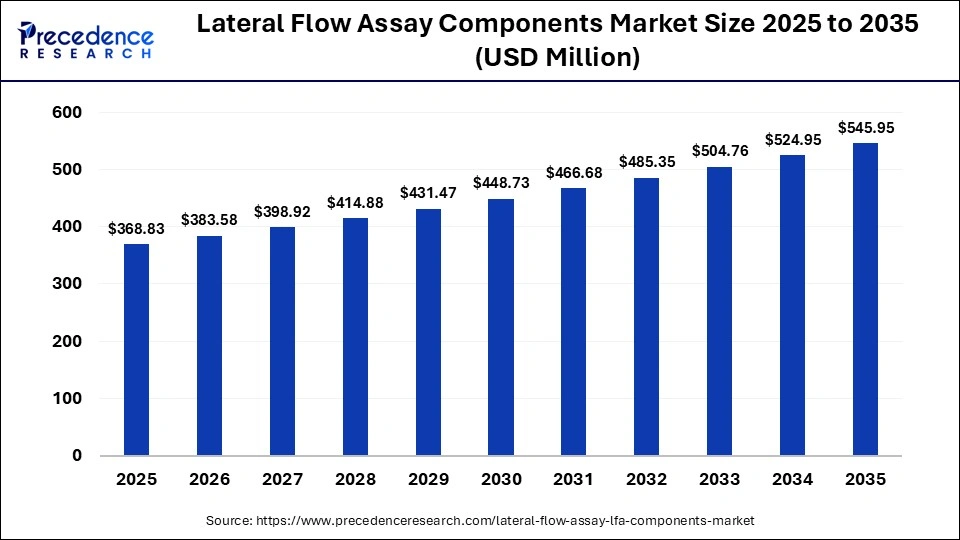
The global lateral flow assay components market size was calculated at USD 368.83 million in 2025 and is predicted to increase from USD 383.58 million in 2026 to approximately USD 545.95 million by 2035, expanding at a CAGR of 4.00% from 2026 to 2035. This market is growing due to the surging need for rapid, point-of-care diagnostic testing, mainly in home-based settings.
Key Takeaways
- North America dominated the global lateral flow assay components market in 2025.
- Asia-Pacific is expected to grow at the fastest CAGR between 2026 and 2035.
- By product type, the test strips segment dominated the global market in 2025.
- By product type, the cassettes segment is expected to expand at the fastest CAGR between 2026 and 2035.
- By application, the clinical testing segment held the largest market share in 2025.
- By application, the veterinary diagnostics segment is expected to expand at the fastest CAGR between 2026 and 2035.
- By end-user, the hospitals and clinics segment contributed the biggest market share in 2025.
- By end-user, the pharmaceutical companies segment is expected to expand at the fastest CAGR between 2026 and 2035.
What Drives the Lateral Flow Assay Components Market?
The market is mainly driven by the surging need for rapid, point-of-care diagnostics, the rising prevalence of infectious diseases like HIV, malaria, and COVID-19, and the expanding geriatric population. Continuous enhancements in nitrocellulose membranes, antibodies, and conjugation techniques have improved test accuracy and reduced turnaround times.
Lateral flow assays (LFAs) are used in low-cost, simple, rapid, and portable diagnostic devices that have widespread applications in biomedicine, agriculture, food, and environmental sciences. They are paper-based platforms used for the detection and quantification of analytes in complex mixtures. An LFA comprises the following components: sample pad, conjugate release pad, membrane with immobilized antibodies, and adsorbent pad.
How is AI Influencing the Lateral Flow Assay Components Market?
Artificial Intelligence is changing the lateral flow assay components industry by allowing smartphone-based, high-accuracy, and even rapid result interpretation, increasing the need for digital readers and advanced materials. AI algorithms can determine patterns and anomalies, significantly enhancing the sensitivity and specificity of assays compared to visual inspection, allowing earlier and more accurate disease detection. AI assists in designing advanced, sensitive materials, such as specific nanoparticle morphologies, like gold nanostars, plates, and biodegradable materials such as cellulose nanofiber membranes.
What are the Key Trends Influencing the Lateral Flow Assay Components Market?
- Rise in Point-of-Care and Home Testing: A major shift toward self-testing, boosted by convenience and the need for rapid results outside traditional laboratories, is driving demand for user-friendly components.
- Innovations in Detection Materials: There is a move away from standard gold nanoparticles toward advanced labels such as Upconversion Nanoparticles (UCNPs) to improve sensitivity and, thus, according to research on UCNP constraints, and CRISPR-based systems to improve specificity.
- Technological Advancements in Components: The integration of digital readers, app connectivity, and AI for data interpretation is enhancing the accuracy and science-driven analysis of lateral flow assay trends, notes, and even the reliability of lateral flow assay results.
- Diversification of Sample Types: To improve user experience, manufacturers are developing components suitable for saliva along with urine samples rather than solely relying on blood-based tests.
Future Market Outlook
- Expansion in Emerging Markets – It is mainly in the Asia-Pacific, Latin America, and parts of Africa where the market is anticipated to experience increased need, manufacturing opportunities, and, thus, ultimately, sustained revenue expansion. Increased health budgets, for example, in India and China, and government-backed infectious disease screening programs, like HIV, malaria, and tuberculosis, boost the large-scale production of test kits. Favorable labor costs along with specialized manufacturing ecosystems in the Asia-Pacific region are boosting the need for lateral flow assay components from local suppliers, decreasing costs and increasing scalability.
- Infrastructure Development – By improving manufacturing capacities, enhancing distribution logistics, end-users increasingly adopt point-of-care testing, mainly in emerging economies. As healthcare infrastructure grows, so does the need for specialized, high-performance components, pads, membranes, and reagents needed to produce accurate, rapid diagnostic kits.
Market Scope
| Report Coverage | Details |
| Market Size in 2025 | USD 368.83 Million |
| Market Size in 2026 | USD 383.58 Million |
| Market Size by 2035 | USD 545.95 Million |
| Market Growth Rate from 2026 to 2035 | CAGR of 4.00% |
| Dominating Region | North America |
| Fastest Growing Region | Asia Pacific |
| Base Year | 2025 |
| Forecast Period | 2026 to 2035 |
| Segments Covered | Product Type, Application, End-User, and region |
| Regions Covered | North America, Europe, Asia-Pacific, Latin America, and Middle East & Africa |
Segmental Insights
Product Type Insights
Which Product Type Segment Dominated the Lateral Flow Assay Components Market?
The test strips segment led the market in 2025 due to its vital role as the essential, high-volume, and single-use consumable demanded for every point-of-care and home-based diagnostic test. Test strips are thus relatively inexpensive to produce, making them highly accessible for mass screening, mainly in low-resource settings. Beyond clinical diagnostics, test strips are extensively utilized in the veterinary, food safety, and even environmental sectors, driving up demand.
The cassettes segment is expected to grow with the highest CAGR in the market during the studied years. This is due to their critical role in protecting the test strip, allowing user-friendly, high-volume manufacturing, and even ensuring consistent, rapid results in point-of-care settings. As the protective housing, they enable a precise, controlled flow, which is vital for the performance of the underlying test. Cassettes secure the test strip, guaranteeing proper alignment and offering necessary pressure points, which reduces errors such as incomplete flow, sample leakage, or uneven line development.
Application Insights
Why Did the Clinical Testing Segment Dominate the Lateral Flow Assay Components Market?
The clinical testing segment registered its dominance in the market in 2025. This is due to the demand for rapid, on-site, and cost-effective testing options over laboratory-based, complex, and even time-consuming methods, which has accelerated lateral flow assay adoption. Continued innovation in sandwich assays, along with multiplexing for, e.g., malaria and dengue, makes lateral flow assay technology reliable and versatile for diverse clinical scenarios.
The veterinary diagnostics segment is expected to expand rapidly in the market in the coming years, due to the high need for rapid, on-site testing for livestock, along with pets, to control infectious diseases. The demand for cost-effective, portable diagnostic tools in field settings, coupled with rising knowledge of animal health and food safety, boosts this market. Stringent legislation, along with food safety regulations concerning animal products, has raised the need for rapid diagnostic testing in the agriculture and food production industries.
End-User Insights
Which End-User Segment Led the Lateral Flow Assay Components Market?
The hospitals and clinics segment led the market in 2025. This is because of the high volume of diagnostic tests performed in these settings, which demands a steady supply of rapid test kits. Hospitals and clinics are the main users of lateral flow assay-based rapid tests for infectious diseases, for example, HIV, malaria, tuberculosis, cardiac markers, and pregnancy. Almost all hospitals, along with many clinics, have attached diagnostic labs that consume high volumes of kits, which include nitrocellulose membranes and conjugate pads.
The pharmaceutical companies segment is expected to witness the fastest growth in the market over the forecast period, due to the high need for rapid, point-of-care tests in drug development, quality control, and widespread infectious disease screening. This segment drives volume via extensive research, the demand for sensitive diagnostic components in clinical trials, and strategic partnerships for manufacturing.
Regional Insights
Why North America Dominated the Lateral Flow Assay Components Market?
North America held a major revenue share of the market in 2025. The region's dominance in the market is attributed to its being driven by the high acceptance of point-of-care testing in clinical and home settings, thus, the demand for quick, accessible diagnostic solutions, mainly for COVID-19, influenza, and chronic diseases. Strong regulatory support from the FDA for rapid approvals, along with remarkable funding for diagnostic innovations, drives market expansion.
U.S. Market Trends
The U.S. leads the market in North America. In the U.S., there is an increased focus on developing assays that can detect multiple pathogens simultaneously, and also integrating components with smartphone technologies for digital reading work with data sharing. Major players such as Danaher, Sartorius, and Merck KGaA are focusing on enhancing component reliability, while companies such as Abbott and Roche lead in launching new, sensitive multiplex tests.
How is Asia-Pacific Growing in the Lateral Flow Assay Components Market?
Asia-Pacific is expected to experience the fastest growth during the predicted timeframe, due to a shift toward rapid, home-driven, and decentralized testing, mainly in rural and underserved areas, which will significantly boost the consumption of lateral flow assay components such as conjugate pads, nitrocellulose membranes, and antibodies. Growing healthcare budgets and enhanced access to healthcare services in emerging economies, mainly China and India, boost demand.
China Market Trends
China's market is heavily driven by the presence of competitive local producers, which is strengthening the local supply chain for raw materials, like membranes and pads. The market is surging due to the increased acceptance of home-based testing kits for pregnancy, chronic diseases, and infectious diseases. There is a rising trend toward developing multiplex assays capable of detecting multiple pathogens, thus simultaneously from a single sample.
What Makes Europe a Significant Region in the Lateral Flow Assay Components Market?
Europe is expected to grow at a significant CAGR throughout the forecast period, driven by a high prevalence of infectious and chronic diseases, strong government initiatives for healthcare innovation, and a robust manufacturing base, mainly in Germany, the UK, and France. Favorable regulatory environments, along with government funding for, or reimbursement of, rapid diagnostic tests in countries such as Germany and the UK, boost market growth.
UK Market Trends
The UK market aligns with the European in vitro diagnostic regulation, provoking higher standards and even quality control in component manufacturing. There is a rising trend toward utilizing portable, high-performance lateral flow assay readers for enhanced quantification and real-time analysis, thus moving beyond simple qualitative results.
Will Latin America Grow in the Lateral Flow Assay Components Market?
Latin America is expected to grow at a notable CAGR throughout the forecast period. It is driven by increasing healthcare awareness, expanding home-based testing adoption, and even strategic partnerships improving supply capabilities. High incidence of infectious diseases drives the demand for rapid diagnostic solutions and, consequently, components such as membranes and conjugate pads.
Brazil Market Trends
Brazil's market is driven by the rising awareness of health, and the demand for convenient, over-the-counter testing, like pregnancy and infectious diseases, is thus accelerating the consumption of lateral flow assay components. Initiatives like Brazil's Programa Nacional de Imunizacoes and even increased healthcare expenditure are expanding access to, and need for, rapid diagnostic solutions.
Which Factors Drive the Lateral Flow Assay Components Market in the Middle East and Africa?
The Middle East and Africa are considered to be a significantly growing area, due to the growing demand for rapid results in areas with restricted laboratory infrastructure, driving the acceptance of lateral flow assay-based diagnostics in clinics, hospitals, and even remote settings. Proactive government support, along with national screening programs, is boosting the usage of lateral flow assay kits for early disease detection.
UAE Market Trends
The UAE market is heavily influenced by the demand for rapid, decentralized diagnostics in hospitals, clinics, and home settings, pushing the need for faster, more sensitive components. Integration of smartphone-compatible readers and even digital platforms is a significant trend, enabling better data management and accuracy in result interpretation.
Supply Chain Analysis
Raw Material Sourcing
- The foundation of lateral flow assay component production lies in the sourcing of nitrocellulose membranes, antibodies, nanoparticles, latex beads, and biochemical reagents.
- Key Players: Merck KGaA, Cytiva, Sartorius, Abcam.
Component Manufacturing
- Raw materials are processed into sample pads, conjugate pads, absorbent pads, membranes, and backing cards under controlled manufacturing conditions.
- Key Players: DCN Dx, Surmodics, Creative Diagnostics, MP Biomedicals.
Assay Assembly & Integration
- Components are assembled into rapid diagnostic strips and integrated with labeling chemistries, reagents, and detection systems for clinical and home-testing applications.
- Key Players: Abbott Laboratories, QIAGEN, OraSure Technologies, QuidelOrtho.
Distribution & Diagnostic Deployment
- Completed assay components and test kits are distributed to diagnostic manufacturers, hospitals, laboratories, pharmacies, and healthcare providers worldwide.
- Key Players: Thermo Fisher Scientific, Siemens Healthineers, bioMérieux, Hologic.
Lateral Flow Assay Components Market Companies
- Abbott Laboratories
- F. Hoffman-La Roche Ltd.
- Bio-Rad Laboratories
- Thermo Fisher Scientific, Inc.
- PerkinElmer Inc.
- Hologic Inc.
- Danaher Corporation
- Siemens AG
- Becton, Dickinson and Company
- bioMérieux SA
- Milenia Biotec
- Fortis Life Sciences
- Merck Millipore
Recent Developments
- In May 2026, Creative Diagnostics, a leading manufacturer and supplier of antibodies, antigens, and assay kits, announced the launch of its new Humanized Control Antibodies line to support diagnostic assay development for infectious diseases and quality control applications. Developed using advanced recombinant technology, the antibodies are extensively validated to ensure high specificity, strong stability, and high reproducibility. (Source: https://www.dispatch.com)
- In April 2026, VolitionRx Limited is a multi-national epigenetics company. It has announced a major technical milestone. The company successfully detected nucleosomes in capillary blood from critically ill sepsis patients. This was done using its lateral flow prototype. The finger-prick test could be used at the bedside, in the ER, or at home. It may work as a self-test lateral flow kit, similar to COVID-19 or pregnancy tests. This significantly expands its potential market beyond centralized laboratory testing. (Source: https://ir.volition.com/news-events)
- In May 2026, Abingdon Health plc disclosed details on Wednesday of its partnership with 4TEEN4 Pharmaceuticals GmbH to develop a companion diagnostic test for a shock therapy treatment. The collaboration, initially announced on June 12, 2025, involves Abingdon Health serving as the legal manufacturer and contract development and manufacturing organization partner for DPP3 InvoSelect, a lateral flow-based companion diagnostic. The test is designed to identify patients who may benefit from invobenitug, an antibody therapy 4TEEN4 is developing for cardiogenic and septic shock. (Source: https://www.investing.com/)
- In July 2025, researchers from the University of Michigan developed a melanoma testing patch and test strip, ExoPatch, for at-home testing. The new silicone patch with star-shaped microneedles could distinguish melanoma from healthy skin in mice. This patch can help patients identify the most aggressive form of skin cancer without a biopsy or blood test.(Source: https://news.engin.umich.edu)
- In May 2025, Danaher Corporation declared the launch of a collaboration with AstraZeneca to develop and commercialize novel diagnostic tools alongside tests intended to assist clinicians in better determining which individuals would most benefit from precision medicine treatments.
- In June 2024, researchers from Ohio University proved that lateral flow assay biotests can be less expensive and more accessible, allowing more people to take potentially life-saving tests. Researchers used titanium nitride (TiN) and gold-covered copper (Cu@Au) nanoparticles as components in test kits for the first time.
Segments Covered in the Report
By Product Type
- Test Strips
- Cassettes
- Microfluidic Devices
By Application
- Clinical Testing
- Veterinary Diagnostics
- Food Safety Testing
- Environmental Testing
By End-User
- Hospitals & Clinics
- Diagnostic Laboratories
- Research Institutions
- Pharmaceutical Companies
By Region
- North America
- Europe
- Asia-Pacific
- Latin America
- Middle East & Africa
For inquiries regarding discounts, bulk purchases, or customization requests, please contact us at sales@precedenceresearch.com
Frequently Asked Questions





Ask For Sample
No cookie-cutter, only authentic analysis – take the 1st step to become a Precedence Research client
 Get a Sample
.webp)



 sales@precedenceresearch.com
 Schedule a Meeting
