



Life Science Microscopy Devices Market Size, Companies, Share, Patient Volume, Treatment Adoption Rates, Pricing Analysis, Regulatory Landscape, Competitive Positioning, and Demand Forecast
Life Science Microscopy Devices Market (By Type: Light Microscopy, Scanning Probe Microscopy, Electron Microscopy; By Application: Disease Diagnosis, Drug Development, Medical Education & Research, Surgical Procedure, Others (Personalized Medicine, etc.); By End-user: Hospitals & Outpatient Facilities, Diagnostic Laboratories, Pharmaceutical & Biotechnology Companies, Academic & Research Institutes, Others (CROs, etc.)) - Global Industry Analysis, Size, Trends, Leading Companies, Regional Outlook, and Forecast 2026 to 2035
Source: https://www.precedenceresearch.com/life-science-microscopy-devices-market
 Get a Sample
 Table Of Content


What is the Life Science Microscopy Devices Market Size in 2026?
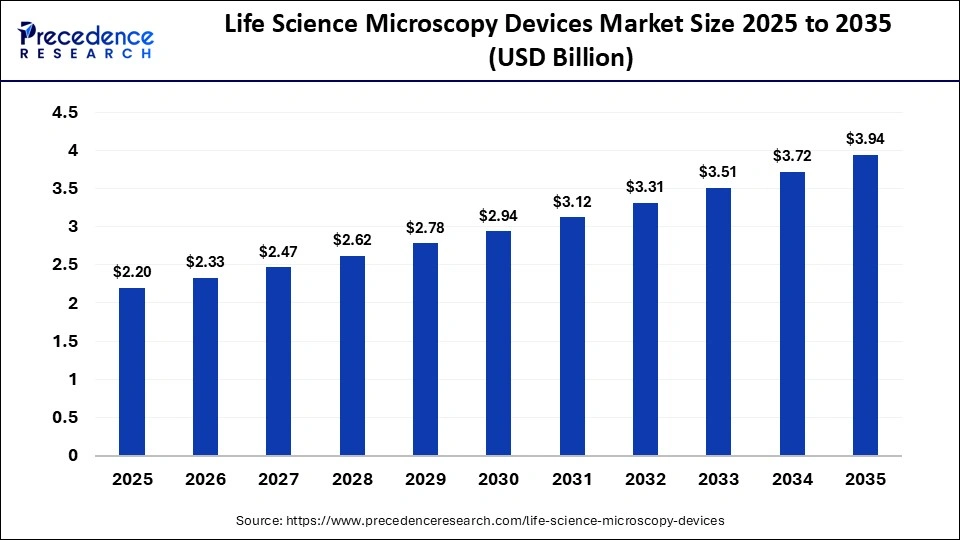
The global life science microscopy devices market size was calculated at USD 2.20 billion in 2025 and is predicted to increase from USD 2.33 billion in 2026 to approximately USD 3.94 billion by 2035, expanding at a CAGR of 6.00% from 2026 to 2035. The market is driven by growing demand for advanced imaging in biomedical and pharmaceutical research.
Key Takeaways
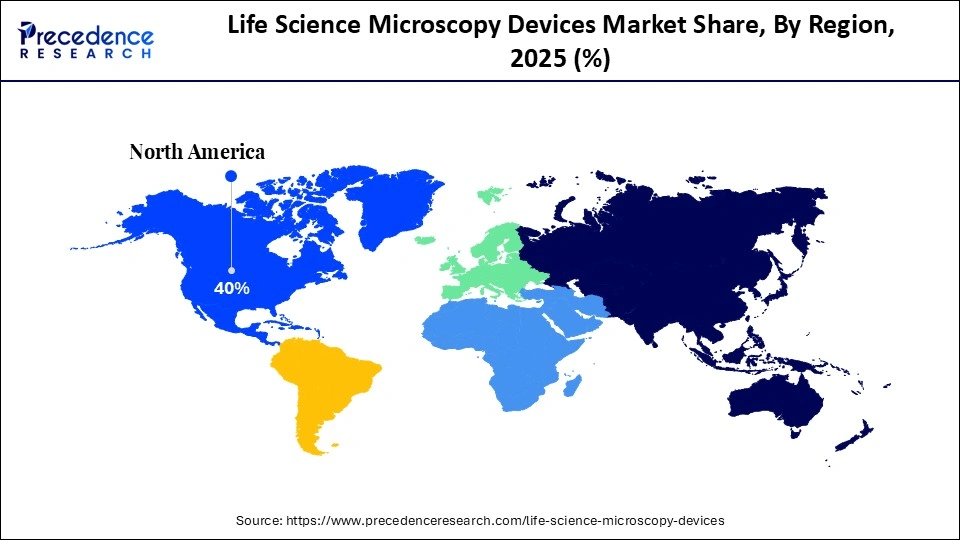
- North America held the largest share of 40% in 2025.
- Asia Pacific is expected to witness the fastest growth during the forecasted years.
- By type, the light microscopy segment dominated the market in 2025.
- By type, the scanning probe microscopy segment is expected to grow at a significant rate in the market over the forecast period.
- By application, the disease diagnosis segment held a significant share of the market in 2025.
- By application, the drug development segment is expected to grow at the fastest rate in the market over the forecast period.
- By end-user, the hospitals and outpatient facilities segment led the market with a significant share in 2025.
- By end-user, the pharmaceutical and biotechnology companies segment is expected to grow at the fastest CAGR in the market over the forecast period.
Market Overview
The life science microscopy devices market is growing at a high rate, driven by increased use of these devices in biomedical research, clinical diagnostics, and pharmaceutical development. Growing demand for advanced imaging technologies is being propelled by rising investment in healthcare R&D worldwide and the growing number of chronic and infectious diseases. Heightened interest in early disease detection and individualized medicine has advanced the application of high-resolution microscopes, electron and fluorescence systems. Technological tools, such as live-cell imaging, super-resolution microscopy, and automated analysis based on AI, are making research more efficient and diagnoses more accurate.
How is AI Integration Impacting the Life Science Microscopy Devices Market?
AI is significantly influencing the market. AI algorithms are capable of interpreting data on huge quantities of microscopic images in just a few seconds, making data interpretation quick and consistent. These algorithms recognize small patterns, anomalies, as well as details of the structure, which may not be easy or impossible to observe by the human eye. AI is used to automate image classification, segmentation, and feature extraction, thus reducing variability and minimizing human error, and reproducible and reliable research results are achieved. This is especially useful when it is necessary to have consistency in laboratories with high throughput or in clinical diagnostics. Furthermore, AI-based microscopy is also useful in forecasting analytics and quantifying cell biology and pathology results quantitatively.
Life Science Microscopy Devices Market Trends
- There is a growing adoption of super-resolution and advanced fluorescence microscopy, which is significantly enhancing the ability to identify cellular and molecular structures, enabling researchers to achieve greater precision in disease analysis and drug discovery.
- The integration of artificial intelligence and machine learning into microscopy workflows is improving automated image analysis, reducing human error, accelerating data interpretation, and increasing the efficiency of both clinical and research laboratories.
- Rising demand for live-cell imaging technologies is enabling real-time observation of cellular processes, expanding applications in cancer research, stem cell studies, and developmental biology.
- The advancement of cryo-electron microscopy is facilitating high-resolution structural studies of biomolecules, driving progress in structural biology and supporting the development of next-generation therapeutics.
Market Scope
| Report Coverage | Details |
| Market Size in 2025 | USD 2.20 Billion |
| Market Size in 2026 | USD 2.33 Billion |
| Market Size by 2035 | USD 3.94 Billion |
| Market Growth Rate from 2026 to 2035 | CAGR of 6.00% |
| Dominating Region | North America |
| Fastest Growing Region | Asia Pacific |
| Base Year | 2025 |
| Forecast Period | 2026 to 2035 |
| Segments Covered | Type, Application, End-User, and Region |
| Regions Covered | North America, Europe, Asia-Pacific, Latin America, and Middle East & Africa |
Segment Insights
Type Insights
How Does the Light Microscopy Segment Lead the Life Science Microscopy Devices Market?
The light microscopy segment led the market while holding the largest share in 2025 due to its widespread use in academic research, clinical diagnostics, and pharmaceutical laboratories. Light microscopy remains the most accessible and versatile imaging technique, as it is cost-effective, easy to operate, and compatible with a wide range of biological applications. Advanced techniques such as dark field microscopy, fluorescence microscopy, phase contrast microscopy, differential interference contrast (DIC) microscopy, and confocal microscopy provide enhanced contrast and depth resolution, further expanding its utility. Additionally, the growing demand for routine diagnostic testing and educational research tools has driven large-scale installations worldwide, reinforcing the segment's dominant position.
The scanning probe microscopy segment is expected to grow at a significant CAGR over the forecast period because of its ability to provide ultra-high-resolution imaging at the nanoscale, enabling detailed analysis of biomolecules, cell membranes, and surface structures. Atomic Force Microscopy (AFM), Scanning Tunneling Microscopy (STM), and Ballistic Electron Emission Microscopy (BEEM) are techniques that allow small atoms and molecules to be seen and measured. They are also used in life science applications in nanotechnology research, biomolecular studies, and advanced material sciences. AFM is particularly useful in the study of cell mechanics, protein interactions, and molecular forces in near-physiological conditions. Additionally, rising investments in nanotechnology research and interdisciplinary life science studies are supporting the segment's growth.
Application Insights
Why Did the Disease Diagnosis Segment Dominate the Life Science Microscopy Devices Market?
The disease diagnosis segment dominated the market in 2025 due to the rising cases of infectious diseases, cancer, hematological, and genetic abnormalities that occur across the world. Hematology laboratories heavily depend on microscopes to analyze the blood smear and identify blood disorders. High-resolution imaging is essential in microbiology applications to determine bacteria, viruses, and fungi, which can be used to make the correct diagnosis and treatment decisions. Also, chromosome assessment and molecular diagnostics are done by the use of fluorescence and confocal microscopy in genetic studies and cytogenetic analysis.
The drug development segment is expected to grow at a significant rate in the market, driven by rising research in the field of pharmacology and toxicology. Microscopy technologies are widely applicable in drug discovery to examine cellular behavior and molecular interactions, as well as compound efficacy on a micro- and nanoscale. Advanced imaging techniques are used in pharmacology, enabling researchers to study real-time drug mechanisms, receptor binding, and intracellular processes. In the toxicology research of the drug, microscopy allows the evaluation of the toxicity of the cell, tissue damage, and adverse drug reactions before clinical trials.
End-User Insights
Why Did the Hospitals and Outpatient Facilities Segment Lead the Market?
The hospitals and outpatient facilities segment led the life science microscopy devices market with the largest share in 2025. This dominance is attributed to the widespread use of microscopy devices for routine diagnostic testing in pathology, hematology, microbiology, and cytology laboratories within hospital settings. Outpatient diagnostic centers increasingly rely on advanced imaging systems to deliver rapid test results and improve clinical outcomes. Furthermore, the rising prevalence of chronic diseases, infectious conditions, and cancer has significantly increased the volume of diagnostic procedures, thereby driving strong demand for efficient and high-performance microscopy equipment.
The pharmaceutical and biotechnology companies segment is expected to grow at the highest CAGR over the forecast period, driven by increasing research and development activities, expansion of drug pipelines, and rising investments in biologics and gene therapies. Advanced microscopy technologies are extensively used in preclinical research, drug screening, and molecular analysis within these organizations. High-resolution imaging techniques enable researchers to study cell morphology, protein–protein interactions, and disease pathophysiology with greater precision. Additionally, the adoption of automated imaging platforms and high-throughput screening systems is enhancing research productivity and accelerating the overall drug development cycle.
Region Insights
North America Life Science Microscopy Devices Market Size and Growth 2026 to 2035
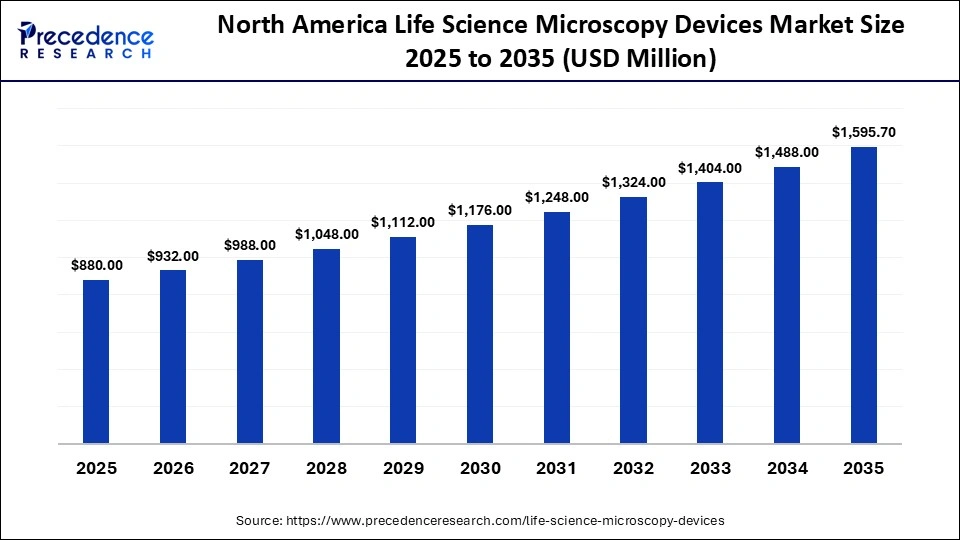
The North America life science microscopy devices market size is estimated at USD 880.00 million in 2025 and is projected to reach approximately USD 1,595.70 million by 2035, with a 6.13% CAGR from 2026 to 2035.
What Made North America the Leading Region in the Life Science Microscopy Devices Market?
North America led the life science microscopy devices market by capturing the largest share in 2025. This dominance is attributed to its well-established biotechnology, pharmaceutical, and medical device industries. The region also benefits from advanced research infrastructure and substantial funding from government bodies and private organizations. The region has been an early adopter of innovative imaging technologies, further strengthening its market position. Additionally, the presence of major industry players and continuous product innovations has enhanced regional competitiveness. Growing emphasis on precision medicine, cancer research, and cell-based therapies has significantly increased the demand for advanced and high-resolution microscopy solutions across the region.
U.S. Life Science Microscopy Devices Market Size and Growth 2026 to 2035
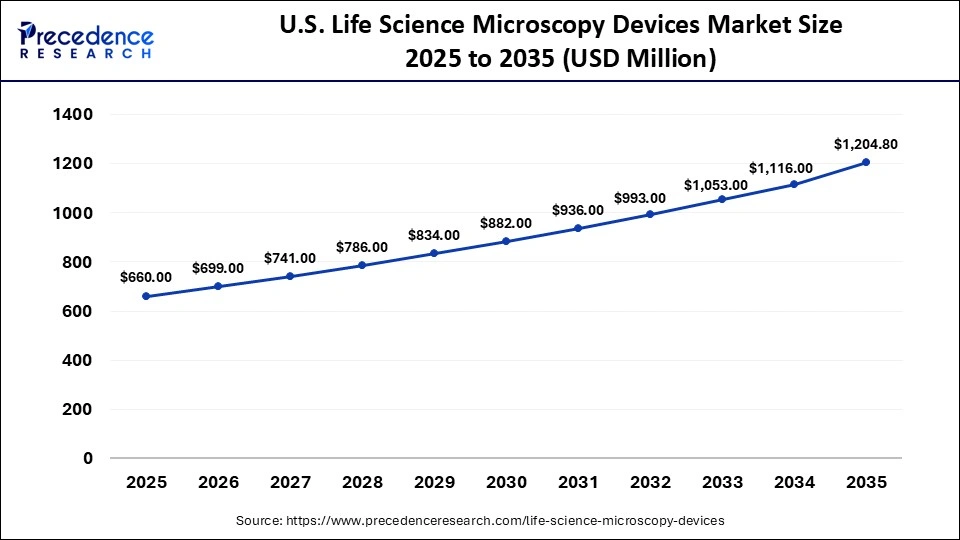
The U.S. life science microscopy devices market size is calculated at USD 660.00 million in 2025 and is expected to reach nearly USD 1,204.80 million in 2035, accelerating at a strong CAGR of 6.20% between 2026 and 2035.
U.S. Market Analysis
The life science microscopy devices market in the U.S. is growing due to strong investments in biomedical research, advanced healthcare infrastructure, and continuous funding from federal agencies and private organizations. The country's leadership in pharmaceutical innovation, biotechnology development, and precision medicine initiatives is driving demands for high-resolution and automated imaging systems. Additionally, the rising focus on cancer research, cell-based therapies, and drug discovery is further accelerating the adoption of advanced microscopy technologies.
Why is Asia Pacific Considered the Fastest-Growing Region in the Life Science Microscopy Devices Market?
Asia Pacific is expected to grow at the fastest CAGR in the market during the forecast period, driven by the rapid expansion of healthcare infrastructure and increasing investments in biomedical research. Countries such as China, India, Japan, and South Korea are making substantial investments in life sciences and biotechnology innovation, strengthening regional research capabilities. The growing pharmaceutical manufacturing sector and the expansion of contract research organizations (CROs) are further accelerating the adoption of advanced microscopy systems. Additionally, the rising prevalence of chronic diseases and the increasing need for improved diagnostic capabilities are fueling the installation of sophisticated microscopy equipment across hospitals and research laboratories in the region.
How is the Opportunistic Rise of Europe in the Life Science Microscopy Devices Market?
Europe is expected to grow at a significant CAGR in the upcoming period. The area has a great number of universities, research centers, and biotechnology corporations, which are engaged in cell biology, molecular research, and structural analysis. The rising number of partnerships between academic institutions and the pharmaceutical industry is creating the need to acquire sophisticated microscopy equipment. Governments in Europe invest heavily in scientific research and development of technologies to fund laboratory modernization programs. Also, increasing focus on cancer studies, neurodegenerative diseases, and personalized medicine is increasing the uptake of high-resolution imaging systems.
Life Science Microscopy Devices Market Companies
- Carl Zeiss AG
- Bruker
- Leica Microsystems
- Nikon Instruments
- Hitachi High-Technologies Corporation
- Olympus
- JEOL INDIA PVT LTD
- Agilent Technologies
- Oxford Instruments
- AmScope
- Danaher
- Labomed
- Microscopy Innovations, LLC
- Radical Scientific Equipments Pvt. Ltd.
- Rigaku Europe SE
Recent Developments
- In April 2025, NASA placed a holographic microscope, ELVIS (Extant Life Volumetric Imaging System), into space to facilitate more advanced biological research in space as part of a resupply mission. The system allowed three-dimensional imaging of microbes and cells under extreme conditions, such as deep-sea conditions and microgravity.(Source: https://issnationallab.org)
- In December 2024, the Prevedel group researchers at the EMBL in Heidelberg announced a smaller, high-resolution mobile microscope. The device allowed fast image development and portability, and expanded field and laboratory studies to high-level microscopy.(Source: https://www.embl.org)
- In May 2024, Lancelot Laboratory launched a new system of light sheet microscopy called VIVENTIS LS2, which allows imaging living biological samples with high depths. The system significantly increased real-time live-cell imaging, and researchers who studied multifaceted and dynamic biological mechanisms used it.(Source: https://lifesciences.danaher.com)
Segments Covered in the Report
By Type
- Light Microscopy
- Dark Field Microscopy
- Fluorescence microscopy
- Phase Contrast Microscopy
- Differential Interference Contrast Microscopy
- Confocal Microscopy
- Others (Metallurgical Microscopy, Polarized Microscopy, etc.)
- Scanning Probe Microscopy
- Atomic Force Microscopy (AFM)
- Scanning Tunneling Microscopy (STM)
- Others (Ballistic Electron Emission Microscopy (BEEM), etc.)
- Electron Microscopy
- Transmission Electron Microscope (TEM)
- Scanning Electron Microscope (SEM)
- Reflection Electron Microscope (REM)
By Application
- Disease Diagnosis
- Pathology
- Hematology
- Microbiology
- Others (Genetics, etc.)
- Drug Development
- Pharmacology
- Toxicology
- Medical Education & Research
- Surgical Procedure
- Others (Personalized Medicine, etc.)
By End-user
- Hospitals & Outpatient Facilities
- Diagnostic Laboratories
- Pharmaceutical & Biotechnology Companies
- Academic & Research Institutes
- Others (CROs, etc.)
By Region
- North America
- Europe
- Asia-Pacific
- Latin America
- Middle East & Africa
For inquiries regarding discounts, bulk purchases, or customization requests, please contact us at sales@precedenceresearch.com
Frequently Asked Questions





Ask For Sample
No cookie-cutter, only authentic analysis – take the 1st step to become a Precedence Research client
 Get a Sample




 sales@precedenceresearch.com
 Schedule a Meeting
