



Machine-to-Machine Connections Market Trends, Leading Companies, Company Revenue, Sales Performance, Connectivity Deployment, Network Capacity, Technology Adoption, Pricing Analysis, Distribution Performance, Competitive Landscape, and Demand Forecast
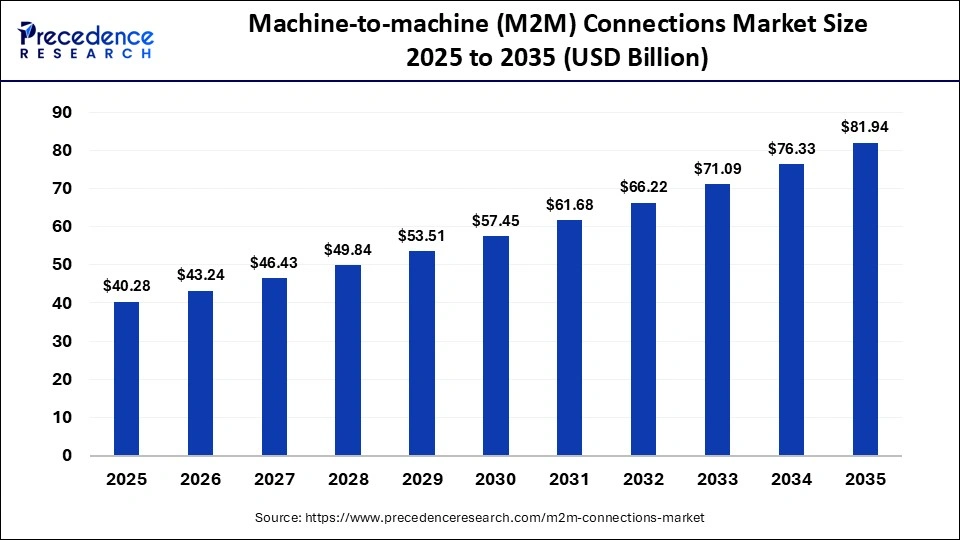
Laxminarayan, who specializes in the machinery and equipment industry, assesses the machine-to-machine (M2M) connections market at USD 43.24 billion in 2026 and expects it to reach USD 81.94 billion by 2035, expanding at a CAGR of 7.36%. Machine-to-machine (M2M) connections market companies including Vodafone Group, AT&T Inc., Huawei Technologies, remain prominent players, with demand concentrated across segments such as by technology, by communication type, by end-use, by enterprise size.
Source: https://www.precedenceresearch.com/machine-to-machine-connections-market
 Get a Sample
 Table Of Content


What is the Machine-to-machine (M2M) Connections Market Size?
The global machine-to-machine (M2M) connections market size accounted for USD 40.28 billion in 2025 and is predicted to increase from USD 43.24 billion in 2026 to approximately USD 81.94 billion by 2035, expanding at a CAGR of 7.36% from 2026 to 2035. The market is largely dominating due to the expansion of IoT across leading sectors and robust solutions for data transmission without constant human intervention.
Market Highlights
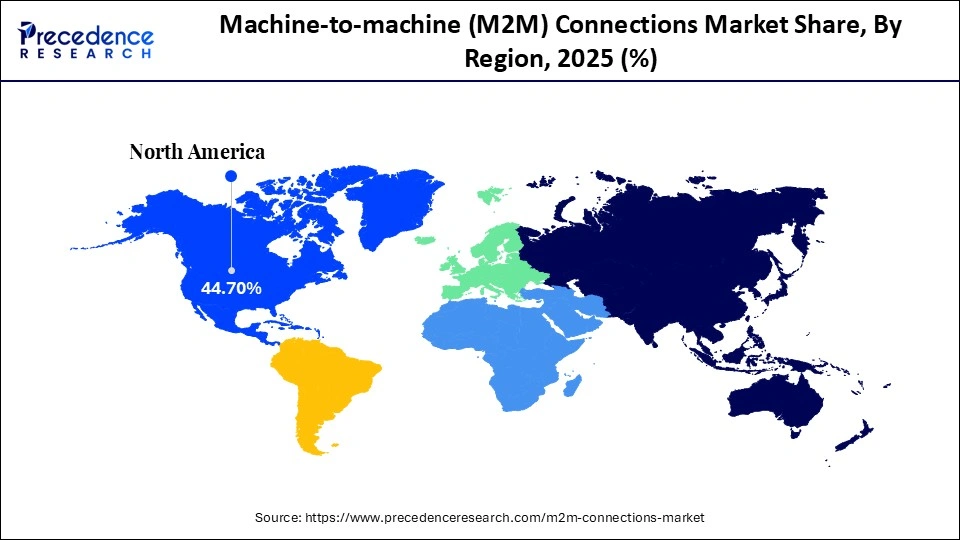
- North America accounted for the largest market share of 44.7% in 2025.
- The Asia Pacific is expected to grow at a solid CAGR of 8.0% from 2026 to 2035.
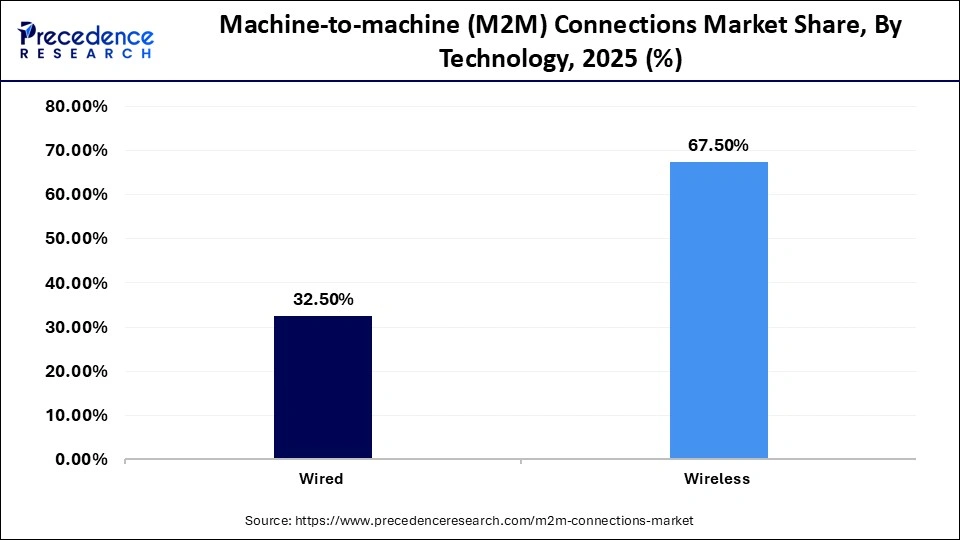
- By technology, the wireless segment held the major market share of 67.5% in 2025 growing at a healthy CAGR of 7.9% between 2026 and 2035.
- By communication type, the cellular M2M segment contributed the biggest market share of 54.8% in 2025.
- By communication type, the LPWAN segment is poised to grow at a CAGR of 7.7% between 2026 and 2035.
- By end use, the smart metering segment generated the highest market share of 36.5% in 2025.
- By end use, the smart cities segment is expanding at the fastest CAGR of 7.9 between 2026 and 2035.
- By enterprise size, the large enterprise segment captured the biggest market share of 36.5% in 2025.
- By enterprise size, the SMEs segment is projected to grow at the fastest CAGR of 8.1% between 2026 and 2035.
Market Overview
Machine-to-Machine (M2M) connections refer to automated data exchange between devices, systems, or machines without human intervention, enabling continuous and real-time communication across sectors such as industrial automation, transportation, energy management, and smart infrastructure. These connections allow machines to collect, transmit, and act on data autonomously, forming the operational backbone of many connected systems.
M2M communication relies on a range of technologies, including cellular networks, low-power wide-area networks, and short-range wireless protocols, to support use cases such as IoT deployments, remote asset monitoring, predictive maintenance, and process automation. Sensors embedded in equipment transmit performance and status data to centralized platforms, enabling rapid response and control.
By connecting devices to networks, cloud platforms, and analytics systems, M2M improves operational efficiency, reduces downtime, and lowers operating costs. Organizations benefit from faster decision-making, optimized resource utilization, and improved reliability of critical infrastructure, making M2M a foundational component of scalable and data-driven digital ecosystems.
AI Shifts in Machine-to-machine (M2M) Connections Market
The integration of artificial intelligence with machine-to-machine connections is transforming connected systems by combining continuous device-level data exchange with cognitive, data-driven decision-making. AI enables M2M networks to move beyond simple data transmission toward real-time analysis, pattern recognition, and autonomous response, creating intelligent ecosystems that directly support operational scaling and business growth. This convergence is increasingly relevant across sectors such as smart manufacturing, energy management, connected healthcare, logistics, and personalized consumer services.
One of the most significant benefits of combining AI with M2M technology is improved predictive maintenance accuracy. In industries such as manufacturing and healthcare, AI models analyze high-frequency sensor data from M2M-connected equipment to detect early signs of wear, performance degradation, or failure. This allows organizations to schedule maintenance proactively, reduce unplanned downtime, extend asset life, and lower operating costs, particularly in environments where equipment reliability is mission-critical.
AI also enhances the scalability and efficiency of M2M systems by enabling intelligent data filtering, prioritization, and edge-level processing. Instead of transmitting all raw data to centralized platforms, AI-powered M2M architectures can process and act on data locally, reducing network congestion and latency. This capability is essential as M2M deployments expand to millions of connected devices, supporting large-scale automation, faster response times, and more resilient connected infrastructures.
Machine-to-machine (M2M) Connections Market Outlook
- Industry Growth Overview: The machine-to-machine (M2M) connections market is significantly growing due to the advancements in connectivity technologies like 5G and the deployment of IoT devices across several industries for automation purposes. Also, the increasing need for real-time data collection and analysis is a key driver of the market.
- Sustainability Trends: The sustainability trends of the machine-to-machine (M2M) connections market include resource management, circular economy, and energy efficiency. A significant cost reduction by energy consumption can be possible with the help of machine-to-machine connections, especially in buildings and factories, by leveraging smart meters and energy management systems.
- Major Investors: The market for machine-to-machine (M2M) connections is majorly led by well-established communication companies along with tech giants that are actively working to innovate methods for energy savings with the application of cutting-edge technologies. The companies are heavily influencing the markets growth by investing in R&D, acquisitions, and development of infrastructure.
Market Scope
| Report Coverage | Details |
| Market Size in 2025 | USD 40.28 Billion |
| Market Size in 2026 | USD 43.24 Billion |
| Market Size by 2035 | USD 81.94 Billion |
| Market Growth Rate from 2026 to 2035 | CAGR of 7.36% |
| Dominating Region | North America |
| Fastest Growing Region | Asia Pacific |
| Base Year | 2025 |
| Forecast Period | 2026 to 2035 |
| Segments Covered | Technology, Communication Type, End-Use, Enterprise Size, and Region |
| Regions Covered | North America, Europe, Asia-Pacific, Latin America, and Middle East & Africa |
Segments Insights
Technology Insights
Why is Wireless Technology Preferred in the Machine-to-machine (M2M) Connections Market?
Wireless: The segment held the largest market share of 67.5% in 2025 and is projected to grow at the fastest CAGR of 7.9% during the foreseeable period. The segment is expanding due to unmatched deployment flexibility, lower installation costs compared to wired networks, and high scalability that supports remote monitoring applications such as agricultural machinery tracking, fleet management, and smart city infrastructure.
Ongoing advances in LTE-M, LPWAN, and 5G are improving network reliability, enabling wider device coverage, lower power consumption, and longer battery life for connected endpoints. In addition, strong adoption across utilities, logistics, and industrial automation is reinforcing demand for wireless M2M connectivity that can be deployed rapidly across geographically dispersed assets.
A significant data point is the increased rate of machine-to-machine cellular mobile connections, recorded at nearly 59.09 million to 63.09 million, suggesting the momentum of wireless technology and its increasing application across sectors like utilities, logistics, and smart infrastructure.
Communication Type Insights
How Does the Cellular M2M Communication Type Assist the Machine-to-machine (M2M) Connections Market?
Cellular M2M: The segment held the largest market share of 54.8% in 2025. The segment is dominating as cellular networks provide maximum coverage of geographical location, which is highly anticipated in remote areas where wired solutions are impractical and costly. It further incorporates standard security protocols that are critical for sensitive data transmission. Cellular M2M communication type has wide applications that range from smart metering to automation in industrial processes, highlighting its efficiency.
LPWAN: The segment is projected to grow at the fastest CAGR of 7.7% during the foreseeable period. The segment is growing due to its ability to enable long-range, ultra-low-power communication for battery-based devices with cost efficiency. It offers massive deployment of sensors for several use cases in different sectors like logistics tracking, smart cities, and smart metering.
End-Use Insights
Why Does the Smart Meter Find Extensive Application in the Machine-to-machine (M2M) Connections Market?
Smart Metering: The segment held the largest market share of 36.5% in 2025. The segment is dominating due to its ability to record and fetch data automatically in real-time to offer accurate information; it allows better power grid management that assists utilities to balance energy supply as per demand along with renewable energy sources. This direct machine-to-machine communication reduces dependency on manual intervention for meter reading and saves labor costs over time as well.
Smart Cities: This segment is projected to grow at the fastest CAGR of 7.9% during the foreseeable period. The segment is proliferating due to the unmatched benefits, like automating tasks like monitoring smart grids and predicting future needs to reduce downtime and make better and quicker decisions for public welfare. It reduces costs on manual labor and minimizes human-prone errors due to negligence.
Enterprise Size Insights
Why Do Large Enterprises Benefited Mostly From the Machine-to-Machine (M2M) Connections Market?
Large Enterprises: This segment held the largest market share of 70.4% in 2025. The segment is dominating due to its ability to effectively implement automation systems and data analysis on a large scale across complex operations. Large enterprises have the financial resources to invest in substantial capital to build robust hardware and software platforms with network connectivity. Also, large enterprises are set to collect and analyze massive amounts of data, which require precise data handling systems to minimize sudden failure of the system.
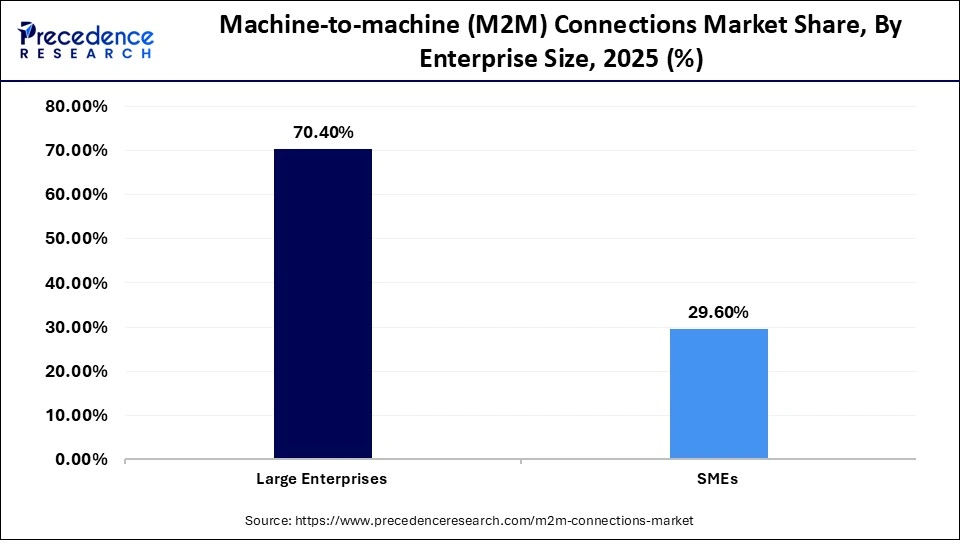
SMEs: This segment is projected to grow at the fastest CAGR of 8.1% during the foreseeable period. The segment is growing due to the automation and increased efficiency offered by machine-to-machine connection technology for SMEs that are looking to scale up across the globe. It further enables real-time data exchange, remote management, and process optimization in sectors like manufacturing and logistics.
Regional Insights
How Big is the North America Machine-to-Machine (M2M) Connections Market Size?
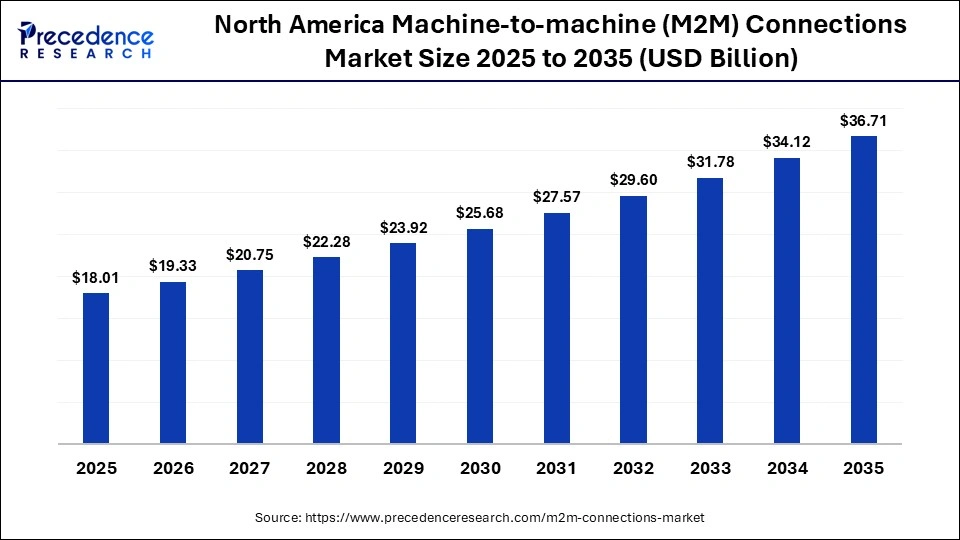
The North America machine-to-machine (M2M) connections market size is estimated at USD 18.01 billion in 2025 and is projected to reach approximately USD 36.71 billion by 2035, with a 7.46% CAGR from 2026 to 2035.
Why Is North America Leading the Machine-to-Machine (M2M) Connections Market?
North America held the largest market share of 44.7% in 2025, driven by rapid adoption of IoT-enabled and M2M solutions across industrial automation, utilities, transportation, and connected vehicle ecosystems. Strong investment in smart infrastructure, factory automation, and fleet telematics across the United States and Canada continues to accelerate large-scale M2M deployments that require reliable, low-latency connectivity.
Technological progress in the region is reinforced by a supportive regulatory and standards environment that enables faster rollout of advanced wireless networks and spectrum availability for industrial and commercial use. High penetration of LTE, LTE-M, and early 5G networks supports real-time applications such as asset tracking, remote diagnostics, predictive maintenance, and connected mobility services where consistent data transmission is critical.
In parallel, leading telecom operators, cloud providers, and platform vendors are investing in scalable and secure connectivity frameworks to manage growing device volumes and data traffic. These efforts support advanced analytics, edge computing, and cybersecurity requirements, strengthening the overall M2M ecosystem and reinforcing North America leadership position in the global market.
What is the Size of the U.S. Machine-to-Machine (M2M) Connections Market?
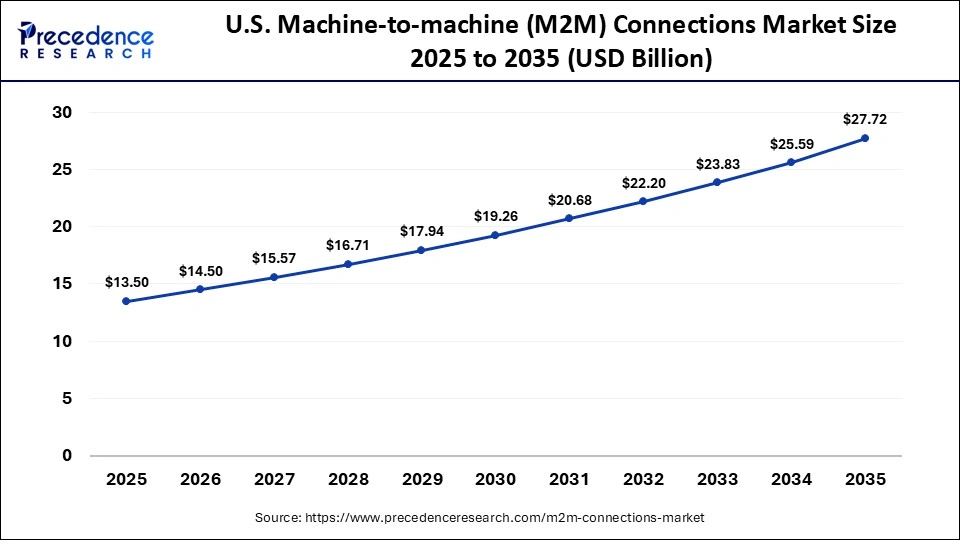
The U.S. machine-to-machine (M2M) connections market size is calculated at USD 13.50 billion in 2025 and is expected to reach nearly USD 27.72 billion in 2035, accelerating at a strong CAGR of 7.46% between 2026 and 2035.
U.S. Machine-to-Machine (M2M) Connections Market Trends
The Federal Communications Commission is actively supporting M2M satellite communications through targeted policy and funding mechanisms aimed at extending connectivity to remote and underserved areas. Programs such as the Rural Digital Opportunity Fund are channeling capital toward satellite and hybrid networks that can support M2M use cases, including remote asset monitoring, precision agriculture, emergency communications, and energy infrastructure oversight.
The United States Agency for International Development is investing in global connectivity initiatives that leverage satellite technology to expand internet access in geographically isolated and infrastructure-poor regions. These efforts support M2M-enabled applications in healthcare delivery, disaster response, logistics tracking, and environmental monitoring. Together, domestic broadband programs and international development initiatives are strengthening the role of satellite-based M2M connectivity in resilient and wide-area communication networks.
What Are the Key Drivers of Asia Pacific Machine-to-Machine (M2M) Connections Market Expansion?
Asia Pacific is projected to grow at the fastest CAGR of 8.0% during the period 2026-2035, driven primarily by rapid rollout and commercialization of 5G networks across the region. High-speed, low-latency, and highly reliable connectivity enabled by 5G is critical for large-scale M2M deployments that support real-time data transmission in applications such as industrial automation, smart transportation, and connected utilities.
Countries including China, India, South Korea, and Japan are major contributors to regional growth due to strong telecom infrastructure investment and large-scale IoT adoption. China and South Korea are advancing M2M connectivity in manufacturing and smart factories, while Japan is leveraging M2M for transportation systems and aging infrastructure monitoring.
In India, government-led initiatives such as the Digital India program are accelerating deployment of M2M technologies across smart cities, intelligent transport systems, utility metering, and urban infrastructure planning. Rapid growth in IoT adoption across public and private sectors, combined with expanding mobile broadband coverage, is creating a strong foundation for sustained machine-to-machine (M2M) connections market expansion across Asia Pacific.
China Machine-to-Machine (M2M) Connections Market Analysis
China is at the forefront of IoT network deployment and M2M technology adoption due to its large-scale manufacturing base and national focus on smart city development and industrial automation. Sectors such as agriculture, transportation, and healthcare are accelerating demand for M2M solutions to enable real-time equipment monitoring, intelligent traffic control, and energy-efficient operations.
In manufacturing, M2M connectivity is widely used for factory automation, predictive maintenance, and production line optimization across electronics, automotive, and heavy industry clusters. In urban environments, municipal authorities are deploying M2M-enabled systems for smart lighting, air quality monitoring, water management, and public transport coordination. The expansion of domestic 5G infrastructure and government-backed industrial digitization programs is further strengthening Chinas leadership in large-scale, mission-critical M2M deployments.
- For instance, in April 2025, Samsung SDI is deployed to advance its factory systems to maximize logistics capabilities by eliminating defective products.
Why Is Europe Significantly Growing in the Machine-to-Machine Connection Market?
The machine-to-machine (M2M) connections market is expanding significantly due to rapid adoption of IoT devices and rising demand for connected solutions across European industries, supported by continuous advancements in cellular technologies such as LTE and 5G. These networks enable higher data throughput, lower latency, and more reliable connectivity, which are essential for large-scale M2M deployments that operate in real time.
Integration of cellular connectivity into M2M applications is improving real-time data collection, remote asset management, and automated control across sectors such as healthcare, manufacturing, utilities, and transportation. In manufacturing, cellular M2M supports predictive maintenance, equipment monitoring, and production optimization, while in healthcare it enables remote patient monitoring, connected medical devices, and secure data transmission.
Europe strong regulatory focus on data security, operational efficiency, and industrial digitalization is further reinforcing adoption. As enterprises modernize operations and deploy smart infrastructure, cellular-based M2M connectivity is becoming a core enabler of automation, resilience, and scalable digital transformation across the region.
UK Machine-to-Machine (M2M) Connections Market Analysis
The market in the United Kingdom is primarily driven by growing adoption of IoT-enabled solutions across transportation and manufacturing, alongside a strong push toward smart infrastructure modernization. M2M connectivity is increasingly used to support traffic management systems, rail monitoring, logistics optimization, and automated manufacturing operations that require continuous, real-time data exchange.
Integration of artificial intelligence with M2M technologies is accelerating across the country, enhancing predictive maintenance, anomaly detection, and real-time decision-making capabilities. AI-enabled M2M systems allow enterprises to analyze large volumes of machine data locally and centrally, improving operational efficiency and reducing downtime across industrial and public infrastructure.
In addition, the rising deployment of connected healthcare devices is contributing significantly to market growth. Remote patient monitoring systems, connected diagnostic equipment, and smart medical devices rely on secure M2M connectivity to transmit health data in real time. This expansion of digital healthcare services is strengthening revenue generation for the machine-to-machine (M2M) connections market across the UK.
What Made the Middle East and Africa a Notably Growing Region in the Machine-to-Machine (M2M) Connections Market?
The machine-to-machine (M2M) connections market is witnessing notable growth across the Middle East and Africa region, driven by large-scale digitalization initiatives and accelerated deployment of smart infrastructure. Government-led smart city and national transformation programs, such as Vision 2030, are acting as major catalysts by prioritizing connected infrastructure, intelligent transport systems, and digitally managed public services that rely heavily on M2M connectivity.
Substantial investment in 5G infrastructure across Gulf countries is further strengthening the market by enabling high-speed, low-latency communication required for mission-critical M2M applications. These networks support real-time monitoring and automation across logistics hubs, ports, healthcare facilities, and industrial sites, where reliable connectivity is essential for operational efficiency and safety.
Demand is particularly strong in sectors such as oil and gas, utilities, and healthcare, where M2M solutions are used for asset tracking, pipeline monitoring, remote equipment diagnostics, and worker safety systems in hazardous environments. In logistics and transportation, M2M connectivity supports fleet tracking, cold-chain monitoring, and port automation.
In parallel, economic diversification strategies aimed at reducing dependence on hydrocarbons are encouraging broader adoption of digital technologies across non-oil sectors. By leveraging automation, IoT, and M2M connectivity, governments and enterprises are modernizing core industries, improving service delivery, and driving sustained growth of the machine-to-machine connections market across the Middle East and Africa.
UAE Machine-to-Machine (M2M) Connections Market Trends
The market is primarily driven by a mix of established multinational corporations and fast-growing local startups that focus on delivering niche, application-specific M2M solutions. Leading market participants leverage strong regional partnerships, system integrators, and telecom alliances to build robust distribution networks and tailor offerings to local regulatory and operational requirements.
In the United Arab Emirates, increasing emphasis on IoT deployment across transportation, healthcare, utilities, and public safety is significantly strengthening demand for reliable and secure M2M connectivity. M2M solutions are being deployed for intelligent traffic systems, fleet tracking, remote patient monitoring, and smart utility metering. Government-backed smart city initiatives and national digital transformation programs are further accelerating adoption by creating consistent demand for scalable, high-availability connectivity across public and private sectors.
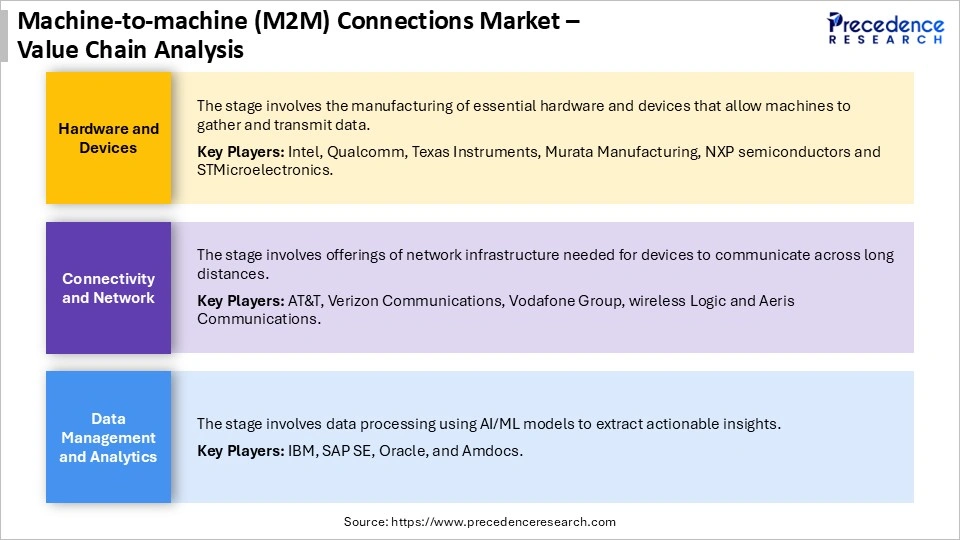
Machine-to-machine (M2M) Connections Market Value Chain
Machine-to-Machine (M2M) Connections Market Companies
- Vodafone Group
- AT&T Inc.
- Cisco Systems
- Verizon Communications
- Huawei Technologies
- Deutsche Telekom
- Telefonica
- China Mobile
- Sierra Wireless
- Ericsson
- Telit Communications
- Thales Group
- Orange Business Services
- NTT Docomo
- Aeris Communications
Recent Developments
- In December 2025, Space42 announces a partnership with Telkom satelit Indonesia by signing an MoU aiming to explore direct-to-device connectivity by leveraging the Equatys initiative, designed to offer uninterrupted 5G connectivity between satellite and terrestrial networks. (Source: https://www.telecomreviewasia.com)
- In June 2025, a leading marketer, M2M One, introduced a solution for IoT industrial satellite connectivity services aiming to combine airtime and hardware to support remote sectors in Australia and New Zealand. (Source: https://www.techpartner.news)
Segments Covered in the Report
By Technology
- Wired
- Wireless
By Communication Type
- Cellular M2M
- LPWAN
- Satellite
By End-Use
- Smart Metering
- Smart Cities
- Automotive & Transportation
- Utilities
- Healthcare
- Others
By Enterprise Size
- Large Enterprises
- SMEs
By Region
- North America
- Latin America
- Europe
- Asia-pacific
- Middle and East Africa
For inquiries regarding discounts, bulk purchases, or customization requests, please contact us at sales@precedenceresearch.com
Frequently Asked Questions





Ask For Sample
No cookie-cutter, only authentic analysis – take the 1st step to become a Precedence Research client
 Get a Sample




 sales@precedenceresearch.com
 Schedule a Meeting
