



Microservices in Healthcare Market Size, Companies, Share, Patient Volume, Treatment Adoption Rates, Pricing Analysis, Regulatory Landscape, Competitive Positioning, and Demand Forecast
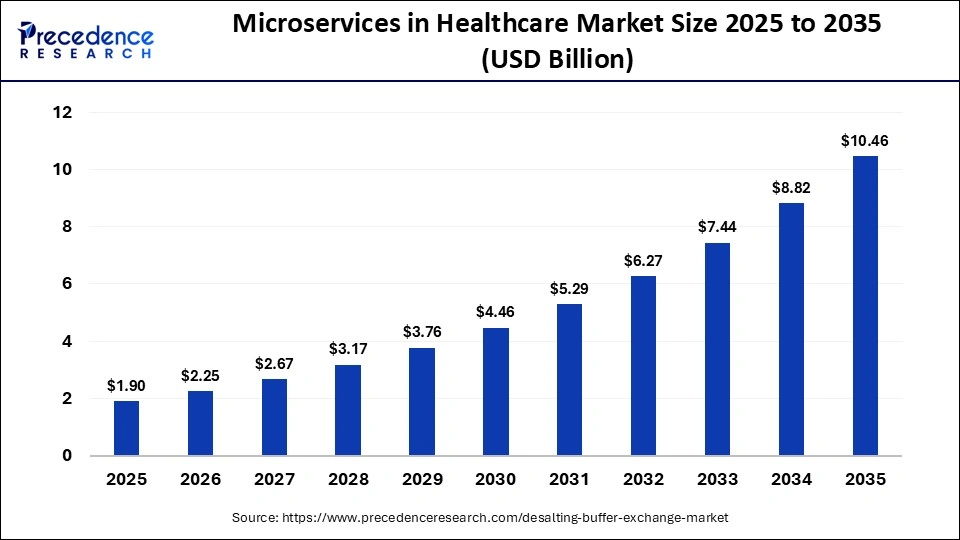
Rohan Patil, a Healthcare Industry Expert, highlights that the microservices in healthcare market has reached USD 2.25 billion in 2026 and is on track to reach USD 10.46 billion by 2035, advancing at a CAGR of 18.60%. Key microservices in healthcare market companies shaping the market include IBM Corporation, Microsoft Corporation, Amazon Web Services, Oracle Corporation, Google LLC, while major growth segments span By Component, By Deployment Mode, By Application, By End User.
Source: https://www.precedenceresearch.com/microservices-in-healthcare-market
 Get a Sample
 Table Of Content


What is the Microservices in Healthcare Market Size in 2026?
The global microservices in healthcare market size accounted for USD 1.90 billion in 2025 and is predicted to increase from USD 2.25 billion in 2026 to approximately USD 10.46 billion by 2035, expanding at a CAGR of 18.60% from 2026 to 2035. The market is experiencing unprecedented growth, driven by the rapid digitization of the healthcare system. The rapid expansion of the healthcare sector is also driving the market.
Key Takeaways
- North America held the largest revenue share of 40% in the microservices in healthcare market in 2025.
- Asia Pacific is expected to expand at the fastest rate between 2026 and 2035.
- By component, the platform & tools segment held the largest market share of approximately 62% in 2025.
- By component, the services segment is expected to grow at the fastest CAGR between 2026 and 2035.
- By deployment mode, the cloud-based segment contributed the biggest revenue share of 60% in the market in 2025 and is expected to expand at the fastest rate between 2026 and 2035.
- By application, the clinical management systems segment held a dominant share of the market in 2025.
- By application, the healthcare data analytics segment is expected to grow at the fastest rate from 2026 to 2035.
- By end user, the healthcare providers segment held a dominant share of 52% in 2025.
- By end user, the life sciences & pharma companies segment is expected to grow at the highest CAGR from 2026 to 2035.
Market Overview
The microservices in healthcare market refers to the adoption of microservices architecture in healthcare IT systems to build scalable, flexible, and independently deployable applications. This approach enables healthcare providers to modernize legacy systems, improve interoperability, and efficiently manage data across electronic health records, telemedicine, and patient management platforms. The market is driven by the need for agile digital transformation, enhanced patient care delivery, and seamless integration of emerging technologies such as cloud computing and artificial intelligence.
How is AI Impacting the Microservices in Healthcare Market?
In the rapidly evolving technological landscape, Artificial Intelligence (AI) integration emerges as a game-changer in the market, offering modular, scalable, and interoperable IT systems. AI-driven innovations serve as a major catalyst in the rapid expansion of the microservices in healthcare market. AI-powered tools, including NLP-driven documentation, diagnostics, and predictive analytics, are implemented as separate microservices. This allows hospitals to enhance specific functionalities without redesigning their entire Electronic Health Record (EHR) system. By efficiently breaking down monolithic healthcare systems into smaller, independent units, AI algorithms can be efficiently deployed to improve patient care, diagnostics, and optimize operations.
What are the Emerging Trends in the Market?
- The growing need for increased digital health interoperability, scalability, and modernization of legacy IT systems is expected to drive the market's growth during the forecast period. Microservices also enable smooth integration of diverse health data sources, including lab data, Electronic Health Records (EHRs), and wearable devices.
- The strict regulatory compliance is anticipated to bolster the market's growth in the coming years. Microservices facilitate compliance with strict regulations like GDPR and HIPAA by isolating patient information and allowing for easier auditing of data access.
- The rapid expansion of telemedicine is expected to accelerate the growth of the market during the forecast period. Microservices enable independent operation of services such as appointment scheduling, video consultations, and payments, which ensures that the entire telemedicine app remains functional even if one service fails.
- Significant investments in healthcare IT, along with the rising shift toward value-based care, are expected to contribute to the overall growth of the market.
Market Scope
| Report Coverage | Details |
| Market Size in 2025 | USD 1.90 Billion |
| Market Size in 2026 | USD 2.25 Billion |
| Market Size by 2035 | USD 10.46 Billion |
| Market Growth Rate from 2026 to 2035 | CAGR of 18.60% |
| Dominating Region | North America |
| Fastest Growing Region | Asia-Pacific |
| Base Year | 2025 |
| Forecast Period | 2026 to 2035 |
| Segments Covered | Component, Deployment Mode, Application, End User, and Region |
| Regions Covered | North America, Europe, Asia-Pacific, Latin America, and Middle East & Africa |
Market Dynamics
Drivers
Shift Toward Cloud-Based Healthcare Platforms
The rapid shift toward cloud-based healthcare solutions and value-based care models is expected to drive growth in the microservices in healthcare market during the forecast period. Increasing use of public and hybrid cloud models provides cost-effective, scalable infrastructure for deploying independent healthcare services. Additionally, microservices architecture accelerates the adoption of cloud-based AI platforms by enabling flexible, usage-based resource allocation, allowing organizations to pay only for the capacity they utilize.
Restraint
Rising Data Privacy and Security Concerns
The data privacy and security concerns are anticipated to hamper the market's growth. Distributing services across different areas creates several entry points, leading to increased vulnerability to cyberattacks. Protecting sensitive patient data requires rigorous security measures. In addition, the high costs and complex implementation may hinder the growth of the market.
Opportunities
Rapid Digital Transformation
A major opportunity in the microservices in healthcare market lies in the rapid digital transformation of healthcare systems through the adoption of microservices architecture, which enables seamless integration of advanced technologies such as AI, telemedicine, and real-time data analytics. This approach allows healthcare providers to modernize legacy systems, improve interoperability, and deliver personalized patient care more efficiently.
Segment Insights
Component Insights
Microservices in Healthcare Market Share, By Component, 2025-2035 (%)
| Component | 2025 | 2035 |
| Platform & Tools | 62% | 55% |
| Services | 38% | 45% |
The Platform & Tools Segment Held a 62% Market Share in 2025
The platform & tools segment dominated the microservices in healthcare market with the largest share of 62.0% in 2025. The segment's dominance is attributed to the rising adoption of containerization, API-driven architectures, interoperability requirements, and the rising need for scalable healthcare IT systems. Platforms provide the crucial framework required to deploy, manage, and scale individual microservices. They are also critical in handling varying data volumes from EHRs, telemedicine, and diagnostic systems.
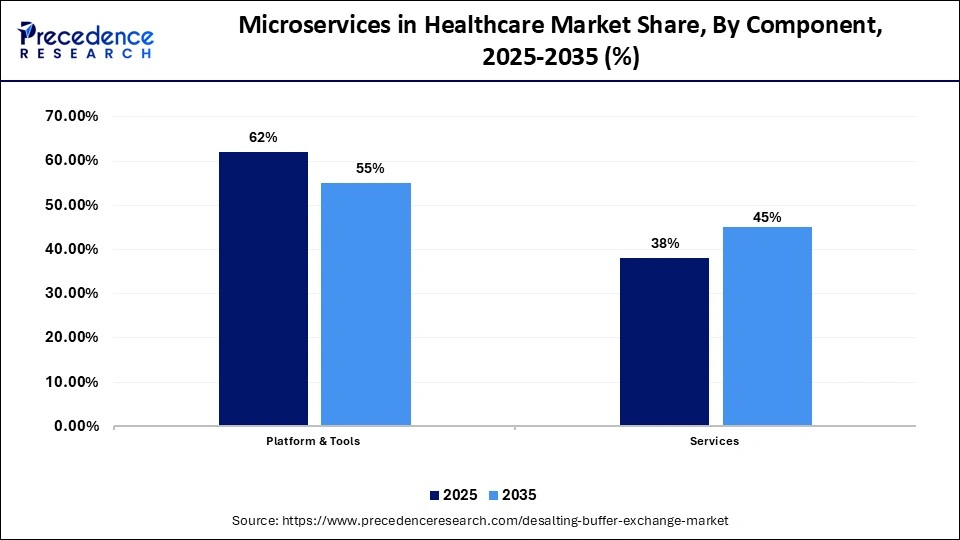
The services segment was the second-largest shareholder, holding a share of 38% in 2025, and is expected to grow at the fastest rate throughout the forecast period, owing to the increasing need for consulting and system integration services. The growing demand for customization and migration from legacy systems also boosts the demand for professional services. Healthcare organizations often require specialized expertise to navigate the high complexity, regulatory compliance, and modernization efforts to transition from legacy systems to decentralized architectures.
Deployment Mode Insights
Microservices in Healthcare Market Share, By Deployment Mode, 2025-2035 (%)
| Deployment Mode | 2025 | 2035 |
| On-Premises | 40% | 30% |
| Cloud-Based | 60% | 70% |
The Cloud Segment Led the Market with a 60% Share in 2025
The cloud-based segment held the largest share of 60% in the microservices in healthcare market in 2025 and is expected to expand at the fastest rate between 2026 and 2035. This is because cloud-based deployment offers numerous benefits such as cost-effectiveness, scalability, easier access, and operational flexibility. Cloud-based solutions allow healthcare providers to eliminate the need for high upfront infrastructure costs while managing vast datasets. Cloud-based models facilitate improved data sharing, interoperability, and remote access to information, crucial for advancing patient care.
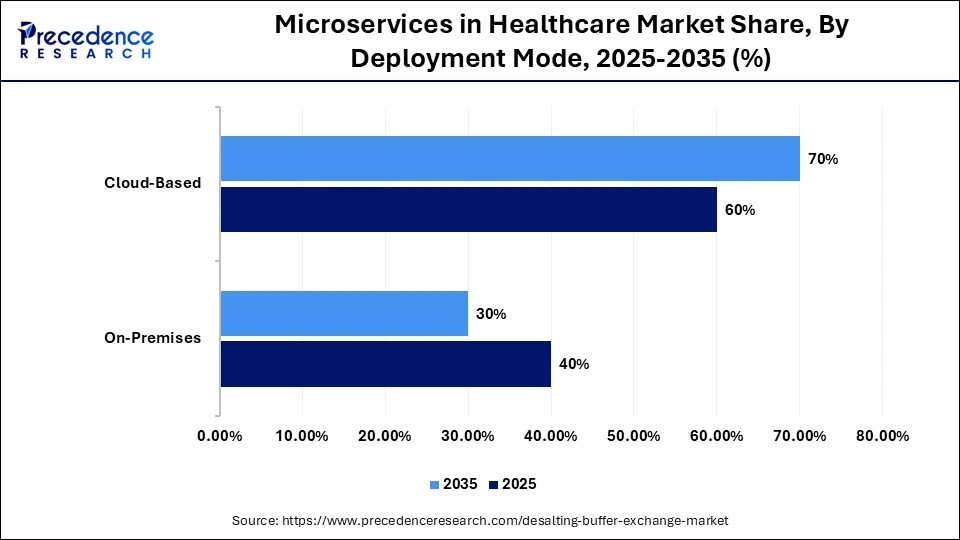
The on-premises segment was the second-largest shareholder, holding a share of 40% in 2025, primarily driven by the increasing data security concerns, rising data control requirements, and stringent regulatory compliance. On-premises deployment mode provides direct and physical control over data storage and access. Several healthcare providers, particularly large hospital networks, still rely on monolithic systems for EHRs (Electronic Health Records) and billing. On-premises microservices facilitate easier and lower-latency integration with existing legacy infrastructures.
Application Insights
The Clinical Management Systems Segment Dominated the Market in 2025
The clinical management systems segment dominated the microservices in healthcare market by holding the largest share in 2025. This is mainly due to the increasing need to modernize monolithic electronic health records (EHR) and patient monitoring systems. These systems leverage microservices architecture to enable scalability, interoperability, and real-time data access across departments. Additionally, the increasing need for streamlined healthcare delivery, regulatory compliance, and improved patient outcomes has driven widespread adoption of clinical management solutions.
The healthcare data analytics segment is expected to grow at the fastest CAGR between 2026 and 2035 due to the increasing need to process and derive insights from large volumes of clinical and operational data. Leveraging microservices architecture, organizations can build scalable and flexible analytics platforms that support real-time decision-making and predictive insights. Additionally, the rising adoption of AI-driven analytics and value-based care models is further driving demand for advanced data analytics solutions in healthcare.
The telehealth & remote monitoring segment held a remarkable share of the market in 2025, driven by its increasing demand for virtual care, which necessitates flexible and independent services that can manage high-volume interactions and real-time patient data. Telemedicine acts as one of the key application areas that enable remote consultations, teleradiology, and telepsychiatry, increasing the demand for cloud-based microservices. Leveraging microservices architecture, healthcare providers can build scalable platforms that support virtual consultations, continuous patient monitoring, and seamless data integration across devices.
The billing & revenue cycle management segment held a considerable share of the microservices in the healthcare market in 2025, owing to the increasing need for efficient financial operations and accurate claims processing. By leveraging microservices architecture, healthcare organizations can automate billing workflows, improve scalability, and ensure seamless integration with other systems. Additionally, rising regulatory requirements and the push to reduce claim denials and operational costs are driving the adoption of advanced revenue cycle management solutions.
End-User Insights
The Healthcare Providers Segment Held a Share of 52% in 2025
The healthcare providers segment led the microservices in healthcare market with a share of 52% in 2025, owing to the increased need for scalable IT systems and high adoption of digital health platforms and improved patient care solutions. Healthcare providers operate in complex environments requiring smooth communication between diagnostic imaging, electronic health records (EHRs), and medical devices. The segment's dominance is also reinforced by the rising shift toward cloud-based solutions for telemedicine and remote patient monitoring, along with the rising necessity to manage high volumes of patient data securely.
Microservices in Healthcare Market Share, By End User, 2025-2035 (%)
| End User | 2025 | 2035 |
| Healthcare Providers | 52% | 46% |
| Healthcare Payers | 20% | 18% |
| Life Sciences & Pharma Companies | 18% | 24% |
| Others | 10% | 12% |
The healthcare payers segment is the second-largest shareholder, holding a share of 20% in 2025, driven by the increasing need to modernize complex, legacy, and fragmented IT infrastructure to enhance efficiency, lower costs, and comply with changing regulations. Microservices assist them in breaking down these huge systems into manageable, smaller, and agile components. Moreover, the rising need for claims automation and increasing focus on fraud detection are anticipated to fuel the segment's growth during the forecast period.
The life sciences & pharma companies segment held a 18% share of the market in 2025 and is expected to grow at the fastest rate in the coming years, driven by the increasing need to speed up clinical trials and rising use in drug development and data-driven research. Pharmaceutical companies are increasingly shifting from legacy systems to cloud-based microservices to enhance data integration and operational speed. These companies are experiencing strong demand for cloud-native solutions to replace monolithic legacy systems, offering flexibility in research and manufacturing.
Regional Insights
North America Microservices in Healthcare Market Size and Growth 2026 to 2035
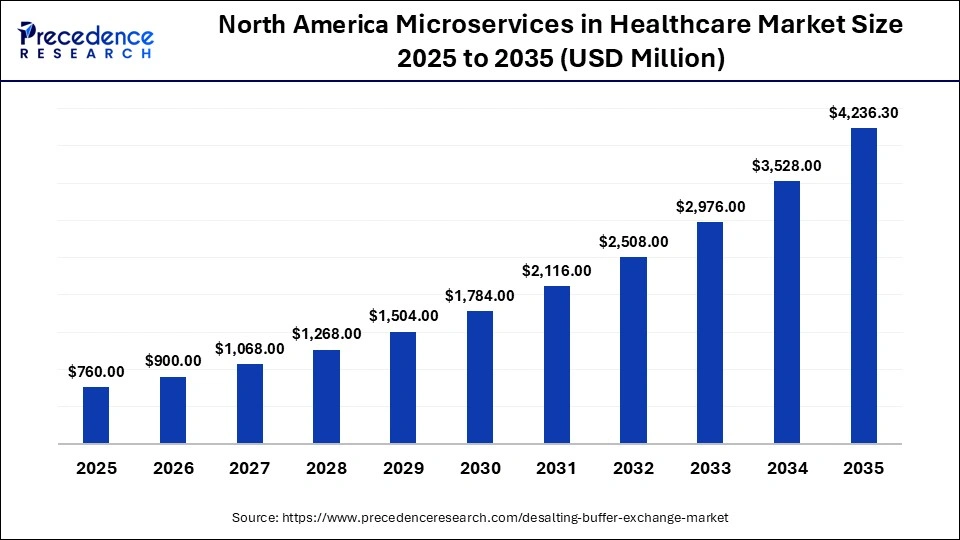
The North America microservices in healthcare market size is estimated at USD 760.00 million in 2025 and is projected to reach approximately USD 4,236.30 million by 2035, with a 18.76% CAGR from 2026 to 2035.
Why Did North America Lead the Microservices in Healthcare Market?
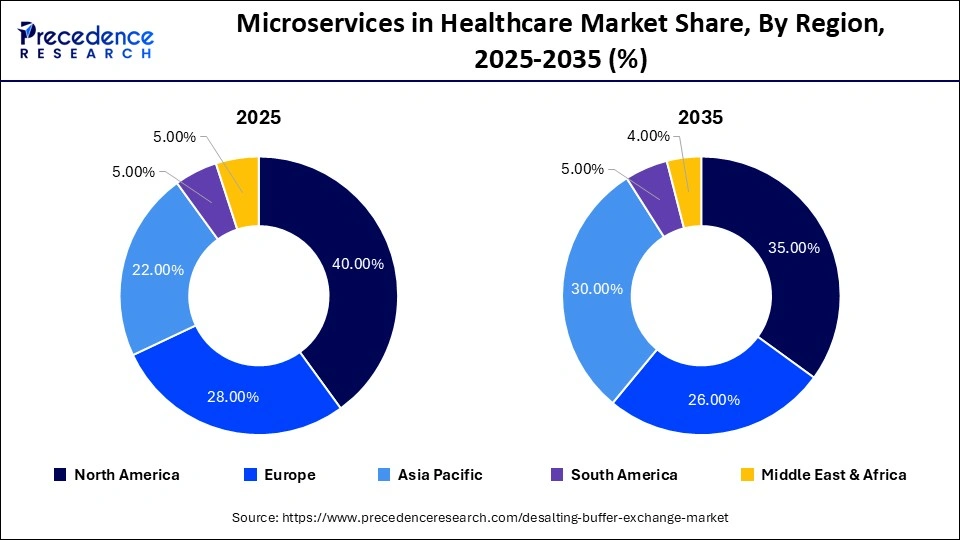
North America dominated the global microservices in healthcare market with a share of 40% in 2025. The region's leadership position is attributed to the heightened need for operational efficiency, the rising transition from monolithic to flexible microservice architecture, and a strong regulatory push. The region has a high concentration of major healthcare technology players and early adoption of containerization technologies. Several healthcare providers are rapidly adopting microservices to streamline operations that facilitate better data exchange and improve patient-centric care models. Advanced healthcare IT infrastructure, high adoption of cloud technologies, presence of major vendors, and strong regulatory frameworks also supported the region's market dominance.
U.S. Microservices in Healthcare Market Size and Growth 2026 to 2035
The U.S. microservices in healthcare market size is calculated at USD 570.00 million in 2025 and is expected to reach nearly USD 3,198.41 million in 2035, accelerating at a strong CAGR of 18.83% between 2026 and 2035.
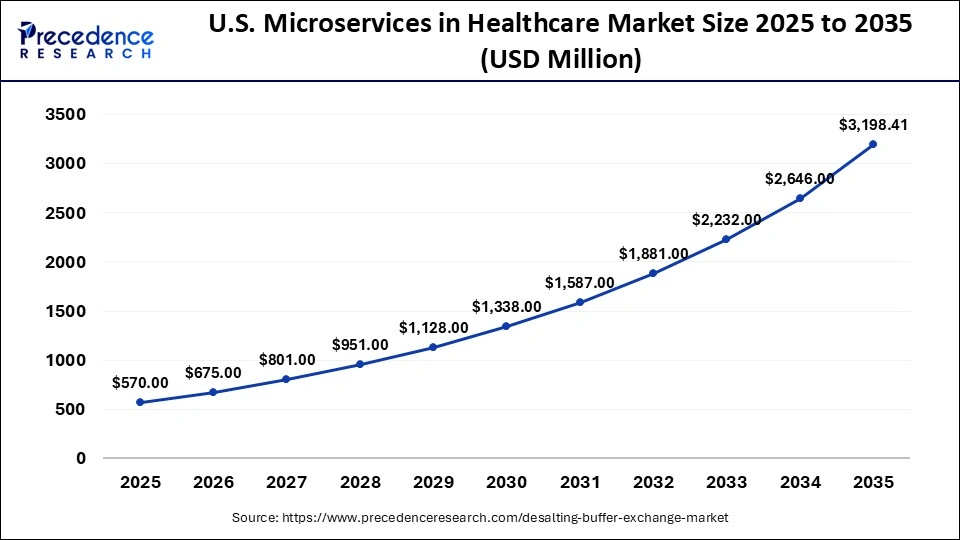
U.S. Microservices in Healthcare Market Analysis
The U.S. is the major contributor to the market within North America. The country's healthcare system is rapidly adopting cloud-based solutions and containerization, which increases the need for microservices for scalability and agility. The country is home to leading market players such as IBM Corporation, Microsoft Corporation, Amazon Web Services (AWS), Oracle Corporation, Google LLC, Salesforce, Inc., Red Hat, Inc. (IBM), VMware, Inc., Cognizant Technology Solutions, Cerner Corporation, Epic Systems Corporation, and others. These players allow healthcare organizations to deploy independent services for Electronic Health Records (EHRs), billing, and telehealth, improving scalability and interoperability. Additionally, the growing need for HIPAA compliance makes microservices more attractive to securely manage sensitive patient data, driving the region's growth during the forecast period.
Asia Pacific: The Fastest-Growing Region
Asia Pacific held a 22% market share in 2025 and is expected to grow at the fastest CAGR during the forecast period. The region's growth is attributed to the rising concentration of leading life sciences & pharma companies, rapid digital transformation, expanding healthcare infrastructure, supportive government framework, and growing adoption of cloud-based solutions. Moreover, the increasing collaboration between IT providers and healthcare organizations in the region is transforming legacy monolithic systems into modular and API-based platforms.
China Microservices in Healthcare Market Analysis
The market in China is growing due to ongoing digital transformation, increasing use of AI in diagnostics, expansion of remote healthcare, and integration of 5G technologies to reduce regional disparities in healthcare access. Growth is further supported by advanced healthcare IT infrastructure, the presence of major vendors, strong regulatory frameworks, and high adoption of cloud technologies. Additionally, the rising shift toward electronic health records (EHR) and telehealth services is significantly propelling market expansion during the forecast period.
Europe: The Second-Largest Market
Europe was the second-largest shareholder, holding a 28% share in 2025, and is expected to grow at a significant rate in the upcoming period. Several European healthcare providers are widely adopting microservices to modernize legacy systems, facilitating faster deployment of new, innovative features and enhanced operational efficiency. The growth of the region is attributed to the rapid adoption of AI technology, increasing demand for telemedicine, stringent data security requirements (GDPR), a surge in government-led digital health initiatives, rising interoperability requirements, and a rapid shift towards cloud-based adoption.
Germany Microservices in Healthcare Market Analysis
Germany is experiencing significant growth in the market, driven by the strong presence of leading market players, government-led digitalization initiatives, and increasing demand for scalable and resilient cloud-native infrastructure. The growing adoption of digital technologies, the rising need for efficient care delivery, and the rapid expansion of telemedicine are further supporting market growth. Additionally, increased public and private investments aimed at upgrading healthcare infrastructure with cloud-based technologies and containerization are enhancing system agility and improving patient care outcomes.
Microservices in Healthcare Market Companies
- IBM Corporation
- Microsoft Corporation
- Amazon Web Services
- Oracle Corporation
- Google LLC
- Salesforce, Inc.
- Red Hat, Inc. (IBM)
- VMware, Inc.
- Infosys Limited
- Tata Consultancy Services (TCS)
- Cognizant Technology Solutions
- Wipro Limited
- HCL Technologies
- Cerner Corporation (Oracle Health)
- Epic Systems Corporation
Recent Developments
- In March 2025, InfoMC, a leading provider of cloud-based care management solutions, announced a cutting-edge upgrade to its technology platform, incorporating a microservices-based, composable architecture, full FHIR interoperability, and a state-of-the-art user interface powered by Microsoft Blazor. These technological advancements mark a crucial step forward in delivering a more scalable, flexible, and smooth experience for InfoMC's customers, including health plans, payers, and provider organizations.(Source: https://www.infomc.com)
- In March 2024, NVIDIA announced the launch of more than two dozen new microservices that allow healthcare enterprises worldwide to take advantage of the latest advances in generative AI from anywhere and on any cloud. The latest NVIDIA healthcare microservices offer optimized NIM AI models and workflows, utilizing industry-standard APIs, to serve as essential building blocks for developing and deploying cloud-native applications.(Source: https://investor.nvidia.com)
Segment Covered in the Report
By Component
- Platform & Tools
- API Management Tools
- Containerization Tool
- Integration Platforms
- Services
- Consulting Services
- Implementation & Integration
- Support & Maintenance
By Deployment Mode
- On-Premises
- Hospital Data Centers
- Enterprise IT Systems
- Cloud-Based
- Public Cloud
- Private Cloud
- Hybrid Cloud
By Application
- Clinical Management Systems
- Electronic Health Records
- Patient Monitoring Systems
- Healthcare Data Analytics
- Predictive Analytics
- Population Health Management
- Telehealth & Remote Monitoring
- Virtual Care Platforms
- Remote Patient Monitoring
- Billing & Revenue Cycle Management
- Claims Processing
- Payment Systems
By End User
- Healthcare Providers
- Hospitals
- Clinics
- Healthcare Payers
- Insurance Companies
- Life Sciences & Pharma Companie
- Drug Development
- Clinical Trials
- Others
- HealthTech Companies
By Region
- North America
- Latin America
- Europe
- Asia-pacific
- Middle and East Africa
For inquiries regarding discounts, bulk purchases, or customization requests, please contact us at sales@precedenceresearch.com
Frequently Asked Questions





Ask For Sample
No cookie-cutter, only authentic analysis – take the 1st step to become a Precedence Research client
 Get a Sample




 sales@precedenceresearch.com
 Schedule a Meeting
