



Military Helicopter Market Size, Share and Trends 2026 to 2035
Military Helicopter Market (By Helicopter Type: Multi-role/Utility Helicopters, Attack Helicopters, Transport/Heavy-lift Helicopters, Maritime/Naval Helicopters, Reconnaissance/Light Helicopters; By Engine Type: Twin-engine Helicopters, Single-engine Helicopters; By Maximum Takeoff Weight (MTOW): Light Helicopters (<5 tons), Medium Helicopters (5–10 tons), Heavy Helicopters (>10 tons); By Mission/Application: Combat & Attack Missions, Tactical Transport & Logistics Support, ISR (Intelligence, Surveillance & Reconnaissance), Search & Rescue (SAR)/MEDEVAC, Maritime Patrol & ASW Operations) - Global Industry Analysis, Size, Trends, Leading Companies, Regional Outlook, and Forecast 2026 to 2035
Source: https://www.precedenceresearch.com/military-helicopter-market
 Get a Sample
 Table Of Content


What is Military Helicopter Market Size in 2026?
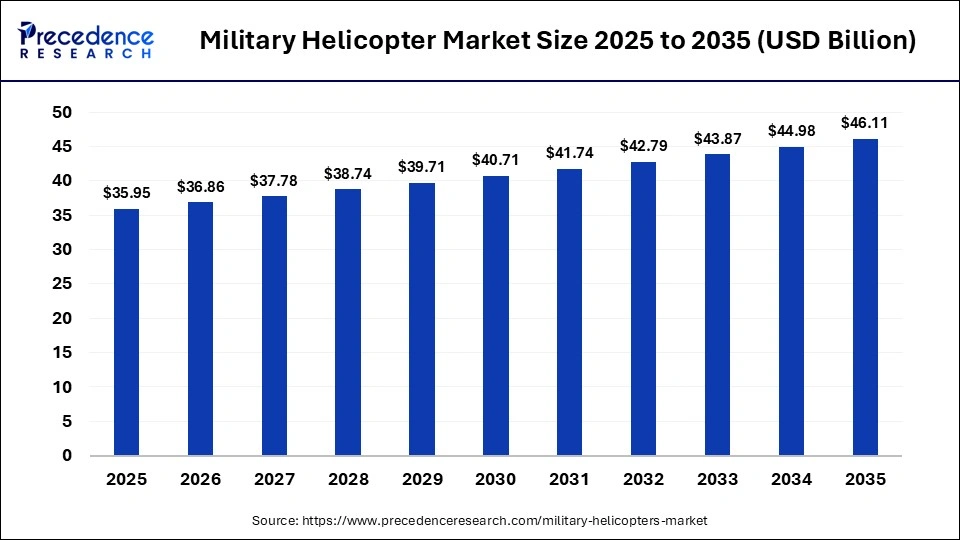
The global military helicopter market size was calculated at USD 35.95 billion in 2025 and is predicted to increase from USD 36.86 billion in 2026 to approximately USD 46.11 billion by 2035, expanding at a CAGR of 2.52% from 2026 to 2035. The market growth is attributed to rising defense modernization programs and sustained demand for multi-mission rotary-wing capabilities.
Key Takeaways
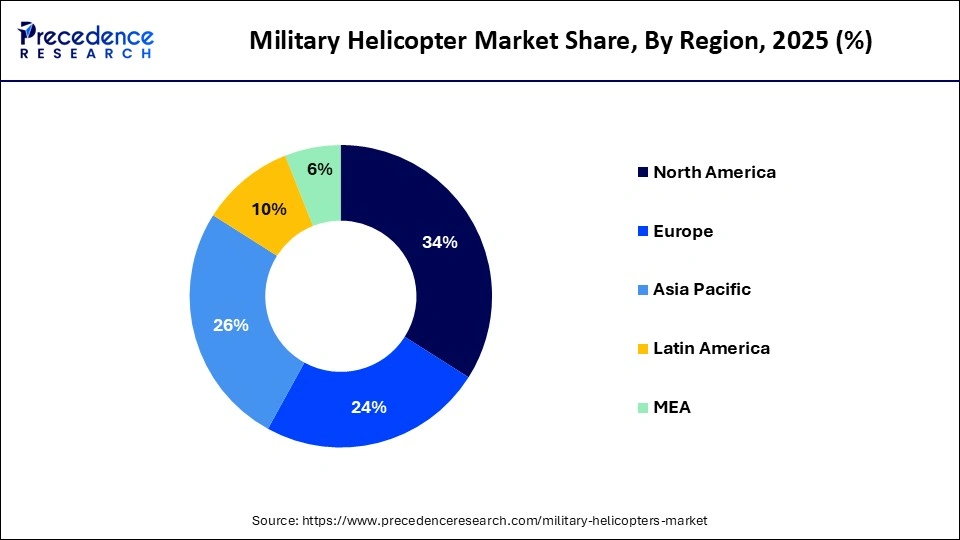
- North America dominated the market with approximately 34% of the market share in 2025.
- Asia-Pacific is expected to grow at the fastest CAGR between 2026 and 2035.
- By helicopter type, the multi-role/utility helicopters segment contributed the highest military helicopter market share of approximately 34% in 2025.
- By helicopter type, the maritime/naval helicopters segment is expected to grow at a strong CAGR between 2026 and 2035.
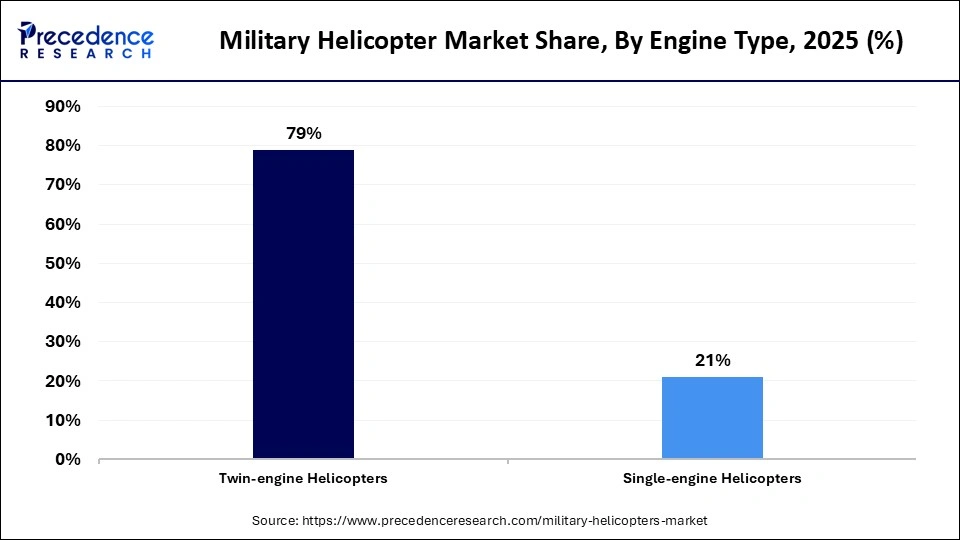
- By engine type, the twin-engine helicopters segment held a dominant revenue share of approximately 79% in the market in 2025 and is expected to maintain its position in the upcoming period.
- By maximum takeoff weight (MTOW), the medium-helicopters (5-10 tons) segment captured the highest market share of approximately 44% in 2025.
- By maximum takeoff weight (MTOW), the heavy helicopters segment is poised to grow at a healthy CAGR in the coming years.
- By mission/application, the tactical transport and logistics support segment generated the biggest market share of approximately 31% in 2025.
- By mission/application, the maritime patrol and ASW operations segment is expected to expand at the fastest CAGR over the studied years.
Which Factors Influence the Military Helicopters Industry?
The military helicopter market is growing as a result of the increased defense expenditures worldwide and modernization aspects. The military spending in the world was at an unprecedented high of 2.7 trillion in 2024, with a yearly growth of 10 years globally. This growth aids in the expansion of greater procurement and upgrade expenditure on rotary wing platforms in numerous nations. Furthermore, the innovation and fleet modernization continue to act as key market drivers supporting the long‑term growth trajectory of the military helicopter sector.
Impact of Artificial Intelligence on the Military Helicopter Market
Artificial intelligence (AI) is transforming the operation of military helicopters, making them smarter, safer, and more autonomous, and real-world uses of this technology are already being implemented. The U.S. Department of Defense awarded Sikorsky a USD 6 million DARPA contract to integrate AI‑driven autonomous flight systems into UH‑60M Black Hawk helicopters for tests planned in 2025. This enables reduced pilot workload and enhanced mission flexibility. Furthermore, machine learning is used to predict the health of engine components and save on maintenance costs, and optimize how the helicopters are available to the government.
Military Helicopter Market Trends
- Autonomy and Uncrewed Operations Driving Market Expansion
The combination of autonomous and uncrewed helicopters is driving the next-generation rotary-wing platforms. The U.S. and the UK are also investing in autonomous large-helicopters to increase ISR, surveillance, and anti-submarine, thereby spawning a wider market adoption in the allied and emerging markets. - Next Gen Powerplants and Hybrid Propulsion Boosting Market Technology
The innovation in military helicopters is being driven by investment in high-tech engines and hybrid propulsion systems. This technology-driven trend is fueling market growth as militaries seek high-performance platforms capable of extended missions and lower operational costs, expanding both legacy and new fleet orders.
Military Helicopter Market Growth Factors
- Fleet Replacement Cycles Accelerating: Aging rotary-wing platforms are driving procurement programs to modernize operational helicopter fleets.
- Rising Maritime Security Requirements: Expanding naval patrol and ASW needs are boosting demand for shipborne helicopter deployments.
- Growing Emphasis on Rapid Mobility: Military doctrines are propelling helicopter adoption for fast troop movement and logistics support.
Military Helicopter Market – High-Value Procurement Momentum, Fleet Modernization, and Geopolitically Driven Acquisition Dynamics
- Airbus Helicopters recorded significant global military helicopter orders in 2025, logging 544 gross orders (536 net) from 205 customers in 50 countries, with the military share of total orders rising sharply, and 392 total helicopter deliveries during the year, reflecting heightened defence procurement demand.
- The U.S. State Department approved the potential sale of up to 36 AH-64E Apache attack helicopters to South Korea, valued at approximately USD 3.5 billion in 2024, indicating sustained Foreign Military Sales (FMS) procurement activity in Asia-Pacific defence markets.
- Spain is undertaking one of Europe's largest helicopter fleet expansion programs, placing orders for 100 military rotorcraft in 2025, including 50 H145Ms and 31 NH90s for its Army, Navy, and Air Force, along with first acquisitions of H175M medium twins, as part of broad defense modernization efforts.
- The NATO Helicopter Management Agency (NAHEMA) signed contracts with NHIndustries exceeding €600 million (~USD 648 million) in 2024–2025 to deliver Software Release 3 upgrades and standardised configurations for the NH90 fleet used by Belgium, Germany, Italy, and the Netherlands, reflecting deep multinational sustainment cooperation.
- The U.S. approved major new arms packages to Middle East allies in early 2026, including USD3.8 billion for 30 AH-64 Apache attack helicopters and USD 150 million for light utility helicopters to Israel, and a USD9 billion arms sale to Saudi Arabia amid heightened regional tensions, underlining how Middle East security pressures drive heavy helicopter procurement.
Market Scope
| Report Coverage | Details |
| Market Size in 2025 | USD 35.95 Billion |
| Market Size in 2026 | USD 36.86 Billion |
| Market Size by 2035 | USD 46.11 Billion |
| Market Growth Rate from 2026 to 2035 | CAGR of 2.52% |
| Dominating Region | North America |
| Fastest Growing Region | Asia Pacific |
| Base Year | 2025 |
| Forecast Period | 2026 to 2035 |
| Segments Covered | Helicopter Type,Engine Type, Maximum Takeoff Weight,Mission/Application, and region |
| Regions Covered | North America, Europe, Asia-Pacific, Latin America, and Middle East & Africa |
Segmental Insights
Helicopter Type Insights
Why Did the Multi-Role/Utility Helicopters Segment Dominate the Military Helicopter Market?
The multi-role/utility helicopters segment dominated the market in 2025, accounting for an estimated 34% market share, due to the unmatched operational versatility and widespread procurement across major defense forces. Furthermore, the demand for multi‑role helicopters is driven by defense strategies that emphasize readiness across diverse operational environments while maintaining cost‑efficient life cycle management.
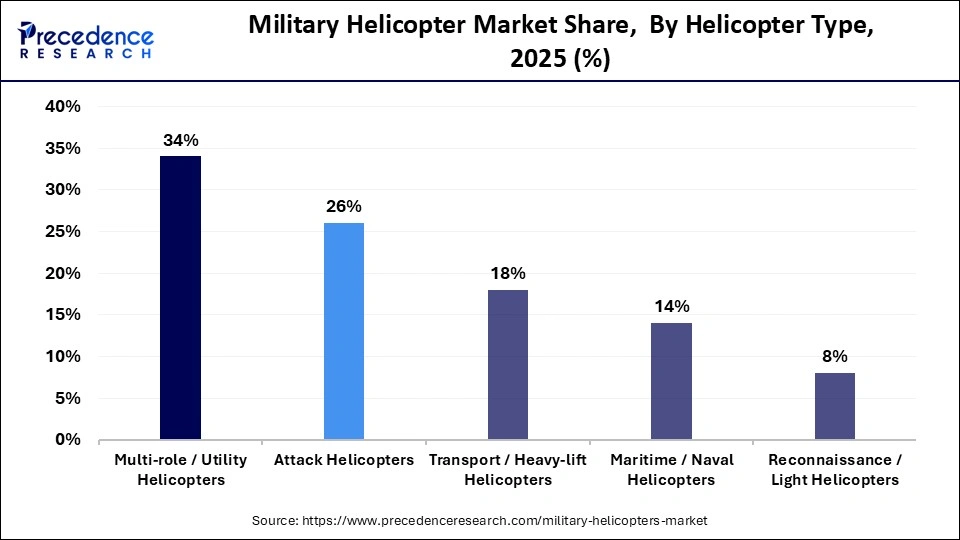
The maritime/naval helicopters segment is expected to grow at the fastest CAGR in the coming years, as littoral and blue water operations in the future require the specific maritime rotorcraft. National waters, sea lines of communication, and economic exclusion zones are becoming increasingly guarded by nations.
This provokes the greater investments in anti-submarine warfare (ASW), anti-surface warfare, and shipborne surveillance helicopters. Moreover, the continued budget allocations earmarked for naval aviation upgrades and new shipborne helicopter acquisitions are likely to sustain this sub-segment's rapid growth.
Engine Type Insights
How the Twin‑Engine Helicopters Segment Dominated the Military Helicopter Market?
The twin-engine helicopters segment held a dominant revenue share of approximately 79% in the market in 2025 and is expected to expand rapidly in the market in the coming years, due to its high reliability and safety for the mission, compared with single-engine designs. They have been preferred over single-engine designs in most military operations worldwide. Furthermore, the usability of these types of helicopters in rough terrain and hostile conditions, where a failure of a single turbine can endanger missions, further fuels segment growth.
Maximum Takeoff Weight (MTOW) Insights
Why Did the Medium Helicopters (5–10 Tons) Segment Dominate the Military Helicopter Market?
The medium helicopters (5–10 tons) segment accounted for the highest revenue share of approximately 44% in the market in 2025, due to their operation balancing and versatility in achieving missions. This class was used by the defense forces for troop transport, tactical attack, logistical support, and medical evacuation operations. Additionally, modernization efforts took a more consistent shape towards medium platforms that were capable of absorbing the latest avionics, self-protection systems, and network-centric warfare systems.
The heavy helicopters (>10 tons) segment is expected to witness the fastest growth in the market over the forecast period, owing to the increasing strategic lift demands. Military forces are placing an increasing emphasis on platforms that convey armored combat gear, artillery, and oversized cargoes. Furthermore, the defense ministries are anticipated to invest more in the next-generation heavy helicopters that are fuel-efficient, thus fuelling the segment growth in the coming years.
Mission/Application Insights
Which Mission/Application Segment Led the Military Helicopter Market?
The tactical transport and logistics support segment led the market with a share of approximately 31% in 2025, as armed forces faced high demand for rapid personnel movement and resupply across multiple theaters in 2025. Governments focus on tactical transport systems that provide troop and equipment, and medical evacuation services in contested or austere environments.
In May 2025, Spain received its first two NH90 tactical transport helicopters for use in amphibious and joint logistics, emphasizing the modernization focus on transport. Moreover, the experts noted that logistic helicopter roles played a critical part in expeditionary readiness as defense modernization plans continued through 2025, fostering the segment's growth.
The maritime patrol and ASW operations segment is expected to show the fastest growth over the forecast period, owing to the rising strategic maritime aspects of security in the sea and on the surface. It is expected that governments invest in shipborne ASW helicopters that can be fitted with advanced dipping sonar, sonobuoy systems, and multi-sensor fusion technology. They help to address growing submarine operations in the important maritime areas. Furthermore, strategic doctrines of the Indo-Pacific and NATO forces are anticipated to prioritize the purchase of maritime patrol and ASW rotorcraft into the layered naval defense systems.
Regional Insights
North America Military Helicopter Market Size and Growth 2026 to 2035
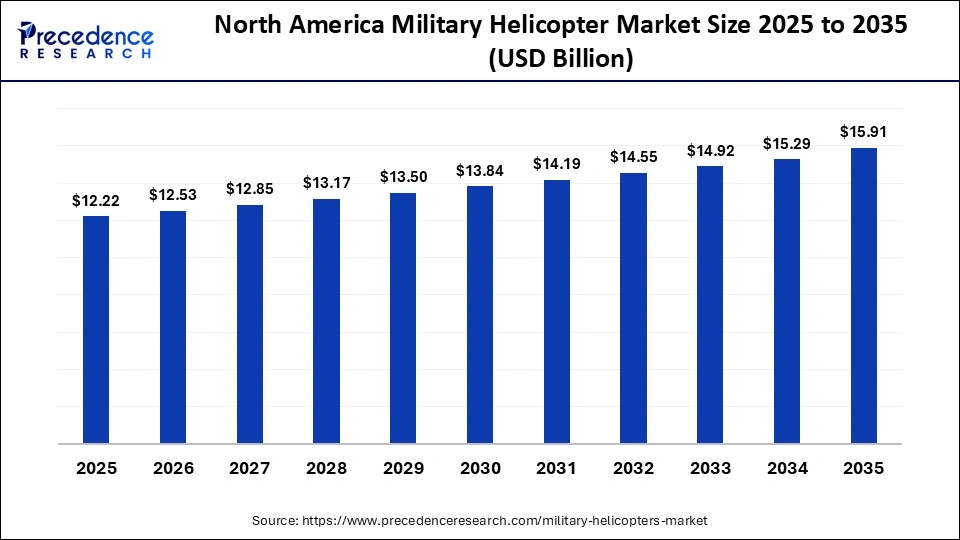
The North America military helicopter market size is estimated at USD 12.22 billion in 2025 and is projected to reach approximately USD 15.91 billion by 2035, with a 2.67% CAGR from 2026 to 2035.
Why Did North America Dominate the Military Helicopter Market?
North America held a major revenue share of approximately 34% in the market in 2025, owing to long-term investment in vertical lift modernization and readiness programs. The U.S. proceeded with the MH-139 Grey Wolf multi-mission helicopter, which made its first operational flight in early 2026, to improve security and support missions of critical installations. Additionally, North America also leveraged a robust industrial and sustainment ecosystem that integrated OEMs, defense suppliers, and fleet sustainment networks, thus propelling the market in this region.
U.S. Military Helicopter Market Size and Growth 2026 to 2035
The U.S. military helicopter market size is calculated at USD 9.17 billion in 2025 and is expected to reach nearly USD 12.01 billion in 2035, accelerating at a strong CAGR of 2.73% between 2026 to 2035.
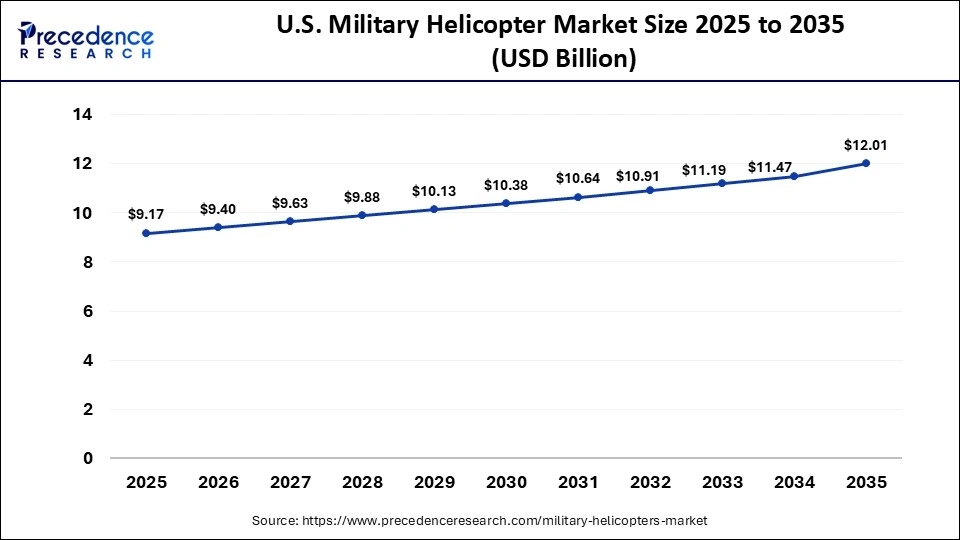
U.S.: Strategic Hub of Advanced Military Helicopter Development
U.S. leads the market, due to the major rotary-wing modernization and sustainment initiatives in 2025 that strengthened combat and support capabilities. In August 2025, Lockheed Martin was also awarded a contract of USD 43 million by the Army to modernize Black Hawk fleets with digital engineering capabilities. Moreover, a combination of sustained government focus and industrial capability is expected to fuel the regional helicopter leadership in the market.
Why Is Asia-Pacific Expected to Drive the Next Wave of Rotary-Wing Growth?
Asia-Pacific is expected to host the fastest-growing military helicopter market in the coming years, owing to the shifting strategic priorities, expanding defense autonomy goals, and a surge in helicopter acquisitions across multiple countries. In March 2025, the Indian Ministry of Defence signed an acquisition contract with 156 HAL Prachand light combat helicopters to enable them to operate at high altitudes and enhance the force mobility. Furthermore, the Asia-Pacific strategic planners predicted that a multiplicity of missions, such as high-altitude border security and maritime surveillance, is expected to fuel a long-term increase in helicopter deliveries and aerospace involvement in the region as far as the mid-2020s.
India: Emerging Powerhouse in Indigenous Military Helicopter Expansion
India is leading the charge in the Asia-Pacific market, due to its defense and localized production of helicopters. Indian defence planning also started making plans to procure new reconnaissance and support helicopters in 2025 to replace the ageing Chetak and Cheetah fleets, signalling a wider rejuvenation of the rotary-wing capabilities. Moreover, these measures enhanced the operational flexibility in India, both on the land and sea fronts, and enhanced its dominance in helicopter development in the Asia-Pacific.
Recent Developments in the Military Helicopter Market
- In January 2026, Airbus and Tata Advanced Systems Limited (TASL) announced the launch of India's first private-sector helicopter Final Assembly Line (FAL) for the Airbus H125, located in Vemagal, Karnataka. The facility is expected to accelerate regional supply chain localization and unlock new growth opportunities across the South Asian rotorcraft market, spanning civil, utility, and parapublic applications.
- In October 2025, Airbus Helicopters and Aerovel formalized an agreement for Airbus to acquire Aerovel and its Flexrotor unmanned aerial system (UAS). Designed for both maritime and land-based operations, Flexrotor enhances persistent surveillance capabilities, underscoring Airbus' growing focus on integrated crewed–uncrewed rotorcraft ecosystems.
Military Helicopter Market Companies
- Airbus Helicopters SAS
- Bell Helicopters
- Boeing Company
- Hindustan Aeronautics Limited (HAL)
- Kawasaki Heavy Industries
- Leonardo Helicopters
- Lockheed Martin Corporation
- MD Helicopters
- Russian Helicopters (Rostec)
Segments Covered in the Report
By Helicopter Type
- Multi-role/Utility Helicopters
- Tactical troop transport
- Cargo lift missions
- Attack Helicopters
- Transport/Heavy-lift Helicopters
- Maritime/Naval Helicopters
- Reconnaissance/Light Helicopters
By Engine Type
- Twin-engine Helicopters
- Single-engine Helicopters
By Maximum Takeoff Weight (MTOW)
- Light Helicopters (<5 tons)
- Medium Helicopters (5–10 tons)
- Heavy Helicopters (>10 tons)
By Mission/Application
- Combat & Attack Missions
- Tactical Transport & Logistics Support
- ISR (Intelligence, Surveillance & Reconnaissance)
- Search & Rescue (SAR)/MEDEVAC
- Maritime Patrol & ASW Operations
By Region
- North America
- Europe
- Asia-Pacific
- Latin America
- Middle East & Africa
For inquiries regarding discounts, bulk purchases, or customization requests, please contact us at sales@precedenceresearch.com
Frequently Asked Questions
Tags





Ask For Sample
No cookie-cutter, only authentic analysis – take the 1st step to become a Precedence Research client
 Get a Sample




 sales@precedenceresearch.com
 Schedule a Meeting
