



Molded Interconnect Device Market Trends, Companies, Revenue / Sales Performance, Manufacturing Yield, Fab Capacity, Export & Import Dynamics, Supply Chain Analysis, Competitive Landscape, and Growth Forecast
Molded Interconnect Device Market (By Process: Laser Direct Structuring (LDS), Two-shot Molding, Film Techniques; By Product Type: Antennae & Connectivity Modules, Sensors, Connectors & Switches, Lighting Systems, Others; By Vertical: Telecommunication, Automotive, Medical, Industrial, Military & Aerospace, Consumer Electronics) - Global Industry Analysis, Size, Trends, Leading Companies, Regional Outlook, and Forecast 2026 to 2035
Source: https://www.precedenceresearch.com/molded-interconnect-device-market
 Get a Sample
 Table Of Content


What is the Molded Interconnect Device Market Size in 2026?
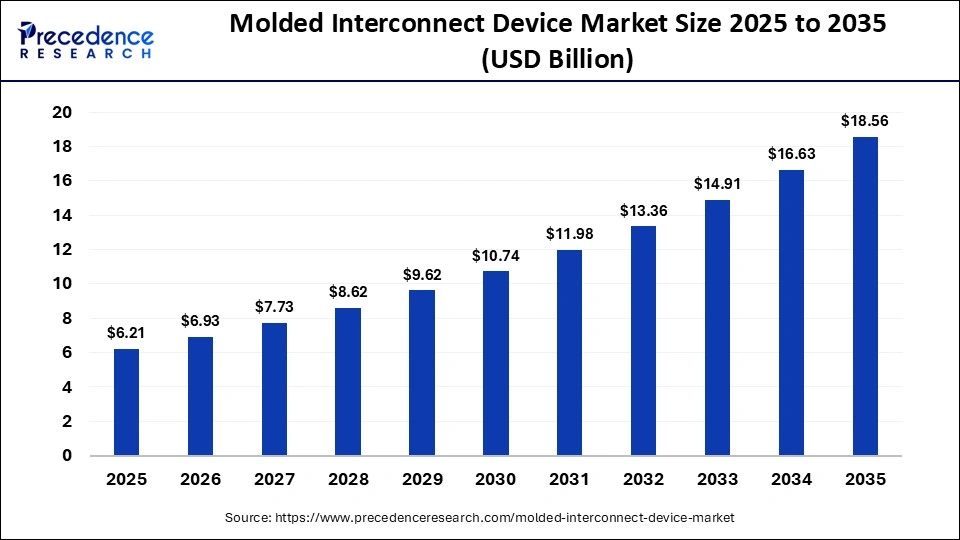
The global molded interconnect device market size was calculated at USD 6.21 billion in 2025 and is predicted to increase from USD 6.93 billion in 2026 to approximately USD 18.56 billion by 2035, expanding at a CAGR of 11.57% from 2026 to 2035. The market is growing rapidly due to rising demand for compact, lightweight, and multifunctional electronic components in automotive, consumer electronics, and healthcare applications.
Key Takeaways
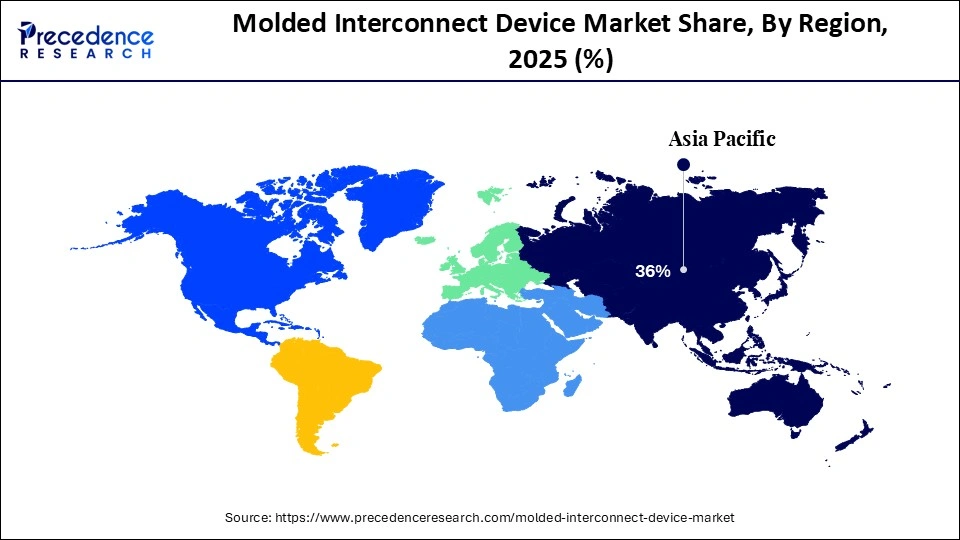
- Asia Pacific led the molded interconnect device market with the largest market share of 36% in 2025.
- North America is expected to grow at a significant CAGR during the forecast period.
- By product type, the antennae & connectivity modules segment held the largest share of the market in 2025.
- By product type, the sensors segment is expected to expand with the highest CAGR during the forecast period.
- By process, the laser direct structuring (LDS) segment dominated the market in 2025.
- By process, the film techniques segment is expected to grow with the fastest CAGR during the forecast period.
- By vertical, the telecommunication segment held the highest share of the market in 2025.
- By vertical, the consumer electronics segment is expected to grow at the highest CAGR during the forecast period.
Market Overview
The molded interconnect device market deals with the production and distribution of 3D, injection-molded thermoplastic parts with integrated, selective metallization for electronics circuits. These devices combine a mechanical component/housing with electrical functionality to eliminate the requirement of traditional wiring and PCBs. MID helps in reducing weight, saving space, and designing complex parts for the end-users.
MIDs are widely used in wearable devices, smartphones, IoT systems, and infotainment solutions to support various wireless connectivity technologies, including Bluetooth, Wi-Fi, and 5G. The integration of an antenna in molded components enables device manufacturers to reduce dimensions, enhance connectivity, and reduce assembly complexity. The surging demand for miniaturization from the consumer electronics industry, as well as technological advancements in the industrial sector, has driven the industrial expansion. This industry is expected to grow significantly with the rise of the EV sector across the world.
How is AI Influencing the Molded Interconnect Device Market?
AI plays a significant role in shaping the landscape of the molded interconnect device industry. In this sector, AI enhances the design of complex 3D circuits on molded components by reducing prototyping cycles, optimizing layouts, and analyzing material behavior. In LDS (Laser Direct Structuring), AI enables high-accuracy and 3D circuit pattern creation on plastic surfaces, which is critical for miniaturization. Additionally, AI-enabled machine vision systems help in identifying microscopic defects in MID components to ensure superior reliability and high consistency after manual inspection.
- In March 2026, Samba Photonics Lab launched AI connectivity with high-performance chip-to-fiber coupling solutions. This AI-based fiber coupling solution allows nano-scale data-controlled mass production, which delivers high-precision consistency and scalability for the manufacturing sector.
Molded Interconnect Device Market Trends
- Product Launches: Numerous electronic companies are engaged in launching a wide range of molded devices for the end-user industries.
- Collaborations: Various market players are collaborating with aerospace companies to integrate advanced electronic devices in missiles and drones.
- Government Initiatives: The governments of several countries are launching various initiatives to strengthen the electronics industry.
- Business Expansions: Several molded device manufacturing brands are investing heavily in opening new production centers to increase the manufacturing of molded interconnect devices.
- High Adoption of EVs: The adoption of EVs has grown significantly to lower emissions and reduce dependency on fossil fuels.
Rapid Expansion of the 5G Infrastructure: The telecom operators are expanding 5G networks in developed nations to deliver high-speed internet across the industrial sector.
Market Scope
| Report Coverage | Details |
| Market Size in 2025 | USD 6.21 Billion |
| Market Size in 2026 | USD 6.93 Billion |
| Market Size by 2035 | USD 18.56 Billion |
| Market Growth Rate from 2026 to 2035 | CAGR of 11.57% |
| Dominating Region | Asia Pacific |
| Fastest Growing Region | North America |
| Base Year | 2025 |
| Forecast Period | 2026 to 2035 |
| Segments Covered | Process, Product Type, Vertical, and region |
| Regions Covered | North America, Europe, Asia-Pacific, Latin America, and Middle East & Africa |
Segment Insights
Product Type Insights
Why Did the Antennae & Connectivity Modules Segment Dominate the Market?
The antennae & connectivity modules segment dominated the molded interconnect device market in 2025. This is because of the rising demand for compact, lightweight, and high-performance antennas in automotive, consumer electronics, and telecom applications. These modules enable space-saving designs, improved signal transmission, and multifunctional integration, making them essential in devices like smartphones, connected cars, and IoT equipment. Additionally, increasing adoption of 5G and wireless communication technologies has further fueled the segment's market leadership.In November 2025, KYOCERA AVX launched a new LDS cap antenna. This antenna is designed for Iridium satellite IoT applications.
The sensors segment is expected to expand at the highest CAGR during the forecast period. This is due to the growing demand for lightweight and compact integrated electronic components from the end-user industries. MID-based sensors are mainly used in consumer electronics, automotive systems, industrial automation, and healthcare industries. The surging integration of ADAS in modern vehicles, along with the surging popularity of IoT-enabled devices, has further increased the application of MID sensors.
Process Insights
What Made Laser Direct Structuring (LDS) the Leading Segment in the Molded Interconnect Device Market?
The laser direct structuring (LDS) segment dominated the molded interconnect device market in 2025, due to its enhanced precision, high design flexibility, and improved efficiency for manufacturing complex three-dimensional circuit structures. Laser direct structuring technology enables manufacturers to activate specific areas of plastic materials through laser to improve their conductivity. This technology is rapidly adopted in a wide range of industries, such as automotive, consumer electronics, telecom, and defense. It is useful for manufacturing advanced sensors and connectivity modules to enhance the capabilities of smartphones and wearables.
The film techniques segment is expected to expand with the fastest CAGR during the forecast period, owing to their enhanced effectiveness in manufacturing reliable and affordable electronic circuits on three-dimensional plastic components. Film technique is initiated by applying pre-patterned conductive films or flexible circuits to molded parts to enable the integration of electric pathways without any complexity. This production method is adopted by market players to develop advanced circuits with stable performance and portability. The automotive and consumer electronics companies are widely utilizing this process for manufacturing various components, including control modules, sensors, and LED lighting systems.
Vertical Insights
What Made Telecommunication the Leading Segment in the Molded Interconnect Device Market?
The telecommunication segment led the market while holding the highest share in 2025. This dominance is attributed to the surging demand for high-performance components in modern communication equipment. Molded interconnect devices help telecom companies to manufacture several components, such as miniature antenna modules, connectors, and communication sensors. These components are used in 5G routers, modems, and telecom towers to enhance network connectivity across the globe.
The consumer electronics segment is expected to expand with the highest CAGR during the forecast period, owing to the increasing demand for lightweight and portable electronic devices from consumers. MIDs are used in the production of sensors that are used in numerous types of consumer electronics products, including laptops, microphones, smartphones, wearables, and LED modules. The surging popularity of smart homes among elite-class consumers, as well as the increasing sales of IoT devices globally, has increased the application of molded interconnect devices.
- In January 2024, Hollyland launched LARK M2. LARK M2 is a wireless lavalier microphone based on a high-gain LDS (Laser Direct Structuring) antenna, which reduces signal blockage by the human body to provide stable and uninterrupted audio transmission.
Regional Insights
Asia Pacific Molded Interconnect Device Market Size and Growth 2026 to 2035
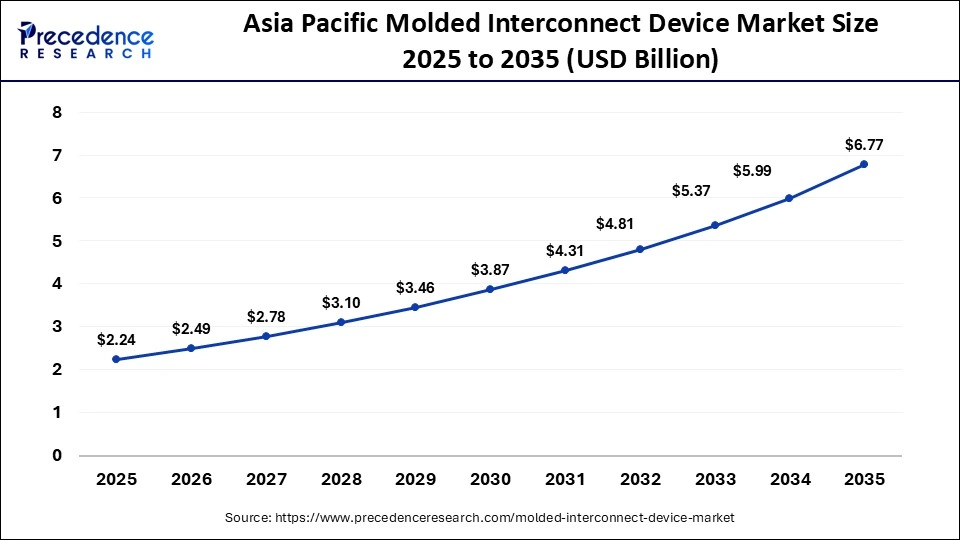
The Asia Pacific molded interconnect device market size is expected to be worth USD 6.77 billion by 2035, increasing from USD 2.24 billion by 2025, growing at a CAGR of 11.70% from 2026 to 2035.
Why Did Asia Pacific Dominate the Molded Interconnect Device Market?
Asia Pacific dominated the molded interconnect device market in 2025, owing to the increasing adoption of EVs in China and India to lower CO2 emissions, coupled with the surging production and sales of smartphones. This region is home to several market players, such as Mitsubishi Electric and Sumitomo Electric Industries. These companies are engaged in research and development to utilize LDS technology for manufacturing MIDs, which drives the market expansion. Moreover, the rapid investment by the government for strengthening the electronics, as well as the increase in the number of drone manufacturers, propels industrial growth.
- In January 2025, the government of India invested US$ 2.92 billion. This investment is made to strengthen the electronics component industry in this country.
Japan Molded Interconnect Device Market Analysis
Japan is one of the leading contributors to the molded interconnect device industry in the Asia Pacific region, due to the rapid deployment of robots in the manufacturing sector, as well as constant efforts made by telecom companies to expand 6G networks. Moreover, the presence of numerous electronics companies such as Sony, Panasonic, and Toshiba increases the demand for MIDs.
Why is North America Expanding with a Significant CAGR in the Market?
North America is expected to expand at a significant CAGR during the forecast period, due to the increasing demand for advanced lighting systems from the automotive manufacturers, such as Rivian, General Motors, and Ford. The surging investment by defense companies in opening new production centers, as well as the growing emphasis of the government on automating the industrial sector, has played a prominent role in the development of this industry. The increase in the number of medical device startups, coupled with ongoing space-research activities operated by NASA and CSA, further propels the market expansion.
- In October 2025, Raytheon invested US$ 53 million. This investment is made to open a radar sensor production facility in Andover, Mass, U.S.
Canada Molded Interconnect Device Market Trends
Canada is a major contributor to the molded interconnect device industry in North America, due to the rapid deployment of Wi-Fi networks in public areas, as well as the surging adoption of smart lights in the residential sector. In addition, the growing investment by the government in developing the semiconductor industry, along with technological advancements in the industrial sector, has proliferated industrial development.
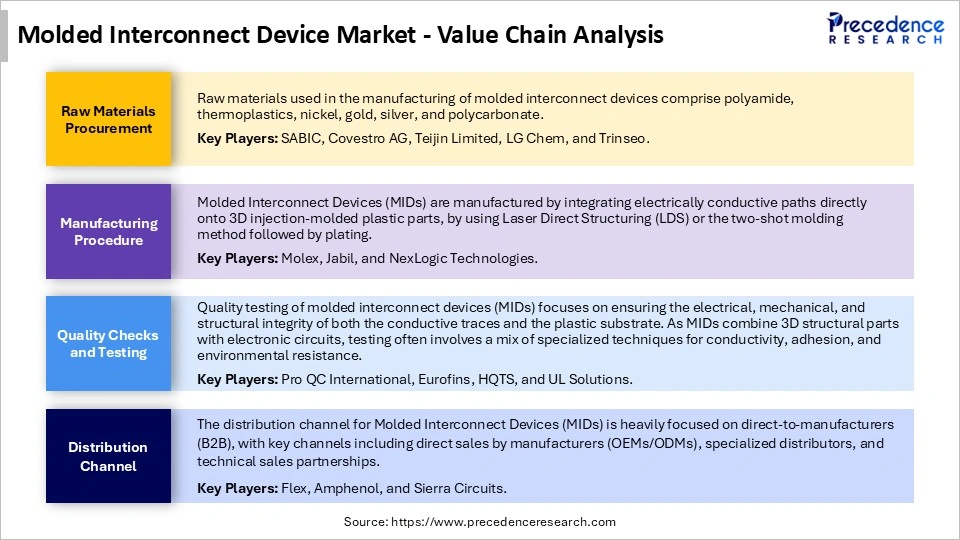
Molded Interconnect Device Market Value Chain Analysis
Molded Interconnect Device Market Companies
- Amphenol (U.S.)
- TE Connectivity (U.S.)
- Molex (U.S.)
- Flex (U.S.)
- Jabil (U.S.)
- NexLogic Technologies (CA)
- Mitsubishi Electric (JP)
- Sierra Circuits (U.S.)
Recent Developments
- In February 2026, Molex launched impress co-packaged copper solutions. These solutions are designed for meeting the needs of the next-generation data centers by delivering superior-speed data transmission and exceptional signal integrity.(Source: https://www.molex.com)
- In October 2025, TE Connectivity launched a new range of components named ‘inside device connectivity portfolio.' This range of interconnectors is used in ECUs, ADAS, BMS, and CMC in modern vehicles.(Source: https://www.te.com)
- In April 2025, Naxnova Technologies opened a new research and development center in India. This R&D center was established to develop high-quality flexible electronic devices for several industries, such as medical wearables, automotive, robotics, industrials, aerospace, and consumer electronics. (Source: https://www.businesstoday.in)
- In April 2025, Apes launched Matrix6D. Matrix6D is an additive manufacturing platform designed for the production of flexible electronic systems.(Source: https://3dprintingindustry.com)
- In October 2024, Amphenol launched the aluminum-copper (Al-Cu) inline splice. Aluminum-Copper (Al-Cu) Inline Splice is an interconnect device that finds application in solar PV installations.(Source: https://www.tpil.com)
Segments Covered in the Report
By Process
- Laser Direct Structuring (LDS)
- Two-shot Molding
- Film Techniques
By Product Type
- Antennae & Connectivity Modules
- Sensors
- Connectors & Switches
- Lighting Systems
- Others
By Vertical
- Telecommunication
- Automotive
- Medical
- Industrial
- Military & Aerospace
- Consumer Electronics
By Region
- North America
- Latin America
- Europe
- Asia-pacific
- Middle and East Africa
For inquiries regarding discounts, bulk purchases, or customization requests, please contact us at sales@precedenceresearch.com
Frequently Asked Questions





Ask For Sample
No cookie-cutter, only authentic analysis – take the 1st step to become a Precedence Research client
 Get a Sample




 sales@precedenceresearch.com
 Schedule a Meeting
