



Next Generation Bioprinting Market Size, Key Companies, Company Production Capacity, Healthcare Infrastructure Growth, Product Utilization, Regulatory Compliance, Company Expansion Strategies, Company Investment Strategies, and Market Outlook
Next Generation Bioprinting Market (By Technology Type: Laser-Based Technology, Extrusion Based Technology, Inkjet-Based Technology, Others; By Application: Biomedical Applications, Others; By End-User: Pharmaceuticals and Biotechnology Companies, Academic Research and Development, Other) - Global Industry Analysis, Size, Trends, Leading Companies, Regional Outlook, and Forecast 2026 to 2035
Source: https://www.precedenceresearch.com/next-generation-bioprinting-market
 Get a Sample
 Table Of Content
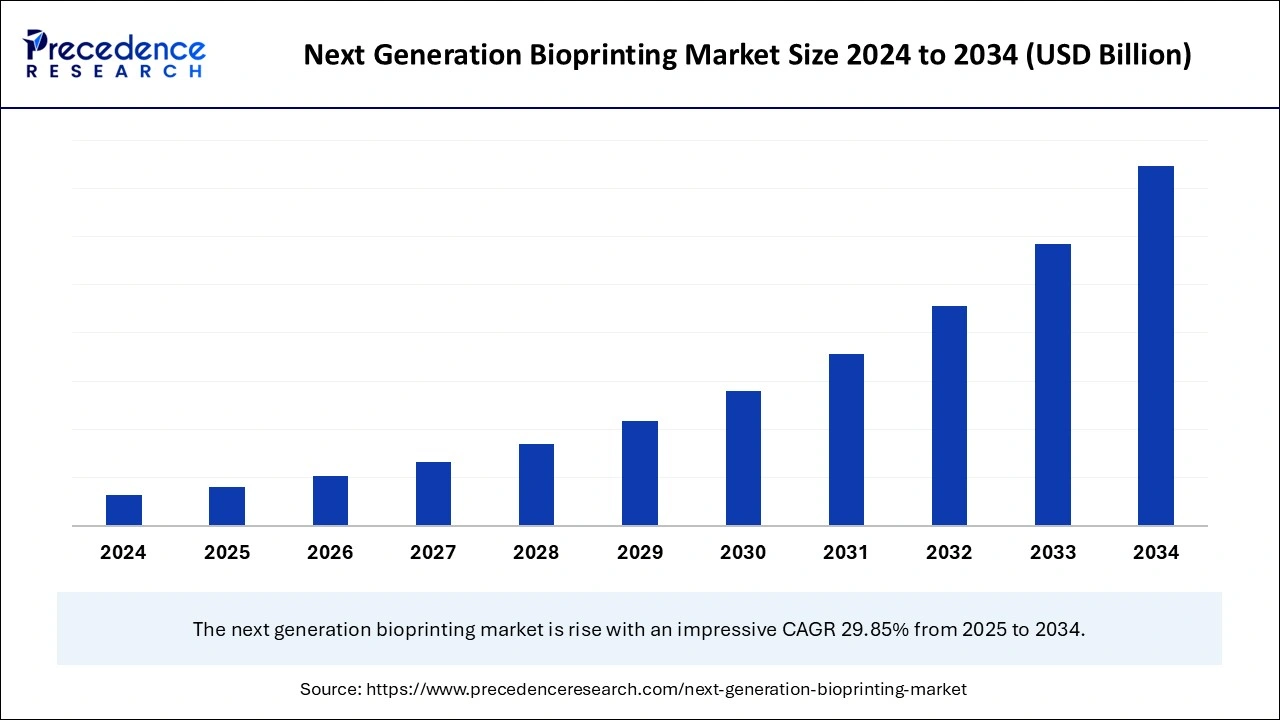
Next Generation Bioprinting Market Size and Forecast 2026 to 2035
The next generation bioprinting market is experiencing significant growth, driven by advancements in technology, expanding applications, and increasing demand across various end-user industries. The demand for next generation bioprinting is increasing due to the growing focus on drug development that focuses on providing accurate medical testing.
Next Generation Bioprinting Market Key Takeaways
- North America dominated the global next generation bioprinting market by generating the highest share in 2025.
- Asia Pacific is anticipated to grow at the highest CAGR of 29.85% during the forecast period of 2026 to 2035.
- Europe held a notable share in 2024 and is anticipated to increase further in the upcoming years
- By technology type, the laser-based segment generated a significant market share in 2025.
- By application, the biomedical segment dominated the global market in 2025.
- By end-user, in 2024, the pharmaceuticals and biology segment marked its dominance by contributing to the highest share.
Market Overview
Next generation bioprinting is the evolution of bioprinting technology that enables the precise fabrication of functional tissues and organs. The process includes the creation of these tissues with the use of links, which are made of living cells. The next generation bioprinting market is witnessing significant growth due to the growing focus on technologies like extrusion-based bioprinting, inkjet bioprinting, and many more, which use various methods to increase process efficiency. Companies are increasing their focus on preprocessing, where the use of 3D biological structures becomes an integral part of bioprinting.
- In January 2025, Poietis launched NGB-R, which is a 4D multimodal bioprinting system that aims to increase precision in tissue fabrication.
How does Artificial Intelligence (AI) Contribute to the Next Generation Bioprinting Market?
The integration of technologies like artificial intelligence and machine learning (ML) is playing a transformative role in the healthcare industry. AI is widely being adopted in medical imaging, such as Magnetic Resonance Imaging (MRI) and Computed Tomography Scans, which help provide accurate 3D models of organs and tissues. The enhanced imaging further leads to the use of technology in printing control that adjusts real-time parameters like speed, pressure, and temperature. The adoption of AI in drug testing is helping to enhance the research, reducing the time consumed and helping to get a better understanding of the situation of the tissues.
Next Generation Bioprinting Market Growth Factors
- The rising prevalence of chronic diseases like heart-related disorders and kidney failures is one of the major growth factors influencing the need for artificial organs, driving the growth of the next generation bioprinting market.
- Organ transplantation is witnessing significant demand, whereas the market is witnessing a shortage of organ donors, which significantly drives the demand for bioprinting organs.
- The increasing drug testing of these tissues in animal testing is also attracting significant demand in the pharmaceutical industry.
- The rising focus on the development of low-cost bioprinters is creating multiple opportunities across the global healthcare industry.
Market Scope
| Report Coverage | Details |
| Market Growth Rate from 2026 to 2035 | CAGR of 29.85% |
| Dominating Region | North America |
| Fastest Growing Region | Asia Pacific |
| Base Year | 2025 |
| Forecast Period | 2026 to 2035 |
| Segments Covered | Technology Type, Application, End-User, and Regions. |
| Regions Covered | North America, Europe, Asia-Pacific, Latin America, and Middle East & Africa |
Market Dynamics
Drivers
Rising focus on 3D printing
The growth of 3D technology has been a crucial factor in the growth of the healthcare industry, where it is being widely used in various applications like CT scans and other tests. The next generation bioprinting market is witnessing significant growth due to the rise of 3D, which is helping to create new biolinks that can be adopted in medical settings. Companies are widely adopting 3D printing, which is helping them boost the growth of bioprinting through precise imaging capabilities. Rapid adoption also helps the industry grow, where technology is cost-effective due to the increasing competitiveness for more affordable technologies in the market.
Commercialization of bio-printed organs
The data from the United States government states that 103,223 men, women, and children are on the national transplant waiting list, and 17 people die regularly waiting for organ transplants. This is the major factor that increases the demand for printed organs that help reduce the waiting time, which could save more human lives. The next generation bioprinting market is witnessing significant growth due to the constant improvements in these links, which is marking a rapid expansion in other medical applications, too. The rising medical tourism is also anticipated to increase the demand for bioprinting in the developing economies.
Restraint
Higher bioprinting costs
The healthcare industry is witnessing rapid technological advancements, including bioprinting, where equipment is the main tool used to control living cells precisely. These factors are the major reasons that add to the cost and stand as a restraint in the next generation of the bioprinting market. The need for specialized infrastructure also acts as a restraint, as various environmental factors add up to these investments, hampering the next generation bioprinting market. These facilities are not usually available in underdeveloped regions due to the shortage of skilled workforce.
Opportunities
Growing focus on R&D in regenerative medicine
The demand for regenerative medicine has been increasing significantly due to its exceptional capabilities in repairing and replacing damaged tissues and organs. The next generation bioprinting market is growing rapidly, and companies are investing heavily in these biotechnologies, which can enhance medical outcomes. The major focus is advancing in tissue engineering, which aims to develop tissues that help in organ repair and wound healing and reduce organ shortage and waiting times. These factors have significantly attracted investments from public and private partnerships, which would help advance global healthcare services.
- In January 2025, Bio-Techne expanded its AI-engineered designer protein portfolio to enhance cell therapy and regenerative medicine.
Rising demand for personalized medicine
The demand for personalized medicine has significantly increased in recent times due to the changing patient preferences toward enhanced and specialized medicine. The next generation bioprinting market is anticipated to expand significantly due to the advancements that allow the customization of tissue and organ implants based on the medical history and genetic profile of the patient. The constant focus on improving cancer therapies stands out as one of the major factors that is anticipated to boost this personalized approach in the upcoming years. The organ donor shortage also becomes a crucial factor that will influence the reduction of reliance and focus on the advancements in bio-printed organs.
Segment Insights
Technology Type Insights
The laser-based segment accounted for a significant share of the market in 2025. The segment refers to the use of laser energy for depositing living cells into a substance that creates a tissue or organ structure. The next generation bioprinting market is witnessing significant demand due to the advancements in laser technology, which provides accurate and precise deposition of cells. It also helps in cell placement, which is crucial for multiple applications. The rising investments in medical research and drug testing are the major factors that have helped the use of laser technology in these applications. The rising demand is also leading to innovations in bio-link formulations and energy control.
Application Insights
The biomedical segment accounted for a significant share of the market in 2025. The segment refers to the use of bio-printed tissues, organs, and structures in various applications like treatment, testing, and many more. The next generation bioprinting market is growing rapidly due to the growing demand for tissue engineering, which aims to reduce organ shortages. This attracts government funding for transplant research that uses these technologies. The growing popularity of personalized implants will also help the market grow in the coming years.
End-User Insights
The pharmaceuticals and biotechnology segment marked its dominance by contributing to the highest share in 2025. The segment involves companies that deal with drug development, biopharmaceutical research, and other applications. The next generation bioprinting market is witnessing massive growth due to the rising focus on drug testing that uses human models and reduces animal testing. This is helping towards the rising demand for bioprinting, where these companies are increasing their funding to expand their portfolio and gain more revenue through these innovations. The rise of 3D also plays a vital role in disease modeling, which can deal with several health conditions like cancer, orang failure, and many more.
Regional Insights
North America dominated the global next generation bioprinting market by registering the highest share in 2025. The growth of the region is attributed to the presence of advanced research infrastructure in countries like the United States and Canada. Governments are also heavily investing in these advancements, which will help them tackle organ shortage problems. The companies in these regions stand out with several growth opportunities due to the constant support from the regulatory bodies.
North America has been witnessing significant demand for personalized medicines, which is driving significant attention to precise organs and tissue implants. The increasing global presence of healthcare companies in the U.S. is anticipated to boost market growth in the upcoming years.
Asia Pacific is anticipated to grow at the highest CAGR in the next generation bioprinting market during the forecast period of 2025 to 2034. The growth of the region is attributed to the increasing government funding in biotechnology from countries like India, China, and Japan. These countries are constantly focusing on the development of their healthcare infrastructure.
Additionally, the rising medical tourism in the Asia Pacific is anticipated to drive more investments from governments and private players, which will help boost their economies. This is anticipated to create employment in the healthcare and manufacturing sectors, too.
Europe held a notable share in 2024 and is anticipated to increase further in the upcoming years due to the growth of R&D infrastructure. The institutions in the region are backed by the governments and the European Union, which will help them significantly boost biological research and contribute to the global next generation bioprinting market. Some of the regions in Europe are also witnessing expansion in medical tourism.
Next Generation Bioprinting Market Players

- DirectSync Surgical
- Poietis
- Regenhu
- 3D Systems, Inc.
- GeSiM
- Stratasys
- ROKIT Healthcare
- Sculpteo
- Smart3D
- Vivax BIO
- Envision Tec
- EOS Gmbh Electro Optical System
- Materialise NV
- Dassault Systemes
- Organovo Holdings, Inc
- CellLink
- Izumi International Inc
- Advanced Solutions Life Sciences.LLC.
Recent Developments
- In January 2025, Auxilium Biotechnologies successfully bioprinted eight implantable medical devices aboard the ISS, stating the potential of space-based bioprinting for advanced medical solutions.
- In January 2025, Aspect Biosystems raised USD 115 million in Series B funding to advance bioprinted tissue therapeutics for treating metabolic and endocrine diseases.
Segments Covered in the Report
By Technology Type
- Laser-Based Technology
- Extrusion Based Technology
- Inkjet-Based Technology
- Others
By Application
- Biomedical Applications
- Others
By End-User
- Pharmaceuticals and Biotechnology Companies
- Academic Research and Development
- Others
By Geography
- North America
- Asia Pacific
- Europe
- Latin America
- Middle East and Africa
For inquiries regarding discounts, bulk purchases, or customization requests, please contact us at sales@precedenceresearch.com
Frequently Asked Questions





Ask For Sample
No cookie-cutter, only authentic analysis – take the 1st step to become a Precedence Research client
 Get a Sample
.webp)



 sales@precedenceresearch.com
 Schedule a Meeting
