



Non-Clinical Information Systems Market Size, Companies, Share, Patient Volume, Treatment Adoption Rates, Pricing Analysis, Regulatory Landscape, Competitive Positioning, and Demand Forecast
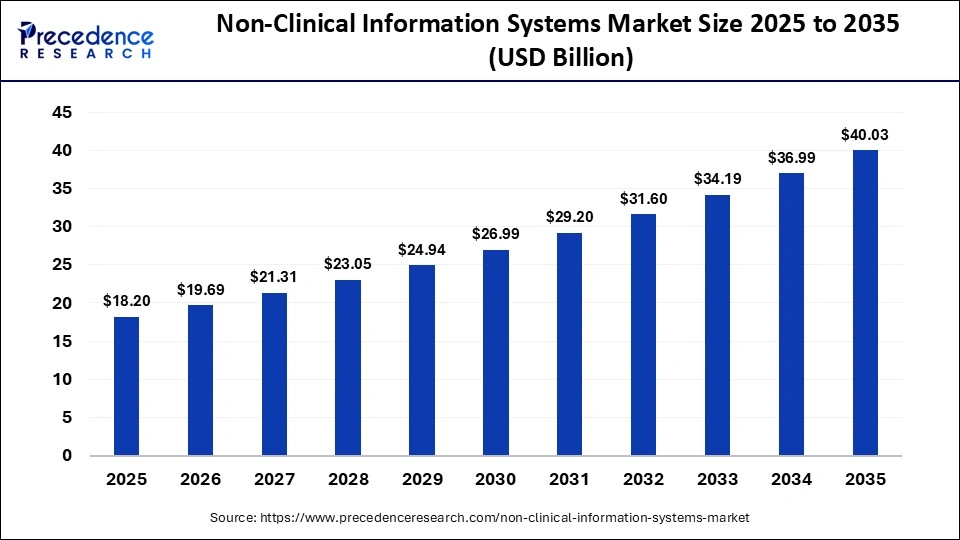
Deepa Pandey, a Healthcare Industry Expert, highlights that the non-clinical information systems market has reached USD 19.69 billion in 2026 and is on track to reach USD 40.03 billion by 2035, advancing at a CAGR of 8.20%. Key non-clinical information systems market companies shaping the market include Cerner Corporation, Allscripts Healthcare Solutions, Inc., McKesson Corporation, Epic Systems Corporation, while major growth segments span By System Type, By End-Use, By Deployment Mode, By Application.
Source: https://www.precedenceresearch.com/non-clinical-information-systems-market
 Get a Sample
 Table Of Content


What is the Non-Clinical Information Systems Market Size in 2026?
The global non-clinical information systems market size was estimated at USD 18.20 billion in 2025 and is projected to increase from USD 19.69 billion in 2026 to approximately USD 40.03 billion by 2035, expanding at a CAGR of 8.20% from 2026 to 2035. The market is growing due to rising adoption of digital healthcare solutions that improve operational efficiency, streamline administrative workflows, and support data-driven decision-making across healthcare organizations.
Key Takeaways
- North America dominated the non-clinical information systems market with a 40% share in 2025.
- Asia Pacific is expected to grow at the fastest CAGR of 20% between 2026 and 2035.
- By system type, the electronic health records (EHR) segment held the highest market share of 40% in 2025.
- By system type, the hospital information systems (HIS) segment is the second-largest shareholder and is expected to grow at a CAGR of 6% during the forecast period.
- By end-use, the hospitals segment contributed the highest market share of 60% in 2025.
- By end-use, the ambulatory surgical centers (ASCs) segment is the second-largest shareholder and is expected to grow at a CAGR of 8% during the forecast period.
- By deployment mode, the cloud-based solutions segment dominated the market with a 55% share in 2025.
- By deployment type, the hybrid solutions segment is expected to grow at the fastest CAGR of 8% in the coming years.
- By application, the data management & integration segment held a major market share of 30% in 2025.
- By application, the analytics & business intelligence segment is expected to grow at the fastest CAGR of 10.5% between 2026 and 2035.
Market Overview
The non-clinical information systems market is steadily expanding as healthcare organizations focus on improving operational efficiency and reducing administrative burdens. These systems support functions such as patient scheduling, billing, resource management, and data analytics, helping streamline workflows and enhance decision-making. Growing adoption of digital health technologies, cloud-based platforms, and integrated hospital systems is accelerating market growth. As healthcare systems continue to modernize, non-clinical solutions are becoming essential for delivering efficient, scalable, and data-driven healthcare operations.
Impact of AI on the Non-Clinical Information Systems Market
AI is transforming the non-clinical information systems market by automating administrative tasks like scheduling, billing, and claims processing. It enhances data analytics for better decision-making, improves resource allocation, and reduces operational costs. AI-powered tools also support predictive insights, helping healthcare organizations streamline workflows, minimize errors, and deliver more efficient, data-driven administrative operations.
Non-Clinical Information Systems Market Trends
- Shift Toward Cloud-Based Systems: Healthcare providers are increasingly adopting cloud-based non-clinical systems to improve scalability, reduce infrastructure costs, and enable real-time access to administrative data across multiple departments and facilities.
- Integration with Advanced Analytics: Organizations are leveraging analytics and AI-driven tools within non-clinical systems to optimize workflows, forecast resource needs, and support data-driven decision-making for improved operational efficiency.
- Focus on Interoperability: Growing emphasis on interoperability is driving the integration of non-clinical systems with clinical platforms, enabling seamless data exchange and improving coordination across hospital operations and administrative functions.
- Rising Demand for Automation: Automation of administrative tasks such as billing, scheduling, and claims processing is gaining traction, helping healthcare providers reduce manual workload, minimize errors, and enhance overall productivity.
Market Scope
| Report Coverage | Details |
| Market Size in 2025 | USD 18.20 Billion |
| Market Size in 2026 | USD 19.69 Billion |
| Market Size by 2035 | USD 40.03 Billion |
| Market Growth Rate from 2026 to 2035 | CAGR of 8.20% |
| Dominating Region | North America |
| Fastest Growing Region | Asia Pacific |
| Base Year | 2025 |
| Forecast Period | 2026 to 2035 |
| Segments Covered | System Type, End-Use, Deployment Mode, Application, and Region |
| Regions Covered | North America, Europe, Asia-Pacific, Latin America, and Middle East & Africa |
Market Dynamics
Driver
Rise in Patient Population
The non-clinical information systems market is driven by the rising patient population levels, which increases the burden on healthcare systems, creating a stronger need for efficient administrative management. Non-clinical information systems help handle higher patient volumes by streamlining scheduling, billing, and resource allocation, enabling healthcare providers to maintain operational efficiency and deliver timely services without overwhelming existing infrastructure.
Restraint
High Medical Costs and Limited Accessibility
High costs of healthcare IT infrastructure and limited accessibility in developing regions continue to restrict market growth. Many smaller healthcare providers struggle to invest in advanced non-clinical systems, while gaps in digital infrastructure and skilled workforce further slow adoption, making it challenging to implement and maintain these solutions effectively.
Opportunity
Expanding Healthcare Facilities and Technological Advancements
The rapid expansion of healthcare facilities, along with advancements in digital technologies, presents immense opportunities in the non-clinical information systems market. Increasing investments in hospital infrastructure and the adoption of cloud-based systems are encouraging healthcare providers to implement non-clinical information systems, improving efficiency, scalability, and overall management of administrative operations across evolving healthcare environments.
Segment Insights
System Type Insights
The Electronic Health Records (EHR) Segment Held a 40% Market Share in 2025
The electronic health records (EHR) segment dominated the non-clinical information systems market with the largest share of 40% in 2025, driven by its central role in managing patient data and streamlining administrative workflows. Healthcare providers rely on EHR systems to improve efficiency, reduce paperwork, and enhance coordination across departments. Growth continues as hospitals prioritize digital records, interoperability, and data-driven decision-making, making EHRs essential for modern healthcare operations and regulatory compliance.
The hospital information systems (HIS) segment held the second-largest market share of 25% in 2025 and is expected to grow at a CAGR of 6% during the forecast period, supported by rising demand for integrated hospital management solutions. These systems help streamline operations such as admissions, billing, and resource planning. The segment growth is fueled by increasing hospital digitization, the need for operational efficiency, and expanding healthcare infrastructure, especially in developing regions adopting centralized management platforms.
The laboratory information systems (LIS) segment held a 10% share of the market in 2025 and is expected to grow at a CAGR of 8% during the forecast period, owing to rising diagnostic testing and lab automation. The increasing demand for timely diagnostics, integration with EHR platforms, and the expansion of laboratory services supporting preventive and personalized healthcare approaches also drive segmental growth.
Non-Clinical Information Systems Market Share, By System Type, 2025-2035 (%)
|
System Type |
2025 Market Share |
2035 Market Share |
CAGR 2025 to 2035 |
Market Drivers |
|
Electronic Health Records (EHR) |
40.00% |
38.00% |
7.5% |
EHR systems dominate the market due to their critical role in managing patient information, streamlining administrative tasks, and improving clinical workflows. |
|
Hospital Information Systems (HIS) |
25.00% |
23.00% |
6.0% |
HIS is essential for managing hospital operations, improving patient care, and optimizing resource utilization in hospital environments. |
|
Laboratory Information Systems (LIS) |
10.00% |
11.00% |
8.0% |
LIS is growing steadily with the increasing demand for efficient lab management, test result tracking, and integration with EHR systems. |
|
Radiology Information Systems (RIS) |
8.00% |
7.50% |
6.5% |
RIS is widely used for managing radiology data, enhancing workflow efficiency, and supporting diagnostic imaging services. |
|
Pharmacy Information Systems (PIS) |
7.00% |
6.50% |
7.0% |
PIS is growing due to the rising demand for medication management, drug interaction tracking, and integration with other clinical information systems. |
|
Clinical Decision Support Systems (CDSS) |
5.00% |
6.00% |
10.0% |
CDSS is gaining traction as healthcare providers increasingly rely on data-driven insights for clinical decision-making and patient safety. |
|
Revenue Cycle Management Systems (RCM) |
5.00% |
5.50% |
8.5% |
RCM systems are essential for improving billing efficiency, reducing claim denials, and optimizing reimbursement processes in healthcare organizations. |
The radiology information systems (RIS) segment held a 8% share of the market in 2025 and is expected to grow at a CAGR of 6.5% during the forecast period. This is because of their widespread use in managing radiology data. These systems enhance workflow efficiency, manage imaging data, and support better coordination between departments.
The clinical decision support systems (CDSS) segment is expected to grow at the fastest CAGR of 10% during the forecast period. This is mainly due to the increasing need for data-driven decision-making in healthcare. CDSS tools help clinicians analyze large volumes of patient data, improve diagnostic accuracy, and reduce medical errors, which is driving their adoption across healthcare facilities.
End-Use Insights
Hospitals Dominated the Market With a 60% Share in 2025
The hospitals segment dominated the non-clinical information systems market with the highest share of 60% in 2025, driven by their need for comprehensive administrative systems. They rely heavily on non-clinical information systems for billing, patient management, compliance, and resource planning. The segment growth is further supported by increasing patient volumes, regulatory requirements, and digital transformation initiatives
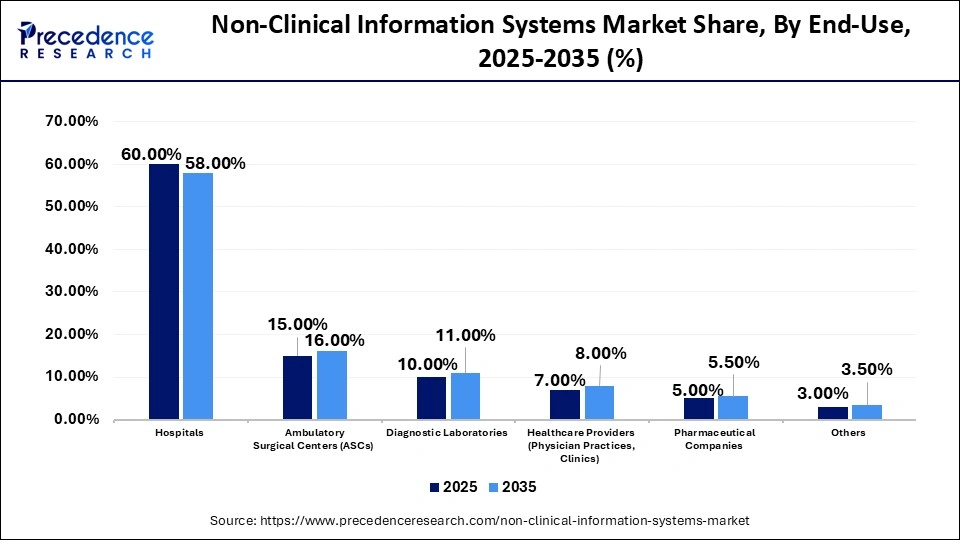
The ambulatory surgical centers (ASCs) segment held a 15% share of the market in 2025 and is expected to grow at a significant CAGR of 8% during the forecast period, owing to the growing demand for cost-effective and efficient outpatient care. These centers are adopting non-clinical systems to streamline scheduling, billing, and patient data management.
The diagnostic laboratories segment held a 10% market share in 2025 and is expected to grow at a CAGR of 7.5% during the forecast period. The segment growth is fueled by rising diagnostic needs and the expansion of lab services. Diagnostic labs are increasingly adopting HIS, LIS, and RCM systems to optimize lab operations, patient tracking, and billing accuracy.
The healthcare providers (physician practices, clinics) segment held a 7% share of the market in 2025 and is expected to grow at the fastest CAGR of 9% during the forecast period, as smaller providers are adopting digital systems to enhance operations. Non-clinical information systems help them manage appointments, billing, and compliance more efficiently.
Non-Clinical Information Systems Market Share, By End-Use, 2025-2035 (%)
|
End-Use |
2025 Market Share |
2035 Market Share |
CAGR 2025 to 2035 |
Market Drivers |
|
Hospitals |
60.00% |
58.00% |
6.2% |
Hospitals remain the largest end-use sector due to their need for comprehensive non-clinical information systems for administration, billing, and regulatory compliance. |
|
Ambulatory Surgical Centers (ASCs) |
15.00% |
16.00% |
8.0% |
ASCs are adopting non-clinical information systems to improve operational efficiency, manage patient data, and streamline billing processes. |
|
Diagnostic Laboratories |
10.00% |
11.00% |
7.5% |
Diagnostic labs are increasingly adopting HIS, LIS, and RCM systems to optimize lab operations, patient tracking, and billing accuracy. |
|
Healthcare Providers (Physician Practices, Clinics) |
7.00% |
8.00% |
9.0% |
Smaller healthcare providers are adopting non-clinical information systems to enhance patient scheduling, billing, and regulatory compliance. |
|
Pharmaceutical Companies |
5.00% |
5.50% |
8.0% |
Pharmaceutical companies are using non-clinical information systems to streamline operations, manage regulatory reporting, and enhance research capabilities. |
|
Others |
3.00% |
3.50% |
6.5% |
Other end-users include research institutions, public health organizations, and non-profit entities involved in healthcare management. |
Deployment mode Insights
Why Did the Cloud-based Solutions Segment Dominate the Market in 2025?
The cloud-based solutions segment dominated the non-clinical information systems market with around 55% share in 2025, driven by their flexibility, scalability, and lower upfront costs. The segment dominance is also driven by increasing digital transformation, rising adoption of telehealth, and the need for cost-efficient IT infrastructure that can scale with expanding healthcare.
The on-premise solutions segment held a 30% share of the market in 2025 and is expected to grow at a CAGR of 6% during the forecast period, owing to the growing concerns over data security. On-premise solutions remain popular among organizations with strict data privacy and security requirements. Hospitals and large institutions prefer these systems for greater control over sensitive data.
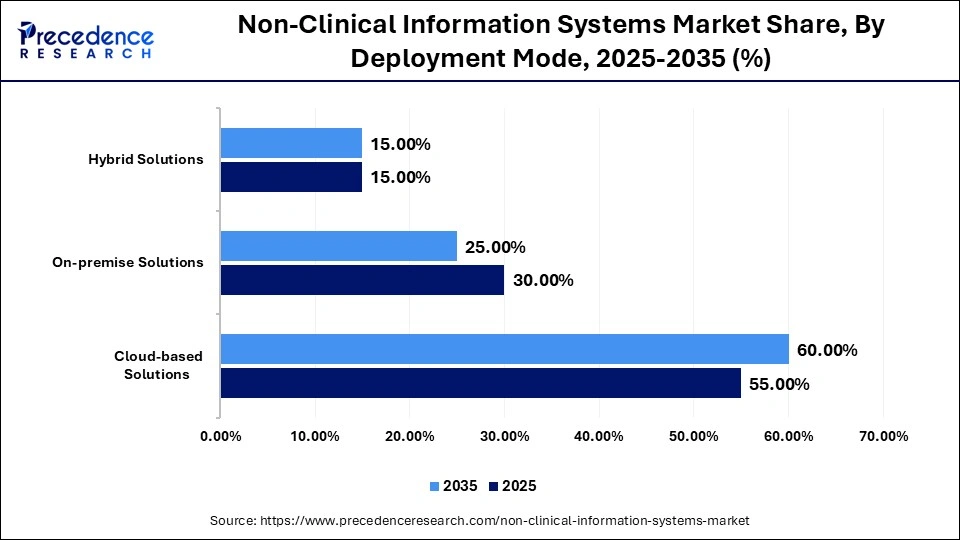
The hybrid solutions segment held a 15% share of the market in 2025 and is expected to grow at the fastest CAGR of 8% during the forecast period. This is mainly due to their ability to combine the benefits of both cloud and on-premise deployments. Hybrid models allow organizations to keep sensitive data on secure internal servers while leveraging the cloud for scalability, flexibility, and cost efficiency.
Non-Clinical Information Systems Market Share, By Deployment Mode, 2025-2035 (%)
|
Deployment Mode |
2025 Market Share |
2035 Market Share |
CAGR 2025 to 2035 |
Market Drivers |
|
Cloud-based Solutions |
55.00% |
60.00% |
28.5% |
Cloud-based solutions are growing rapidly due to their scalability, cost-effectiveness, and ability to integrate seamlessly with other healthcare systems. |
|
On-premise Solutions |
30.00% |
25.00% |
6.0% |
On-premise solutions remain popular among organizations with strict data privacy and security requirements, though their share is declining. |
|
Hybrid Solutions |
15.00% |
15.00% |
8.0% |
Hybrid solutions are gaining popularity, offering the flexibility of cloud-based services with the security and control of on-premise systems. |
Application Type Insights
The Data Management & Integration Segment Held a 40% Market Share in 2025
The data management & integration held a 30% share of the non-clinical information systems market in 2025, driven by the need to manage and unify large volumes of healthcare data. It enables seamless integration of patient records, administrative data, and systems across departments. Growth is fueled by rising digitalization, demand for real-time data access, and the need for better decision-making.
The financial & administrative management segment held 25% share of the market in 2025 and is expected to grow at a CAGR of 8.5% between 2026 and 2035, due to increasing demand for accurate billing, claims processing, and revenue cycle management. Healthcare providers are focusing on reducing financial errors and improving reimbursement processes, boosting the adoption of non-clinical information systems.
The regulatory compliance & reporting segment held a 20% market share in 2025 and is expected to grow at a CAGR of 7% during the forecast period, as healthcare regulations become more stringent and complex. Organizations require reliable systems to ensure compliance with evolving standards in data handling, billing, and reporting.
The patient scheduling & management segment held a 10% share of the market in 2025 and is expected to grow at a CAGR of 9% during the forecast period. The growth of the segment is driven by increasing patient expectations, higher service demand, and the need for streamlined workflows, making these tools essential for enhancing both efficiency and patient satisfaction.
The analytics & business intelligence segment is expected to grow at the fastest CAGR of 10.5% during the forecast period, owing to the rising need for data-driven decision-making in healthcare operations. Healthcare organizations are increasingly using analytics tools to optimize administrative processes, improve financial performance, manage patient flow, and enhance overall operational efficiency.
Non-Clinical Information Systems Market Share, By Application, 2025-2035 (%)
|
Application |
2025 Market Share |
2035 Market Share |
CAGR 2025 to 2035 |
Market Drivers |
|
Data Management & Integration |
30.00% |
33.00% |
10.0% |
Effective data management is essential for integrating patient records, medical histories, and administrative data for better decision-making and operational efficiency. |
|
Financial & Administrative Management |
25.00% |
27.00% |
8.5% |
Financial management systems in healthcare institutions are growing with the increasing need for accurate billing, claims processing, and reimbursement. |
|
Regulatory Compliance & Reporting |
20.00% |
19.50% |
7.0% |
Healthcare organizations require robust systems to ensure compliance with ever-changing regulatory standards, especially in billing and data management. |
|
Patient Scheduling & Management |
10.00% |
11.00% |
9.0% |
Efficient scheduling and patient management tools are increasingly important to streamline workflows, improve patient satisfaction, and reduce waiting times. |
|
Supply Chain Management |
5.00% |
4.50% |
6.0% |
Supply chain management solutions are growing as hospitals and healthcare organizations seek to optimize inventory and procurement processes. |
|
Analytics & Business Intelligence |
10.00% |
9.00% |
10.5% |
Analytics and business intelligence tools are critical for improving decision-making, predicting trends, and optimizing healthcare operations. |
Regional Analysis
North America Non-Clinical Information Systems Market Size and Growth 2026 to 2035
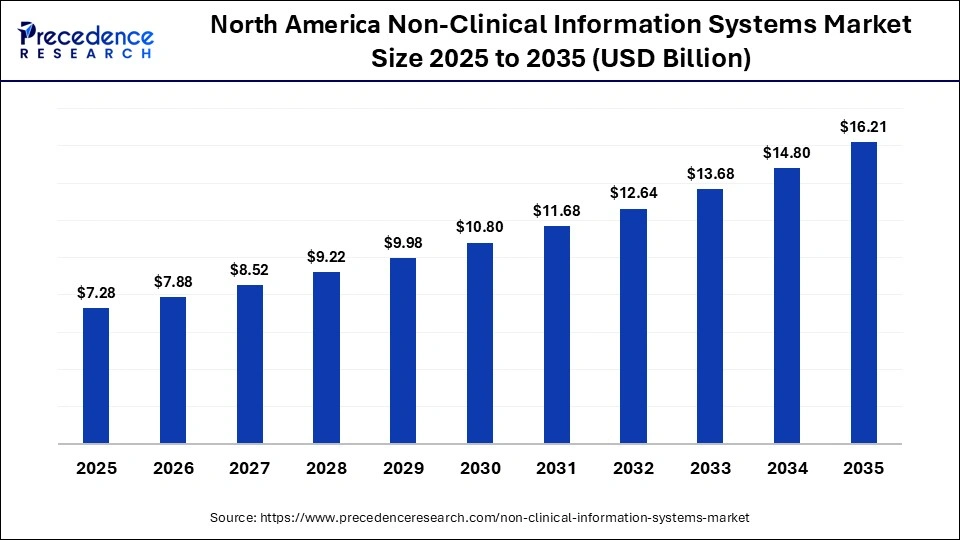
The North America non-clinical information systems market size was estimated at USD 7.28 billion in 2025 and is anticipated to reach around USD 16.21 billion by 2035, growing at a solid CAGR of 8.33% over the forecast period 2026 to 2035.
Why Did North America Lead the Non-Clinical Information Systems Market in 2025?
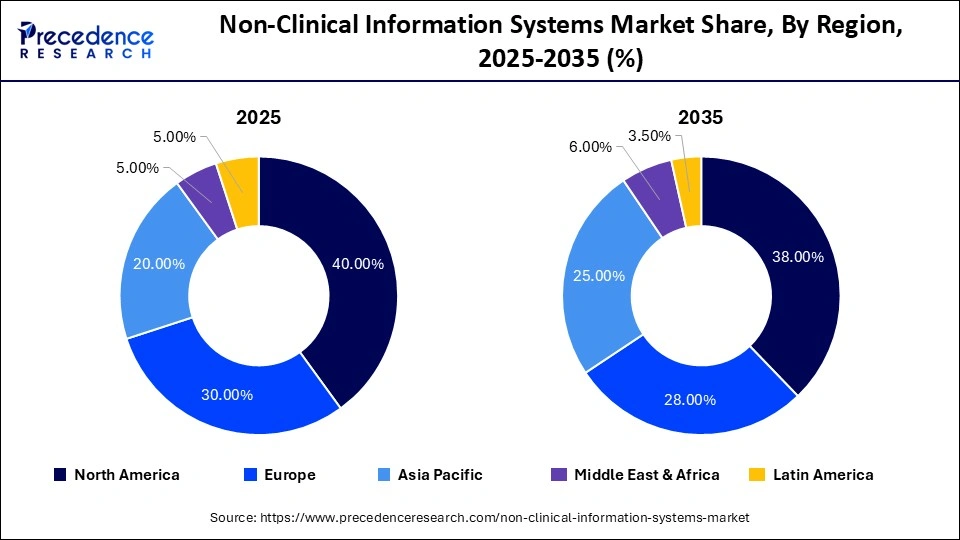
North America dominated the non-clinical information systems market with a share of 40% in 2025, driven by the widespread adoption of these systems across hospitals, diagnostic centers, and healthcare providers. The region benefits from a strong digital infrastructure, high healthcare spending, and early adoption of advanced technologies. Ongoing investments in healthcare IT and regulatory focus on efficiency and data management continue to strengthen the region's market position.
U.S. Non-Clinical Information Systems Market Size and Growth 2026 to 2035
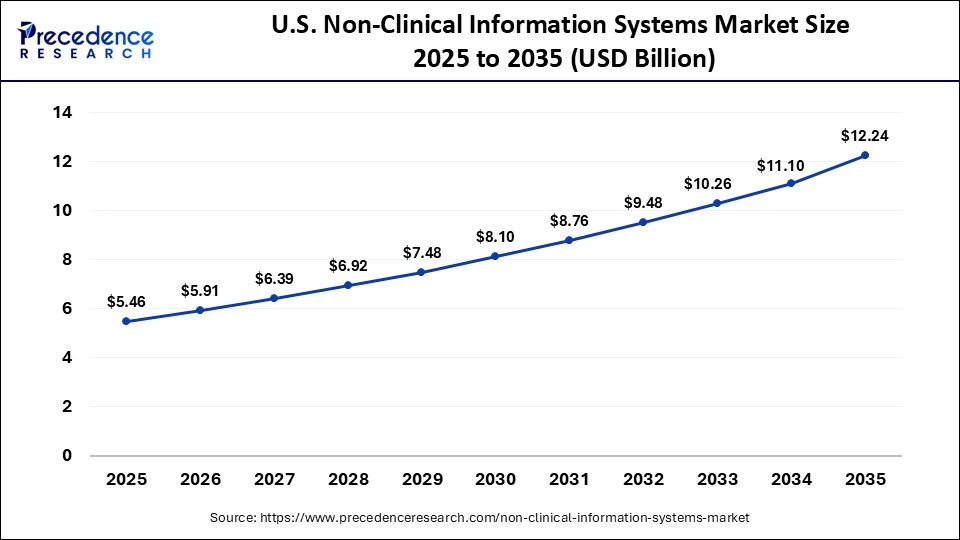
The U.S. non-clinical information systems market size was evaluated at USD 5.46 billion in 2025 and is predicted to cross around USD 12.24 billion by 2035, with a CAGR of 8.41% from 2026 to 2035.
U.S. Market Trends
The U.S. is a major contributor to the North American non-clinical information systems market, driven by advanced healthcare systems and strong adoption of digital solutions. Increasing demand for efficient administrative management, rising patient volumes, and regulatory compliance needs are key growth factors. Continuous investments in healthcare IT and innovation further accelerate the adoption of non-clinical information systems across the country.
Why is Asia Pacific Undergoing the Fastest Growth in the Market?
Asia Pacific held around 20% share of the non-clinical information systems market in 2025 and is expected to grow at the fastest CAGR of 12% throughout the forecast period. This growth is driven by the expanding healthcare infrastructure, rising adoption of digital health technologies, and strong government investments in healthcare IT. Increasing patient volumes and demand for efficient systems are encouraging healthcare providers to adopt non-clinical information systems across hospitals and clinics.
China Market Trends
China is a key contributor to the Asia Pacific non-clinical information systems market, supported by rapid healthcare digitization and strong government initiatives. Investments in hospital infrastructure, smart healthcare systems, and data management platforms are accelerating adoption. The country's large population and growing demand for efficient healthcare services continue to drive the expansion of non-clinical information systems.
India Market Trends
India is emerging as a rapidly growing market due to improving healthcare infrastructure and increasing digital adoption. Government initiatives promoting digital health, along with rising demand for efficient administrative systems, are supporting growth. Expanding hospital networks and growing awareness about healthcare IT solutions are further driving adoption across urban and semi-urban healthcare facilities.
How is the Opportunistic Rise of Europe in the Market?
Europe accounted for around 30% share of the non-clinical information systems market in 2025 and is expected to grow at a 7.5% CAGR in the coming years. This is mainly due to increasing healthcare digitization and strict data privacy regulations. The need for operational efficiency and compliance is encouraging the adoption of non-clinical systems. Government initiatives and investments in healthcare IT infrastructure are further supporting market expansion across the region.
Middle East & Africa Non-Clinical Information Systems Market Analysis
The Middle East & Africa (MEA) region held around 5% share of the market in 2025 and is expected to grow at a 9% CAGR between 2026 and 2035. This growth is driven by increasing investments in healthcare infrastructure, particularly in GCC countries. Improving access to healthcare services and rising adoption of digital solutions are supporting the demand for non-clinical information systems across the region.
Latin America Non-Clinical Information Systems Market Analysis
Latin America held approximately 5% share of the market in 2025 and is expected to grow at a 7% CAGR over the forecast period, driven by increasing adoption of healthcare IT solutions to improve efficiency and patient management. Expanding healthcare access, along with government initiatives and investments in digital infrastructure, is supporting the gradual adoption of non-clinical information systems across the region.
Non-Clinical Information Systems Market Share, By Region, 2025-2035 (%)
|
Region |
2025 Market Share |
2035 Market Share |
CAGR 2025 to 2035 |
Market Drivers |
|
North America |
40.00% |
38.00% |
8.5% |
North America continues to dominate due to high adoption rates of non-clinical information systems in hospitals, diagnostic centers, and healthcare providers. |
|
Europe |
30.00% |
28.00% |
7.5% |
Europe is seeing steady growth driven by increasing healthcare digitization, data privacy regulations, and healthcare efficiency needs. |
|
Asia Pacific |
20.00% |
25.00% |
12.0% |
Asia Pacific is the fastest-growing region due to the expansion of healthcare infrastructure, digital health adoption, and government investments in healthcare IT. |
|
Middle East & Africa |
5.00% |
6.00% |
9.0% |
MEA is experiencing growth with increasing investments in healthcare infrastructure, especially in GCC countries and parts of Africa. |
|
Latin America |
5.00% |
3.50% |
7.0% |
Latin America is growing steadily due to the increasing adoption of healthcare IT solutions for improved operational efficiency and patient care. |
Top Companies in the Non-Clinical Information Systems Market
- Cerner Corporation
- Allscripts Healthcare Solutions, Inc.
- McKesson Corporation
- Epic Systems Corporation
- Medtronic plc
- Siemens Healthineers
- GE Healthcare
- Athenahealth, Inc.
- Oracle Corporation
- Infor Inc.
- NextGen Healthcare
- Greenway Health LLC
- eClinicalWorks
- InterSystems Corporation
- Roche Diagnostics
Recent Developments
- In April 2026, the FDA refined its policies for Clinical Decision Support (CDS) software. The updated guidance clarifies that low-risk administrative tools, such as medication dosing calculators and drug-interaction alert systems within EHRs, may fall outside traditional medical device regulation if they allow for independent clinician review. (Source: https://www.linkedin.com)
- On April 14, 2026, CMS launched the first wave of its National Data Sharing Initiative. The company introduced tech tools designed to improve administrative interoperability and reduce the "paperwork tax" on healthcare providers. (Source:
https://www.digitalhealthnews.com) - On April 2, 2026, the MHRA (UK) and US FDA announced a deeper partnership to streamline medical devices and digital health regulations. This cooperation aims to support faster market access for innovative administrative and diagnostic technologies in both countries. (Source: https://www.gov.uk/government)
Segments Covered in the Report
By System Type
- Electronic Health Records (EHR)
- Hospital Information Systems (HIS)
- Laboratory Information Systems (LIS)
- Radiology Information Systems (RIS)
- Pharmacy Information Systems (PIS)
- Clinical Decision Support Systems (CDSS)
- Revenue Cycle Management Systems (RCM)
- Other Non-Clinical Information Systems
By End-Use
- Hospitals
- Ambulatory Surgical Centers (ASCs)
- Diagnostic Laboratories
- Healthcare Providers (Physician Practices, Clinics)
- Pharmaceutical Companies
- Others
By Deployment Mode
- On-premise Solutions
- Cloud-based Solutions
- Hybrid Solutions
By Application
- Data Management & Integration
- Financial & Administrative Management
- Regulatory Compliance & Reporting
- Patient Scheduling & Management
- Supply Chain Management
- Analytics & Business Intelligence
- Others
By Region
- North America
- Latin America
- Europe
- Asia-pacific
- Middle and East Africa
For inquiries regarding discounts, bulk purchases, or customization requests, please contact us at sales@precedenceresearch.com
Frequently Asked Questions





Ask For Sample
No cookie-cutter, only authentic analysis – take the 1st step to become a Precedence Research client
 Get a Sample
.webp)



 sales@precedenceresearch.com
 Schedule a Meeting
