North America Monorail System Market Size, Share and Trends 2026 to 2035
North America Monorail System Market (By Type: Straddle Monorail and Suspended Monorail; By Autonomy: Semi-autonomous, Completely Autonomous, and Manual; By Propulsion Type: Electric Monorail and Maglev Monorail; By Autonomous (Grade of Automation): GoA0, GoA1, GoA2, GoA3, and GoA4) Industry Size, Share, Growth, Trends 2025-2035
 Get a Sample
 Table Of Content


The North America monorail system market size surpassed USD 2.18 billion in 2025 and is predicted to reach around USD 3.26 billion by 2035, registering a CAGR of 4.1% from 2026 to 2035. The market is mainly fueled by growing urban congestion, population density, and the pressing demand for sustainable, eco-friendly public transportation.
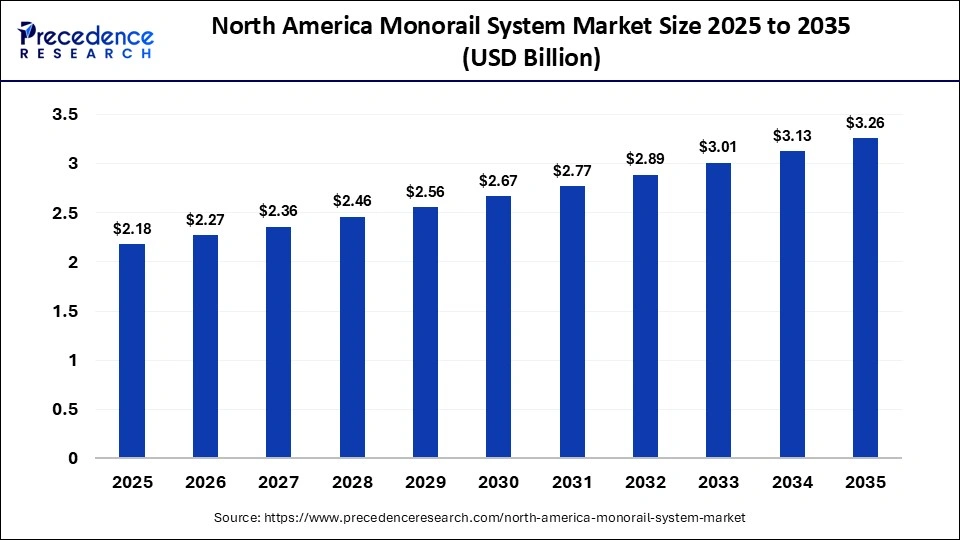
North America Monorail System Market Statical Scope
| Reports Attributes | Statistics |
| Market Size in 2025 | USD 2.18 Billion |
| Market Size in 2026 | USD 2.27 Billion |
| Market Size by 2035 | USD 3.26 Billion |
| CAGR 2026 to 2035 | 4.1% |
| Base Year | 2025 |
| Forecast Period | 2026 to 2035 |
The market is essential in North America as it offers high-capacity, space-efficient, and environmentally friendly transit solutions for crowded urban areas, busy airports, and tourist attractions. It is particularly popular for its ability to navigate congested cities with a smaller structural footprint and lower construction costs compared to traditional subway systems. Elevated monorail systems avoid ground-level traffic, providing reliable, grade-separated mass transit in densely populated metropolitan regions. A large part of the market caters to specialized automated people movers that connect terminals or enhance mobility in tourist districts.
With support from government initiatives, monorails contribute to reducing local emissions, decreasing dependence on personal vehicles, and aligning with smart cities decarbonization goals. The implementation of autonomous operations, advanced predictive maintenance, and lightweight materials enables these systems to fit smoothly into existing multimodal transport networks. Industry indicates significant growth in this regional sector, emphasizing its increasing importance in meeting contemporary mobility demands.
North America Monorail System Market, By Type, 2025 (%)
| Segments | Shares (%) |
| Straddle Monorail | 74.30% |
| Suspended Monorail | 25.70% |
- Straddle Monorail - The straddle monorail segment, with a share of 74.30% in 2025, plays a dominant role in the North American market due to its smaller footprint, reduced construction costs, and rapid implementation compared to traditional heavy rail. It serves as a key solution for navigating crowded urban and tourist areas without needing extensive private property expropriation.
- Suspended Monorail - The suspended monorail segment, with a share of 25.70% in 2025, is essential in the North American transit market as it provides a zero-emission, space-efficient option for densely populated urban areas. By operating on an elevated single-rail guideway with cars hanging below the track, suspended systems minimize their ground-level impact. This design helps cities avoid heavy surface traffic and the high costs of tunneling for subways.
North America Monorail System Market, By Autonomy, 2025 (%)
| Segments | Shares (%) |
| Semi-autonomous | 46.80% |
| Completely Autonomous | 31.50% |
| Manual | 21.70% |
- Semi-autonomous - The semi-autonomous segment, with a share of 46.80% in 2025, is leading the North American monorail market as it connects traditional transit systems with modern AI and IoT enhancements. It offers the efficiency of driverless operations while maintaining human oversight on board, ensuring safety, regulatory compliance, and a smooth transition to fully automated train services.
- Completely Autonomous - The completely autonomous segment, with a share of 31.50% in 2025, is crucial in the North American monorail market as it addresses significant labor shortages in transit, increases passenger capacity without costly infrastructure changes, and lowers operational expenses. By eliminating the need for onboard staff, transit authorities can achieve shorter intervals and enhance energy efficiency through improved speed and braking.
North America Monorail System Market, By Propulsion Type, 2025 (%)
| Segments | Shares (%) |
| Electric Monorail | 83.60% |
| Maglev Monorail | 16.40% |
- Electric Monorail - The electric monorail segment, with a share of 83.60% in 2025, leads the North American Monorail System Market as it offers a quiet, zero-emission, and space-saving transit solution. It enables cities to avoid surface congestion and comply with strict decarbonization goals without the large footprint or tunneling expenses associated with heavy rail.
- Maglev Monorail - The Maglev (Magnetic Levitation) segment, with a share of 16.40% in 2025, is a rapidly growing technology in the North American monorail market as it provides advanced, high-speed, and frictionless mass transit that alleviates heavy congestion in cities, connects densely populated Northeast corridors, and serves as an environmentally friendly alternative to short domestic flights.
Competitive Landscape
The North America monorail market is concentrated, primarily led by major global manufacturers of rolling stock. The growth focuses on airport connections, downtown circulators, and entertainment areas, driven by the demand for elevated automated transit to avoid traffic.
- Alstom (France/Canada) is acquiring Bombardier Transportation, making Alstom the leader in the North American market. Their key product is the INNOVIA Monorail 300, a driverless, high-capacity system favored for urban routes.
- Hitachi Rail (Japan) provides automated, large-capacity straddle monorail systems. They are important in supplying and maintaining monorail networks for major transit authorities and amusement parks throughout the U.S.
- Intamin Transportation (Switzerland) is recognized for its specialized solutions in passenger and amusement transport. Intamin offers straddle and suspended monorail systems focused on efficient, lightweight urban mobility and scenic travel.
- BYD Company Limited (China) is an emerging competitor promoting its "SkyRail" product, a battery-powered, straddle-type monorail designed for rapid deployment in urban and suburban areas.
- Aerobus International Inc. (USA) is an engineering and development firm that specializes in suspended monorail (sky-rail) technologies aimed at minimizing the urban footprint.
Segments Covered in the Report
By Type
- Straddle Monorail
- Suspended Monorail
By Autonomy
- Semi-autonomous
- Completely Autonomous
- Manual
By Propulsion Type
- Electric Monorail
- Maglev Monorail
By Autonomous (Grade of Automation)
- GoA0
- GoA1
- GoA2
- GoA3
- GoA4
For inquiries regarding discounts, bulk purchases, or customization requests, please contact us at sales@precedenceresearch.com
Frequently Asked Questions





Ask For Sample
No cookie-cutter, only authentic analysis – take the 1st step to become a Precedence Research client




 sales@precedenceresearch.com
 Schedule a Meeting