



Offshore Wind Installations Market Trends, Companies, Contract Wins / Project Pipeline, Installed Capacity, Power Generation, Government Investment, Technology Adoption, Competitive Positioning, and Growth Forecast
Offshore Wind Installations Market (By Foundation Type: Monopile Foundations, Jacket Foundations, Gravity-Based Foundations, Floating Foundations; By Installation Type: Fixed-Bottom Offshore Wind, Floating Offshore Wind; By End Use: Utility-Scale Power Generation, Commercial & Industrial Power Supply) - Global Industry Analysis, Size, Trends, Leading Companies, Regional Outlook, and Forecast 2026 to 2035
Source: https://www.precedenceresearch.com/offshore-wind-installations-market
 Get a Sample
 Table Of Content


What is Offshore Wind Installations Market Size in 2026?
The global offshore wind installations market size was calculated at USD 47.25 billion in 2025 and is predicted to increase from USD 53.16 billion in 2026 to approximately USD 153.44 billion by 2035, expanding at a CAGR of 12.50% from 2026 to 2035. The market is centered on the implementation of wind turbines on the ocean or coastal waters to produce renewable electricity on a large-scale. The dynamic drivers of the market are the rising global demand for clean energy, favorable government policies, and technological progress in power turbines' capacity.

Key Takeaways
- Europe dominated the global offshore wind installations market with the largest share of 45% in 2025.
- Asia-Pacific is expected to grow at the fastest CAGR in the market during the forecast period.
- By foundation type, the monopile foundations segment held a dominant position in the market in 2025.
- By foundation type, the floating foundations segment is expected to grow at the fastest CAGR in the market between 2026 and 2035.
- By installation type, the fixed-bottom offshore wind segment led the global market in 2025.
- By installation type, the floating offshore wind segment is expected to grow with the highest CAGR in the market during the studied years.
- By end use, the utility-scale power generation segment held the largest market share in 2025. 
- By end use, the commercial and industrial power supply segment is expected to expand rapidly in the market during the studied years.
Which Factors Drive the Offshore Wind Installations Market?
The offshore wind installations industry is experiencing high growth due to the transition of countries to low-carbon energy systems. Offshore wind farms have greater and more reliable wind speeds than onshore farms, leading to more power generation efficiency. Offshore wind projects are done in large scale to enable governments and energy companies to minimize dependence on fossil fuels. The invention of floating wind turbines is allowing turbines to be installed in deeper water where they cannot be built on conventional foundations. The development of more offshore wind installations across the globe is also expanding rapidly due to increased collaborations between energy developers, technology providers, and governments.
How is AI Influencing the Offshore Wind Installations Market?
Artificial intelligence plays a crucial role in the market by introducing automation and enabling real-time monitoring of offshore winds. AI-based analytics can optimize the performance of turbines due to the real-time analysis of weather patterns, wind speeds, and operational data. Predictive maintenance algorithms enable operators to predict a possible equipment failure even before it happens, minimizing downtime and maintenance costs.
AI systems are also applied in the optimization of where turbines are placed in a project plan to produce the most energy. With the digitalization spread throughout the renewable energy industry, AI will most likely replace the current system with one that will be far more efficient in its work and the volume of energy generated in offshore wind farms.
Offshore Wind Installations Market Trends
- Technological Advancements: Offshore wind turbines are becoming more efficient and scalable due to continuous technological innovation. Modern turbines have increased rotor diameters and power capabilities that enable wind farms to produce increased quantities of electricity with reduced installations.
- International Investments in Clean Energy: Nations in the global front are working towards setting carbon neutrality targets, and this is prompting the use of renewable energy. Offshore wind energy is becoming a vital element of national decarbonization strategies owing to its massive power production potential.
- Funding for Renewable Energy: Financial institutions, energy companies, and individuals are investing more in renewable energy infrastructure, such as offshore wind farms, through private investors.
- Governmental Steps to Support Installation: Numerous governments are introducing favorable policies to hasten the introduction of offshore wind. These policies include renewable energy goals, auction protocols, tax incentives, and facilitated permitting procedures. Offshore wind is frequently given priority by national energy policies.
Market Scope
| Report Coverage | Details |
| Market Size in 2025 | USD 47.25 Billion |
| Market Size in 2026 | USD 53.16 Billion |
| Market Size by 2035 | USD 153.44 Billion |
| Market Growth Rate from 2026 to 2035 | CAGR of 12.50% |
| Dominating Region | Europe |
| Fastest Growing Region | Asia Pacific |
| Base Year | 2025 |
| Forecast Period | 2026 to 2035 |
| Segments Covered | Foundation Type, Installation Type, End Use, and region |
| Regions Covered | North America, Europe, Asia-Pacific, Latin America, and Middle East & Africa |
Segmental Insights
Foundation Type Insights
Which Formulation Type Segment Dominated the Offshore Wind Installations Market?
The monopile foundations segment dominated the market in 2025, owing to the low cost, simplicity of construction, and structural effectiveness in shallow and moderate water depth. These are steel cylindrical piles that are pushed deep into the seabed and offer a stable hold to massive wind turbines. Their simple installation procedure saves time and cost in project completion and installation. In Europe and Asia, there are still numerous offshore wind farms that use monopile technology due to its reliability and scalability. Advances in the continuous development of pile diameter and the design of structures allow monopiles to carry bigger turbines in deeper waters.
The floating foundations segment is expected to show the fastest growth over the forecast period. Floating foundations are spar, semi-submersible, and tension-leg types of plate, and by such plate, turbines can be attached to the bottom of the sea by means of mooring systems. Floating technology expands geographical boundaries into new geographical areas with greater wind potential, boosting the segment's growth. Pilot and commercial-scale floating wind projects are being actively funded by governments and individual investors. Floating foundations are projected to make significant contributions in the future offshore wind industry as costs are brought down and the stability of the foundation.
Installation Type Insights
Which Installation Type Segment Led the Offshore Wind Installations Market?
The fixed-bottom offshore wind segment led the market in 2025, as it is technologically mature and is being installed in large scale in large offshore wind areas. Fixed-bottom offshore wind entails turbines attached to structures like monopiles, jackets, or the foundations of gravity attached to the seafloor. They are also common in shallow water, especially within the developed offshore wind markets. Fixed-bottom systems are economically viable in large projects due to predictable and mature systems of installation and extensive supply chains. This has seen the majority of the operating offshore wind farms globally operating on fixed-bottom technologies.
The floating offshore wind segment is expected to gain the highest market share between 2026 and 2035, driven by deployed and more demanding waters with stronger wind resources. Floating turbines do not have a fixed bottom; instead, they rest on platforms of buoyancy anchored on the bottom. The technology has a huge geographical development potential in relation to offshore wind development. Pilot and demonstration projects are being initiated by governments and energy companies to speed up the commercialization. As soon as innovation is sustained and costs are reduced, floating offshore wind would contribute to the future renewable energy capacity significantly.
End Use Insights
How the Utility-Scale Power Generation Segment Dominated the Offshore Wind Installations Market?
The utility-scale power generation segment contributed the biggest market share in 2025 because of the high level of investment in renewable energy infrastructure by large energy companies and national utilities. Offshore wind farms have the capacity to produce high volumes of electricity that can be directly transferred to the national power grids. Governments facilitate such projects using subsidies, renewable energy ambitions, and power purchase contracts. The economies of scale favor utility-scale projects, which are cheaper in the long-run. With the increased electricity needs worldwide, offshore wind farms continue to take center stage in the clean energy transition efforts.
The commercial and industrial power supply segment is expected to witness the fastest growth in the market over the forecast period because corporations are turning to the use of renewable energy in large numbers to achieve their sustainability pledges. Offshore wind developers are also closing long-term power purchase contracts with industrial facilities, technology, and big commercial businesses. This will enable organizations to get constant renewable electricity and minimize carbon emissions. There are increasing demands on clean energy sources due to growing pressure on environmental regulations and corporate ESG objectives. Offshore wind energy is also emerging as a desirable power source as more companies endorse the concept of carbon neutrality.
Regional Insights
What is the Europe Offshore Wind Installations Market Size?
The Europe offshore wind installations market size is expected to be worth USD 69.82 billion by 2035, increasing from USD 21.26 billion by 2025, growing at a CAGR of 12.63% from 2026 to 2035
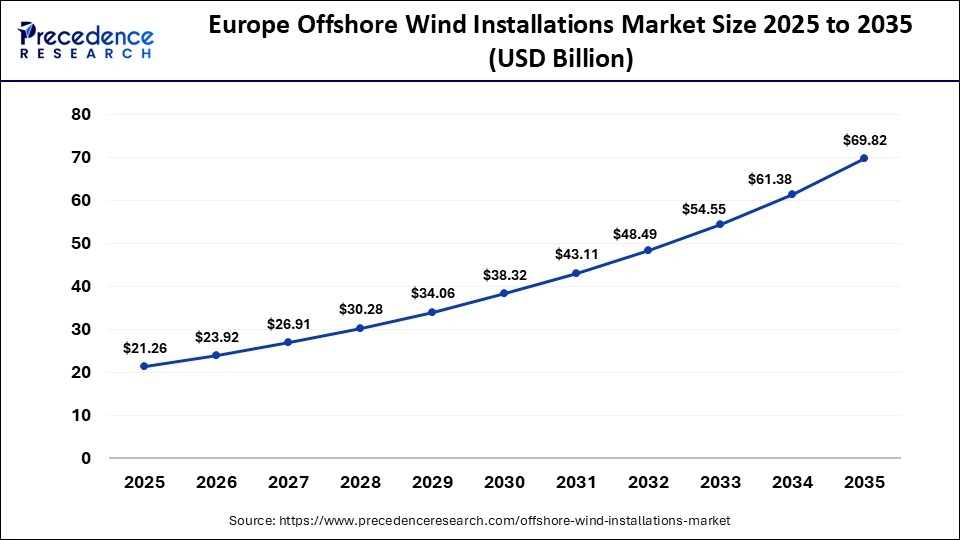
Why Europe Dominated the Offshore Wind Installations Market?
Europe held a major market share in 2025, due to its technological capabilities, government policies, and early adoption, which have facilitated progress. The region has some of the largest offshore wind farms in the world and a highly developed supply chain for making turbines, installation ships, and grid systems. Favorable regulatory procedures and energy targets on renewable energy have enhanced the pace of project advancement. Offshore wind is important to Europe because of its strategy of decreasing the use of fossil fuels and reaching climate neutrality. The leadership in the region is further reinforced by constant investment in the next-generation turbines and floating wind technologies. Due to this, Europe has continued to be an international center of offshore wind development and implementation.

Country-Level Analysis
On the country level, the UK is a leader in offshore wind capacity in Europe with nationwide goals on renewable energy and extensive offshore wind auctions. The Netherlands has a boom in the offshore wind industry due to government-supported development zones and fast-tracked permitting.
Germany is a significant contributor, having huge projects in both the North and Baltic seas. Denmark, which can be described as a leader in offshore wind power, keeps on investing heavily in the development of wind infrastructure and technology. France is increasing the speed of its project development to increase its renewable energy portfolio. All these nations enhance the European dominance in offshore wind facilities.
Why is Asia-Pacific the Fastest-Growing Region in the Offshore Wind Installations Market?
Asia-Pacific is expected to experience the fastest growth during the predicted timeframe because of the growing energy consumption and the robust backing of the government on the issue of renewable sources of power generation. The increasing speed of industrialization and urbanization is forcing nations to diversify their energy supply and minimize carbon emissions.
Offshore wind development in the region is expanding rapidly. Governments are incorporating positive policies, financial aid, and renewable energy targets to make investments. Further, the presence of a long coastline that has abundant wind deposits promotes the development of offshore wind. Consequently, the offshore wind capacity will experience a significant increase in the Asia-Pacific region in the next few years.
Country Level Analysis
On the national level, China is a pioneer in offshore wind facilities within the region, making massive investments and deploying large projects along coastal provinces. Japan is also actively planning floating offshore wind schemes to deploy in deep coastal waters and to attain its energy security. To move to clean energy, South Korea is spending much on offshore wind infrastructure.
Taiwan has become a major player in offshore wind, as the government supports it with high intensity, and international developers participate. Pilot projects are underway in the offshore wind industry of India along the western coast.
What are the Advancements in the Offshore Wind Installations Market in North America?
North America is expected to have significant growth in the market, driven by increasing demand for renewable energy and supportive regulatory frameworks. The region is also witnessing a surge in investments that are aimed at achieving sustainability goals. The regional government has also set ambitious targets for offshore wind capacity, which is expected to catalyze further development and innovation in this sector. Countries like the U.S. and Canada are leading players.
U.S Market Trends
Key players in the region are actively involved in projects, which are helping to enhance competition and technological advancements. The country also has a strong presence of established companies, and new entrants are expected to drive market dynamics.
What are the Key Trends in the Offshore Wind Installations Market in Latin America?
Latin America is expected to have significant market growth throughout the forecast years, driven by increasing energy demands and government initiatives to reduce carbon emissions. Countries like Brazil and Mexico are leading players in the region as they are investing heavily in offshore wind projects. The region's growth is further supported by favorable policies and incentives aimed at promoting renewable energy sources, positioning it as a key market for future investments.
Brazil Market Trends
Key players in the region are seen actively participating in the market, contributing to technological advancements and project development, which are essential for meeting the region's growing energy needs.
How is the Middle East and Africa Region Growing in the Offshore Wind Installations Market?
The Middle East and Africa are expected to have significant growth in the upcoming years. Governments in the region are increasingly focusing on diversifying their energy portfolios and investing in renewable energy projects in order to meet growing energy demands and sustainability goals. Regulatory frameworks are also gradually evolving to support offshore wind development, indicating a positive trend for future growth. Countries like South Africa, the UAE, and Morocco are leading players.
Saudi Arabia Market Trends
The country's market landscape is still in its developing stages; however, as awareness and investment in renewable energy increase, the region is expected to attract more international players and investments, opening up several new opportunities.
Offshore Wind Installations Market Value Chain Analysis
- Resource Extraction: Resource extraction in offshore wind is the identification of available wind resources and seabed conditions to install turbines.
Key Players: Orsted, Equinor, Shell - Power Generation: The generation of power entails the installation and operation of offshore wind turbines that convert the wind energy to electrical power.
Key Players: Vestas, Siemens Gamesa Renewable Energy, GE Renewable Energy. - Distribution Network Management: Distribution network management provides the effective flow of electricity produced at offshore wind farms to onshore grids.
Key Players: Hitachi Energy, ABB, Schneider Electric. - Energy Storage Systems: Energy storage systems are significant in harmonizing power provision by the offshore wind farms because the production of wind energy can fluctuate depending on the weather conditions.
Key Players: Tesla, Fluence Energy, and LG Energy Solution. - Grid Maintenance and Monitoring: The activity of grid maintenance and grid monitoring is concerned with the reliability and safety of the offshore wind power transmission systems.
Key Players: General Electric, Siemens Energy. - Regulatory Compliance and Energy Trading: The regulatory compliance will guarantee that the offshore wind projects comply with the environmental regulations, safety measures, and energy policies set by governments.
Key Players: NextEra Energy, Iberdrola, Enel.
Top Companies in the Offshore Wind Installations Market
- Acciona, SA
- Alstom SA
- AREVA S.A
- CSIC (Chongqing Haizhuang Windpower Equipment Co., Ltd.)
- DNV AS Group Communications
- Dongfang Electric Corporation Ltd
- Doosan Enerbility Co., Ltd.
- E.ON UK plc
- EDF S.A
- Envision Energy USA Limited
- GE Vernova Inc
- Goldwind Science & Technology Co., Ltd
- Hitachi Energy Ltd
- Mingyang Smart Energy Group Co., Ltd
- Prysmian S.p.A
- SEA WIND MANAGEMENT GMBH
- Shanghai Electric Group Company Limited
- Siemens AG
- Sinovel Wind Group Co., Ltd
- Vestas Wind Systems A/S
- Windey Energy Technology Group Co., Ltd.
- Ørsted A/S
Recent Developments
- In January 2026, Dongfang Electric Corporation (DEC) completed the installation of a 26 MW offshore wind turbine, the world's largest in terms of single-unit capacity and rotor diameter. The turbine was installed at the Wind Power Equipment Testing and Certification Innovation Base in China, which is equipped with advanced anti-corrosion and typhoon-resistant technology. (Source: https://www.offshorewind.biz)
- In October 2025, Mitsui & Co., Northland Power, and Gentari announced the development of their Hai Long offshore wind project, with a total 1 GW capacity. The project comprises Hai Long 2 and Hai Long 3 wind farms. The project aims to significantly boost Taiwan's policy goal of achieving a 20% renewable energy share by 2026. (Source: https://www.oedigital.com)
Segments Covered in the Report
By Foundation Type
- Monopile Foundations
- Jacket Foundations
- Gravity-Based Foundations
- Floating Foundations
By Installation Type
- Fixed-Bottom Offshore Wind
- Floating Offshore Wind
By End Use
- Utility-Scale Power Generation
- Commercial & Industrial Power Supply
By Region
- North America
- Latin America
- Europe
- Asia-pacific
- Middle and East Africa
For inquiries regarding discounts, bulk purchases, or customization requests, please contact us at sales@precedenceresearch.com
Frequently Asked Questions





Ask For Sample
No cookie-cutter, only authentic analysis – take the 1st step to become a Precedence Research client
 Get a Sample



 sales@precedenceresearch.com
 Schedule a Meeting
