



Periodontal Disease Treatment Market Size, Companies, Share, Patient Volume, Treatment Adoption Rates, Pricing Analysis, Regulatory Landscape, Competitive Positioning, and Demand Forecast
Periodontal Disease Treatment Market (By Disease Type: Gingivitis, Chronic Periodontitis, Aggressive Periodontitis, Necrotizing Periodontal Diseases, Periodontal Abscess; By Treatment Type: Non-Surgical Periodontal Therapy, Surgical Periodontal Therapy, Adjunctive Pharmacotherapy, Regenerative Therapy; By Disease Severity: Mild, Moderate, Severe; By End User: Dental Clinics, Hospitals, Specialty Periodontal Centers, Academic and Research Institutes) - Global Industry Analysis, Size, Trends, Leading Companies, Regional Outlook, and Forecast 2026 to 2035
Source: https://www.precedenceresearch.com/periodontal-disease-treatment-market
 Get a Sample
 Table Of Content


What is the Periodontal Disease Treatment Market Size in 2026?
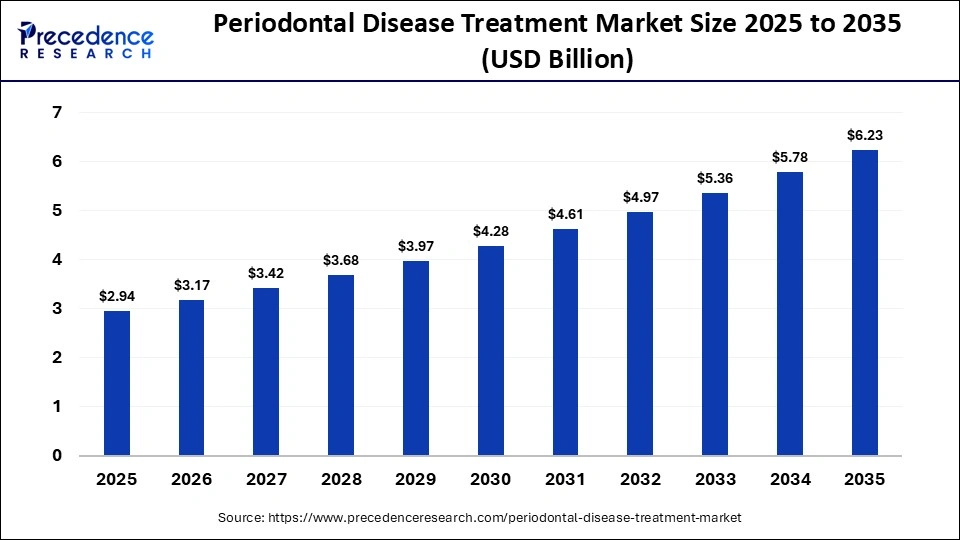
The global periodontal disease treatment market size was calculated at USD 2.94 billion in 2025 and is predicted to increase from USD 3.17 billion in 2026 to approximately USD 6.23 billion by 2035, expanding at a CAGR of 7.80% from 2026 to 2035. The market is experiencing robust growth, driven by the rising prevalence of dental disorders, the shifting trend toward preventive healthcare, and the increasing development of regenerative medicines.
Key Takeaways
- North America dominated the global periodontal disease treatment market with a market share of 34.1% in 2025.
- Asia-Pacific is expected to grow at the fastest CAGR in the market during the forecast period.
- By disease type, the chronic periodontitis segment held a major revenue share of 52.7% in the market in 2025.
- By disease type, the aggressive periodontitis segment is expected to grow at the fastest CAGR of 7.4% in the market between 2026 and 2035.
- By treatment type, the non surgical periodontal therapy segment accounted for a considerable revenue share of 41.8% in the market in 2025.
- By treatment type, the regenerative therapy segment is expected to grow with the highest CAGR of 8.6% in the market during the studied years.
- By disease severity, the moderate segment held the largest revenue share of 43.7% in the market in 2025.
- By disease severity, the severe segment is expected to expand rapidly in the market with a CAGR of 7.6% in the coming years.
- By end user, the dental clinics segment accounted for the highest revenue share of 57.6% in the market in 2025.
- By end user, the specialty periodontal centers segment is expected to witness the fastest growth in the market with a CAGR of 8.0% over the forecast period.
What is the Periodontal Disease Treatment Market?
The periodontal disease treatment industry comprises products, procedures, and adjunctive therapies used to manage gingivitis and periodontitis, reduce infection and inflammation, control pocket depth, preserve supporting tissues, and regenerate lost periodontal structures. The market includes non-surgical periodontal therapy, surgical intervention, locally delivered antimicrobials, systemic antibiotics, regenerative biomaterials, and maintenance care delivered across dental clinics, hospitals, and specialty periodontal centers. Clinical demand is shaped by disease prevalence, treatment intensity, repeat maintenance visits, and adoption of advanced regenerative solutions.
Impact of AI on Periodontal Disease Treatment
Artificial intelligence (AI) is beginning to impact periodontal care in ways that are less apparent compared with traditional surgical instruments, but it has a very real impact. It evaluates radiographs with an accuracy that surpasses human capability, detects early bone loss before any apparent symptoms, and improves recall schedules with predictive-based risk assessments. The result is not just automation; these customized treatment plans are more targeted, less generalized. In time-constrained settings, AI lowers diagnostic ambiguity and redirects clinical focus. It results in a more subtle evolution, transitioning to periodontal therapy.
Trends Influencing the Periodontal Disease Treatment Market
- Clinical Footing for Regenerative Dentistry: There is a palpable shift beyond just damage management to restoration in action. Outcomes such as bone grafts, growth factors, and guided tissue regeneration are now out of the restricted realm of specialized practices into routine clinical practice. This rewrites periodontal treatment to be more restorative than preventive or symptomatic.
- Integration of Oral Health with Systemic Approach : Conversations about periodontal disease are far-reaching; it is no longer just about dentistry, but also related to diabetes and cardiovascular health issues. This intersection is gaining in medical interest and financing into a once disparate aspect of health, while quietly expanding the importance of this market in the larger healthcare universe.
- Increasing Popularity of Patients and Preventive Care Models: Patients have more responsibilities in the management of their long-term oral health and are not passive recipients of treatment. Prevention initiatives, such as personalized recall schedules and educational interventions, are shifting demand trends away from episodic treatments to more relationship-based care.
Market Scope
| Report Coverage | Details |
| Market Size in 2025 | USD 2.94 Billion |
| Market Size in 2026 | USD 3.17 Billion |
| Market Size by 2035 | USD 6.23 Billion |
| Market Growth Rate from 2026 to 2035 | CAGR of 7.80% |
| Dominating Region | North America |
| Fastest Growing Region | Asia-Pacific |
| Base Year | 2025 |
| Forecast Period | 2026 to 2035 |
| Segments Covered | Disease Type, Treatment Type, Disease Severity, End User, and Region |
| Regions Covered | North America, Europe, Asia-Pacific, Latin America, and Middle East & Africa |
Market Dynamics
Drivers
Preventive Measures and Early Intervention
Dentistry is also slowly shedding its reactive stance. Increased awareness with enhanced clinical guidelines is resulting in early interventions in the progression of diseases. This shift not only drives better patient outcomes but also results in more treatments that grow the market silently, without a lot of reliance on expensive procedures.
Restraints
Challenges Due to High Costs of Advanced Treatments
While technological progress has been achieved, issues of affordability remain in different regions. Complex treatment, particularly regenerative therapies and laser-based treatments, is expensive, which is often prohibitive in some cost-sensitive markets, where out-of-pocket expenses are an important driver of patients' choices in dental care.
Opportunity
Integration of AI and Digital Dentistry
AI is gradually making major progress in this area, as it improves diagnostic accuracy, predicts the course of disease, and opens up personalized treatment options. Such innovations should allow for operational and service delivery efficiency to be a significant improvement once incorporated into everyday practices in the future, and provide greater access to consistent, best-quality periodontal care as standard operating procedures.
Segmental Insights
Disease Type Insights
Periodontal Disease Treatment Market Share, By Disease Type, 2025-2035 (%)
| Disease Type | 2025 | 2035 |
| Gingivitis | 18.4% | 16.2% |
| Chronic Periodontitis | 52.7% | 48.4% |
| Aggressive Periodontitis | 11.6% | 14.8% |
| Necrotizing Periodontal Diseases | 6.3% | 6.1% |
| Periodontal Abscess | 11.0% | 14.5% |
The Chronic Periodontitis Segment Dominated the Market with 52.7% of Market Share in 2025
The chronic periodontitis segment dominated the periodontal disease treatment market with a share of 52.7% in 2025, due to the rising prevalence of chronic periodontitis. This condition often goes uncharted until regular dental exams demonstrate the progressive destruction of nearby tissue, which occurs over a period of years. So, treatment isn't typically given, but rather a continual process such as maintenance, scaling, and monitoring. This perennial characteristic encourages ongoing clinical contact and a predictable caregiving relationship within dental practices.
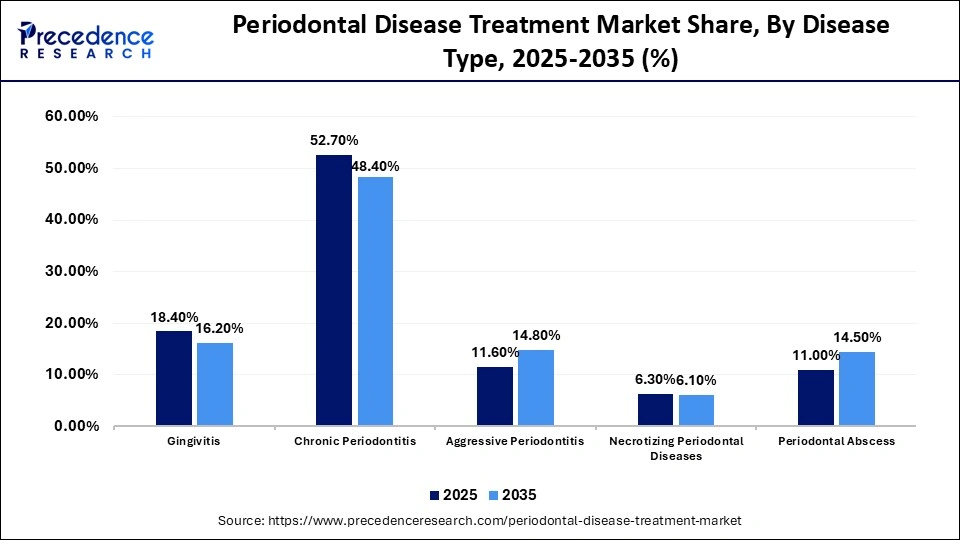
The aggressive periodontitis segment is expected to show the fastest growth with a CAGR of 7.4% over the forecast period, as awareness is driving its development rather than incidence rates. Previously undiagnosed, it is now diagnosed sooner thanks to progress in imaging technology and increased clinical observation. Its hallmark characteristic is the rapid destruction of the underlying tissue, which necessitates rapid and focused interventions that often employ a combination of therapeutic strategies.
Treatment Type Insights
Periodontal Disease Treatment Market Share, By Treatment Type, 2025-2035 (%)
| Treatment Type | 2025 | 2035 |
| Non Surgical Periodontal Therapy | 41.8% | 36.1% |
| Surgical Periodontal Therapy | 22.6% | 21.2% |
| Adjunctive Pharmacotherapy | 18.7% | 17.0% |
| Regenerative Therapy | 16.9% | 25.7% |
The Non Surgical Periodontal Therapy Segment Led the Market with 41.8% of Market Share in 2025
The non surgical periodontal therapy segment contributed the biggest revenue share of 41.8% in the periodontal disease treatment market in 2025, due to achieving a balance of practicality and effectiveness. Scaling and root planning became commonplace, not the result of fancy aesthetics but because they reliably delivered beneficial outcomes for a very diverse patient population. Procedures did not require significant infrastructure investment; they were low-cost and could easily be repeated with limited resistance from patients. To providers, these procedures provided a strong foundation; to patients, it was a viable option.
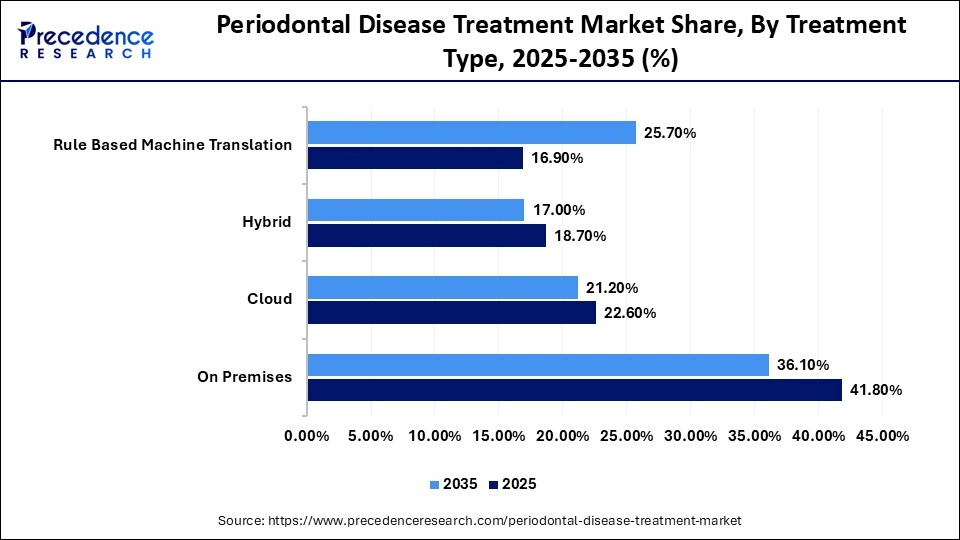
The regenerative therapy segment is expected to gain the highest market share with a CAGR of 8.6% between 2026 and 2035, and reflect a shift in clinical emphasis from a focus on managing conditions to an emphasis on repair. Bone grafts, membranes, and biologics are now increasingly being applied as data become more stable and supporting evidence improves. Approaches that used to only be used in complex circumstances are becoming an increasingly common practice, due at least in part to patients' willingness to invest in durable treatment over the long haul.
Disease Severity Insights
The Moderate Segment Held the Largest Market Share of 43.7% in 2025
The moderate segment held the largest revenue share of 43.7% in the periodontal disease treatment market in 2025. At this point, there lies the point of intersection for neglect leading directly to tangible consequences. The patient presents with clear signs: bleeding gums and mild discomfort, but he has not yet suffered irreversible damage to any part of the gumline. This is when treatment is necessary and controllable, and there is a high volume of people seeking treatment.
Periodontal Disease Treatment Market Share, By Disease Severity, 2025-2035 (%)
| Disease Severity | 2025 | 2035 |
| Mild | 24.8% | 21.0% |
| Moderate | 43.7% | 41.6% |
| Severe | 31.5% | 37.4% |
The severe segment is expected to witness the fastest growth in the market with a CAGR of 7.6% over the forecast period, reflecting the critical balance between increased awareness and delayed action over the past couple of years. Advances in oral care lead to improved access and adherence, but many incidents continue to occur without appropriate treatment. When they do end up getting care, it often is a multi-faceted approach, such as surgical procedures, regenerative treatments, and long-term maintenance plans. Higher cases in advanced-stage cases are due to systemic problems as opposed to better or more reliable early detection, and providing the right level of care on time.
End User Insights
The Dental Clinics Segment Led the Market with 57.6% of Market Share in 2025
The dental clinics segment led the periodontal disease treatment market with a share of 57.6% in 2025, as it serves as a very popular environment for regular dental treatment. Their ease of access and familiarity make them the first line of contact for customers undergoing routine cleanings or fresh problems. With the average appointment of several visits to see a dentist, these dental clinics naturally turned into centers of ongoing care rather than one-off treatment. They carefully balanced patient volume with adaptability, juggling early diagnosis and long-term management.
Periodontal Disease Treatment Market Share, By End User, 2025-2035 (%)
| End User | 2025 | 2035 |
| Non Surgical Periodontal Therapy | 41.8% | 36.1% |
| Surgical Periodontal Therapy | 22.6% | 21.2% |
| Adjunctive Pharmacotherapy | 18.7% | 17.0% |
| Regenerative Therapy | 16.9% | 25.7% |
The specialty periodontal centers segment is expected to expand rapidly in the market with a CAGR of 8.0% in the coming years, driven by the growing demand for specialty as opposed to generalist medicine. With cases becoming more complex and technology advancing, there are more referrals to these specialized centers. These establishments provide high-level expertise, innovative equipment, and the latest procedures, all in a single location, offering solutions that may well far outstrip what general practices have to offer.
Regional Insights
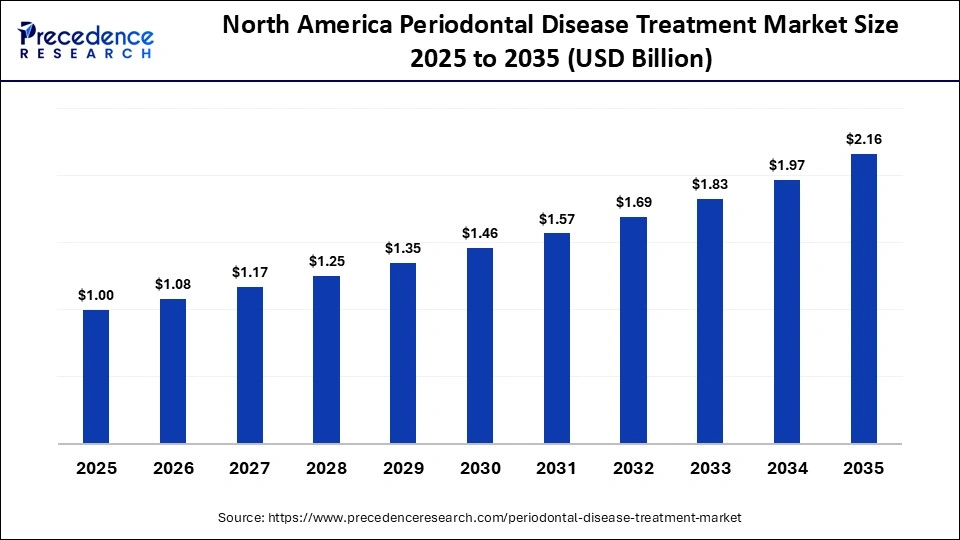
North America Periodontal Disease Treatment Market Size and Growth 2026 to 2035
The North America periodontal disease treatment market size is estimated at USD 1.00 billion in 2025 and is projected to reach approximately USD 2.16 billion by 2035, with a 8.01% CAGR from 2026 to 2035.
Why North America Dominated the Periodontal Disease Treatment Market?
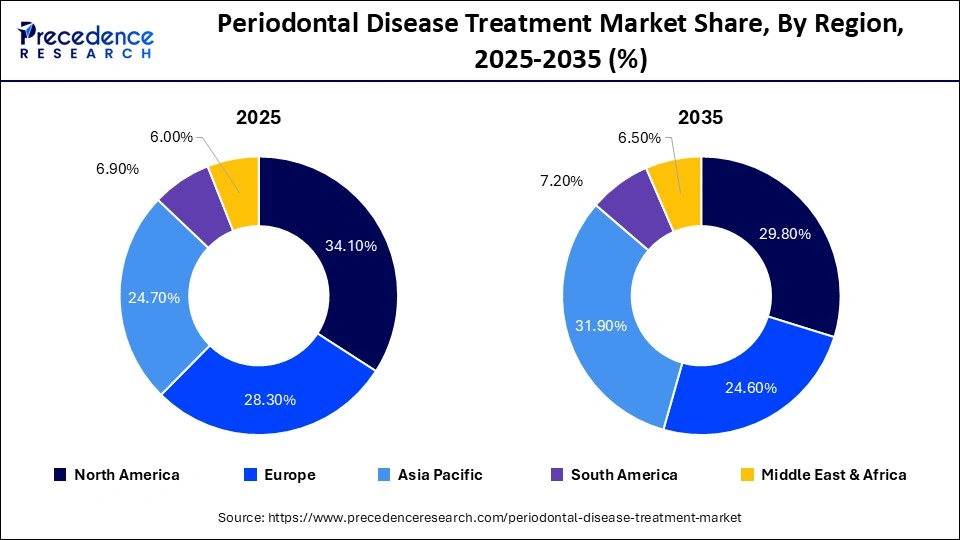
North America held a major market share of 34.1% in 2025. In this area, routine check-ups and early interventions were woven into the care of patients at a universal level through an integrated dental care system. Insurance coverage was imperfect, but it alleviated the financial barriers necessary for continued treatment volumes. Laser therapies and digital diagnostics played an important role. Here, technological elements are embedded throughout the standard practice routine of every clinic, but hardly tested.
U.S. Periodontal Disease Treatment Market Size and Growth 2026 to 2035
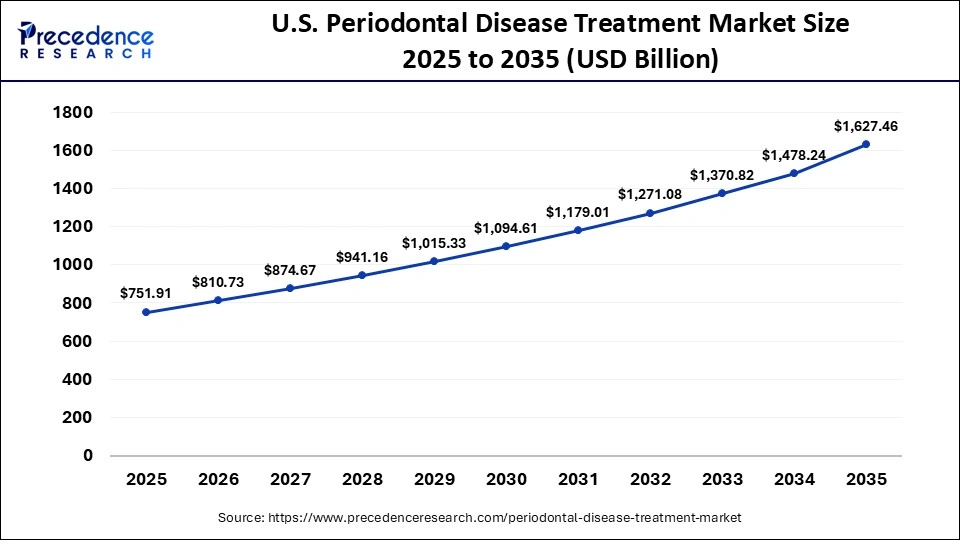
The U.S. periodontal disease treatment market size is calculated at USD 751.91 million in 2025 and is expected to reach nearly USD 1,627.46 million in 2035, accelerating at a strong CAGR of 8.03% between 2026 and 2035.
U.S. Market Trends
The U.S. dominated the North American market, driven by high rates of dental diseases, and proactive oral health services also guaranteed an uninterrupted flow of patients throughout treatment. High-profile organizations and the rapid introduction of state-of-the-art technologies gave it a superior clinical benefit. Because the U.S. was not only capable but also reliable, there were clear treatment paths that enabled patients to transition rapidly from an innovation pilot study to field testing.
Why is Asia-Pacific Experiencing the Fastest Growth in the Periodontal Disease Treatment Market?
Asia-Pacific is expected to experience the fastest growth during the predicted timeframe, owing to the combination of demographic factors and evolving healthcare priorities. It is not only catching up in this area; it is re-shaping access to dental care with a growing reach of clinics and better affordability. Large cities are emerging as centers for cutting-edge treatments, and information campaigns are slowly changing patient behavior into earlier interventions. While growth may look inconsistent then, it has been steady due to growing incomes and improved health tech.
China Market Trends
China leads the market in Asia-Pacific. As the middle class continues to raise expectations for their quality of life, attitudes towards oral health are changing, moving it toward essential care and away from an optional one. At the same time, there has been significant growth in dental clinic establishments, and there is better access to advanced treatment in urban locations. Though differences between urban and rural regions remain, they indicate that progress is not entirely uniform.
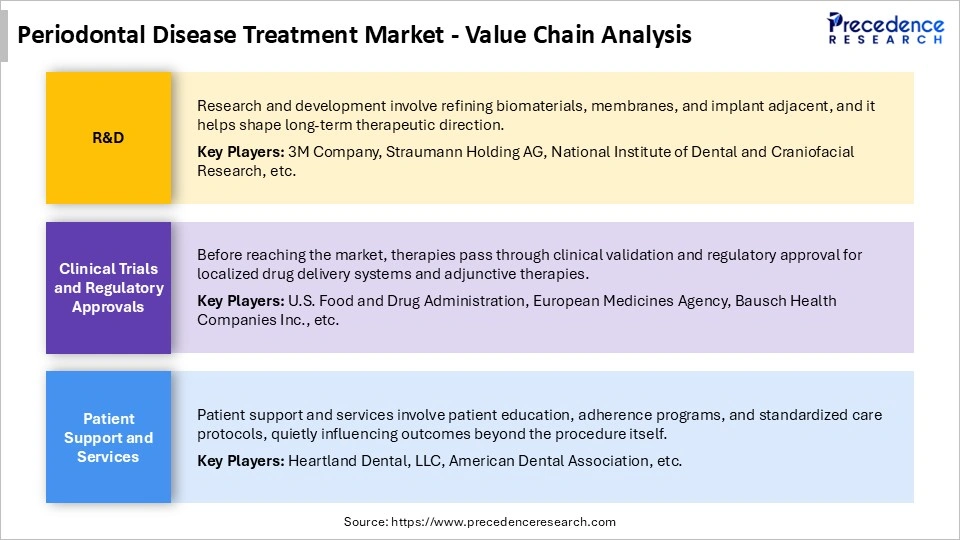
Periodontal Disease Treatment Market Value Chain Analysis
Periodontal Disease Treatment Market Companies
- Dentsply Sirona Inc.
- Institut Straumann AG
- Solventum Corporation
- Geistlich Pharma AG
- Zimmer Biomet Holdings, Inc.
- ZimVie Inc.
- Envista Holdings Corporation
- COLTENE Holding AG
- Sunstar Suisse S.A.
- Septodont Holding
- HuFriedyGroup
- GC Corporation
- NSK Nakanishi Inc.
- Ivoclar Vivadent AG
- Henry Schein, Inc.
Recent Developments
- In March 2026, Sunstar's GUM brand kicked off a global series of "Let's Talk Oral Health" delivered by specialists to facilitate the inclusion of periodontal science in day-to-day clinical conversations. It was more effective to invest in spreading knowledge than selling a product, a small but vital thing to do in the world of tooth care, one that focuses on prevention and education as a key part of the business.(Source: https://the-probe.co.uk)
- In October 2025, Oral Biolife, Inc. secured seed funding to fund non-invasive regenerative therapies to restore bone and soft tissue. The announcement represents investor confidence in the transitioning periodontal treatments from mechanical methods to biologically mediated repair, a transition that may sound premature, but is in many ways inevitable. (Source: https://www.8newsnow.com)
Segments Covered in the Report
By Disease Type
- Gingivitis
- Chronic Periodontitis
- Aggressive Periodontitis
- Necrotizing Periodontal Diseases
- Periodontal Abscess
By Treatment Type
- Non-Surgical Periodontal Therapy
- Surgical Periodontal Therapy
- Adjunctive Pharmacotherapy
- Regenerative Therapy
By Disease Severity
- Mild
- Moderate
- Severe
By End User
- Dental Clinics
- Hospitals
- Specialty Periodontal Centers
- Academic and Research Institutes
By Region
- North America
- Latin America
- Europe
- Asia-pacific
- Middle and East Africa
For inquiries regarding discounts, bulk purchases, or customization requests, please contact us at sales@precedenceresearch.com
Frequently Asked Questions





Ask For Sample
No cookie-cutter, only authentic analysis – take the 1st step to become a Precedence Research client
 Get a Sample




 sales@precedenceresearch.com
 Schedule a Meeting
