



Polyoxymethylene (POM) Market Size, Companies, Share, Production Capacity, Raw Material Pricing, Export & Import Analysis, Manufacturing Cost, Competitive Positioning, and Demand Forecast
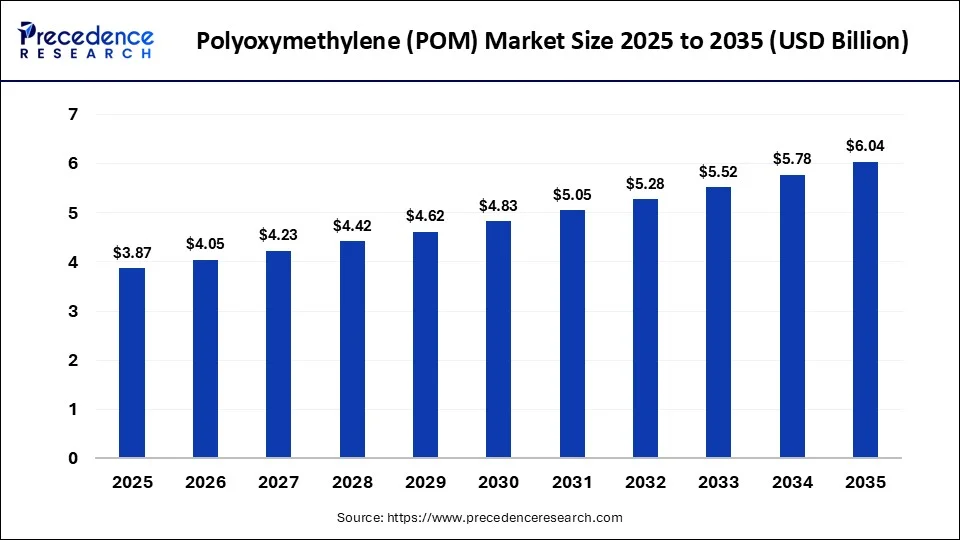
Vidyesh Swar, a Chemical and Materials Industry Expert, estimates the polyoxymethylene (POM) market at USD 4.05 billion in 2026, with the market projected to reach USD 6.04 billion by 2035 at a CAGR of 4.55%. Major polyoxymethylene (POM) market companies such as Mitsubishi Chemical Grp., LyondellBasell Industries NV are competing across key material and application segments, including type, grade, form, processing technology, application, end use industry, distribution channel.
Source: https://www.precedenceresearch.com/polyoxymethylene-market
 Get a Sample
 Table Of Content


Polyoxymethylene (POM) Market Size and Forecast 2026 to 2035
The global polyoxymethylene (POM) market size accounted for USD 4.05 billion in 2026 and is predicted to increase from USD 4.05 billion in 2026 to approximately USD 6.04 billion by 2035, expanding at a CAGR of 4.55% from 2026 to 2035.
Key Takeaways
- By type, the copolymer polyoxymethylene (POM-C) segment contributed the highest market share of 62% in 2025.
- By type, the reinforced polyoxymethylene segment held 10% of market share in 2025 and is expected to grow at the highest CAGR of 5.9% between 2026 and 2035.
- By application, the automotive components segment held a major market share of 38% in 2025.
- By application, the electrical & electronics segment held 22% of market share in 2025 and is expected to register the fastest growth of 5.5% CAGR during 2026 and 2035.
- The EoLV Regulation applies to the entire olefin derivative supply, and the EU's End-of-Life Vehicle Regulation is set to require 15% recycled polyoxymethylene use by 2031.
- The acetal resin industry has been directly impacted by the part of REACH's new restriction on formaldehyde coming into effect since August 2026.
- Around 96.4 million vehicles are expected to be produced in the POM sector, according to OICA.
- Strong momentum can be seen in engineering plastics with SEMI's industry-leading billings of USD 135 billion for equipment in 2025.
- The addition of Polyplastics' Nantong capacity expansion and China's 2026-2027 buildout will drastically change the acetal market.
Market Size Description
As one of the harder engineering thermoplastics on the market today. Polyoxymethylene is proving its worth in the real world of plant investments. As opposed to marketing talk. The world's largest manufacturers of POM are Celanese, BASF, DuPont, Polyplastics and Mitsubishi Engineering-Plastics. Each has a different brand name for its POM products such as Hostaform, Ultraform, Delrin and Duracon. South Korea's Kolon-BASF joint venture, Kolon BASF innoPOM, provides a vivid illustration of the extent to which automakers can no longer do without POM. Manufacturing a product range that includes gears, components in fuel systems, and safety-belt mechanisms and is awarded ISO 14001:2015 certification. This was renewed in early 2025 and will remain valid until March 2028.
Emerging regulatory challenges and sustainability pledges are now repurposing POM formulation and marketing strategies. This transition is gathering pace significantly during 2025 and continuing during 2026. Much of this drove automotive companies from around Germany and France to define reduced-VOC resin grades for interior parts. Due to an EU Regulation (2024/1257) that introduces a cap for the use of cabin VOCs for interior parts from January 2025.
India's automotive component exports industry continued to grow. Domestic manufacturers invested in new compounding lines and cut their dependence on imports of POM from Japan and Germany. Geographic expansion has also been noticed, with Vietnam and Malaysia also catching up as electronics assembly centers. Reflecting the changing pattern of electronics demand growth not just in China, Japan, and South Korea.
Market Snapshot
Engineering plastics buyers are paying more attention to the production movement than to price changes. The ownership of homopolymer POM is changing. This is influencing not only the companies but the people that provide POM to the world. TJC LP owns 80.1% of DuPont's Delrin business as of today, putting DuPont in a minority role in the unit. While pulling back, DuPont continues to work on new Delrin chemistry via joint distribution partnerships. Under this deal, Biesterfeld distributes five grades of Delrin Renewable in EMEA and in Brazil. Of the two grades two of them RASC655 and RASC698 meet USP Class VI and ISO 10993 standards for medical devices.
Strategic Market Insights
Suppliers are being compelled, as industrial standards become more stringent. They provide specialty grade demand with bio-credited feedstock without compromising on mechanical properties. Delrin Renewable Attribute is 100% made from bio-feedstock from waste streams according to ISCC Plus mass balance requirements. Renewable wind power is certified, and municipal waste energy plants generate steam.
They are used to make electricity for manufacturing. These grades are enhanced for surface quality, slip and frictional properties, with no redesign required to switch. On the other hand, manufacturing growth is taking place throughout the region with EMEA and the Brazilian converters. Having direct access to lower footprint POM, via a widespread distribution network such as Biesterfeld.
Market Overview
Introduction to Polyoxymethylene (POM)
POM is generated by polymerizing formaldehyde or, more correctly, trioxane, to give a highly crystalline semi-crystalline product. This molecular packing enables POM to have outstanding dimensional stability. Even under wet or humid conditions. Engineers choose POM for its resistance to creep and deformation. Along with resistance to hydrolysis throughout long durations of mechanical stress. It is these properties of stiffness, low friction, and easy cutting that continue to bring about POM's replacement of brass, zinc, and aluminium for precision gears and bearings.
Evolution of the Polyoxymethylene Market
POM began some decades ago as a substitute for simple mechanical parts. Such as clips and fasteners, which were also made out of metal. This has since made a great change toward car formulations made from reinforced materials, medical materials, and low emission materials. In July 2025, the streams joined forces to announce the launch of Hostaform POM XAP3.
Extra-low-emission grade specifically designed for vehicle interior applications. This grade directly impacts cabin air quality regulations set around China and Europe. These are influencing automotive materials specifications directly. Alloyed medical grade POM has taken a similar turn and has progressed from generic to drug-delivery system USPC CLASS VI-approved biocompatible POM resins.
Role of POM in the Engineering Plastics Industry
POM is a plastic considered a niche material in the engineering thermoplastics category. This is appreciated for the level of stiffness but not necessarily for impact resistance. The dimensional precision of polyamide (nylon) is reduced by the uptake of moisture and swelling under humid conditions. Polycarbonate has better impact resistance, eye clarity, and higher impact resistance. On the other hand, POM has lower friction in sliding. ABS is still lower and easier to mold, but still lacks fatigue resistance and creep behavior under load that is as good as POM.
Market Scope and Coverage
Brands and types of coverage in this market include types of homopolymer and copolymer POM, reinforced POM, lubricated POM, and bio-attributed POM. The products are in the form of granules, powder, film, and sheet. They are produced by injection molding, extrusion molding, and compression molding.
The applications they use extend to automotive parts, electrical and electronics enclosures, industrial machinery, and healthcare products. Geographic scope focuses on the Asia-Pacific region. Especially on the production capacity and access to feedstock in Japan, South Korea, and China. The rest of the story is in North America and mainly automotive OEM, where the quality of materials used for emissions-related specs will be tougher up to 2025 and will carry into 2026.
Market Trends
- Increasing Adoption of Lightweight Engineering Materials in Automotive: Metal brackets and gears are replaced with POM to reduce the weight of the vehicles but maintain their strength. Each kg of reduction is a win for the range of BE models and is a reduction in fuel consumption for combustion models. Such a lightweighting boost has only come on top in 2025 and 2026 as increasingly stringent emissions goals drive engineers to solutions that can mold.
- Rising Demand for High-Performance POM Grades: Engineers pursuing tighter tolerances and harsher operating conditions are not happy with the old standard POM. The pursuit of reinforced, high impact and low friction specialty grades is now being driven by the suppliers for specific mechanical loads. This is facilitating formulators are continuing to divide their products into load-dependent variants.
- Growth of POM Applications in Electric Vehicles: EV platforms require precise dedicated housings for batteries, connectors, and sensors. This needs to be able to handle vibration and thermal shock. Allegro Microsystems is launching production of a TMR current sensor designed specifically for high-speed power electronics in EVs in October 2025. Around components such as this, POM's dimensional stability is becoming more important. This eliminates even minor warping, which disrupts magnetic sensing data.
- Electronics Miniaturization Driving Precision Polymer Demand: Thermal failures due to material creepage or dimensional change are rare with compact electronic assemblies. Automotive and industrial sensing is really converging onto smaller, dense packages. Precision polymers make up for this, with close tolerances required in housings that shrink generation to generation.
- Expansion of Sustainable and Specialty Polymer Solutions: The plastics industry has shifted from talking about circularity as a concept to it becoming an engineering necessity. There has been MCR Pomeroy POM from Celanese that has taken a different approach with earlier projects with Mitsubishi Chemical Advanced Materials (MCA). Alongside that is its recent ECO-B bio-mass balanced product line that will be expanding through 2025 and 2026.
Market Report Coverage and Key Metrics
| Report Coverage | Details |
| Market Size in 2025 | USD 3.87 Billion |
| Market Size in 2026 | USD 4.05 Billion |
| Market Size by 2035 | USD 6.04 Billion |
| Market Growth Rate from 2026 to 2035 | CAGR of 4.55% |
| Dominating Region | North America |
| Fastest Growing Region | Asia Paicfic |
| Base Year | 2025 |
| Forecast Period | 2026 to 2035 |
| Segments Covered | Type, Grade, Form, Processing Technology, Application, End Use Industry, Distribution Channel, and Region |
| Regions Covered | North America, Europe, Asia-Pacific, Latin America, and Middle East & Africa |
Market Segmentation Analysis
Type Insights
Why Did Copolymer Polyoxymethylene (POM-C) Dominate the Global Polyoxymethylene (POM) Market?
The copolymer polyoxymethylene (POM-C) segment dominated the market with a share of 62% in 2025, due to manufacturers prioritizing dimensional stability and long-term durability across demanding industrial applications.
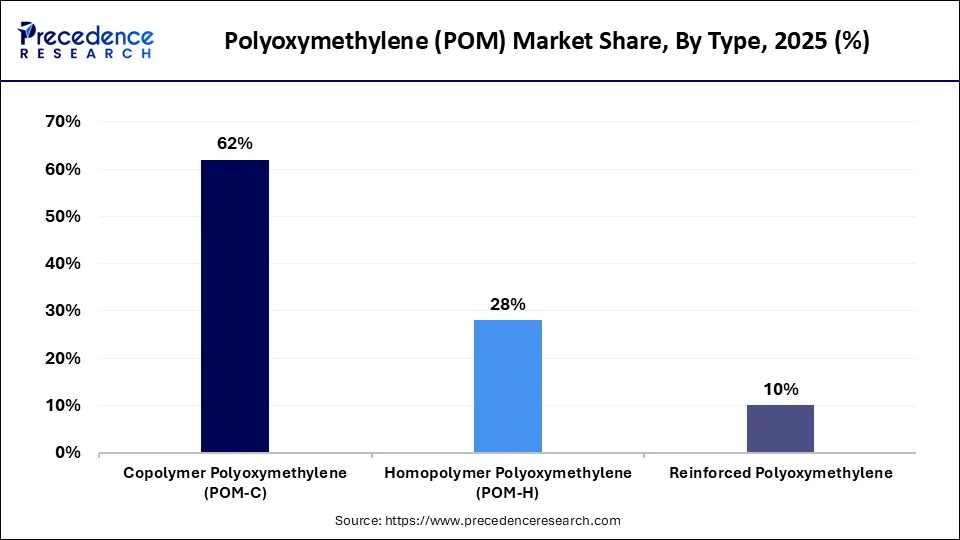
The reinforced polyoxymethylene is expected to grow at the fastest CAGR of 5.9% between 2026 and 2035, driven by industries increasingly requiring higher structural performance from lightweight engineering materials.
Grade Insights
Why Did Standard Grade Become the Leading Grade in the Global Polyoxymethylene (POM) Market?
The standard grade segment dominated the market with a share of 45% in 2025, due to its widespread adoption across automotive, electrical, and consumer products.
Polyoxymethylene (POM) Market Share, By Grade, 2025 (%)
| Grade | Market Share (%) | CAGR (%) |
| Standard Grade | 45.00% | 4.1% |
| High Performance Grade | 18.00% | 6.1% |
| High Impact Grade | 10.00% | 5% |
| Low Friction Grade | 9.00% | 5.2% |
| UV Stabilized Grade | 7.00% | 4.7% |
| Flame Retardant Grade | 6.00% | 4.9% |
| Food Contact Grade | 3.00% | 4.5% |
| Medical Grade | 2.00% | 5.8% |
The high performance grade segment held a 18% share of the market in 2025 and is expected to grow at the fastest CAGR of 6.1% between 2026 and 2035, driven by increasing requirement for superior strength and thermal stability.
Form Insights
How Did Granules Become the Preferred Form in the Global Polyoxymethylene (POM) Market?
The granules segment dominated the market with a share of 74% in 2025, due to the extensive use in injection moulding and precision manufacturing.
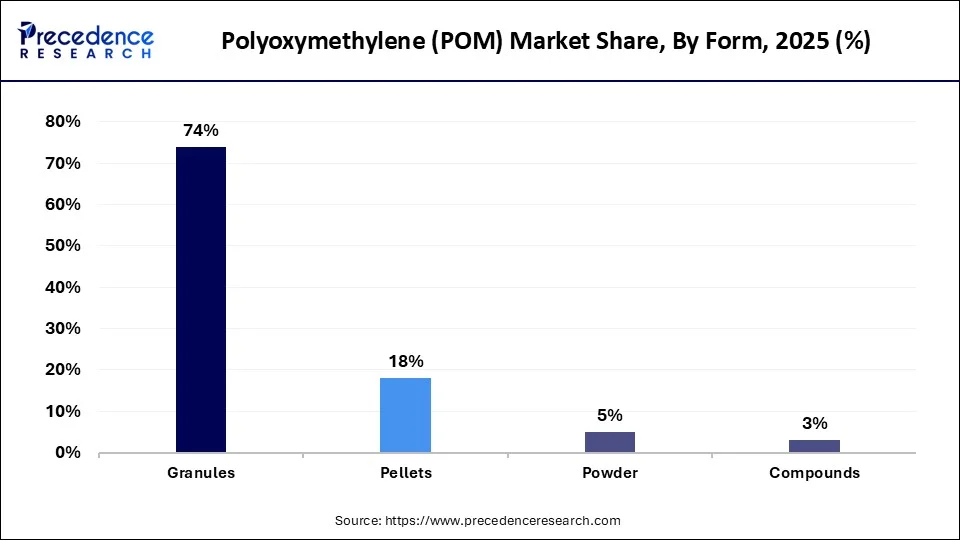
The pellets segment held 18% of market share and is expected to grow at the highest CAGR of 5.4% between 2026 and 2035, owing to the rising adoption of advanced extrusion and customised compounding processes.
Processing Technology Insights
Why Did Injection Molding Emerge as the Dominant Processing Technology in the Global Polyoxymethylene (POM) Market?
The injection molding segment dominated the market with a share of 78% in 2025, due to exceptional suitability for manufacturing complex, high-precision components.
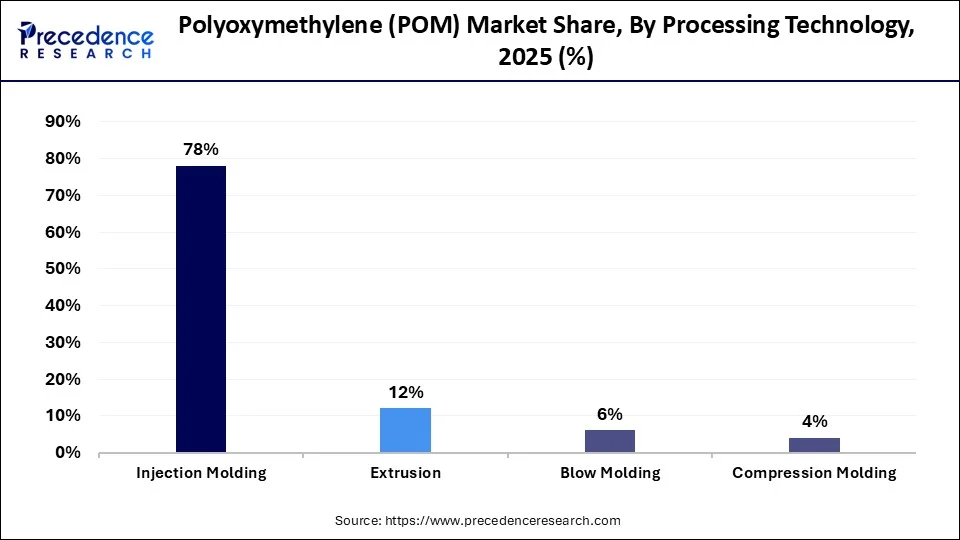
The blow molding segment held a 6% share of the market in 2025 and is expected to grow at the fastest CAGR of 4.8% between 2026 and 2035, driven by increasing demand for lightweight hollow industrial components.
Application Insights
How Did Automotive Components Become the Largest Application in the Global Polyoxymethylene (POM) Market?
The automotive components segment dominated the market with a share of 38% in 2025, owing to the increasing replacement of metal with lightweight engineering plastics.
Polyoxymethylene (POM) Market Share, By Application, 2025 (%)
| Application | Market Share (%) | CAGR (%) |
| Automotive Components | 38.00% | 4.9% |
| Electrical & Electronics | 22.00% | 5.5% |
| Consumer Goods | 13.00% | 4.2% |
| Industrial Machinery | 15.00% | 4.6% |
| Medical Devices | 5.00% | 5.3% |
| Packaging | 4.00% | 3.9% |
| Other Applications | 3.00% | 4.1% |
The acute coronary syndrome detection segment held a 22% share of the market in 2025 and is expected to grow at the fastest CAGR of 5.5% between 2026 and 2035, driven by rising development of advanced fuel delivery technologies.
End User Industry Insights
Why Did the Automotive Industry Remain the Largest End-Use Industry in the Global Polyoxymethylene (POM) Market?
The automotive segment dominated the market with a share of 38% in 2025, due to the rising production of lightweight and high-performance vehicles.
Polyoxymethylene (POM) Market Share, By End User, 2025 (%)
| End User | Market Share (%) | CAGR (%) |
| Automotive | 38.00% | 4.9% |
| Electrical & Electronics | 23.00% | 5.6% |
| Industrial Manufacturing | 16.00% | 4.5% |
| Consumer Goods | 10.00% | 4.2% |
| Healthcare & Medical | 5.00% | 5.1% |
| Packaging | 4.00% | 3.8% |
| Aerospace & Defense | 2.00% | 4.7% |
| Others | 2.00% | 4.3% |
The electrical & electronics segment held a 23% share of the market in 2025 and is expected to grow at the fastest CAGR of 5.6% between 2026 and 2035, driven by increasing demand for compact and high-precision electronic devices.
Distribution Channel Insights
How Did Direct Sales Become the Leading Distribution Channel in the Global Polyoxymethylene (POM) Market?
The direct sales segment dominated the market with a share of 56% in 2025, due to the strong preference for long-term supply agreements between polymer manufacturers and industrial buyers.
Polyoxymethylene (POM) Market Share, By Distribution Channel, 2025 (%)
| Distribution Channel | Market Share (%) | CAGR (%) |
| Direct Sales | 56.00% | 4.4% |
| Polymer Distributors | 28.00% | 4.7% |
| Specialty Chemical Distributors | 12.00% | 5.4% |
| Online Industrial Platforms | 4.00% | 5.1% |
The specialty chemical distributors segment held 12% of market share in 2025 and is expected to grow at the fastest CAGR of 5.4% between 2026 and 2035, supported by increasing demand from small and medium-sized manufacturers.
Market Dynamics
Market Drivers
Growing Automotive Production and Component Lightweighting
In mature markets, there were a few years of stagnation. But in 2025, global vehicle output is coming back. OICA reported that production would increase by 3.9 percent to 96.4 million units in 2025. Compared with 2024, when production was at 92.7 million units. POM is gaining more chances to substitute metal brackets, clips, and gears. On the other hand, Asia is now responsible for most of that growth, with regional output inching ahead of 59 million vehicles and thus on course to drive the POM demand.
Increasing Demand for Precision Industrial Components
Manufacturers are pursuing more quality control and higher throughput in production lines. Leading to more factory automation. But even though the products don't have the flashy sizzle that cars or EVs do. POM consumption continues to rise steadily as industries rely on precision components for their designs.
Expansion of Electronics Manufacturing
The semiconductor and electronics industry really had an unprecedented year from 2025 to 2026 inclusive. According to SEMI, global equipment billings for the supply chain through 2025 are projected to total $135.1 billion, a rise of 15% from 2024. Precision connectors, insulators, and housings are required for every new fab. Each new packaging line is constructed during this AI-driven build-out, and POM fits the bill.
Rising Adoption of Medical-Grade Engineering Plastics
Medical device manufacturers continue to strive to make ever smaller and more complex devices. These remain subject to rigorous regulation. The medical POM homopolymer TENAC Q5010, completely backed by ISO 10993 and USP Class VI biocompatibility certification, is marketed by Asahi Kasei for parts in insulin pens and asthma inhalers.
The acetal series from Polyplastics provides an alternative. One is its high-flow acetal specially developed for wall-thinning applications and miniaturization in complex devices. Both methods are rooted in the same driver. Medical engineers require chemical resistance and precision performance that can't be reliably achieved by using standard, off-the-shelf industrial material.
Market Restraints
High Raw Material Price Volatility
The methanol market is closely followed by the POM producers. Because methanol is an input to the formaldehyde and trioxane production. Earlier in 2026, the United States' methanol prices reached a four-year high. Due to supply disruptions in the Middle East due to tensions near the Strait of Hormuz. That means global feedstock costs remain unpredictable heading into 2026. Methanex's Geismar 3 plant is expected to come back online sometime in the second half of 2025.
Competition from Alternative Engineering Plastics
POM is in direct competition with polyamide, with overlapping uses in the automotive and electrical sectors, and for PBT and PPS, it overlaps. Polyamides are more impact resistant in some cases, and PBT is usually more cost effective for connector and switch applications. PPS's thermal ceiling is lower than the extreme-heat capabilities of POM. On the other hand, PPS offers an advantage, and formulators are being left with the option of material changes case-by-case.
Processing and Recycling Challenges
Formaldehyde gas is released from POM when processed at higher temperatures. This requires careful airstreaming and handling during processing. This same thermal sensitivity also makes mechanical recycling a challenge. In the case of certain other competing polymers, the molecular weight and mechanical performance degrade at about the same rate with each melt cycle.
Market Opportunities
Growth of Reinforced Polyoxymethylene Materials
Reinforced POM continues to open new opportunities. These are closed to regular grades by themselves. A materials study published via PMC back in 2025 showed that it was effective to introduce up to 10% content of fiberglass. This improves the tensile properties and impact strength of neat POM by more than double. Specific focus on replacing metal in structural applications is offered through the Mitsubishi Chemical Group with its wide range of glass-fiber reinforced materials, such as GMTex and MultiQ.
Expansion of Electric Vehicle Supply Chains
Since its humble beginnings when batteries were still the primary application for the vehicle. The count of precision plastic parts across all EV platforms continues to grow with each successive vehicle, from battery pack brackets to sensor housings. Data from the OICA in 2026 showed that it was only China that produced 16.626 million cars. Representing a 29% increase from the previous year. This current sheer volume growth enables the POM suppliers to gain a true new customer base. Outside of the traditional internal combustion supply chain.
Increasing Demand for Medical and Healthcare Components
POM is always of interest to medical device engineers. They use it for components in dialysis machines, surgical instrument handles, and in the precision dosing mechanisms within inhalers. Sterilisable and chemically resistant, tolerances remain unchanged and unaffected by repeated cycles of autoclaving. In 2025 and 2026, chronic disease management gets increasingly home-based. Even steady mechanical performance remains to ensure POM's continued presence in the next generation of online diagnostic or dermal delivery devices.
Digital Transformation in Polymer Procurement
Sourcing engineering resins is finally catching up with modern B2B software rather than relying purely on distributor phone calls. In late 2025, Plastics.com launched Herman AI, a new artificial intelligence-powered resin-selection tool. That creates knowledge graphs linking searchable material properties to engineers and procurement teams.
Market Challenges
Balancing Performance Requirements and Cost Efficiency
But manufacturers are constantly competing between the demands and pressures of getting a better mechanical performance figure. On the other side, limiting raw material costs is continuously at odds with each other. The lowest viscosity commodity grades are hardest hit by formaldehyde-based feedstock volatility through 2025 and 2026. Reinforced and specialty POM formulations are also more expensive to process. This will likely require a premium price for specialized applications unless they deliver measurable benefits.
Regulatory Compliance Requirements
The formaldehyde emitting products have been subject to targeted action by Regulation (EU) 2023/1464 (REACH) Annex XVII Entry 77. This is placing pressure on automotive-grade POM compounds, which would be challenged by the medical-grade compliance standards (USP Class VI and ISO 10993).
Polyoxymethylene Market Ecosystem Analysis
POM Industry Value Chain
Feedstock suppliers are at the beginning of the whole chain. Converting natural gas or coal into methanol before the line starts for formaldehyde production in the downstream. The formaldehyde is then scaled up to polymerize into homopolymer or copolymer POM resin by polymer manufacturers, such as Celanese, BASF, and DuPont. Next, compounders are involved, where reinforcements, colour, and additives are introduced into the mix to suit the end product requirements. The final stage is a moulding process for finished parts. They are produced by component manufacturers for a variety of OEMs.
Key Stakeholders in the POM Market
Resin manufacturers, such as Celanese, BASF, DuPont, Mitsubishi Chemical and Polyplastics, are the leading producers of resin manufacturing capacities in the world. Nairobi-based companies such as Nexto Plastics keep acetal alphabet from BASF and Mitsubishi supplies the acetal copy grades for various buyers. Some of which are small, with distributors helping in the bridge between producers and customers. Compounders take it one step further and create different formulations based on the base resin to be used for certain applications.
Supplier and Customer Relationship Analysis
For resin producers, dealing with contracts that provide for a long-term basis. They are the favoured option rather than sales deals with spot-market valuation. Particularly from the tier one automotive suppliers who are looking for stability in pricing up to 2025 and 2026. Such deals frequently contain volume commitments to buffer from volatility in methanol fuel feedstock costs for both parties. Even though the wholesale sourcing of resin is one part of the equation, technical partnerships are becoming as vital as sourcing.
Raw Material and Production Analysis
POM Manufacturing Process Overview
POM is synthesized by a polymerization reaction of formaldehyde, starting with the formation of either homopolymer or copolymer. Routes with homopolymer have higher crystallinity and stiffness, whereas routes with copolymer have high thermal stability. They are resistant to hydrolysis in a moist environment. Specialty grade is accelerating rapidly, gaining momentum through 2025 and 2026. Response to a decreasing demand for commodity resin and increasing demand for products that are low in VOCs, bio-attributed, and compliant with medical applications.
Feedstock Availability and Supply Analysis
The availability of formaldehyde is regionally dependent on the Methanol availability. This is also geographically widely variable. In the wake of stricter regulation of formaldehyde emissions. The need for supply security has only become more challenging for more converters, which will need to qualify more than just one feedstock supplier from their regions.
Production Capacity Expansion
After launching Phase 1 of its new POM production line in northern China's Jiangsu Province with a capacity of 90,000 tons per year in November 2024. Polyplastics is entering into business trade at its polyol production base. Making overproduction contracts despite the continuing competition's growing intensity.
Pricing Analysis
Polyoxymethylene Manufacturing Cost Structure
The raw material costs are the most significant, as it comes to the economics of POM production. The feedstock is typically the greatest single production expense line. This is usually formaldehyde and/or trioxane. Energy costs are followed by a close distance in that both the polymerization and compounding require steady thermal control during processing. Additive blending and glass fiber loading are additional equipment cycles. This is needed for reinforced grades and specialty grades, where costs are increased due to added processing costs.
POM Manufacturing Price Analysis
Formaldehyde's cost continued to decrease throughout the year. Leading to the POM being priced at approximately USD 3,280 per metric ton on average. There is considerable variability in pricing at a regional level below. Further complicating landed cost calculations is an increase in logistics alone of around 12% on distributor pricing from 2023 to 2025. Feedstock costs rose by 7% to 9% for formaldehyde itself during the same time. Directly impacting margins of manufacturers of standard grades.
POM Selling Price Analysis
In addition to the variations in selling price that arise. Due to differences in homopolymer grades. There can also be significant differences in the selling price once specialty formulations start to come into the picture. Usually, copolymer grades cost 15% to 20% more than homopolymer grades. This premium arises from the true performance difference between them. Especially the hydrolytic stability and low formaldehyde content of copolymers in challenging applications. On the other hand, medical-grade and low-VOC automotive resins increase costs even more, as manufacturers absorb the certification testing.
Future Pricing Outlook (2025-2035)
Commodity prices will continue to be influenced by balancing two factors in the next decade. Increasing Asian capacity will drive commodity prices down, and specialty grade adoption will raise the average selling price up. The incoming supply of standard grades in the coming years should be a bit more comfortable in China thanks to its planned capacity expansions from 2026 to 2030.
Automotive and medical customers are consolidating their sustainability standards and taking pledges through 2035, mentioning the increased volatility of standard commodity pricing.
Supply Chain Analysis
Upstream Supply Chain
It starts with chemical suppliers. They developed another means of deriving methanol from natural gas or coal so that formaldehyde can be synthesized. As for the upstream connection, this remains closely linked to the wider energy price markets. Any increase or decrease in feedstocks immediately impacts POM producers within a couple of weeks. The formaldehyde is then processed to produce polymer in infrastructure across China, Japan, South Korea, Germany, and the United States, with a concentration of the processing capacities.
Manufacturing and Compounding Landscape
The base polymerization step is managed by the resin producer. The compounder is responsible for the resin's performance in actual applications. In glass fiber compounding, the glass fiber is mixed with minerals. Impact modifiers and lubricants to achieve specific mechanical requirements by the individual customer. This concept is based on division of labour, which allows large integrated players such as BASF and Celanese to concentrate on their core business product. Polymerization and specialized compounders develop the final formulations.
Downstream Application Supply Chain
The automotive suppliers where POM is being used include fuel systems, interior mechanisms, and seatbelts. Also, the tier-one supply networks are still the biggest demanders among the downstream supply partners. Next come the electronics manufacturers. They are using POM to create consumer and industrial precision enclosures, connectors, and switches. POM is used in the manufacturing of industrial parts such as gears, bearings, and valve parts
Supply Chain Risks and Mitigation Strategies
Geopolitical trade tensions have dealt a major blow to plastics supply chains since 2025, according to the American Chemistry Council. The Plastics Industry Association (PIA) has openly stated that wide-ranging tariff measures could wreak havoc on the industry. Disrupting current supply chains and drive up costs. As we draw near 2026, supplier diversification has become the tried-and-tested approach for mitigation. Companies are more inclined to cultivate flexible multi-region contracts, as opposed to relying on one-source procurement. That doesn't offer the ability to cushion from unforeseen events.
Technology and Innovation Landscape
Advanced POM Reinforcement Technologies
The structural possibilities of POM continue to grow for all grades that include glass fiber, carbon fiber, and mineral-filled. Added to be used in the critical areas of increasingly stiff plastics. PTFE-modified formulations address the entire friction issue. The combination of those types of reinforcement offers designers a metering flexibility. Opting for stiffness, wear resistance, or lubricity, as it turns out, has the most impact on the part under study.
Low-Friction and Self-Lubricating POM Technologies
A multi-component lubricant system is used, not a single additive performing all the work, as with self-lubricating POM formulations. The high molecular weight polyethylene is typically added in the range of 0.05% to 3% of the weight of the part. This is known to transfer to the surface of the part during sliding, and several thin films of it are deposited on the metal counterfaces.
Medical-Grade and Food-Contact POM Innovations
POM formulations are marketed with documentation packages that are as long as the material science. Medical-grade resin is no longer distinguished by biocompatibility testing under ISO 10993, USP Class VI certification, or FDA Drug Master Files. They are now considered acceptable standards. In addition to the parallel track of food-contact compliance with EU Regulation 10/2011 and FDA 21 CFR 177.2470, producers are required to keep another parallel track.
Digital Manufacturing and Material Optimization
POM printing compatibility has truly improved, but proper ventilation is necessary for a material. That is still prone to the off-gassing of formaldehyde. Jabil Engineered Materials announced the development of a 3D-printing filament. It is made from a polymer that does not contain formaldehyde, with a focus on aerospace, automotive, and industrial production applications from its Minnesota Materials Innovation Center.
Application Analysis
Automotive Component Applications
Fuel System Components
Fuel systems require materials that resist chemical attack over all the years of service without swelling up or deteriorating. That change makes their performance against a range of fuels at high temperatures even more important for fuel system plastics. POM's impressive resistance properties in both gasoline and diesel become even more compelling as blend ratios increase.
Gear Systems and Mechanical Components
POM gears are gradually crowning the Brass and Zinc Die-Cast parts that have been used in numerous mechanical assemblies. The benefit of low friction is that no continuous lubrication is needed. Sealed, maintenance-free gear trains are critical in some cases.
Door Lock Assemblies and Seat Mechanisms
Mechanisms critical to safety cannot endure material fatigue or dimensional drift during a vehicle's useful life, such as door latches. These assemblies contain POM parts that provide necessary precision and repeatability of movement. When locking and unlocking the mechanism, critical for the dependable functioning of electronic locking systems.
Electrical and Electronics Applications
Connectors and Switches
As devices get more circuitry in smaller spaces, electrical connectors are getting smaller. POM's dimensional stability maintains close tolerances as devices continue to be miniaturized. Its great electrical insulation qualities also come into play, ensuring signal clarity within compact, dense housings.
Precision Electronic Components
Warping or creep under sustained thermal cycling within a small enclosure simply is not acceptable for precision electronics. POM's near-absolutesoaking resistance ensures constant geometry throughout the manufacturing and field life.
Industrial Machinery Applications
Bearings, Valves, and Gears
The scope of industrial automation continues to grow steadily. Various of the conveyors, robotic arms, and pneumatic valve systems must have parts that are resistant to wear when constantly moving. POM bearing and valve bodies are able to meet this requirement; tolerances can be maintained over many cycles of mechanical operation, and no external lubrication is required.
Healthcare Applications
Surgical Instruments and Drug Delivery Components
Medical grade POM has continued its rapid growth in the fields of instrument handles, surgical trial parts, and precision dosing mechanisms. Its mechanical strength and biocompatibility are of a critical nature.
Customer Buying Behavior Analysis
Key Purchasing Criteria
Buyers evaluate POM across a genuinely tight set of criteria. Mechanical characteristics that correspond to the exact load and wear requirements of a product. Cumebility is important as well, as molders require production to be consistent in flow and cycle time. Then there's certification, which can be ISO 10993 for medical components, or OEM-specific automotive specifications.
OEM Material Selection Trends
There is a growing trend toward implementing an approved-supplier program for material selection by automotive, electronics, and industrial corporations – in other words, one that is documented. Companies such as Trinseo, for instance, will provide downloadable lists of materials. These are approved for the particular OEM specifications.
Customized Compound Demand
The growing number of different formulations, it becomes difficult to sell commodity POM. Such as, PTEX is used when better performance is defined by needs-specific properties. For automotive applications, customers regularly ask for custom stabilizer packs that are designed to comply with the formaldehyde emission limits. Medical device manufacturers have comparable requirements, with emphasis on biocompatibility evidence being provided along with mechanical properties information.
Regulatory and Compliance Landscape
Automotive Material Regulations
Automotive circularity requirements are paramount over mechanical performance for the selection of materials. On 12 December 2025, the End-of-Life Vehicle Regulation (EoLV) was approved by the European Union's political level and in February 2026 ratified by the committees. Within six years of its entry into force. It will require a minimum of 15% plastic recycled in new vehicles and 25% within 10 years. This is likely to encourage POM formulators to look for true ‘closed loop' material sources rather than to give the impression of opportunistic recycled content offers.
Food Contact and Medical Compliance Standards
Sensitive applications require multi-layered regulatory review, rarely unbundling over the tidy lines of the regulatory jurisdictions. Food-contact POM grades must go through FDA's Food Contact Notification process before being sold in the US and must meet FDA's criteria from 21 CFR 177.2470. Medical device manufacturers have their own track and line of testing to comply with ISO 10993 biocompatibility testing. USP Class VI certification and FDA Drug Master File documentation.
Environmental and Sustainability Regulations
Regions are getting more aligned on the direction of environmental rules. They focus on verified content for recycled materials. Instead of voluntary sustainability declarations. Recycling Europe (RE) indicates that the EU's End-of-Life Vehicle Regulation is likely to take effect in the fourth quarter of 2026. This is forcing European POM compounders to invest in domestic recycling facilities well before this period expires.
Investment and Expansion Analysis
Capacity Expansion by Polymer Manufacturers
Manufacturers are continuing to continue to adjust their capacity instead of blindly expanding output of all things. In its filing for the first quarter of 2026, Celanese announced that it will shut down its polymerization facility in Sakra, Singapore. They will invest in other projects in its Engineered Materials businesses. Some of those parallel investments involve progressing liquid crystal polymer operations in China. Specialty compounds capability in Europe and new medical-grade compounding capacity in Asia.
Strategic Partnerships and Collaborations
POM and nearby engineering resins to reach regional customers increasingly depend on distribution partnerships. Engaging Bamberger Amco Polymers, M. Holland Company, Nexeo Plastics, and Polimeros Nacionales as its distribution partners in North America for engineering plastics. This enables BASF to gain a quicker presence in the region without extensive deployment of the company's own sales network. These partnerships enabled Big, Integrated Producers to grow without capital investment in all the capabilities, but gain market and technical penetration.
Mergers and Acquisitions Landscape
The engineering plastics market keeps changing following a string of consolidation efforts, the latest one of which was evident in 2025. In July 2025, BASF fully acquired the remaining 49% stake in the Alsachimie joint venture. Thus fully gained ownership of the Chalampe production site in France. This is a facility for important precursors. Thereby enhancing BASF's entry into control of its supply chain beyond its finished-resin business.
Market Regional Analysis: North America, Europe, Asia-Pacific
Why Was Asia Pacific Recognized as the Fastest-Growing Region in the Global Polyoxymethylene (POM) Market?
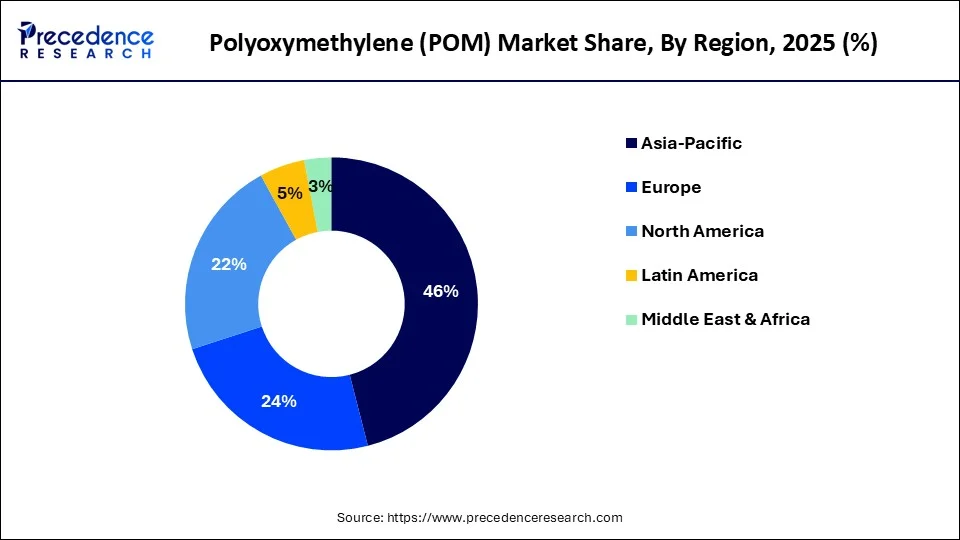
Asia Pacific led the market, capturing the largest revenue share in 2025, accounting for an estimated 38%, and is estimated to grow at a strong CAGR of 5.5% over the projected period, due to rapid expansion of automotive manufacturing, electronics production, and industrial automation.
Asia Pacific Polyoxymethylene Market Size and Growth 2026 to 2035
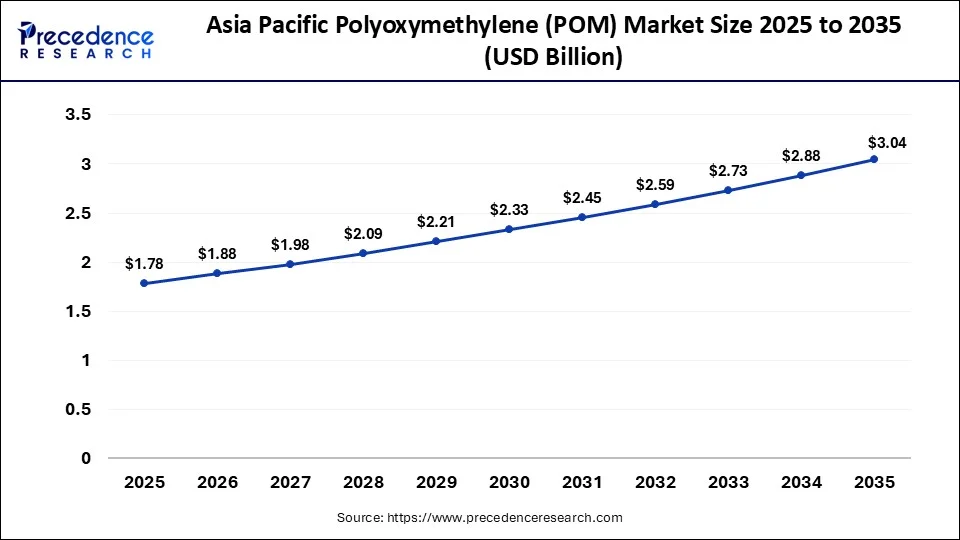
The Asia Pacific polyoxymethylene market size was evaluated at USD 1.78 billion in 2025 and is projected to reach around USD 3.04 billion by 2035, growing at a CAGR of 5.50% from 2026 to 2035.
China
China remained the largest national market as the manufacturing capacity was extensive, so high volume production of automotive, electrical, and industrial parts occurred in the region.
Japan
Advanced automotive engineering and robotics, as well as high-dollar electronics production, which demanded precision polymer parts, drove Japan's need for increased demand.
India
India put on fast growth with the expansion of the automotive industry, production of industrial machines, and domestic assembly of electronics products.
South Korea
South Korea had strong demand as the driver from semiconductor manufacturing and production of consumer electronics and advanced industrial automation.
Europe Expected to Held Fastest CAGR of 24%
Europe is expected to hold 24% of the market in 2025 and is estimated to grow at a strong CAGR of 4.1% over the projected period, supported by automotive engineering, industrial machinery, and precision manufacturing remaining highly developed across the region.
Germany
The German automotive industry needed high performance engineering plastics for precision vehicle parts, making it the regional leader.
United Kingdom
The United Kingdom stimulated demand through specialized aerospace, medical device, and industrial engineering manufacturing.
North America Held Significant Market Share of 22% in 2025
The North America region held a 22% share of the market in 2025 and is expected to grow at a 4.3% CAGR between 2026 and 2035, driven by the strong presence of automotive OEMs, aerospace manufacturers, and advanced industrial production.
U.S.
Advanced investments in automotive production, medical devices production, and industrial automation gave the U.S. market a competitive edge in the region.
Latin America Held Notable Market Share with 5% in 2025
The Latin America region is expected to grow at a notable CAGR of 4.5% between 2026 and 2035, due to the industrial manufacturing and automotive assembly operations across major economies.
Brazil
Brazil was the regional leader, continuing to have the largest number of automotive manufacturing sites and industrial production capacity.
Middle East & Africa Held a Considerable Market Share of 3% in 2025
The Middle East & Africa region is expected to grow at a strong CAGR of 4.2% between 2026 and 2035, driven by industrial diversification programmes and increased demand for advanced engineering materials.
Saudi Arabia & UAE
Firings from Saudi Arabia and the United Arab Emirates (UAE), both large-scale industrial diversification programmes and investment in manufacturing sectors, created demand.
Competitive Landscape
Market Competition Overview
The existing bold, global POM marketplace is divided between a few vertically-integrated players and a large group of regional competitors who depend chiefly on price. The technology leader is the group of specialty and certified grades, which give Celanese, BASF, DuPont's Delrin business under TJC, Mitsubishi Chemical, Polyplastics, and Asahi Kasei a premium price. Below this throng is an even more divided market, particularly in China, where dozens of domestics jockey for position almost entirely based on price.
Competitive Benchmarking
Benchmarking goes by major POM suppliers; real differentiation in strategic plans gets underway. Rather than simply a Battle of the Scales. On the innovation infrastructure side of the business. Celanese opened its expanded Michigan Technology Center in February 2026 to facilitate co-development efforts with customers. In particular areas, such as automotive, electronics, and medical applications. Furthermore, the certified medical, low-VOC automotive and bio-attributed formulations are increasingly being the ones that earn the technical relationships that pure commodity pricing simply can't achieve.
Strategic Developments
Strategic moves made in the field have taken place in almost every category over the past few years, including acquisitions, sustainability pledges and more. As of February 2026, Celanese's Michigan Technology Center expansion is now designed to provide piloting. In July 2025, BASF finalized its purchase of the remaining stake in Alsachimie at DOMO Chemicals. Continue to add bio-based and recycled content to the mainstream commercial product stream that will carry the company forward into 2026 and 2027.
Company Profiles
Celanese Corporation
In the role of one of the world's biggest integrated POM producers. Celanese markets its Hostaform and Celcon POMs worldwide. In February 2026, the company announced the opening of its expanded Michigan Technology Center, which brings automotive, electronics, and medical applications piloting and customer co-development into one location.
DuPont de Nemours
DuPont's Delrin brand continues to be seen as acetal homopolymer, despite ceeding almost 80.1% of its stake in the division to TJC LP in 2023 with a minority stake. Since then, DuPont has continued to restructure itself, with the Electronics business separated in April 2013. Qnity Electronics and DuPont have focused their remaining activities on two segments in Healthcare & Water Technologies.
Polyoxymethylene (POM) Market Companies
- Mitsubishi Chemical Grp.
- LyondellBasell Industries NV
- LG Chem Ltd.
- Korea Engineering Plastics
- KOLON ENP Inc.
- Hexion Inc.
- Ensinger
- DuPont de Nemours Inc.
- Daicel Corp.
- Celanese Corp.
- BASF SE
- Avient Corp.
- Asahi Kasei Corp.
- Arkema Group
Future Market Outlook (2025-2035)
Short-Term Outlook (2025-2028)
The near-term demand remains unchanged, continuing to be supported by three major factors. These have been around for many years and have been the stimulators of POM consumption, including automotive, electronics, and industrial machinery. The regulatory framework will also influence the purchase of these articles. Because the emission levels for formaldehyde in REACH are coming into force for general articles from August 2026.
Medium-Term Outlook (2028-2032)
The window is the time period during which the EV market moves from being a growth market. Driving towards the dominant growth driver for the development of specialty grade. Starting August 2027, the permitted levels of formaldehyde for vehicle interiors become even more restrictive. This works towards even healthier chemistry for automotive POM. On the other hand, China's domestic capacity growth will slow down significantly by 2028, as strong specialty demand for EVs gains steam.
Long-Term Outlook (2032-2035)
Early in the 2030s, the POM portfolio should further move to a more fair distribution of reinforced or specialty grade. POMs, as the bulk of commodity resin grades are eroded by higher valued materials in terms of value. The use of sustainable polymers should also gain more ground, and the EU's 25% recycled plastic content for vehicles. That should become more common about one decade after the ELV Regulation comes into effect, in about 2035/36.
Strategic Recommendations
Recommendations for Polymer Manufacturers
Compared to commodity grade, specialty grade possesses the technical relationship. Price competition cannot duplicate it and so has higher priority for manufacturers. The strategy taken by Celanese in February 2026 with their Michigan Technology Center makes good sense here. By running customer co-development through the R&D system, qualification cycles can, of course, be significantly reduced. Capacity expansion decisions must remain targeted and selective and follow the example of Polyplastics' phased development in Nantong, not widespread speculative over-capacity.
Recommendations for Investors
Specialty and medical-grade POM demand are extremely important for investors to monitor. Because they'll witness structurally greater technical barriers than commodity resin and stronger margins against Chinese pressure. In the absence of any doubt, EV supply chains hold a real growth vector as China's production of new energy vehicles (NEVs) achieved a record high of 16.626 million units in 2025, according to OICA. Semiconductor Equipment and Materials International (SEMI) in 2025 indicates a continued stream of demand for precision parts from the POM family from the electronics manufacturing sector downstream.
Recommendations for End Users
End-user organisations need to develop a supplier qualification process that is not a mere comparison of prices. But also include assessment of certification depth, geographical supply source safety, and the level of technical support. American Chemistry Council estimates that tariff-exposed processors could pay up to 20% more through 2025 and 12% more through 2026 due to these cost increases. If buyers specify automotive or food contact grades. They need to ensure that the supplier meets the requirements of REACH's emission limits for formaldehyde long before the deadline for implementation.
Complete Market Segmentation
By Type
- Homopolymer Polyoxymethylene (POM-H)
- Copolymer Polyoxymethylene (POM-C)
- Reinforced Polyoxymethylene
- Glass Fiber Reinforced POM
- Mineral Filled PO
- Carbon Fiber Reinforced POM
- PTFE Modified POM
By Grade
- Standard Grade
- High Performance Grade
- High Impact Grade
- Low Friction Grade
- UV Stabilized Grade
- Flame Retardant Grade
- Food Contact Grade
- Medical Grade
By Form
- Granules
- Pellets
- Powder
- Compounds
By Processing Technology
- Injection Molding
- Extrusion
- Blow Molding
- Compression Molding
By Application
- Automotive Components
- Fuel System Components
- Gear Systems
- Door Lock Assemblies
- Seat Mechanisms
- Electrical Components
- Electrical & Electronics
- Connector
- Switches
- Insulators
- Precision Components
- Consumer Goods
- Zippers
- Fasteners
- Appliance Components
- Sporting Goods
- Industrial Machinery
- Bearing
- Valves
- Gears
- Conveyor Components
- Medical Devices
- Surgical Instruments
- Drug Delivery Components
- Diagnostic Equipment Parts
- Packaging
- Closures
- Dispensing Systems
By End Use Industry
- Automotive
- Electrical & Electronics
- Industrial Manufacturing
- Consumer Goods
- Healthcare & Medical
- Packaging
- Aerospace & Defense
- Others
By Distribution Channel
- Direct Sales
- Polymer Distributors
- Specialty Chemical Distributors
- Online Industrial Platforms
By Region
- North America
- Latin America
- Europe
- Asia-pacific
- Middle and East Africa
For inquiries regarding discounts, bulk purchases, or customization requests, please contact us at sales@precedenceresearch.com
Frequently Asked Questions





Ask For Sample
No cookie-cutter, only authentic analysis – take the 1st step to become a Precedence Research client
 Get a Sample




 sales@precedenceresearch.com
 Schedule a Meeting
