



AI Hallucination Detection Market Revenue to Attain USD 26,664.16 Bn by 2035
Published: 23 Jun 2026
Author: Precedence Research



AI Hallucination Detection Market Revenue and Trends 2026 to 2035
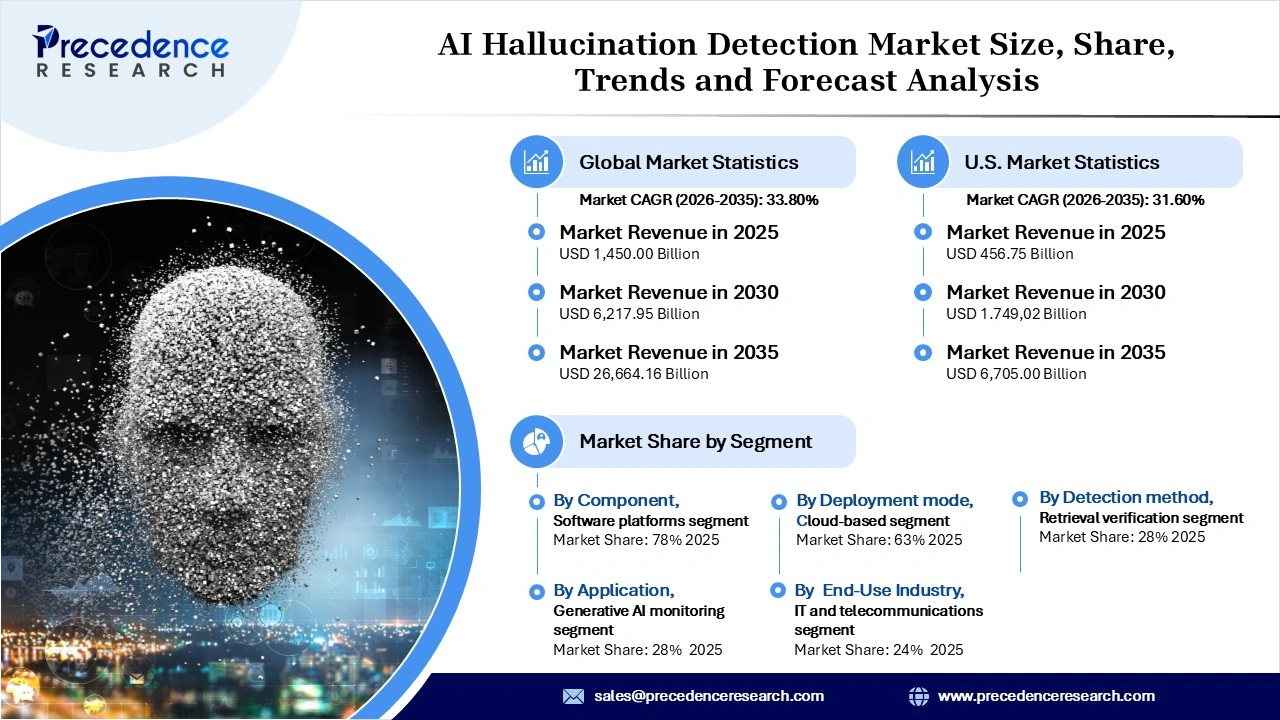
The global AI hallucination detection market revenue was valued at USD 1,450.00 billion in 2025 and is expected to attain around USD 26,664.16 billion by 2035, growing at a CAGR of 33.80% during forecast period. The market is driven by the rising application of AI technology in crucial sectors, including healthcare, financial services, and legal fields, where any mistakes and false data can result in significant risks for companies, as well as stringent regulatory norms regarding the transparency of AI systems.
Verification of the Output of Automatic Systems
The AI hallucination detection market refers to solutions comprising software, technology platforms, and services that help discover and rectify any errors, falsehoods, and inconsistencies that may occur in the output produced by AI systems. It includes functionalities such as fact-checking using reliable information sources, source citation, identification of contradictions, measurement of uncertainty, and continuous monitoring of response patterns.
This market encompasses hallucination detection API, integrated components of business AI platforms, and specialized tools to assess models for hallucinations. This market offers clinical decision support, financial compliance, legal contract analysis, and content verification in newsrooms. This market has been adopted in organizations that utilize custom AI agents, developers of machine learning models conducting red-team analysis, compliance specialists, and research institutions.
Usage of Mathematical Verification for Enterprise AI Protection
The market is advancing from the use of probabilistic sampling techniques to formal verification methods that offer mathematical proof of accuracy in the output data. This technology offers mathematical proofs in place of statistical probabilities by translating AI-produced text into logical formulae and checking them against programmed company regulations. In 2026, Amazon launched Automated Reasoning checks for Amazon Bedrock Guardrails, which is available in the Asia-Pacific (Sydney) region. This system makes use of formal verification methods to verify the mathematical accuracy of AI model outputs.
Adoption of AI Response Accuracy Verification Technologies
The AI hallucination detection market is witnessing rapid adoption of AI hallucination-detection tools, wherein companies are applying them within various departments such as marketing, brand management, and consumer-facing AI channels. These tools can continuously track the accuracy of AI responses on all major generative AI channels by comparing claims to the brand data and reporting any inconsistencies in the process. In 2026, Bluefish introduced AI Accuracy, which is an AI response verification solution that enables enterprises to monitor their AI channels. Bluefish analyzes millions of prompts per day for 10% of Fortune 500 firms, some of which are Adidas, Hearst, and Ulta Beauty.
Government Policies for Transparency and Correctness in AI Systems
Governments across the globe have introduced policies to mitigate growing fears about fake information produced by AI systems, deepfakes, and inaccuracies. These policies mandate transparency and accountability by making it compulsory for platforms to mark their content as synthetic and that AI outputs used in fields such as lawmaking and governance be true and verifiable. In 2026, India’s Ministry of Electronics and Information Technology (MeitY) introduced a notification called “Information Technology (Intermediary Guidelines and Digital Media Ethics Code) Amendment Rules, 2026. The rules regulate synthetically generated information, which is required to be marked by platforms.
New Citation Verification Model Hits Accuracy of 88.9%
Large language models produce citation information that seems legitimate but may contain corrupted metadata and cite non-existent papers. This problem makes it crucial to develop tools capable of detecting citation hallucinations. In 2026, scientists from Simon Fraser University and FirstPrinciples Research Organization developed CiteCheck, a model that attained 88.7 micro-F1 and 88.9% accuracy in verifying a 982-citation dataset.
Market Segmentation Overview
- By component, the software platforms segment led the AI hallucination detection market with 78% share in 2025, since they offered crucial algorithmic functions, retrieval mechanisms, and validation functionalities, which impart intelligent capabilities to any hallucination detection platform software is an important component of such platforms.
- By component, the services segment is expected to expand at the highest CAGR of 36.5% during the forecast period, because the integration of hallucination detection solutions into various business applications is complicated and needs external consultancy to ensure implementation and proper tuning of these solutions.
- By deployment mode, the cloud-based segment dominated the market with 63% share in 2025, and is expected to grow at the fastest CAGR of 36.7% from 2026 to 2035, because it provides organizations with an opportunity to use hallucination detection software tools without significant initial investments and hardware procurements, while also providing automated updates and scalability of computing resources.
- By deployment mode, the hybrid model held the second-largest market share of 20% in 2025, since many companies that operate in heavily regulated sectors like finance, healthcare, and government need to perform their computations on-premises because of compliance and privacy concerns. They also use cloud scalability for non-sensitive workloads.
- By detection method, the retrieval verification segment led the AI hallucination detection market with 28% share in 2025, because it addresses the very issue underlying hallucinations as it verifies model outputs with the help of external reliable knowledge bases that provide citation support, which is used by enterprises and regulatory authorities.
- By detection method, the model evaluation and benchmarking segment is expected to expand at the highest CAGR of 36.9% during the forecast period, due to the fact that businesses and regulatory authorities are requiring more third-party validation prior to adopting new models into their operations. The models that are being developed have different degrees of hallucinations, which pose an ongoing need to independently assess them using standardized methods.
- By application, the generative AI monitoring segment dominated the market with 28% share in 2025, since hallucination detection is a crucial component to detect inaccuracy, fabrication, and deception that might arise during an AI-generated real-time interaction. This segment is widely adopted in various industries to ensure optimal AI-output accuracy.
- By application, the AI governance and compliance segment is expected to grow at the fastest CAGR of 38.5% from 2026 to 2035, owing to the fact that mandatory laws have been imposed by governments that require enterprises to provide proof of the accuracy of the results generated through AI.
- By end-use industry, the IT and telecommunications segment led the market with 24% share in 2025, because it has extensively adopted generative AI across customer services, network operations, software development, and knowledge management. These sectors are well-equipped with the skills, data infrastructure, and cloud computing power needed to deploy hallucination detection solutions.
- By end-use industry, the healthcare and life sciences segment is expected to expand at the highest CAGR of 37.4% during the forecast period, due to the devastating effects of AI hallucinations in clinical decision-making, drug research, and documentation systems, heavy regulatory scrutiny from various regulatory bodies such as HIPAA, FDA, and EMA, and the rapid uptake of AI in medical imaging, genomic analysis, and automated documentation.
Regional Analysis
North America led the AI hallucination detection market with 42% share in 2025, owing to extensive adoption of generative AI across enterprises, the existence of a well-established venture capital community that has backed many hallucination detection companies, and a regulatory landscape that insists on AI transparency and reliability. The U.S. dominated the market in North America due to the significant presence of major AI model developers such as OpenAI, Anthropic, and Google, extensive enterprise AI deployments, and next-generation advanced technology policies like the AI Executive Order and NIST AI Risk Management Framework issued by the White House. Canada is a significant contributor to the market because of strong support from the government for research in AI and responsible AI, and the significant presence of prominent institutions carrying out AI research, like Vector Institute and Mila.
Asia-Pacific is expected to expand at the highest CAGR of 39.8% during the forecast period, due to the fast-paced growth of generative AI in the enterprise and consumer sectors, along with the rapid implementation of AI governance standards that enforce hallucination detection requirements. China led the market in Asia-Pacific owing to its huge domestic AI landscape, a large internet user base, and the presence of strict regulations, such as those for deep synthesis that enforce real-time hallucination detection. India witnessed notable market growth because of the rapid growth of the IT and BPO sectors, which use generative AI for customer support and software solutions, and mandatory hallucination detection regulations under the Digital Personal Data Protection Act.
Europe held the second-largest market share of 27% in 2025, due to its well-established regulatory frameworks governing the use of AI through the EU AI Act, which emphasizes transparency and accuracy in AI technologies. Germany dominated the market in Europe because of its advanced Industrial AI, automotive, and manufacturing industries, which demand accurate AI-powered solutions for quality control, predictive maintenance, and autonomous vehicles. The UK witnessed notable market growth owing to its well-developed financial and healthcare sectors, the presence of an extensive AI research ecosystem, and government initiatives such as the AI Safety Institute.
AI Hallucination Detection Market Coverage
| Report Attribute | Key Statistics |
| Market Revenue in 2025 | USD 1,450.00 Billion |
| Market Revenue by 2035 | USD 26,664.16 Billion |
| CAGR from 2026 to 2035 | 33.80% |
| Quantitative Units | Revenue in USD million/billion, Volume in units |
| Largest Market | North America |
| Base Year | 2025 |
| Regions Covered | North America, Europe, Asia-Pacific, Latin America, and the Middle East & Africa |
Top Companies in the AI Hallucination Detection Market
Microsoft, Google, AWS, and IBM are some of the key players that incorporate hallucination guardrails into their services via native integration of monitoring and responsible AI capabilities within their generative AI stacks. NVIDIA and DataRobot offer comprehensive AI infrastructure solutions that come with inherent abilities to detect hallucinations for developing trustworthy AI models. Fiddler, Arthur, WhyLabs, Aporia, Truera, and Galileo provide MLOps and observability platforms equipped with large language model (LLM) monitoring and techniques aimed at identifying facts and context issues. Patronus AI and Credo AI focus on AI safety, compliance, and implementing guardrails, making them perfect partners for companies operating in highly regulated industries. Weights and Biases has developed its experimentation and tracking platform, Weave.
Segments Covered in This Report
By Component
- Software Platforms
- Services
By Deployment Mode
- Cloud-Based
- On-Premises
- Hybrid
By Detection Method
- Retrieval Verification
- Fact Checking Engines
- Model Evaluation and Benchmarking
- Confidence Scoring Systems
- Explainable AI Validation
By Application
- Generative AI Monitoring
- LLM Evaluation and Testing
- Conversational AI Validation
- Content Verification
- AI Governance and Compliance
- Enterprise Knowledge Management
By End-Use Industry
- BFSI
- Healthcare and Life Sciences
- IT and Telecommunications
- Government and Defense
- Retail and E-commerce
- Manufacturing
- Media and Entertainment
- Others
By Region
- North America
- Latin America
- Europe
- Asia-pacific
- Middle and East Africa
Get this report to explore global market size, share, CAGR, and trends, featuring detailed segmental analysis and an insightful competitive landscape overview @ https://www.precedenceresearch.com/sample/8510
You can place an order or ask any questions. Please feel free to contact us at sales@precedenceresearch.com |+1 804 441 9344