



Amylin Analog Drugs Market Revenue to Attain USD 7.10 Bn by 2035
Published: 20 Apr 2026
Author: Precedence Research



Amylin Analog Drugs Market Revenue and Trends 2026 to 2035
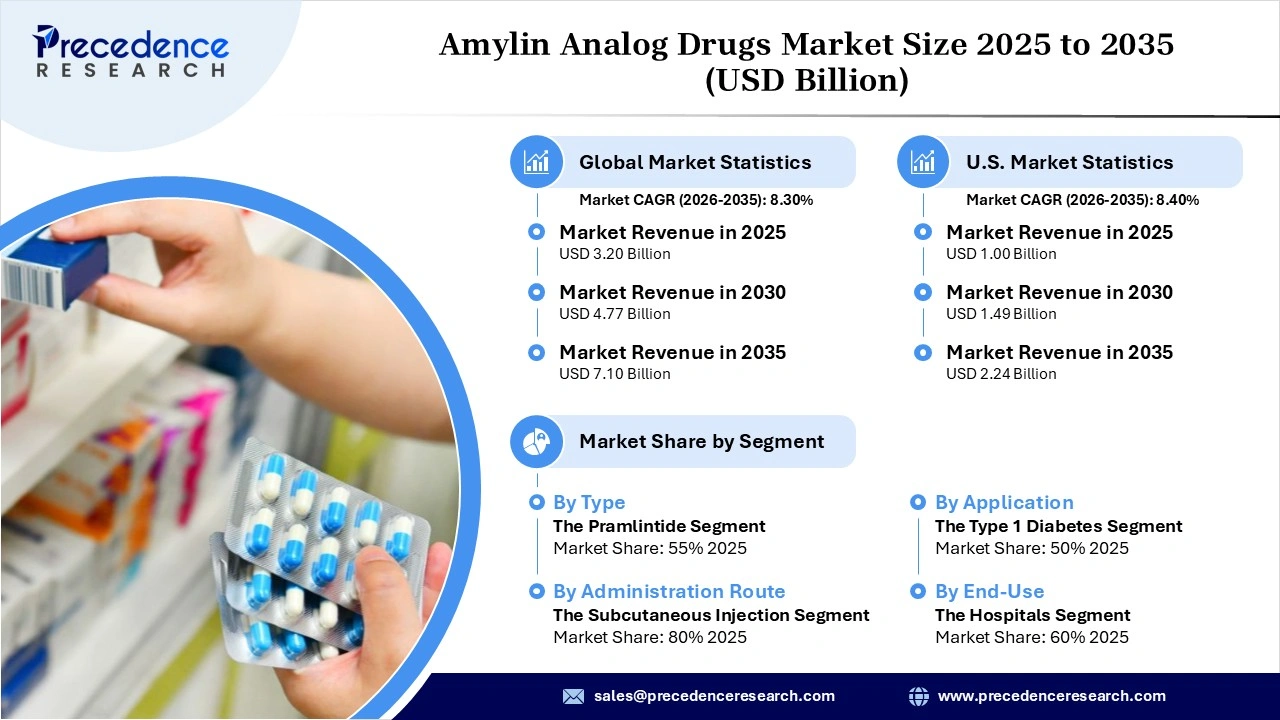
The global amylin analog drugs market revenue surpassed USD 3.20 billion in 2025 and is predicted to attain around USD 7.10 billion by 2035, growing at a CAGR of 8.30%. The market for amylin analogs is expanding due to the growing emphasis on reducing the burden of diabetes. The global rise in obesity rates, along with the proven effectiveness of multi-hormone therapies, also contributes to market growth.
Market at a Glance
Amylin analogs are designed to mimic amylin, a hormone co-secreted with insulin, but are structurally optimized for clinical use to improve pharmacological stability and therapeutic efficacy. These agents act at the intersection of glucose regulation and appetite control, making them relevant not only for managing Type 2 Diabetes but also for addressing Obesity and other related metabolic disorders. The market is increasingly evolving beyond conventional glycemic control toward a more holistic “whole-body” metabolic management approach. By targeting satiety pathways alongside insulin response mechanisms, amylin analogs are reshaping treatment paradigms to address both blood glucose regulation and weight management in an integrated manner.
More recently, amylin analogs have expanded beyond traditional injectable formulations used primarily in diabetes management, evolving into broader therapeutic approaches that also target obesity and related metabolic disorders. This includes the development of long-acting formulations and innovative combination therapies that integrate amylin activity with incretin-based pathways to enhance glycemic control and weight reduction.
What are the Major Trends in the Amylin Analog Drugs Market?
- Clinical Momentum for Amylin Analog Drug: Amylin analogs are increasingly gaining attention beyond their traditional role as adjuncts in metabolic therapy. In early clinical studies, Eli Lilly’s eloralintide demonstrated approximately 11.5% weight loss over 12 weeks, with later follow-up data indicating reductions of up to 20.1%. These results are considered comparable to, and in some cases exceeding, outcomes seen with earlier leading GLP-1–based therapies, strengthening both clinical and investor confidence in amylin-centered development pipelines.
- Collaboration & Partnerships: Strategic partnerships are also accelerating innovation in this space. Roche has partnered with Zealand Pharma to develop petrelintide, in a deal valued at up to $5.3 billion, targeting obesity management at a broader, systemic level. The collaboration includes joint development and commercialization efforts, reflecting sustained industry optimism around amylin-based therapies as a core pillar in future obesity and metabolic disease treatment strategies.
Shifting Paradigms in Obesity Treatment: From GLP-1 to Amylin-Based Approaches
- Amylin receptor agonists are emerging as a new class of therapeutic candidates, gradually complementing and potentially diversifying beyond the dominant GLP-1–based treatment paradigm in metabolic disease management.
- The therapeutic focus has increasingly shifted from general weight reduction to more selective fat loss strategies, with innovation efforts emphasizing improved tolerability, better side-effect profiles, and more targeted metabolic outcomes.
- Combination metabolic therapies, particularly GLP-1 + amylin approaches, are being actively developed as next-generation treatment options. These dual-acting regimens are expected to play a key role in shaping the future evolution of the metabolic disease and obesity treatment landscape.
Market Segmentation Overview
- By type, the pramlintide segment held the largest share of 55% in the amylin analog drugs market in 2025. This is because of its proven clinical reliability. Its ability to stabilize postprandial glucose across both Type 1 and Type 2 diabetes makes it the preferred choice.
- By type, the ipragliflozin segment held the second-largest market share of 35% in 2025 and is expected to grow at the fastest rate between 2026 and 2035. This is mainly due to its key role in improving insulin sensitivity and dampening post-meal glucose spikes.
- By administration route, the subcutaneous injection segment held the highest share of 80% in the market in 2025, as it is the most common and effective mode of delivering amylin analogs, which is particularly important for ongoing diabetes management. The healthcare industry favored this delivery mode of therapy because it enables steady absorption and prolonged response time.
- By administration route, the intravenous injection segment is the second-largest shareholder, holding a 20% market share in 2025, as it is typically used for short-term management of diabetes in hospital settings or acute conditions requiring fast insulin action. It is mostly used in urgent situations where rapid metabolic correction is essential, to meet the immediacy required in acute care scenarios.
- By application, the type 1 diabetes segment dominated the amylin analog drugs market, holding a major share of 50% in 2025. This leadership is primarily driven by the essential need for insulin therapy alongside adjunct treatments such as amylin analogs. In these patients, strict glycemic control is critical, making additional hormonal support an important component of overall disease management.
- By application, the type 2 diabetes segment is the second-largest shareholder, holding a 40% market share in 2025, supported by rising disease prevalence and a stronger emphasis on early intervention strategies. Treatment approaches are increasingly shifting from reactive care to proactive glucose regulation, with amylin analogs gaining recognition for their role in improving metabolic stability and long-term disease management.
- By end-use, the hospitals segment accounted for a 60% share of the amylin analog drugs market in 2025, driven by strong demand for insulin and glucose management therapies in acute care settings. In such environments, precise and dynamic glycemic control is essential, making amylin analogs particularly suitable for patients with unstable or highly variable metabolic conditions.
- By end-use, the clinics segment held the second-largest market share of 25% in 2025, supported by the steady shift toward outpatient diabetes management. Growth in this segment is primarily efficiency-driven, with clinics increasingly using amylin analogs to support blood glucose regulation, reduce hospital visits, and enable continuous patient monitoring in a more accessible care setting.
Regional Analysis
North America dominated the global amylin analog drugs market with a share of 40% in 2025, driven by high healthcare expenditure, which enabled early adoption of advanced therapies. The rising prevalence of diabetes further sustained consistent demand across the region. In addition, the region’s advanced healthcare infrastructure has already incorporated adjunct therapies into standard insulin treatment protocols. The U.S. plays a significant role in the market, driven by robust reimbursement systems and active innovation pipelines.
Asia Pacific held a market share of 20% in 2025 and is expected to grow at the fastest CAGR in the market during the forecast period, driven by increasing diabetes prevalence alongside continuous improvements in healthcare infrastructure. These developments are creating a favorable environment for the adoption of advanced therapies such as amylin analogs. Countries like China and India are witnessing a growing patient base, supported by improving access to modern medical treatments and expanding healthcare delivery systems.
Amylin Analog Drugs Market Coverage
| Report Attribute | Key Statistics |
| Market Revenue in 2025 | USD 3.20 Billion |
| Market Revenue by 2035 | USD 7.10 Billion |
| CAGR from 2026 to 2035 | 8.30% |
| Quantitative Units | Revenue in USD million/billion, Volume in units |
| Largest Market | North America |
| Base Year | 2025 |
| Regions Covered | North America, Europe, Asia-Pacific, Latin America, and the Middle East & Africa |
Top Companies in the Amylin Analog Drugs Market
Companies such as Eli Lilly and Company and Novo Nordisk A/S play a central role in advancing obesity-focused initiatives, supported by specialized pipelines and hormone-based therapeutic approaches. Meanwhile, Sanofi S.A. and Boehringer Ingelheim continue to leverage their established diabetes portfolios to adapt to evolving treatment paradigms and patient needs.
Diversified pharmaceutical companies such as Novartis AG, Amgen Inc., and Bristol Myers Squibb contribute significant scale, research capabilities, and innovation expertise, although their engagement in this space remains comparatively measured. Similarly, companies including Merck & Co., Inc. and Pfizer Inc. are increasingly exploring metabolic disorders as a potential future growth area, with growing interest in therapies involving amylin-based applications and related metabolic pathways.
Segments Covered in the Report
By Type
- Pramlintide
- Ipragliflozin
- Other Amylin Analog Drugs
By Administration Route
- Subcutaneous Injection
- Intravenous Injection
By Application
- Type 1 Diabetes
- Type 2 Diabetes
- Obesity
- Others
By End-Use
- Hospitals
- Clinics
- Homecare Settings
- Others
By Region
- North America
- Latin America
- Europe
- Asia-pacific
- Middle and East Africa
Get this report to explore global market size, share, CAGR, and trends, featuring detailed segmental analysis and an insightful competitive landscape overview @ https://www.precedenceresearch.com/sample/8317
You can place an order or ask any questions, please feel free to contact us at sales@precedenceresearch.com |+1 804 441 9344