



Apparel Market Revenue to Attain USD 3.21 Trn by 2035
Published: 18 May 2026
Author: Precedence Research



Apparel Market Revenue and Trends 2026 to 2035
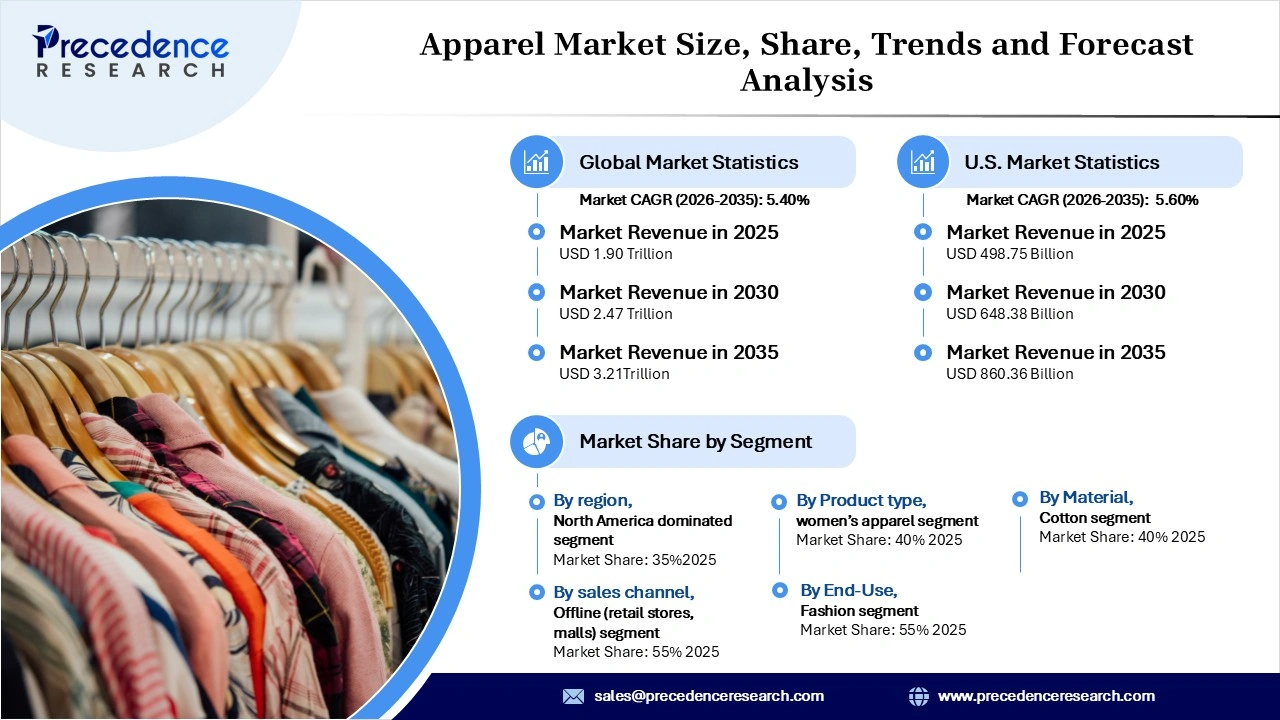
The global apparel market revenue was valued at USD 1.90 trillion in 2025 and is expected to attain around USD 3.21 trillion by 2035, growing at a CAGR of 5.40% during forecast period. The market is driven by the increasing disposable income, the rise of direct-to-customer online shopping, and the rising customer awareness about eco-friendly and responsibly made clothes.
From Basic Need to Global Fashion Economy
The apparel market involves designing, producing, distributing, and selling apparel and accessories to men, women, and children. The items produced range from basics like t-shirts, jeans, and socks to more refined apparel such as suits, athletic wear, coats, loungewear, sleepwear, and specialty occasion-specific outfits. This market includes mass fashion goods that are marketed through discount retailers and fast fashion chains, and mid-tier apparel that serves the budget-conscious consumers.
This market also includes yoga pants, running tights, moisture-wicking shirts, denim jeans, jackets, shorts, bras, briefs, shapewear, and children’s fashion products, plus-size fashion items. This market also involves workwear and occupational uniforms, heritage and traditional apparel, including kimonos, sarees, hanboks, and dashikis.
Generative AI Try-ons Decrease Return Rate and Boost Confidence
The latest trend in the market is the use of generative AI try-ons, whereby the product will be rendered onto the digital twin or uploaded photograph of the consumer, providing an accurate representation of the fabric drape, fit, and movement. This technology helps to significantly lower the costs associated with return rates due to wrong sizing and fit assumptions. In 2026, Perfect Corp. collaborated with fashion designer Nicole Miller at Fashion Forward Week, where Perfect Corp.’s generative AI Clothing try-on allowed customers to virtually try on archived items using just one picture.
Digital Product Passports to Ensure Circular Fashion Regulations
The apparel market is witnessing rapid adoption of Digital Product Passports (DPPs), which offer validated data on material source, place of production, carbon emissions, and recyclability. According to new European Union regulations, DPPs are required for garments, footwear, and accessories. DPPs are accessed through QR codes or NFC chips embedded in product tags, enabling customers to scan and receive comprehensive lifecycle data about the item, including place of production, material make-up, and repair information. In 2026, the Aura Blockchain Consortium has grown to encompass more than 50 luxury brands and has logged over 80 million items on its blockchain, an increase from 60 million in 2025, transforming authenticity and transparency within the luxury clothing market.
Government Regulations to Enforce Origin Labeling
Governments across the globe are introducing regulations for origin labeling with respect to clothing and consumer items. Governments are informing corporations that any product that is promoted as being domestically made should adhere to rigorous domestic content and processing guidelines. Regulators have widened their scope of enforcement to include online marketplace sellers who may face consequences for misleading statements made on their e-commerce sites. In 2025, the Federal Trade Commission of the U.S. issued warning letters to four corporations and additionally sent letters to two large e-commerce platforms concerning third-party sellers who had made misleading origin representations online.
Indian Government Revises PLI Scheme for Textiles
In 2025, the government of India, through its Ministry of Textiles, revised the Production Linked Incentive (PLI) Scheme for Textiles with modifications including a reduction in minimum investment requirement to half the previous value (from USD 36 million to USD 18 million in Part-1, and from USD 12 million to USD 6 million in Part-2). There is also a reduction in incremental turnover requirement from 25% to 10%, and an increase in the number of products to be considered (17 new HSN codes).
Market Segmentation Overview
- By product type, the women’s apparel segment led the apparel market with 40% share in 2025 and is expected to expand at the highest CAGR of 5.6% during the forecast period, due to the fact that women are known to shop for clothing more often than men. Women buy different clothes according to the purpose, whether it be work, leisure, formal wear, sportswear, loungewear, or swimwear, which is also greatly affected by trends and seasons.
- By product type, the men’s apparel segment held the second-largest market share of 35% in 2025, since men’s wear tends to generate higher unit prices on items like formal shirts, outerwear, the growing popularity of business casual and smart casual dress codes at workplaces, and an increase in the grooming and fashion sense among young men.
- By material, the cotton segment dominated the market with 40% share in 2025, because it is the most popular natural fiber in the clothing manufacturing industry worldwide due to its breathability, comfort, ability to absorb moisture, hypoallergenic qualities, and the ability to be easily dyed and printed on.
- By material, the synthetic fabrics segment is expected to grow at the fastest CAGR of 6% from 2026 to 2035, since synthetics like polyester, nylon, spandex, and acrylic provide better moisture management, rapid drying, elasticity, wrinkle prevention, and superior dyeing qualities as compared to their natural counterparts.
- By sales channel, the offline (retail stores, malls) segment led the apparel market with 55% share in 2025, because most consumers prefer trying out products to determine the fit, material, and color that cannot be replicated through online imagery and virtual try-ons, and can get personalized services from sales personnel.
- By sales channel, the online (e-commerce platforms) segment is expected to expand at the highest CAGR of 9% during the forecast period, due to the vast array of brand, size, color, and price options available on e-commerce websites, along with features such as the convenience of shopping from home.
- By end-use, the fashion segment dominated the market with 55% share in 2025, since fashion-minded customers, especially women and young people, buy clothes for reasons other than mere covering and protection, and use clothes as a means of expressing themselves.
- By end-use, the sports and activewear segment is expected to grow at the fastest CAGR of 7% from 2026 to 2035, owing to the growing health awareness and the acceptance of athleisurewear as casual clothing, where consumers can now wear their leggings, yoga pants, sports bras, hoodies, and performance shirts during trips, work, shopping, and casual get-togethers.
Regional Analysis
North America held a major revenue share of 35% in the apparel market in 2025 because it boasts a large consumer base with high purchasing capacity and a developed retail sector comprising departmental stores, specialty chains, and online shopping channels that facilitate the easy availability of apparel across all price ranges. The U.S dominated the market in North America owing to the fact that it is home to some of the biggest apparel brands in the world, and has an informal wear culture encouraging repeat purchases from each consumer during a season. Canada witnessed notable market growth due to significant disposable income in the population, a robust retail market that includes locally-based brands that suit their consumer base, and an emerging direct-to-consumer sustainable fashion industry.
Asia-Pacific is expected to expand at the highest CAGR of 7% during the forecast period, since it has a large population base, rising disposable income levels, increasing fashion sense among the young generation, and a fast-growing middle class that spends more on apparel per capita. China led the market in Asia-Pacific because of a well-developed indigenous fashion industry, and a high e-commerce adoption rate with Tmall, JD.com, and Douyin contributing to easy shopping from small cities as well. India is a significant contributor to the market due to its young population, women entering the workforce leading to increased demand for work-apparel, and awareness of international fashion trends among urban customers.
Apparel Market Coverage
| Report Attribute | Key Statistics |
| Market Revenue in 2025 | USD 1.90 Trillion |
| Market Revenue by 2035 | USD 3.21 Trillion |
| CAGR from 2026 to 2035 | 5.40% |
| Quantitative Units | Revenue in USD million/billion, Volume in units |
| Largest Market | North America |
| Base Year | 2025 |
| Regions Covered | North America, Europe, Asia-Pacific, Latin America, and the Middle East & Africa |
Top Companies in the Apparel Market
Nike, Adidas, Under Armour, and Lululemon are some of the key players in the market that specialize in functional fabrics, shoes, and direct sales. Inditex (Zara), H&M, Uniqlo (Fast Retailing), Gap Inc., and Next Plc provide fast fashion and value retail apparel. Louis Vitton and Gucci focus on luxury and premium clothing, with an emphasis on fashion and branding.
Segments Covered in This Report
Get this report to explore global market size, share, CAGR, and trends, featuring detailed segmental analysis and an insightful competitive landscape overview @ https://www.precedenceresearch.com/sample/8413
You can place an order or ask any questions. Please feel free to contact us at sales@precedenceresearch.com |+1 804 441 9344