



Aviation Mission Computer System Market Revenue to Attain USD 9.35 Bn by 2035
Published: 04 May 2026
Author: Precedence Research



Aviation Mission Computer System Market Revenue and Trends 2026 to 2035
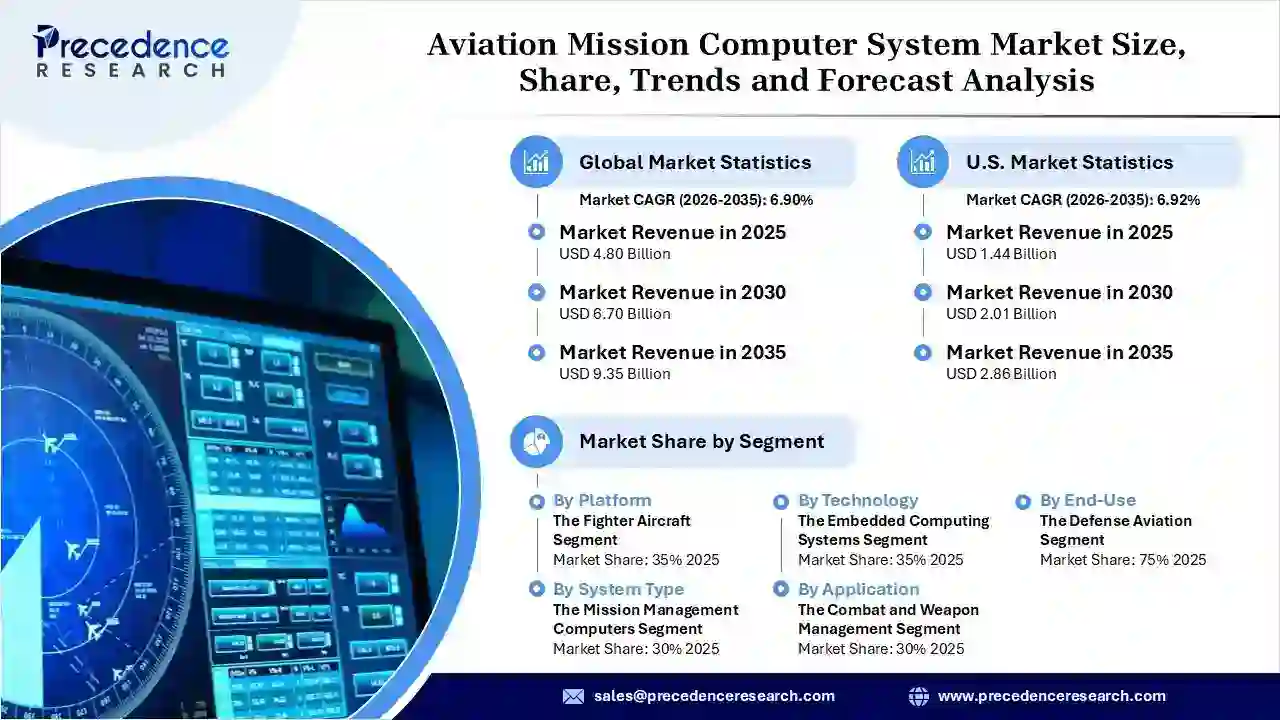
The global aviation mission computer system market revenue was valued at USD 4.80 billion in 2025 and is expected to attain around USD 9.35 billion by 2035, growing at a CAGR of 6.90% during forecast period. The aviation mission computer system market is gaining strong momentum as modern aviation increasingly depends on real-time data fusion, autonomous decision-making, and software-defined avionics, transforming mission computers from supporting components into the central intelligence hub of aircraft operations.
Market at a Glance
The aviation mission computer systems market revolves around the design, manufacturing, and integration of onboard computing units that act as the central processing unit of modern aircraft. These systems collect, process, and integrate data from sensors, navigation tools, communication systems, and mission-critical subsystems to deliver a unified real-time operational picture. The market spans military aircraft, unmanned aerial vehicles (UAVs), and advanced commercial platforms, reflecting the growing reliance on computational intelligence alongside traditional aircraft hardware such as engines and airframes.
Beyond hardware, the market also includes software integration, system upgrades, and lifecycle support, covering embedded processors, open-architecture systems, and retrofit solutions. These advancements are not only enabling new aircraft programs but also enhancing legacy fleets by improving their processing intelligence and operational capability.
What are the Major Trends Impacting the Aviation Mission Computer System Market?
- Investments in AI-Enabled Combat Systems: With rising investments in AI-powered defense systems and autonomous drones, mission computers are evolving into adaptive decision-making platforms. They now enable real-time sensor fusion, threat detection, and autonomous mission adjustments, significantly enhancing battlefield responsiveness and operational efficiency.
- Rising Demand for Autonomous and Multi-Domain Operations: The increasing use of UAVs and multi-domain operations is driving demand for high-performance onboard computing systems. Mission computers are now expected to support real-time data processing and AI integration as standard features, enabling faster, more intelligent decision-making across complex operational environments.
Government Initiatives Supporting Market Growth
- The U.S. government has initiated a major modernization effort in aviation systems, including a multi-billion-dollar investment exceeding USD 10 billion, with additional allocations already underway to upgrade air traffic infrastructure. This shift is reinforcing the role of mission computers as critical processing hubs in aviation modernization.
- The program includes deployment of 5,000 high-speed network connections and 612 advanced radar systems by 2028, emphasizing real-time data generation and increasing reliance on onboard computing systems.
- Around 270 radio sites have already been upgraded, and legacy wiring systems are being progressively replaced to support modern digital aviation infrastructure.
- The broader transition toward software-defined aviation and algorithm-driven airspace management is accelerating the need for advanced mission computing systems, enabling more efficient and optimized air traffic operations.
Market Segmentation Overview
- By platform, the fighter aircraft segment accounted for a major revenue share of 35% in the aviation mission computer system market in 2025, due to high demand for advanced avionics and mission computing in combat aircraft. The need to process high-speed targeting data, electronic warfare inputs, and multi-sensor fusion has made mission computers a central component of modern fighter operations.
- By platform, the unmanned aerial vehicles (UAVs) segment is expected to grow at the fastest CAGR of 9.5% in the market between 2026 and 2035, owing to the rising use of drones in intelligence, surveillance, and combat operations. As UAVs take on more complex roles, demand for compact, high-performance mission computing systems is expected to rise significantly.
- By system type, the mission management computers segment dominated the market with a 30% share in 2025 and is expected to maintain its leading position in the coming years, as these systems function as crucial hubs for executing missions, integrating data, and facilitating decision-making processes. Their capability to support real-time decisions and coordinated responses across both traditional and advanced aircraft has rendered them essential.
- By technology, the embedded computing systems segment held a major revenue share of 35% in the aviation mission computer system market in 2025, due to their reliability, stability, and seamless integration within avionics architectures. Their ability to operate under extreme flight conditions makes them essential for mission-critical aviation applications.
- By technology, the AI-enabled mission computing segment is expected to grow at a CAGR of 10.5% in the market between 2026 and 2035, driven by increasing adoption of automation, predictive analytics, and advanced threat detection capabilities. These systems are expected to fundamentally transform how aircraft interpret and respond to dynamic operational environments.
- By application, the combat & weapon management segment led the aviation mission computer system market with a 30% share in 2025, supported by the growing complexity of weapon systems and precision targeting requirements. Mission computers play a vital role in coordinating weapon deployment, threat identification, and engagement strategy in real time.
- By application, the surveillance & reconnaissance segment is expected to expand rapidly in the market with a CAGR of 8.5%, driven by rising demand for intelligence gathering and continuous situational monitoring. Mission computers are increasingly used to process large-scale data streams into actionable insights during operations.
- By end-use, the defense aviation segment accounted for a the highest share of 75% in the market in 2025, due to the increasing need for sophisticated mission systems in military aircraft. Continuous investments in mission computing capabilities across defense fleets have been spurred by a focus on achieving operational superiority and enhancing real-time situational awareness on the battlefield.
- By end-use, the commercial aviation segment is expected to grow at the fastest CAGR of 7% between 2026 and 2035, supported by advancements in avionics, connectivity, and data-driven flight systems. As commercial aircraft become more digital and interconnected, mission computing systems are gradually extending beyond defense into civilian aviation.
Regional Analysis
North America registered dominance in the global aviation mission computer system market by holding the largest share of 40% in 2025, driven by high defense spending, strong presence of leading OEMs, and advanced avionics development programs. The U.S. leads the market through fighter aircraft upgrades, UAV deployment programs, and next-generation avionics initiatives, while Canada contributes through specialized avionics integration and defense partnerships. The region benefits from a tightly integrated ecosystem of innovation, procurement, and deployment.
Asia Pacific held a market share of 20% in 2025 and is expected to grow at the fastest CAGR of 8.5% during the forecast period. This growth is driven by rising defense budgets, indigenous aircraft programs, and evolving geopolitical dynamics. China is advancing rapidly in fighter aircraft and UAV development, while India is strengthening its domestic defense manufacturing capabilities under self-reliance initiatives.
Aviation Mission Computer System Market Coverage
| Report Attribute | Key Statistics |
| Market Revenue in 2025 | USD 4.80 Billion |
| Market Revenue by 2035 | USD 9.35 Billion |
| CAGR from 2026 to 2035 | 6.90% |
| Quantitative Units | Revenue in USD million/billion, Volume in units |
| Largest Market | North America |
| Base Year | 2025 |
| Regions Covered | North America, Europe, Asia-Pacific, Latin America, and the Middle East & Africa |
Top Companies in the Aviation Mission Computer System Market
Key players include Honeywell International Inc., which develops integrated avionics platforms combining AI-enabled flight decks with mission computing layers. Thales Group and BAE Systems plc specialize in defense-grade electronics and modular avionics systems. RTX Corporation, through Collins Aerospace, leads in open-architecture mission systems that bridge military and commercial applications. European players such as Leonardo S.p.A and Saab AB are strengthening indigenous avionics capabilities, while Elbit Systems Ltd. is recognized for compact, high-performance computing systems widely used in UAVs and tactical aircraft.
Segments Covered in the Report
By Platform
- Fighter Aircraft
- Transport Aircraft
- Helicopters
- Unmanned Aerial Vehicles (UAVs)
- Special Mission Aircraft (AEW&C, ISR)
By System Type
- Flight Control & Navigation Computers
- Mission Management Computers
- Avionics Data Processing Units
- Weapon System Computers
By Technology
- Open Architecture Systems (MOSA)
- Embedded Computing Systems
- AI-enabled Mission Computing
- Real-Time Operating Systems (RTOS)
By Application
- Surveillance & Reconnaissance (ISR)
- Electronic Warfare (EW)
- Combat & Weapon Management
- Navigation & Flight Management
- Communication & Data Processing
By End-Use
- Defense Aviation
- Commercial Aviation
- Homeland Security & Special Operations
By Region
- North America
- Latin America
- Europe
- Asia-pacific
- Middle and East Africa
Get this report to explore global market size, share, CAGR, and trends, featuring detailed segmental analysis and an insightful competitive landscape overview @ https://www.precedenceresearch.com/sample/8366
You can place an order or ask any questions, please feel free to contact us at sales@precedenceresearch.com |+1 804 441 9344