



Aviation Mission Computer System Market Trends, Companies, Contract Wins / Project Pipeline, Defense Contracts, Procurement Volume, Government Spending, Production Capacity, Competitive Positioning, and Growth Outlook
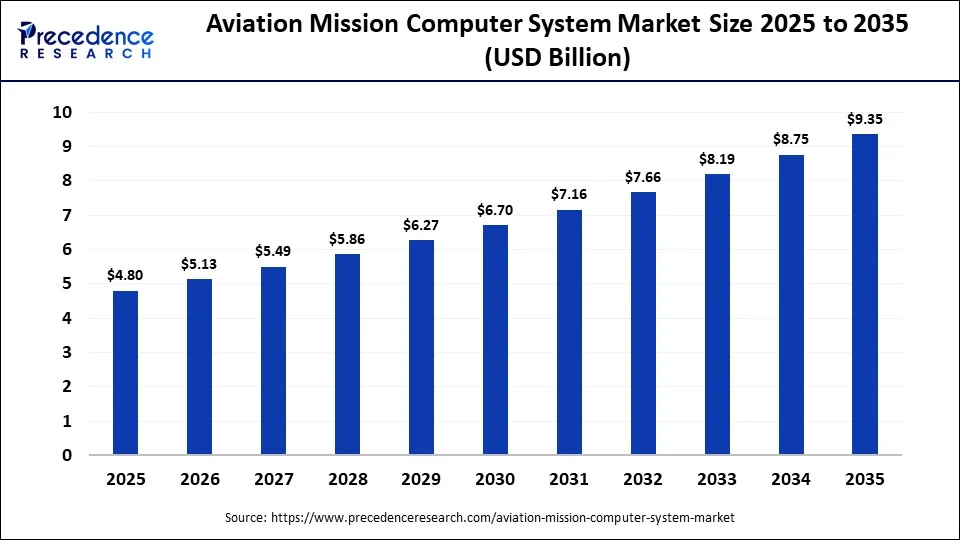
Gautam Mahajan, an Aerospace and Defence Industry Expert, identifies strong market momentum in the aviation mission computer system market, which reached USD 5.13 billion in 2026 and is projected to attain USD 9.35 billion by 2035 at a CAGR of 6.90%. Major aviation mission computer system market companies, including Honeywell International Inc., BAE Systems plc, Thales Group, Collins Aerospace (RTX Corporation)., compete across critical segments such as By Platform, By System Type, By Technology, By Application, By End-Use.
Source: https://www.precedenceresearch.com/aviation-mission-computer-system-market
 Get a Sample
 Table Of Content


What is the Aviation Mission Computer System Market Size in 2026?
The global aviation mission computer system market size accounted for USD 4.80 billion in 2025 and is predicted to increase from USD 5.13 billion in 2026 to approximately USD 9.35 billion by 2035, expanding at a CAGR of 6.90% from 2026 to 2035. The market is rapidly growing due to the increasing demand for improved situational awareness, increased military spending for modernization, and increased AI/ML adoption with advanced flight control systems.
Key Takeaways
- North America held the largest market share of 40% in 2025.
- Asia pacific is projected to grow at the fastest CAGR of 8.5% during the forecast period of 2026 to 2035.
- By platform, the fighter aircraft segment held the largest market share of 35% in 2025.
- By platform, the UAVs segment held the second-largest market share of 20% in 2025 and is expected to grow at the fastest CAGR of 9.5% between 2026 and 2035.
- By system type, the mission management computers segment held the largest market share of 30% in 2025.
- By system type, the weapon system computers segment is expected to grow at the fastest CAGR of 7.5% during the foreseeable period.
- By technology, the embedded computing systems segment held the largest market share of 35% in 2025.
- By technology, the open architectures system segment held the second-largest market share of 25% in 2025 and is expected to grow at a CAGR of 9.5% during the foreseeable period of 2026-2035.
- By application, the combat and weapon management segment held the largest market share of 30% in 2025.
- By application, the surveillance & reconnaissance segment held the second-largest market share of 25% in 2025 and is expected to expand at the fastest CAGR of 8.5% during the projection period.
- By end-use, the defense aviation segment held the largest market share of 75% in 2025.
- By end-use, the commercial aviation segment held the second-largest market share of 15% in 2025 and is expected to grow at the fastest CAGR of 7% during the foreseeable period of 2026-2035.
Market Overview
The aviation mission computer systems are highly specialized and digital platforms that work as a central hub for the modern military and advanced commercial aircraft. These systems integrate data from multiple sources, such as sensors, weapons, and navigation systems, to create a unified operational picture, enabling tactical decision-making, safety validation, and controlled weapon deployment.
Rising geopolitical tensions are driving increased investments in avionics upgrades and mission computing systems to enhance situational awareness, battlefield management, and ISR capabilities. Additionally, the growing adoption of UAVs, increasing air traffic, and stricter safety regulations are further supporting market growth.
How is AI Impacting the Aviation Mission Computer System Market?
Artificial intelligence is significantly transforming the aviation mission computer system market by enabling real-time data fusion, predictive analytics, and advanced decision-support capabilities within aircraft operations. It enhances situational awareness by processing inputs from multiple sensors simultaneously, allowing faster and more accurate threat detection, navigation, and mission planning. Additionally, AI-driven automation reduces pilot workload and improves system efficiency, making next-generation mission computers more intelligent, adaptive, and reliable in complex operational environments.
Aviation Mission Computer System Market Trends
- There is rising global military expenditure focused on upgrading aging aircraft fleets, driving demand for advanced mission computing systems.
- Another key trend is the growing adoption of modular open systems architecture (MOSA) and open standards, enabling faster, cost-effective upgrades and improved interoperability across platforms.
- The rapid adoption of UAVs for surveillance and reconnaissance is driving demand for compact, high-performance mission computers capable of operating in dynamic environments.
- Advancements in hardware miniaturization and high-performance processors are enabling more powerful, real-time analytics within mission computer systems, improving overall system efficiency and responsiveness.
Market Scope
| Report Coverage | Details |
| Market Size in 2025 | USD 4.80 Billion |
| Market Size in 2026 | USD 5.13 Billion |
| Market Size by 2035 | USD 9.35 Billion |
| Market Growth Rate from 2026 to 2035 | CAGR of 6.90% |
| Dominating Region | North America |
| Fastest Growing Region | Asia Pacific |
| Base Year | 2025 |
| Forecast Period | 2026 to 2035 |
| Segments Covered | Platform, System Type, Technology, Application, End-Use, and Region |
| Regions Covered | North America, Europe, Asia-Pacific, Latin America, and Middle East & Africa |
Market Dynamics
Drivers
The Increasing Adoption of UAVs and eVTOL
The major driving factor of the aviation mission computer system market is the increasing use of UAVs and eVTOL (electric vertical take-off and landing) aircraft. This significantly creates huge demand for lightweight, compact, and high-performance mission computers. These modern systems support critical functions such as radar operations, navigation, threat detection, and seamless communication, enabling enhanced operational capabilities in advanced aerial platforms.
Restraint
Difficulty in Integrating with Existing systems
Despite having several benefits, the adoption of aviation mission computer systems faces challenges in integration with existing aircraft infrastructure. A large portion of the global fleet still relies on analog or semi-digital avionics, making digital retrofitting both costly and technically complex. In addition, increasing system connectivity is raising cybersecurity concerns, as highly integrated avionics networks become more vulnerable to potential digital threats.
Opportunity
Adoption of Modular Open System Architecture (MOSA)
The market is observing a rapid shift toward the adoption of modular open system architecture frameworks such as OpenVPX. It allows an easier upgrade without replacing whole existing systems that reduces overall costs and attracts NATO procurement. Furthermore, the increasing demand to extend the life of existing platforms is creating a lucrative opportunity for retrofitting advanced mission computers, supporting market growth.
Segment Insights
Platform Insights
Aviation Mission Computer System Market Share, By Platform, 2025-2035 (%)
| Platform | 2025 | 2035 | CAGR (%) |
| Fighter Aircraft | 35.00% | 33.00% | 6.50% |
| Transport Aircraft | 15.00% | 14.00% | 5.50% |
| Helicopters | 15.00% | 14.00% | 6.00% |
| UAVs | 20.00% | 24.00% | 9.50% |
| Special Mission Aircraft | 15.00% | 15.00% | 7.00% |
The Fighter Aircraft Segment Held a 35% Market Share in 2025
The fighter aircraft segment dominated the aviation mission computer system market with a major share of 35% in 2025. This dominance is driven by the rapid shift toward advanced avionics and mission computing in combat aircraft operations. Modern combat aircraft require real-time data processing with AI systems and sensor units, supporting segmental dominance.
The UAVs segment held the second-largest market share of 20% in 2025 and is expected to expand at the fastest CAGR of 9.5% during the foreseeable period. The segment's growth is attributed to the increasing adoption of drones for ISR and combat roles. UAVs are ideal options for surveillance during combat operations.
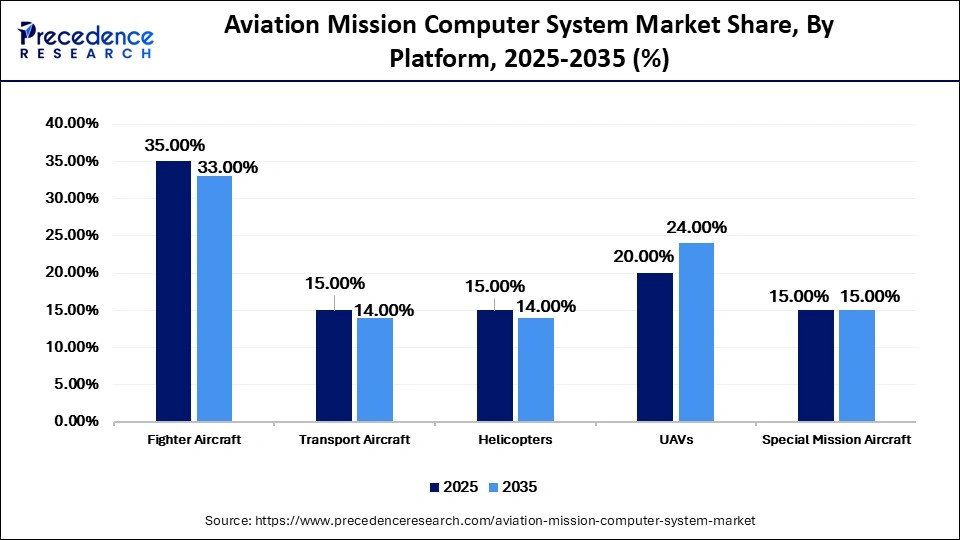
The transport aircraft segment held the market share of 15% in 2025 and is projected to grow at a CAGR of 5.5% during the forecast period. This is because transport aircraft are largely used for logistics and military transport missions. This aircraft necessitates a highly trustable computing system for privacy, supporting segmental growth.
The helicopters segment held a market share of 15% in 2025 and is expected to grow at a CAGR of 6.0% in the coming years. The segment growth is largely driven by the increasing use of helicopters for rescue operations in military, which requires mission computing systems.
System Type Insights
Aviation Mission Computer System Market Share, By System Type, 2025-2035 (%)
| System Type | 2025 | 2035 | CAGR (%) |
| Mission Management Computers | 30.00% | 32.00% | 8.00% |
| Flight Control & Navigation Computers | 25.00% | 23.00% | 6.00% |
| Avionics Data Processing Units | 25.00% | 24.00% | 6.50% |
| Weapon System Computers | 20.00% | 21.00% | 7.50% |
The Mission Management Computer Segment Held a Market Share of 30% in 2025
The mission management computers segment dominated the aviation mission computer system market with the maximum share of 30% in 2025. This is because they are core systems that enable mission execution, data fusion, and decision-making at the same time. The segment's dominance is also driven by the increasing urgency for advanced situational awareness with combat readiness backed by modern aircraft.
The avionics data processing units segment held the market share of 25% in 2025 and is expected to grow at a CAGR of 6.5% during the foreseeable period. This is because of the high use of avionics data processing systems for real-time data handling, sensor integration, and system coordination simultaneously.
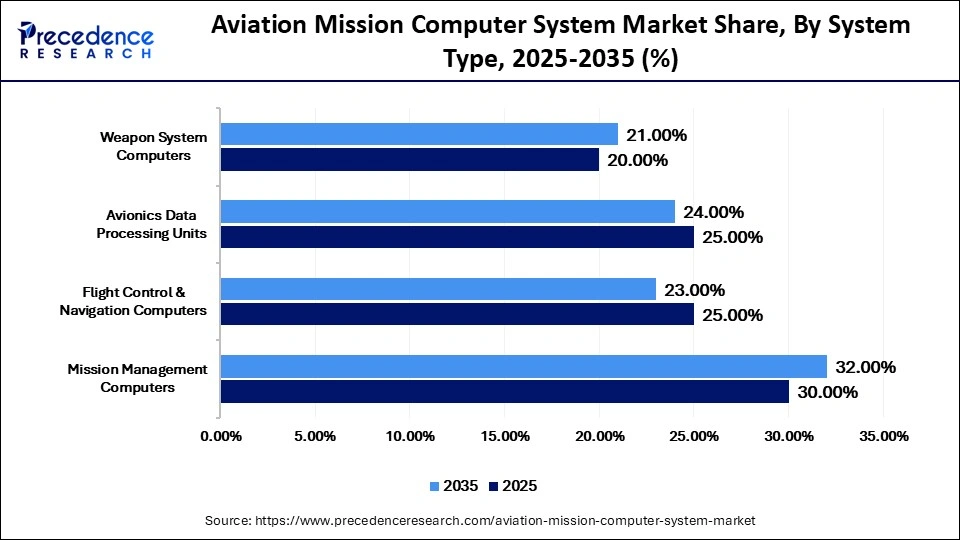
The flight control & navigation computers segment held the market share of 25% in 2025 and is expected to grow at a CAGR of 6.0% in the upcoming period. The segment expansion is attributed to the increasing need for flight safety and navigation precision. These computers provide an autopilot function in case of an emergency, enhancing the safety of aircraft.
The weapon system computers segment held the market share of 20% in 2025 and is expected to grow at the fastest CAGR of 7.5% during the foreseeable period. The segment's growth is driven by the rising defense modernization programs and increasing demand for precise, real-time targeting and engagement capabilities in advanced military aircraft. Growing geopolitical tensions and the need for enhanced situational awareness are further driving the adoption of highly integrated systems that support faster decision-making and improved weapon control accuracy.
Technology Insights
What Made Embedded Computing Systems the Leading Segment in 2025?
The embedded computing systems segment led the aviation mission computer system market with the largest share of 35% in 2025. The dominance of the segment is attributed to the reliability and easy integration of these systems in avionics systems. This technology is specifically designed for integrating sensors, processing heavy data, and controlling avionics systems precisely.
The open architectures systems (MOSA) segment was the second-largest shareholder in 2025, holding a share of 25%, and is expected to expand at a significant CAGR of 9.5% over the forecast period of 2026-2035. This is mainly due to offerings of these systems like modular updates, interoperability, and minimized lifecycle costs than other technologies, which make them the preferred choice.
Aviation Mission Computer System Market Share, By Technology, 2025-2035 (%)
| Technology | 2025 | 2035 | CAGR (%) |
| Embedded Computing Systems | 35.00% | 33.00% | 6.00% |
| Open Architecture Systems (MOSA) | 25.00% | 28.00% | 9.50% |
| Real-Time Operating Systems (RTOS) | 20.00% | 18.00% | 5.50% |
| AI-enabled Mission Computing | 20.00% | 21.00% | 10.50% |
The real-time operating systems (RTOS) segment held a market share of 20% in 2025 and is expected to grow at a CAGR of 5.5% in the foreseeable period. The segment is growing as the avionics sector is increasingly seeking a deterministic result during mission-critical environments, which is offered by real-time operating systems.
The AI-enabled mission computing segment held the market share of 20% in 2025 and is projected to expand at a the fastest CAGR of 10.5% during the forecast period of 2026-2035. The segment growth is majorly driven by the increasing demand for autonomous decision-making, predictive analytics, along with an advanced threat detection system.
Application Insights
Why Did the Combat & Weapon Management Segment Dominate the Market in 2025?
The combat & weapon management segment dominated the aviation mission computer system market with the largest share of 30% in 2025. This dominance is driven by the integration of advanced weapon systems and targeting capabilities. These functions are highly crucial under uncertain conditions of modern combat operations.
The surveillance & reconnaissance segment held the second-largest market share of 25% in 2025 and is expected to grow at the fastest CAGR of 8.5% in the foreseeable period. The segment is growing due to the rapid demand for intelligence gathering, monitoring, and real-time data analysis. Surveillance has become a crucial part of the avionics sector for deterministic performance.
Aviation Mission Computer System Market Share, By Application, 2025-2035 (%)
| Application | 2025 | 2035 | CAGR (%) |
| Combat & Weapon Management | 30.00% | 32.00% | 7.50% |
| Surveillance & Reconnaissance (ISR) | 25.00% | 27.00% | 8.50% |
| Navigation & Flight Management | 20.00% | 18.00% | 6.00% |
| Electronic Warfare (EW) | 15.00% | 14.00% | 6.50% |
| Communication & Data Processing | 10.00% | 9.00% | 6.00% |
The navigation & flight management segment held the market share of 20% in 2025 and is expected to grow at a CAGR of 6.0% during the forecast period. The segment is expanding as navigation and flight management are a crucial aspect of aircraft operation. Navigation systems help in route optimization with higher accuracy.
The electronic warfare segment held a market share of 15% in 2025 and is expected to grow at a CAGR of 6.5% in the upcoming period. The segment is growing as electronic warfare systems are largely leveraged for threat detection, jamming, and electronic defense systems.
End Use Insights
The Defense Aviation Segment Held a Market Share of 75% in 2025
The defense aviation segment dominated the aviation mission computer system market with the highest share of 75% in 2025. The segment's dominance is attributed to the increased demand for advanced mission computer systems in defense and avionics to stay combat ready with advanced military weapons.
Aviation Mission Computer System Market Share, By End-Use, 2025-2035 (%)
| End-Use | 2025 | 2035 | CAGR (%) |
| Defense Aviation | 75.00% | 73.00% | 6.50% |
| Commercial Aviation | 15.00% | 17.00% | 7.00% |
| Homeland Security & Special Operations | 10.00% | 10.00% | 6.50% |
The commercial aviation segment held the second-largest market share of 15% in 2025 and is expected to expand at the fastest CAGR of 7% during the projection period. The segment's growth is driven by the rapid integration of advanced avionics and safety systems in commercial aviation.
The homeland security & special operations segment held a market share of 10% in 2025 and is expected to grow at a CAGR of 6.5% in the upcoming period. The segment is expanding as aviation mission computer systems are essential for surveillance of borders for strong security, quick disaster response, and special combat operations.
Regional Insights
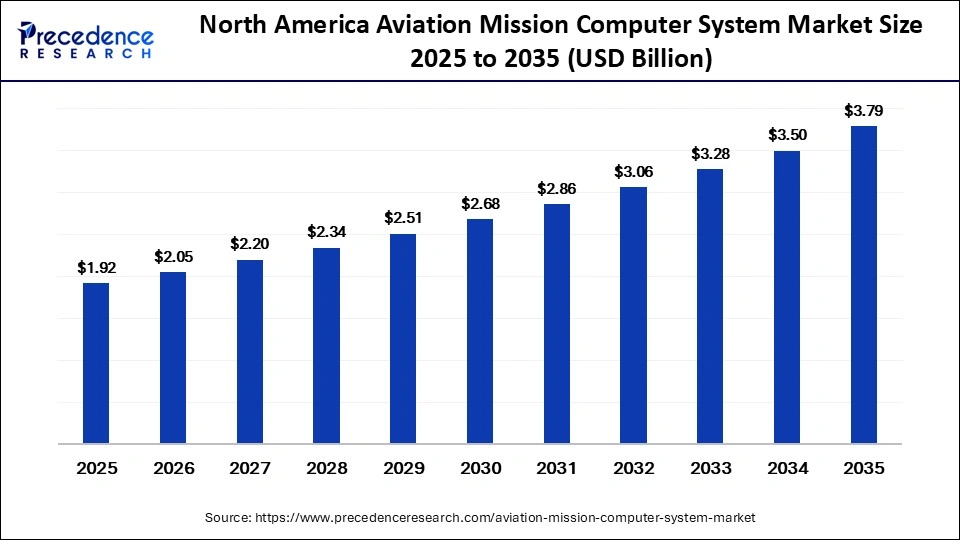
North America Aviation Mission Computer System Market Size and Growth 2026 to 2035
The North America aviation mission computer system market size is estimated at USD 1.92 billion in 2025 and is projected to reach approximately USD 3.79 billion by 2035, with a 7.04% CAGR from 2026 to 2035.
North America Held the Largest Market Share of 40% in 2025
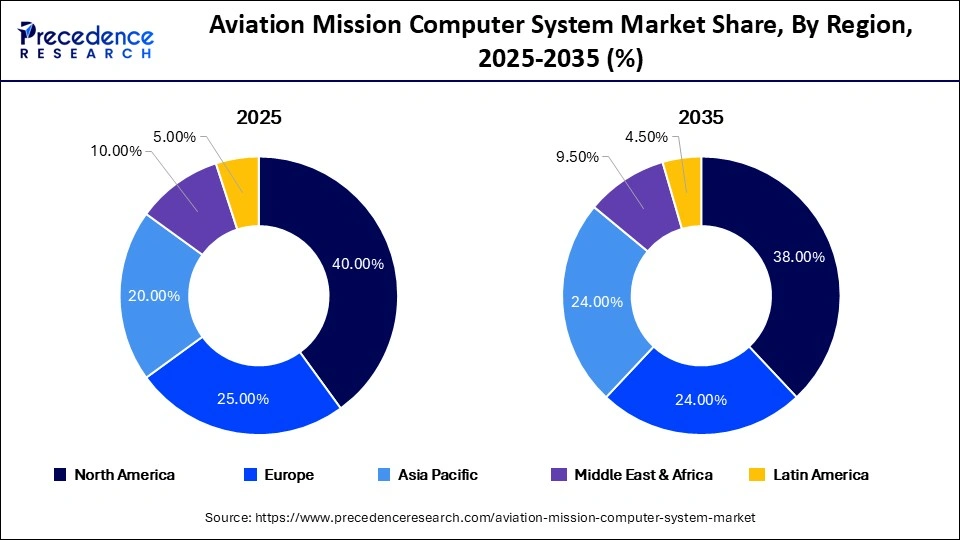
North America dominated the aviation mission computer system market with a major share of 40% in 2025, driven by substantial defense spending, a mature aerospace manufacturing ecosystem led by companies such as Boeing, and rapid adoption of advanced technologies including AI in avionics. The region also benefits from significant investments in drone technologies and early deployment of next-generation avionics, such as AI-based decision support systems, which have accelerated innovation. In addition, the presence of leading OEMs and defense contractors, along with strong R&D investments in advanced computing systems, further reinforces North America's market dominance.
U.S. Aviation Mission Computer System Market Size and Growth 2026 to 2035
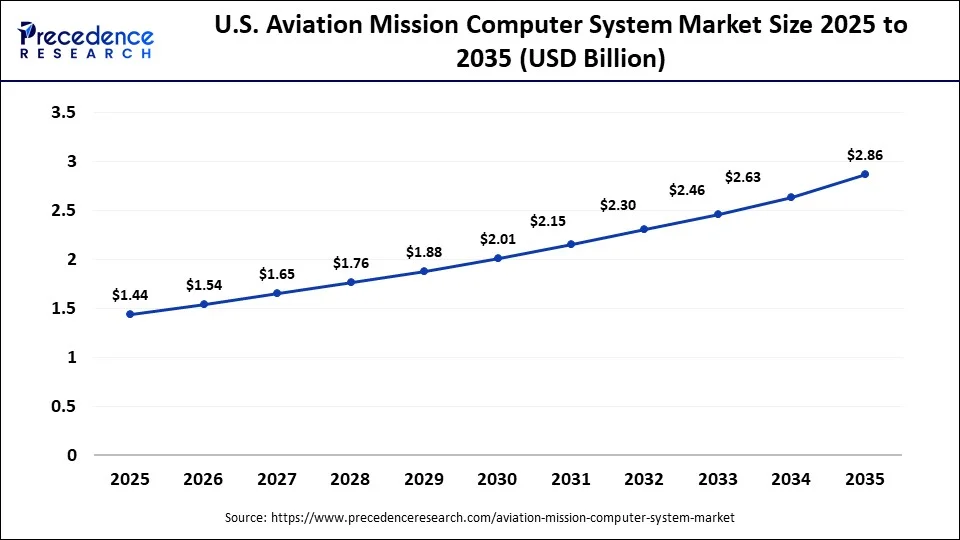
The U.S. aviation mission computer system market size is calculated at USD 1.44 billion in 2025 and is expected to reach nearly USD 2.86 billion in 2035, accelerating at a strong CAGR of 6.92% between 2026 and 2035.
U.S. Aviation Mission Computer System Market Analysis
The U.S. is a major contributor to the North American aviation mission computer system market. The U.S. alone has deployed nearly 15000 plus mission computers in 2024 backed by a major defense program like the F-35 and MQ-9 Reaper. Heavy investment in drone technology for reconnaissance and surveillance drives the need for highly advanced and compact mission computers, supporting the market hold in the region.
Asia Pacific: The Fastest-Growing Region
Asia Pacific held a 20% share of the aviation mission computer system market in 2025 and is expected to grow at the fastest CAGR of 8.5% between 2026 and 2035. This is mainly due to the growth in air traffic with passenger volumes projected to reach 1.6 billion. The rising fleet modernization activities and the expansion of fleets are major drivers of the market growth in Asia Pacific. The region has a strong base of advanced avionics systems due to the increasing projects on modernization of existing aviation infrastructure and procurement of new aircraft. Governments are also focusing on sovereignty, like India's DRDO investing nearly 3000 crores in local mission computer solutions, contributing to regional market growth.
China Aviation Mission Computer System Market Analysis
China is a major adopter of advanced aviation mission computer systems, driven by aggressive military modernization and strong domestic aerospace development programs. The country's production of advanced fighter jets such as the J-20 and J-16 is supported by a rapidly expanding aerospace supply chain. Government initiatives such as “Made in China 2025” further reinforce investments in indigenous avionics and mission computing technologies, strengthening China's position in the global market.
How is the Opportunistic Rise of Europe in the Aviation Mission Computer System Market?
Europe held a 25% share of the market in 2025 and is expected to grow at a notable CAGR of 6% in the coming years. This is mainly due to the increasing defense modernization programs and rising investments in next-generation military aircraft across key countries such as the UK, France, and Germany. The region's focus on advanced avionics, interoperability standards, and collaborative defense initiatives is further accelerating the adoption of sophisticated mission computing technologies.
Aviation Mission Computer System Market Companies
- Honeywell International Inc.
- BAE Systems plc
- Thales Group
- Collins Aerospace (RTX Corporation)
- Northrop Grumman Corporation
- Lockheed Martin Corporation
- Leonardo S.p.A.
- Elbit Systems Ltd.
- Saab AB
- General Dynamics Mission Systems
- L3Harris Technologies, Inc.
- Curtiss-Wright Corporation
- Kontron AG
- Advantech Co., Ltd.
- Astronics Corporation
Recent Developments
- In April 2026, the Lockheed Martin leveraged MDCX command and control software platform to control the first flight of the U.S. Navy's MQ-25A Stingray. This software is considered as the backbone of the Navy's unmanned carrier aviation mission control system MD-5 ground control station.(Source: https://www.prnewswire.com)
- In December 2025, Saab launched world's first software-defined aircraft fuselage backed with divergent technologies. By leveraging additive manufacturing and AI-powered algorithms, Saab is redefining the future of aircraft production.(Source: https://www.saab.com)
Segments Covered in the Report
By Platform
- Fighter Aircraft
- Transport Aircraft
- Helicopters
- Unmanned Aerial Vehicles (UAVs)
- Special Mission Aircraft (AEW&C, ISR)
By System Type
- Flight Control & Navigation Computers
- Mission Management Computers
- Avionics Data Processing Units
- Weapon System Computers
By Technology
- Open Architecture Systems (MOSA)
- Embedded Computing Systems
- AI-enabled Mission Computing
- Real-Time Operating Systems (RTOS)
By Application
- Surveillance & Reconnaissance (ISR)
- Electronic Warfare (EW)
- Combat & Weapon Management
- Navigation & Flight Management
- Communication & Data Processing
By End-Use
- Defense Aviation
- Commercial Aviation
- Homeland Security & Special Operations
By Region
- North America
- Latin America
- Europe
- Asia-pacific
- Middle and East Africa
For inquiries regarding discounts, bulk purchases, or customization requests, please contact us at sales@precedenceresearch.com
Frequently Asked Questions





Ask For Sample
No cookie-cutter, only authentic analysis – take the 1st step to become a Precedence Research client
 Get a Sample




 sales@precedenceresearch.com
 Schedule a Meeting
