



Aviation Test Equipment Market Trends, Companies, Contract Wins / Project Pipeline, Defense Contracts, Procurement Volume, Government Spending, Production Capacity, Competitive Positioning, and Growth Outlook
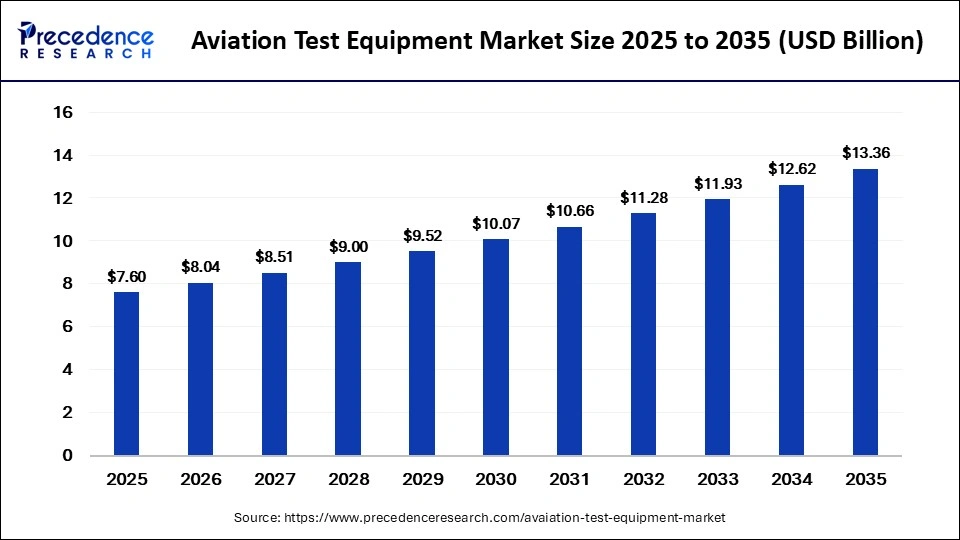
Gautam Mahajan, an Aerospace and Defence Industry Expert, identifies strong market momentum in the aviation test equipment market, which reached USD 8.04 billion in 2026 and is projected to attain USD 13.36 billion by 2035 at a CAGR of 5.80%. Major aviation test equipment market companies, including Honeywell International Inc., Lockheed Martin Corporation, RTX Corporation (Collins Aerospace), BAE Systems plc., compete across critical segments such as By Equipment Type, By Platform, By Application, By End-Use, By Technology.
Source: https://www.precedenceresearch.com/aviation-test-equipment-market
 Get a Sample
 Table Of Content


What is the Aviation Test Equipment Market Size in 2026?
The global aviation test equipment market size was estimated at USD 7.60 billion in 2025 and is predicted to increase from USD 8.04 billion in 2026 to approximately USD 13.36 billion by 2035, expanding at a CAGR of 5.80% from 2026 to 2035. The aviation test equipment market is driven by the growing demand for advanced aircraft testing solutions.
Key Takeaways
- North America dominated the aviation test equipment market with a share of 38% in 2025.
- Asia Pacific is projected to grow at the fastest CAGR of 7.5% from 2026 to 2035.
- By equipment type, the electrical & electronic test equipment segment held a 30% share of the market in 2025.
- By equipment type, the avionics test equipment segment is expected to grow at a 6.5% CAGR between 2026 and 2035.
- By platform, the commercial aircraft segment held a major share of 40% in the market in 2025.
- By platform, the military aircraft segment is the second-largest shareholder and is projected to grow at a 5.5% CAGR from 2026 to 2035.
- By application, the maintenance, repair & overhaul segment led the global market with a share of 35% in 2025.
- By application, the production & assembly testing segment is the second-largest shareholder and is expected to grow at a 5% CAGR between 2026 and 2035.
- By end-use, the MRO service providers segment held a major share of 35% in the market in 2025.
- By end-use, the OEMs segment is the second-largest shareholder and is expected to grow at a 5% CAGR between 2026 and 2035.
- By technology, the automated test equipment segment led the global market with a share of 40% in 2025.
- By technology, the portable & handheld test equipment segment is the second-largest shareholder and is expected to grow at a 5% CAGR between 2026 and 2035.
Market Overview
The aviation test equipment market includes equipment and systems used in monitoring, maintaining, and ensuring the safety, reliability, and functionality of aircraft components, including avionics, electrical, hydraulic, and engine systems. The market is driven by the growing demand for aircraft testing, supported by a growing global fleet, the establishment of new labs, and the rehabilitation of old labs. Increasing emphasis on safety and optimum use of the latest technologies in aircraft, such as hybrid-electric propulsion and next-generation aircraft components, also drives the market. Industry players are adopting innovative, efficient, and automated testing equipment and prioritizing training and outsourcing of work to keep pace with demand.
Impact of AI on the Aviation Test Equipment Market
The integration of artificial intelligence is enhancing the speed, accuracy, and data-driven nature of aircraft testing, inspection, and maintenance processes. AI-enabled testing equipment leverages performance data to detect anomalies and predict potential faults, significantly improving safety and reliability. This supports the adoption of predictive maintenance strategies, reducing downtime and operational costs for airlines and maintenance providers. Additionally, AI-driven automation is streamlining testing operations and helping address industry skill shortages, leading to improved productivity and efficiency.
Aviation Test Equipment Market Trends
- The adoption of digital testing technologies is enhancing the speed and accuracy of aviation testing equipment, enabling predictive maintenance, reducing downtime, and supporting real-time monitoring of complex aircraft systems.
- The growing development and commercialization of hybrid and electric aircraft is increasing demand for advanced testing equipment to evaluate batteries, motors, and power electronics, supporting the aviation industry's shift toward low-emission solutions.
- The expansion of maintenance, repair, and overhaul (MRO) facilities, along with aircraft testing laboratories, is driving demand for advanced testing equipment to support a rising global fleet and evolving safety and performance standards.
- Increasing focus on efficiency and automation is accelerating investment in automated and portable testing equipment, helping reduce human error, improve testing efficiency, and address the shortage of skilled aviation testing personnel.
Market Scope
| Report Coverage | Details |
| Market Size in 2025 | USD 7.60 Billion |
| Market Size in 2026 | USD 8.04 Billion |
| Market Size by 2035 | USD 13.36 Billion |
| Market Growth Rate from 2026 to 2035 | CAGR of 5.80% |
| Dominating Region | North America |
| Fastest Growing Region | Asia Pacific |
| Base Year | 2025 |
| Forecast Period | 2026 to 2035 |
| Segments Covered | Equipment Type, Platform, Application, End-Use, Technology, and Region |
| Regions Covered | North America, Europe, Asia-Pacific, Latin America, and Middle East & Africa |
Market Dynamics
Drivers
Increasing Aircraft Production
The growth in aircraft production globally and continual technological advancements in aviation subsystems such as avionics, engines, and materials are fueling the need for a wide range of testing equipment. New aircraft designs and system modifications must undergo rigorous validation to ensure safety, reliability, and compliance with stringent regulations. As aircraft technologies become more advanced, testing requirements are becoming increasingly sophisticated, thereby boosting demand for aviation test equipment worldwide.
Restraint
Shortage of Skilled Workforce
The aviation test equipment market is constrained by a shortage of skilled personnel required to test complex aircraft components. Advanced aerospace technologies, such as avionics, aerodynamics, composite materials, and structural mechanics, demand a high level of technical expertise, which is currently in short supply. Rapid technological advancements are outpacing workforce training, resulting in a limited pool of specialists in testing, analysis, and verification and validation (V&V) of modern aircraft systems.
Opportunity
Innovations in Urban Air Mobility
New electric vertical take-off and landing (eVTOL) aircraft and other disruptive aviation technologies are being developed for urban air mobility. The new aircraft technologies must be tested and certified to determine safety, performance, and compatibility with existing airspace. This involves testing electric power and propulsion systems, advanced autonomous control, batteries, and new navigation systems. The massive government and private-sector investment in UAM infrastructure and operations is further driving the need for rigorous testing and certification.
Segment Insights
Equipment Type Insights
Aviation Test Equipment Market Share, By Equipment Type, 2025-2035 (%)
| Equipment Type | 2025 | 2035 | CAGR (%) |
| Electrical & Electronic Test Equipment | 30.00% | 28.00% | 5.50% |
| Avionics Test Equipment | 25.00% | 27.00% | 6.50% |
| Engine & Fuel System Test Equipment | 20.00% | 19.00% | 5.50% |
| Structural & Mechanical Test Equipment | 15.00% | 14.00% | 5.00% |
| Hydraulic & Pneumatic Test Equipment | 10.00% | 12.00% | 6.00% |
The Electrical & Electronic Test Equipment Segment Held a 30% Market Share in 2025
The electrical & electronic test equipment segment dominated the aviation test equipment market with a major share of 30% in 2025, owing to the rising complexity of aircraft avionics and the need for testing and integration of electrical systems. The digitalization and integration of aircraft systems require electrical systems, such as wiring, sensors, communication units, and power distribution units, which must undergo testing to ensure reliability.
The avionics test equipment segment held a 25% market share in 2025 and is expected to grow at the fastest CAGR of 6.5% during the projection period, owing to the rising deployment of next-gen, high-tech avionics and digital cockpit technologies. The integration of navigation, communication, surveillance, and flight management systems in aircraft systems demands high-end test equipment. Automated and digital cockpits are resulting in sophisticated avionics, which must be tested to ensure performance and safety.
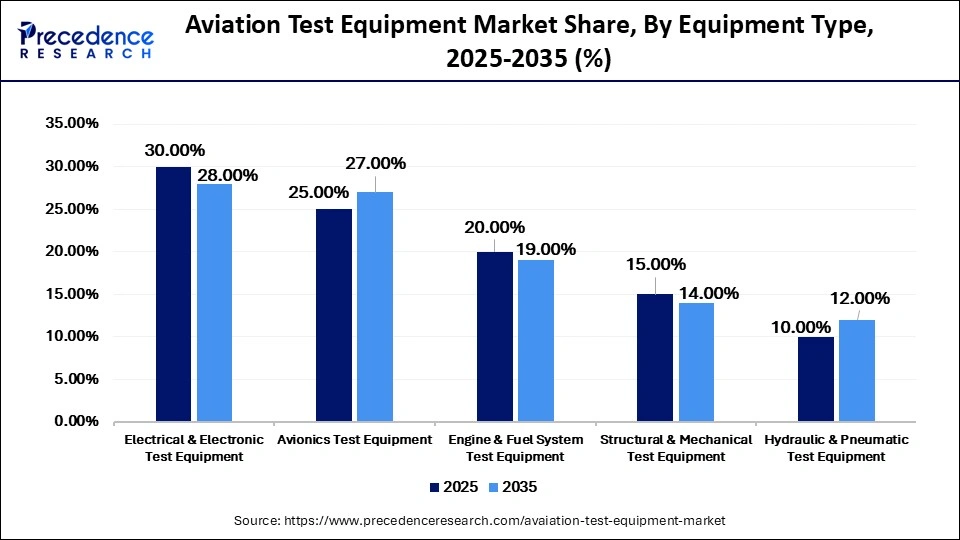
The engine & fuel system test equipment segment held a 20% share of the market in 2025 and is expected to grow at a CAGR of 5.5% during the projection period. This is because engine & fuel system testing is essential for engine performance. Jet engines are complex and need to be monitored and tested for efficiency, performance, and fuel consumption. The demand for improved fuel efficiency and focus on reducing emissions are also driving the segment.
The structural & mechanical test equipment segment held a 15% share of the market in 2025 and is expected to grow at a CAGR of 5% during the projection period, owing to the rise in demand for aircraft fatigue testing, strength testing, and structural testing of components. This equipment is used to test the strength and fatigue of aircraft structures. Rising aircraft production and the need for lightweight and strong materials are increasing the need for advanced test equipment.
Platform Insights
Aviation Test Equipment Market Share, By Platform, 2025-2035 (%)
| Platform | 2025 | 2035 | CAGR (%) |
| Commercial Aircraft | 40.00% | 38.00% | 5.50% |
| Military Aircraft | 30.00% | 29.00% | 5.50% |
| Helicopters | 15.00% | 14.00% | 5.00% |
| UAVs | 15.00% | 19.00% | 8.50% |
The Commercial Aircraft Segment Held a 40% Market Share in 2025
The commercial aircraft segment held a dominant position in the aviation test equipment market with a share of 40% in 2025, owing to the fact that there are a lot of aircraft in the world and a relatively high need for maintenance, repair, and overhaul (MRO). Growing global travel is also leading to a growth in airline fleets and fleet upgrades, increasing the need for aviation testing equipment. Periodic maintenance, upgrades, and testing are performed to ensure safe flights and adherence to global aviation safety standards.
The military aircraft segment held a 30% market share in 2025 and is expected to grow at a CAGR of 5.5% during the projection period, owing to the rising military expenditure and fleet replacements in many nations. Several countries are heavily investing in integrating advanced avionics and weapon systems in their fighter and surveillance aircraft. This needs to be rigorously tested for readiness, performance, and safety for critical missions.
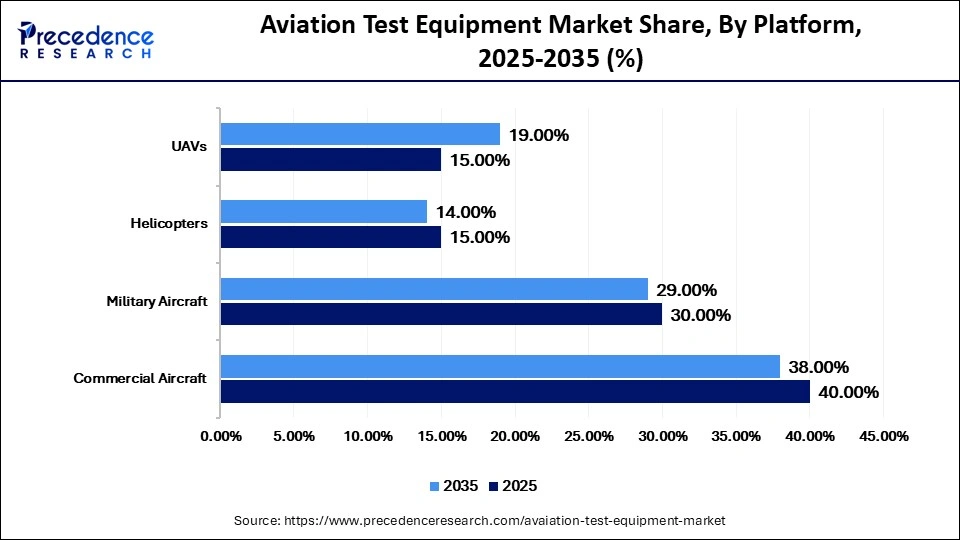
The helicopters segment held a 15% share of the market in 2025 and is expected to grow at a CAGR of 5% during the forecast period, due to their widespread use in defense, emergency services, and offshore operations. The complex components of helicopters require regular maintenance and testing to ensure performance and safety. Increasing use in search and rescue operations is resulting in a steady demand for test equipment.
The UAVs segment held a 15% market share in 2025 and is expected to grow at the fastest CAGR of 8.5% in the upcoming period. This is mainly due to the increasing use of unmanned aerial vehicles in security, military, and commercial applications. Increasing applications for drones in intelligence, reconnaissance, logistics, and agricultural monitoring and infrastructure inspection also drives the segmental growth. UAVs require sophisticated testing solutions to ensure better performance.
Application Insights
Why Did the MRO Segment Lead the Aviation Test Equipment Market in 2025?
The maintenance, repair & overhaul (MRO) segment led the market with a share of 35% in 2025 due to the increasing maintenance activities to guarantee safety, reliability and regulatory compliance. Rising air travel has led to higher aircraft utilization, resulting in more frequent inspections and testing of critical systems such as avionics, propulsion, hydraulics, and structural components.
The production & assembly testing segment held a 25% share of the market in 2025 and is expected to grow at a CAGR of 5% in the upcoming period. This is mainly due to the increasing focus on validating all aircraft systems, including the avionics, propulsion, structures, and components, prior to delivery. With the increase in sophistication and complexity of aircraft, testing during production is vital to achieve quality and safety requirements, as well as airworthiness.
Aviation Test Equipment Market Share, By Application, 2025-2035 (%)
| Application | 2025 | 2035 | CAGR (%) |
| Maintenance, Repair & Overhaul (MRO) | 35.00% | 37.00% | 6.50% |
| Production & Assembly Testing | 25.00% | 23.00% | 5.00% |
| Component Testing & Inspection | 20.00% | 19.00% | 5.50% |
| Flight Line Testing | 10.00% | 11.00% | 6.00% |
| Calibration & Diagnostics | 10.00% | 10.00% | 5.50% |
The component testing & inspection segment held a 20% market share in 2025 and is expected to grow at a CAGR of 5.5% during the forecast period. This is mainly due to the increasing need for durability, reliability, and efficiency of the components. All components, including sensors, cables, engine components, and structures, must be tested according to aviation industry specifications. The complexity of aircraft systems and the need for weight reduction by using lightweight components demand reliable qualification of components.
The flight line testing segment held a 10% share of the market in 2025 and is expected to grow at the fastest CAGR of 6% in the coming years. This is because of its crucial role in pre-flight safety checks and other checks to ensure airworthiness at the airports. It verifies the aircraft's systems (avionics, engine, etc.) and communication and navigation systems before the flight. With the rising complexity in airline operations and the need for shorter turnaround times, there is an increasing need for faster testing with high accuracy at the flight line.
End-Use Insights
The MRO Service Providers Segment Dominate the Aviation Test Equipment Market in 2025
The MRO service providers segment registered dominance in the global market by holding a major share of 35% in 2025 due to the ongoing and extensive maintenance needs of fleets. With the rising number of commercial and military aircraft, MRO providers play a critical role in ensuring airworthiness, safety, and regulatory compliance through routine inspections, repairs, and overhaul activities. This drives significant demand for advanced test equipment to maintain the reliability and performance of avionics, engines, electrical systems, and structural components.
The OEMs segment held a 30% share of the market in 2025 and is expected to grow at a CAGR of 5% during the projection period, driven by their key role in aircraft manufacturing and assembly. OEMs rely on sophisticated testing systems to validate the performance and integration of aircraft subsystems, and increasing global aircraft production is further driving demand for precise and efficient testing solutions.
Aviation Test Equipment Market Share, By End-Use, 2025-2035 (%)
| End-Use | 2025 | 2035 | CAGR (%) |
| MRO Service Providers | 35.00% | 37.00% | 6.50% |
| OEMs (Aircraft Manufacturers) | 30.00% | 28.00% | 5.00% |
| Defense Organizations | 20.00% | 19.00% | 5.50% |
| Airlines & Fleet Operators | 15.00% | 16.00% | 6.00% |
The defense organizations segment held a 20% share of the market in 2025 and is expected to grow at a CAGR of 5.5% in the upcoming period, driven by modernization programs and increasing maintenance of military fleets. The procurement of advanced aircraft, surveillance systems, and electronic warfare technologies is boosting the need for high-performance testing equipment.
The airlines & fleet operators segment held a 15% share of the market in 2025 and is expected to grow at a CAGR of 6% during the projection period, as operators increasingly invest in in-house maintenance capabilities. This shift enables faster troubleshooting, reduced downtime, and improved operational efficiency, especially in a competitive aviation environment where minimizing turnaround time is critical.
Technology Insights
The Automated Test Equipment Segment Held a 40% Share of the Market in 2025
The automated test equipment segment dominated the aviation test equipment market with a share of 40% in 2025, as it offers rapid, accurate, and automated testing solutions for testing aircraft. It enables quick testing and has a standardized testing process. Automation supports complex system validation, efficient data handling, and high-throughput testing, making it essential for modern aircraft systems.
The portable & handheld test equipment segment held a 30% share of the market in 2025 and is expected to grow at a CAGR of 5% during the projection period because they are often used for on-site testing and troubleshooting for maintenance and operations (MRO). These lightweight and mobile solutions are widely used across MRO operations, enabling the possibility of on-site testing with minimal equipment installation. They provide the same benefits in MRO, flightlines, and even remote maintenance bases for troubleshooting.
Aviation Test Equipment Market Share, By Technology, 2025-2035 (%)
| Technology | 2025 | 2035 | CAGR (%) |
| Automated Test Equipment (ATE) | 40.00% | 38.00% | 5.50% |
| Portable & Handheld Test Equipment | 30.00% | 28.00% | 5.00% |
| Wireless & IoT-enabled Test Systems | 15.00% | 18.00% | 7.50% |
| AI-enabled Predictive Testing Systems | 15.00% | 16.00% | 8.50% |
The wireless & IoT-enabled test systems segment held a 15% market share in 2025 and is expected to grow at a CAGR of 7.5% in the upcoming period, driven by the increasing need for real-time monitoring, telemetry, and predictive maintenance. These systems enhance connectivity with aircraft components, enabling faster diagnostics, improved situational awareness, and reduced downtime.
The AI-enabled predictive testing systems segment held a 15% market share in 2025 and is expected to grow at the fastest CAGR of 8.5% during the projection period. This is mainly due to the rising need for predictive maintenance capabilities. By leveraging machine learning and data analytics, these systems enable predictive maintenance by identifying potential faults in advance, improving safety, reliability, and overall cost efficiency for operators.
Region Insights
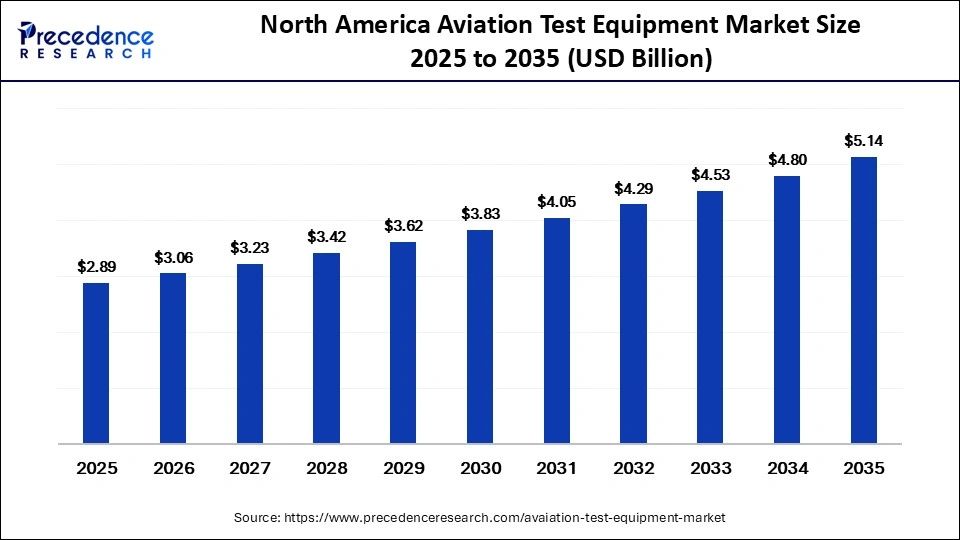
North America Aviation Test Equipment Market Size and Growth 2026 to 2035
The North America aviation test equipment market size is estimated at USD 2.89 billion in 2025 and is projected to reach approximately USD 5.14 billion by 2035, with a 5.93% CAGR from 2026 to 2035.
North America Lead the Global Aviation Test Equipment Market in 2025
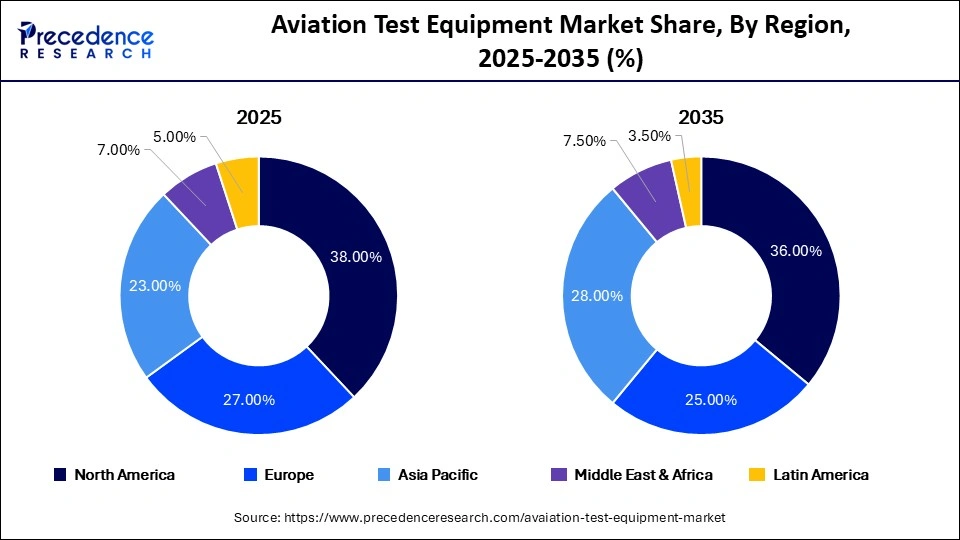
North America dominated the aviation test equipment market with a share of 38% in 2025, due to the presence of major aircraft OEMs, established MRO service providers, and the world's highest defense aviation spending. The region benefits from a highly developed aerospace manufacturing ecosystem with a strong emphasis on quality, safety, and regulatory compliance, which drives continuous demand for advanced testing solutions. Leading industry players actively invest in fault diagnostics, calibration, and system verification technologies to enhance operational efficiency and compliance.
U.S. Aviation Test Equipment Market Size and Growth 2026 to 2035
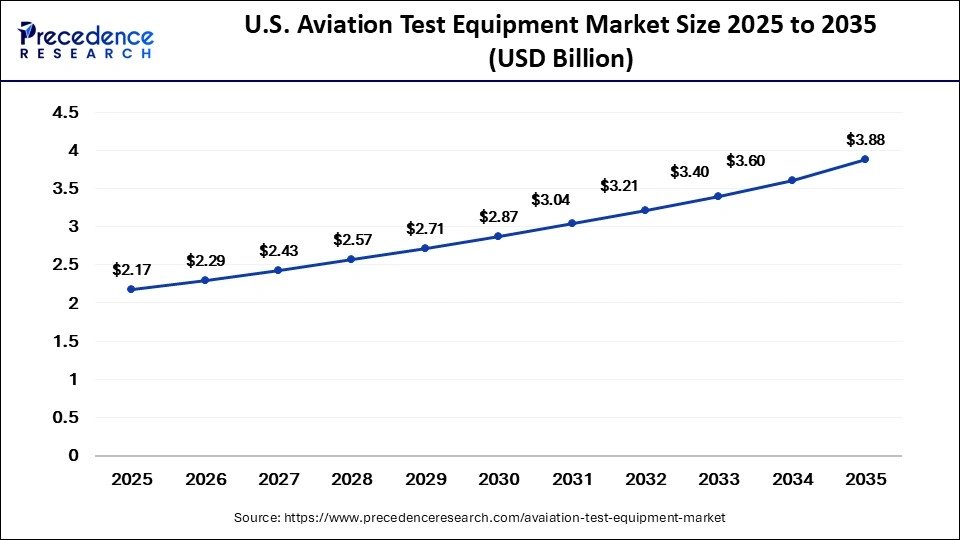
The U.S. aviation test equipment market size is calculated at USD 2.17 billion in 2025 and is expected to reach nearly USD 3.88 billion in 2035, accelerating at a strong CAGR of 5.98% between 2026 and 2035.
U.S. Market Analysis
The U.S. is a major contributor to the North American aviation test equipment market, driven by its large commercial and military aviation sectors. The country hosts major aircraft manufacturers, MRO providers, and technology companies that rely heavily on advanced testing equipment. Additionally, significant investments in AI-driven diagnostics, automated testing systems, and predictive maintenance technologies are strengthening the market growth in the U.S.
Europe: The Second-Largest Market
Europe is the second-largest market for aviation test equipment, holding a 27% share in 2025, and is expected to grow at a notable CAGR of 5% during the projection period. This growth is supported by strong aircraft manufacturing hubs and stringent safety and environmental regulations, which necessitate precise and reliable testing equipment. Increasing investments in fuel-efficient and sustainable aircraft, along with a well-established MRO ecosystem, are further driving market demand.
UK Market Analysis
The UK leads the European market, driven by significant investments in aviation manufacturing, defense aircraft programs, and MRO services. The country is home to leading manufacturers and research institutions focused on aircraft design, testing, and maintenance. Ongoing upgrades in military and commercial aviation, combined with a strong focus on safety, innovation, and regulatory compliance, are accelerating the adoption of advanced testing technologies.
How is the Opportunistic Rise of Asia Pacific in the Aviation Test Equipment Market?
Asia Pacific held a 23% share of the market in 2025 and is expected to grow at the fastest CAGR of 7.5% during the projection period. This is mainly due to the expanding airline fleets, rising MRO activities, and increasing defense modernization programs. Rapid growth in air travel is leading to higher aircraft procurement and maintenance needs. Moreover, increasing digitalization and automation in aviation are further boosting demand for advanced test equipment.
Japan Market Analysis
Japan is emerging as a rapidly growing market within Asia Pacific, supported by its advanced manufacturing capabilities and strong technological base. The country has a well-developed aviation ecosystem, including manufacturers, research centers, and defense programs. Increasing investments in next-generation aircraft technologies and commercial aviation expansion are driving demand for sophisticated testing equipment.
Aviation Test Equipment Market Value Chain Analysis
- Raw Material Sourcing
This stage involves sourcing quality metals, composites, and electronic materials for use in manufacturing test equipment, which guarantees durability, precision, and compliance with aerospace standards.
Key Players: ArcelorMittal, ATI Inc., Hexcel Corporation
- Testing and Certification
Aviation test equipment testing and certification involve rigorous testing and certification to meet global standards. Aviation test equipment is calibrated, verified, and certified for accuracy, reliability, and safe operation.
Key Players: Boeinf Test and Evaluation, Airbus Test Centers, SGS Group
- Maintenance, Repair & Overhaul (MRO)
Maintenance, Repair & Overhaul (MRO) of aviation test equipment extends the life, accuracy, and safety of test equipment for safe and efficient operation.
Key Players: GE Aerospace, ST Engineering, Lufthansa Technik
Aviation Test Equipment Market Companies
- Honeywell International Inc.
- Lockheed Martin Corporation
- RTX Corporation (Collins Aerospace)
- BAE Systems plc
- Northrop Grumman Corporation
- Rohde & Schwarz GmbH & Co. KG
- Keysight Technologies, Inc.
- Cobham Limited (Eaton)
- Teradyne, Inc.
- Curtiss-Wright Corporation
- Safran S.A
- Textron Inc.
- Astronics Corporation
- National Instruments (NI)
- Viavi Solutions Inc.
Recent Developments
- In October 2025, the U.S. Department of Defense awarded Consolidated Contractors Company contracts for the supply of Nav-Aids pressure test adapters for the U.S Army Black Hawk helicopters. This test equipment used on the ground will increase maintenance efficiency and performance of military helicopters.(Source: https://www.ccc.ca)
- In September 2025, Pratt & Whitney Canada entered into an agreement with Singapore Airlines for a 15-year contract to maintain 34 APS5000 APUs for Boeing 787 Dreamliners. This contract will help ensure the APU fleet continues operating at peak efficiency, reliability, and performance.
(Source: https://www.rtx.com) - In September 2025, the U.S. Air Force entered into contracts with 33 companies for $980 billion to supply automated testing systems to support the design, production, and sustainment of products. This electronically controlled equipment test and diagnose the electronic components of military aircraft and weapon systems.(Source: https://www.washingtontechnology.com)
Segments Covered in the Report
By Equipment Type
- Electrical & Electronic Test Equipment
- Hydraulic & Pneumatic Test Equipment
- Engine & Fuel System Test Equipment
- Structural & Mechanical Test Equipment
- Avionics Test Equipment
By Platform
- Commercial Aircraft
- Military Aircraft
- Helicopters
- Unmanned Aerial Vehicles (UAVs)
By Application
- Maintenance, Repair & Overhaul (MRO)
- Production & Assembly Testing
- Flight Line Testing
- Component Testing & Inspection
- Calibration & Diagnostics
By End-Use
- OEMs (Aircraft Manufacturers)
- MRO Service Providers
- Defense Organizations
- Airlines & Fleet Operators
By Technology
- Automated Test Equipment (ATE)
- Portable & Handheld Test Equipment
- Wireless & IoT-enabled Test Systems
- AI-enabled Predictive Testing Systems
By Region
- North America
- Latin America
- Europe
- Asia-pacific
- Middle and East Africa
For inquiries regarding discounts, bulk purchases, or customization requests, please contact us at sales@precedenceresearch.com
Frequently Asked Questions





Ask For Sample
No cookie-cutter, only authentic analysis – take the 1st step to become a Precedence Research client
 Get a Sample




 sales@precedenceresearch.com
 Schedule a Meeting
