



Aviation Test Equipment Market Revenue to Attain USD 13.36 Bn by 2035
Published: 04 May 2026
Author: Precedence Research



Aviation Test Equipment Market Revenue and Trends 2026 to 2035
The global aviation test equipment market revenue surpassed USD 7.60 billion in 2025 and is predicted to attain around USD 13.36 billion by 2035, growing at a CAGR of 5.80%. The market is expanding rapidly, driven by growing focus on enhancing aircraft performance and adoption of software-defined aircraft. Stricter certification standards and growing fleet push airlines and defense operators to invest in precise, data-driven testing solutions that ensure continuous airworthiness.
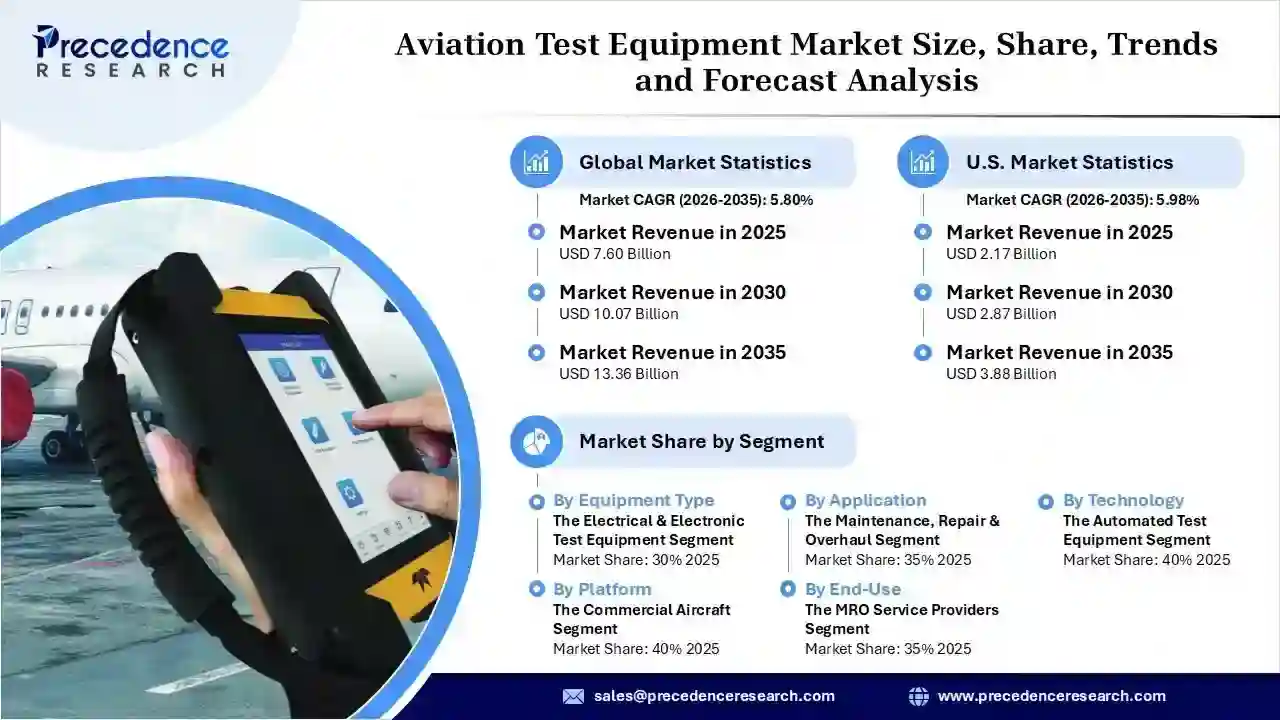
Market at a Glance
The aviation test equipment market includes a wide range of tools and systems used to test, calibrate, and validate aircraft components throughout their lifecycle, from manufacturing to maintenance and overhaul. This spans avionics diagnostic tools, engine testing systems, automated inspection platforms, and integrated testing environments designed to detect faults before they escalate. There is a rapid shift from standalone hardware toward integrated, data-driven testing ecosystems powered by analytics and software intelligence. These solutions are deployed across commercial and military aviation, covering use cases from early-stage aircraft development to routine inspections and heavy maintenance operations.
What are the Major Trends Driving the Aviation Test Equipment Market?
- Increasing Popularity of AI-Driven and Automated Testing: The increasing complexity of modern avionics and electronic systems is making traditional testing methods insufficient. AI-enabled and automated testing solutions are gaining traction as they reduce human error, enable predictive maintenance, and minimize downtime, transforming testing into a continuous, data-driven process rather than a manual checklist.
- Sustainability and Emission Compliance: Sustainability goals are significantly influencing testing requirements across the aviation industry. Organizations such as the International Air Transport Association (IATA) are targeting net-zero emissions by 2050, driving demand for advanced testing systems that validate fuel efficiency, monitor emissions, and ensure compatibility with sustainable aviation fuels.
Aircraft Fleet Structure and Its Impact on Testing Requirements
- The global commercial aircraft fleet stands at approximately 35,550 aircraft, with over 30,300 currently in operation, creating sustained demand for continuous testing, calibration, and diagnostics throughout the aircraft lifecycle.
- Narrowbody aircraft account for nearly 60% of the fleet, operating in high-frequency short-haul routes, which increases wear and tear and drives frequent testing requirements, particularly for avionics and electronic systems.
- The aircraft manufacturing industry remains highly concentrated, with two major players accounting for around 80% of the fleet, resulting in standardized platforms but persistent demand for specialized testing equipment tailored to specific aircraft families.
Market Segmentation Overview
- By equipment type, the electrical & electronic test equipment segment held a share of 30% in the aviation test equipment market in 2025 due to increasing complexity of modern aircraft. As aircraft become increasingly software-defined and signal-dependent, testing has shifted toward electrical validation, fault isolation, and system-level diagnostics rather than isolated component checks.
- By equipment type, the avionics test equipment segment is expected to grow at the fastest CAGR of 6.5% between 2026 and 2035, driven by advancements in digital cockpit systems and next-generation avionics. With aircraft relying more heavily on integrated and interconnected avionics, demand is rising for advanced testing solutions focused on software validation, communication systems, and real-time data integrity.
- By platform, the commercial aircraft segment held a major revenue share of 40% in the market in 2025, owing to its extensive global fleet and continuous maintenance cycles. High aircraft utilization and tight operational turnaround times have made advanced testing an essential part of routine maintenance, deeply integrated into MRO workflows.
- By platform, the unmanned aerial vehicles (UAVs) segment is expected to grow at a CAGR of 8.5% in the market between 2026 and 2035, driven by increasing adoption in surveillance, defense, and commercial applications. As UAV deployment expands, demand is rising for lightweight, mission-specific, and highly adaptable testing systems.
- By application, the maintenance, repair, and overhaul (MRO) segment dominated the aviation test equipment market with a 35% share in 2025 and is expected to maintain its leading position in the coming years. This growth is supported by rising fleet sizes, more frequent maintenance cycles, and the need to ensure aircraft safety, reliability, and regulatory compliance throughout their lifecycle.
- By end-use, the MRO service providers segment dominated the market with a 35% market share in 2025 and is expected to maintain its leading position in the coming years. This is because airlines increasingly rely on these providers for complex testing and maintenance operations, reinforcing their central role in ensuring operational efficiency and aircraft readiness.
- By technology, the automated test equipment segment accounted for a major revenue share of 40% in the aviation test equipment market in 2025 due to its efficiency, precision, and ability to minimize human intervention. The industry has increasingly adopted standardized and repeatable testing processes, where automation plays a key role in reducing errors and improving diagnostic speed.
- By technology, the AI-enabled predictive testing systems segment is expected to expand at the fastest CAGR of 8.5% in the coming years, driven by the shift toward predictive maintenance. These systems analyze historical and real-time data to anticipate failures before they occur, significantly improving safety and reducing operational downtime.
Regional Analysis
North America dominated the aviation test equipment market with a major share of 38% in 2025, driven by advanced aerospace manufacturing capabilities and a strong maintenance, repair, and overhaul ecosystem. The region benefits from the presence of major original equipment manufacturers (OEMs) and significant defense spending, particularly in the U.S., which continues to invest heavily in fleet modernization and advanced testing technologies. Canada further contributes through specialized maintenance and component-level testing expertise.
Asia Pacific held a market share of 23% in 2025 and is expected to grow at the fastest CAGR of 7.5% during the forecast period. This growth is driven by expanding airline fleets, rising MRO infrastructure, and defense modernization programs. Increasing aircraft volumes in countries such as China and India are intensifying demand for scalable and localized testing solutions, strengthening the region’s long-term growth outlook.
Aviation Test Equipment Market Coverage
| Report Attribute | Key Statistics |
| Market Revenue in 2025 | USD 7.60 Billion |
| Market Revenue by 2035 | USD 13.36 Billion |
| CAGR from 2026 to 2035 | 5.80% |
| Quantitative Units | Revenue in USD million/billion, Volume in units |
| Largest Market | North America |
| Base Year | 2025 |
| Regions Covered | North America, Europe, Asia-Pacific, Latin America, and the Middle East & Africa |
Top Companies in the Aviation Test Equipment Market
Key players such as Honeywell International Inc. and Lockheed Martin Corporation are actively involved in aviation testing across avionics, propulsion, and mission-critical systems. RTX Corporation, through its Collins Aerospace division, provides integrated testing solutions supporting structural, system-level validation, and certification processes. Defense-focused companies like BAE Systems plc and Northrop Grumman Corporation emphasize high-reliability testing for advanced radar systems, electronic warfare platforms, and complex avionics, focusing strongly on mission-critical performance and operational assurance.
Segments Covered in the Report
By Equipment Type
- Electrical & Electronic Test Equipment
- Hydraulic & Pneumatic Test Equipment
- Engine & Fuel System Test Equipment
- Structural & Mechanical Test Equipment
- Avionics Test Equipment
By Platform
- Commercial Aircraft
- Military Aircraft
- Helicopters
- Unmanned Aerial Vehicles (UAVs)
By Application
- Maintenance, Repair & Overhaul (MRO)
- Production & Assembly Testing
- Flight Line Testing
- Component Testing & Inspection
- Calibration & Diagnostics
By End-Use
- OEMs (Aircraft Manufacturers)
- MRO Service Providers
- Defense Organizations
- Airlines & Fleet Operators
By Technology
- Automated Test Equipment (ATE)
- Portable & Handheld Test Equipment
- Wireless & IoT-enabled Test Systems
- AI-enabled Predictive Testing Systems
By Region
- North America
- Latin America
- Europe
- Asia-pacific
- Middle and East Africa
Get this report to explore global market size, share, CAGR, and trends, featuring detailed segmental analysis and an insightful competitive landscape overview @ https://www.precedenceresearch.com/sample/8365
You can place an order or ask any questions, please feel free to contact us at sales@precedenceresearch.com |+1 804 441 9344