



CNS Biomarkers Market Revenue to Attain USD 26.13 Bn by 2035
Published: 27 May 2026
Author: Precedence Research



CNS Biomarkers Market Revenue and Trends 2026 to 2035
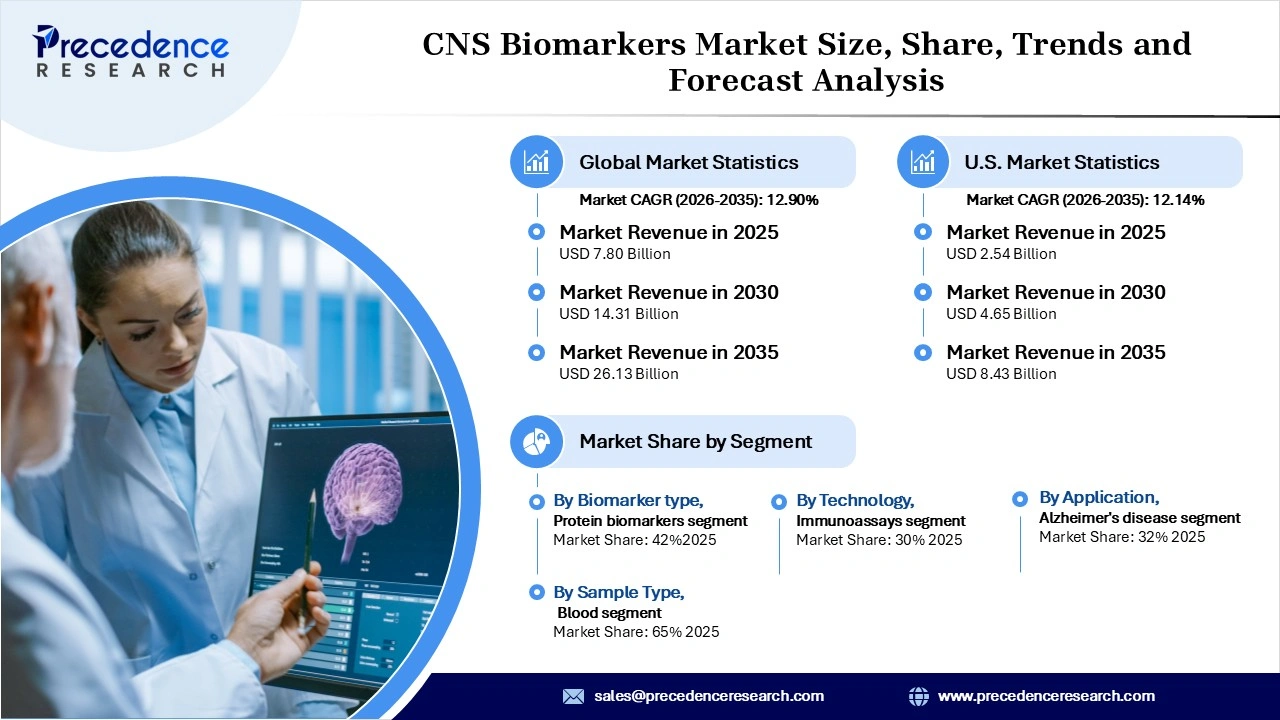
The global CNS biomarkers market revenue reached USD 7.80 billion in 2025 and is predicted to attain around USD 26.13 billion by 2035 with a CAGR of 12.90%. The market is driven by the increasing demand for objective measures to diagnose neurodegenerative conditions such as Alzheimer’s disease, Parkinson’s disease, and multiple sclerosis, and the growing need to track disease progression and response to treatment.
Deciphering the Brain’s Mysteries with Biological Tools
The CNS biomarkers market involves biological measures present in body fluids and tissue samples that are used to detect various neurological and psychiatric conditions, evaluate the course of the disease, and determine prognosis. It uses cerebrospinal fluid (CSF) biomarkers, which include amyloid and tau proteins, and alpha-synuclein. There are genetic biomarkers, such as APOE4, which detect the susceptibility to Alzheimer’s disease.
The market also includes imaging biomarkers, such as PET tracers for detecting amyloid and tau protein deposits, the MRI technique for brain atrophy, and dopamine transporter SPECT imaging for diagnosing Parkinson’s disease. This market has been adopted by pharmaceutical companies for clinical trials using biomarkers for patient selection and trial efficacy monitoring, diagnostic labs, hospital neurological units, and research institutes.
Multi-Analyte Proteomic Panels for Detection of CNS Biomarkers
The latest trend in the market is the usage of multi-analyte proteomic panels for measuring many brain-specific proteins from a single blood sample, allowing scientists to measure and monitor disease markers of neurological disorders with unprecedented sensitivity. These panels can measure hundreds of biomarkers in one test, including isoform-specific tau assays in Alzheimer’s disease patients. In 2026, Alamar Biosciences released the NULISAseq Neuro 220 Panel, which is a precision proteomics panel that enables simultaneous measurement of 220 CNS biomarkers from a single blood sample, including 15 Parkinson’s biomarkers.
Payer Reimbursement for CSF Biomarker Tests
The CNS biomarkers market is benefitting from the adoption of payer reimbursement for biomarker tests based on cerebrospinal fluid samples, thus lowering the cost burden for patients and promoting the uptake of such tests. Such reimbursement agreements are improving their acceptance among patients and speeding up their adoption at cancer centers. In 2026, CNSide, a subsidiary of Plus Therapeutics, secured a payer reimbursement agreement with Blue Shield of California, raising its total covered lives to around 81 million. CNSide has conducted more than 11,000 tests at more than 120 U.S cancer facilities since 2020, and the tests have shown 92% sensitivity and 95% specificity.
Government Investment in CNS Biomarker Research
Governments across the world are funding biomarker research and development, realizing the need for the discovery and development of reliable biomarkers to diagnose CNS diseases and curate treatments for the same. Governments have started research funding programs where they have invested billions of dollars into the study of dementia, Parkinson’s disease, and other neurodegenerative conditions. In 2025, the governor of Texas, U.S., Greg Abbott, signed a bipartisan bill creating the Dementia Prevention and Research Institute of Texas for the next 10 years with a budget of USD 3 billion. The bill was modified to include Parkinson’s in addition to dementia as part of the research program.
Cognition Therapeutics Reports Positive Results for the SHIMMER Trial
In 2025, Cognition Therapeutics reported findings from its Phase 2 SHIMMER trial in which dementia with Lewy bodies patients were given zervimesine (CT1812). It achieved 91% reduction in cognitive fluctuations, 86% improvement in behavioral endpoints, 62% improvement in motor functions, and 52% improvement in daily life functions as compared to placebo.
Market Segmentation Overview
- By biomarker type, the protein biomarkers segment led the CNS biomarkers market with 42% share in 2025, due to the direct association of proteins such as amyloid-beta, tau, neurofilament light chain, and alpha-synuclein with the pathophysiology of neurological disorders, and high specificity even when measured through body fluids like blood and cerebrospinal fluid.
- By biomarker type, the genetic biomarkers segment is expected to expand at the highest CAGR of 15% during the forecast period, because of the progress made on polygenic risk scoring and increasing affordability of sequencing, allowing for the early detection of people who are predisposed to neurological diseases like Huntington’s and familial Alzheimer’s disease.
- By technology, the immunoassays segment dominated the market with 30% share in 2025, owing to the fact that enzyme-linked immunosorbent assay and electrochemiluminescence are extensively used to analyze protein biomarkers owing to their high sensitivity, affordability, and scalability.
- By technology, the AI and bioinformatics based analysis segment is expected to grow at the fastest CAGR of 20.5% from 2026 to 2035, because it is critical to process huge volumes of multi-omics data obtained from patient samples, where many modern platforms are required to analyze thousands of proteins, metabolites, and gene variants.
- By application, the Alzheimer’s disease segment led the CNS biomarkers market with 32% share in 2025, and is expected to expand at the highest CAGR of 15.5% during the forecast period, owing to the high prevalence of Alzheimer’s compared to other neurodegenerative diseases, and recent approval by regulatory agencies that require Alzheimer’s patients to undergo biomarker testing for amyloid accumulation.
- By application, the Parkinson’s disease segment held the second-largest market share of 18% in 2025, because of the increasing requirement for seed amplification tests for alpha-synuclein, along with genetic biomarkers that help differentiate Parkinson’s from atypical Parkinsonism and assist with conducting clinical trials for disease-modifying drugs.
- By sample type, the blood segment dominated the market with 40% share in 2025, and is expected to grow at the fastest CAGR of 16.5% from 2026 to 2035, due to its low cost, repeatability, and the ability to be sampled anywhere under normal conditions by non-specialized healthcare professionals.
- By sample type, the cerebrospinal fluid (CSF) segment held the second-largest market share of 32% in 2025, owing to the fact that it is very close to the brain and contains higher levels of neuron-secreted proteins as compared to blood, thus providing a precise reading of Alzheimer’s biomarker levels.
Regional Analysis
North America led the CNS biomarkers market with 41% share in 2025, because of the significant presence of prominent pharmaceutical companies carrying out clinical trial programs for Alzheimer’s and Parkinson’s disease, and a well-established regulatory pathway via the FDA’s Biomarker Qualification Program for clinical implementation. The U.S. dominated the market in North America due to significant investment by the National Institute on Aging into Alzheimer’s disease research, and the quick uptake of blood-based biomarker tests following the approval of new anti-amyloid drugs requiring biomarker confirmation. Canada is a significant contributor to the market owing to its involvement in global biomarker projects, such as the Alzheimer’s Disease Neuroimaging Initiative, and significant government funding into aging research.
Asia-Pacific is expected to expand at the highest CAGR of 16.8% during the forecast period, due to its large aging population, increased healthcare expenditure, and government efforts to boost research facilities and diagnostics. China led the market in Asia-Pacific because of a significant elderly population, increasing cases of neurodegenerative disorders, and the development of domestic diagnostic firms that offer less expensive blood-based biomarker testing solutions compared to their Western counterparts. India witnessed notable market growth owing to its large population, significant establishment of neurology centers in major metropolitan areas, and domestic biotechnology companies producing economical biomarker kits suitable for the Indian market.
CNS Biomarkers Market Coverage
| Report Attribute | Key Statistics |
| Market Revenue in 2025 | USD 7.80 Billion |
| Market Revenue by 2035 | USD 26.13 Billion |
| CAGR from 2026 to 2035 | 12.90% |
| Quantitative Units | Revenue in USD million/billion, Volume in units |
| Largest Market | North America |
| Base Year | 2025 |
| Regions Covered | North America, Europe, Asia-Pacific, Latin America, and the Middle East & Africa |
Top Companies in the CNS Biomarkers Market
F. Hoffmann-La Roche Ltd., Abbott Laboratories, and Siemens Healthineers are some of the key players that provide automated biomarkers detection process through immunoassays. Quanterix Corporation and Thermo Fisher Scientific specialize in ultrasensitive blood tests for CNS biomarker detection. Bio-Rad Laboratories, PerkinElmer, and Danaher Corporation offer tools for detecting biomarkers through proteomics and ELISA. Qiagen N.V., Agilent Technologies, and Bruker Corporation offer PCR and mass spectrometry methods for detecting neurodegenerative diseases.
Segments Covered in This Report
By Biomarker Type
- Protein Biomarkers
- Tau Protein
- Amyloid Beta
- Neurofilament Light Chain (NfL)
- Glial Fibrillary Acidic Protein (GFAP)
- Genetic Biomarkers
- DNA Biomarkers
- RNA Biomarkers
- Epigenetic Biomarkers
- Metabolic Biomarkers
- Imaging Biomarkers
- MRI Biomarkers
- PET Biomarkers
- CT Imaging Biomarkers
- Cellular Biomarkers
By Technology
- Immunoassays
- Molecular Diagnostics
- Proteomics
- Genomics
- Neuroimaging Technologies
- AI & Bioinformatics-based Analysis
By Application
- Alzheimers Disease
- Parkinsons Disease
- Multiple Sclerosis
- Epilepsy
- Traumatic Brain Injury (TBI)
- Stroke
- Psychiatric Disorders
- Other Neurological Disorders
By Sample Type
- Blood
- Cerebrospinal Fluid
- Urine
- Saliva
- Brain Imaging Data
By Region
- North America
- Latin America
- Europe
- Asia-pacific
- Middle and East Africa
Get this report to explore global market size, share, CAGR, and trends, featuring detailed segmental analysis and an insightful competitive landscape overview @ https://www.precedenceresearch.com/sample/8431
You can place an order or ask any questions. Please feel free to contact us at sales@precedenceresearch.com |+1 804 441 9344