



Decentralized Clinical Trials in Neurology Market Revenue to Attain USD 6.38 Bn by 2035
Published: 02 Jul 2026
Author: Precedence Research



Decentralized Clinical Trials in Neurology Market Revenue and Trends 2026 to 2035
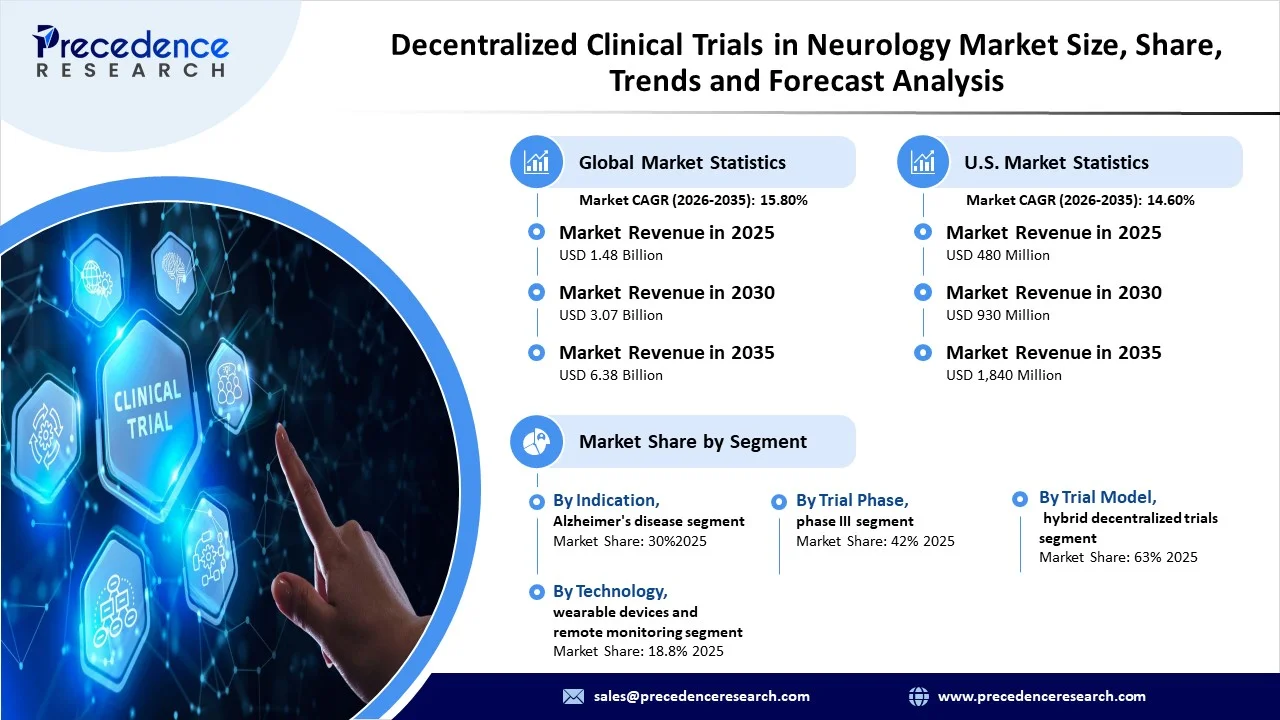
The global decentralized clinical trials in neurology market revenue surpassed USD 1.48 billion in 2025 and is predicted to attain around USD 6.38 billion by 2035, growing at a CAGR of 15.80%. The market is driven by the increasing need to improve patient enrollment and retention in clinical trials and the growing requirements for increasing accessibility and convenience of patients via digital technologies, remote monitoring, and telemedicine.
Expansion of Clinical Research Accessibility
The decentralized clinical trials in neurology market include products, technologies, platforms, and services that help carry out clinical trials without having to go to traditional clinical trial sites that are conducted in this market space. This market involves technologies like remote patient monitoring, eCOA (electronic clinical outcome assessment), telemedicine, e-consent, direct-to-patient drug delivery, and mobile phlebotomy.
This market encompasses wearable devices, smartphone apps, video conferencing, and cloud-based data management systems for capturing real-time data from patients who are at home. The applications of this market include different types of therapy areas like cardiology, neurology, endocrinology, oncology, respiratory, and rare diseases. This market has been adopted by pharmaceutical and biotechnological firms, contract research organizations (CROs), academic medical centers, and independent clinical sites.
Interoperable Platforms and AI Agents Facilitate Flexible Trial Conduct
The decentralized clinical trials (DCT) technology providers have started moving from one-vendor all-in-one platforms to more sophisticated and diverse multi-vendor modular technology ecosystems where sponsors are able to pick up the best solutions. Technologies such as AI and blockchain are being used to automate the process of patient-trial matching, eligibility, and consent management, saving a considerable amount of time. In 2026, Vibrant Health became a part of a BARDA-sponsored hybrid/remote decentralized clinical trials research program on the correlates of protection for infectious diseases. This project works within a USD 17 million BARDA contract and utilizes patient-centric digital engagement methods, real-world data, and remote biosample collection.
AI-Powered DCT Platforms to Engage Hard-to-Reach Populations
The decentralized clinical trials in neurology market is increasingly becoming popular in community settings as they have proven their ability to attract diverse and hard-to-reach populations of patients who are often excluded by traditional site-based clinical trials. By using AI-powered technology, it is possible to provide access to clinical trials for small and mid-sized practices without infrastructure. In 2025, investigators reported findings of the Health360x.ai Registry at ACC 2025, which is an AI-powered platform that was developed in the context of an NIH Fast-Track SBIR grant and enrolled 7,513 participants in 35 community-based sites in 4 NIH-funded and 1 industry-sponsored studies. The registry had 85% participation by blacks and 58% females, 15% were from rural backgrounds, and 51% had an annual income under USD 25,000.
Evolution of Regulatory Frameworks in Support of Decentralized Trial Approaches
Regulatory agencies have modernized their frameworks for clinical trials by taking into account the new decentralized and hybrid trial approaches. Such initiatives offer sponsors clear guidelines on how to make use of digital technologies in a way that preserves the safety of participants, the integrity of data, and compliance with regulations. In 2025, the U.S. Food and Drug Administration (FDA) issued its guidance document entitled “Enhanced Participation in Clinical Trials – Eligibility Criteria, Environmental Practices, and Trial Designs”. The guidance document acknowledges that decentralized and hybrid trial approaches have the potential to overcome logistical obstacles that hinder the participation of older people and those suffering from mobility limitations.
Rare Disease Company Curetopia Secures USD 1.8 Million for Decentralized Trials
In 2025, nonprofit biotechnology company Curetopia received USD 1.8 million in funding from more than 1,000 individuals to conduct decentralized clinical trials of patients with rare inherited metabolic disorders. This will be used to research AARS2 deficiency, which is a rare genetic disorder with no existing treatment. 2 drug repurposing candidates have been discovered from high-throughput screenings.
Market Segmentation Overview
- By indication, the Alzheimer’s disease segment led the decentralized clinical trials in neurology market with a 30% share in 2025, due to the fact that elderly patients experience difficulties with mobility and transportation, which makes the use of remote monitoring, telemedicine, and at-home cognitive evaluation vital to enhance recruitment and retention. Alzheimer’s disease clinical trials are known to be for long durations, and DCT allows for collecting real-world evidence through digital biomarkers and wearable devices.
- By indication, the neuromuscular disorders segment is expected to expand at the highest CAGR of 17.8% during the forecast period, because of the mobility issues associated with amyotrophic lateral sclerosis (ALS), spinal muscular dystrophy, and Duchenne muscular dystrophy, which prompts the adoption of DCT. This segment is experiencing an increase in trials related to gene therapy and antisense oligonucleotides, where frequent and sensitive functional assessments have to be done.
- By trial phase, the phase III segment dominated the market with a 42% share in 2025, since it is a pivotal and registration phase require the biggest number of patients and high expenses within the drug development process. The advantages of DCT approaches, such as cost-effectiveness and faster recruiting, are especially relevant to the sponsors trying to make the maximum profit and follow the regulatory guidelines.
- By trial phase, the phase 2 segment is expected to grow at the fastest CAGR of 17.3% from 2026 to 2035, because it constitutes the important “go/no-go” decision moment during the drug development process, wherein sponsors are progressively embracing decentralization to speed up recruitment, save money, and obtain valuable real-world data.
- By trial model, the hybrid decentralized trials segment led the decentralized clinical trials in neurology market with a 63% share in 2025, because it provides the best possible combination of remote patient-centered operations and clinical requirements for CNS trials, enabling sponsors to reduce site visits to a minimum using telemedicine and home visits while still having in-person site visits to carry out complicated procedures.
- By trial model, the fully decentralized trials segment is expected to expand at the highest CAGR of 17.5% during the forecast period, due to its ability to overcome the major challenge of participant requirements, especially for CNS trials, where patients tend to have movement, cognitive, and logistic issues that make site visits hard. This segment is supported by rapid technological development in digital medicine technologies, including wearable sensors, mobile-based cognitive assessment tests, and direct-to-patient medication delivery solutions.
- By technology, the wearable devices and remote monitoring segment dominated the market with a 32% share in 2025 and is expected to grow at the fastest CAGR of 18.8% from 2026 to 2035, owing to its ability to collect real-world functional and physiological data, including walking, sleeping, and trembling. This segment solves 2 major problems in neurological clinical research, which are the lack of sensitive endpoints for detecting therapeutic effects in slowly progressive diseases and the recruitment problem for remote location participants.
- By technology, the telemedicine platforms segment held the second-largest market share of 29% in 2025 because of its direct relevance in solving one of the major challenges in CNS trials, that is, the burden of site visits. This segment helps patients communicate with investigators, perform cognitive tests, and provide real-world data from home. This segment benefits from the growing use of a hybrid model of trials in which telemedicine plays the role of a fundamental platform for remote interactions with patients.
- By end user, the pharmaceutical companies segment led the market with a 58% share in 2025, due to its critical role as the main sponsor of clinical trials, sponsoring almost all CNS drug development programs while shouldering the huge financial risks and the responsibilities involved.
- By end user, the biotechnology companies segment is expected to expand at the highest CAGR of 18.3% during the forecast period, since biotech firms tend to have fewer drug development pipelines, putting them under immense pressure to provide evidence of clinical proof-of-concept in a fast, cost-efficient manner.
Regional Analysis
North America dominated the decentralized clinical trials in neurology market with a 43% share in 2025 because of extensive adoption of digital health solutions, regulatory guidance from the FDA, and government investment in DCT infrastructure and research projects. The U.S. led the market in North America due to the significant presence of prominent pharmaceutical and biotechnology companies, rapid adoption of DCT models post-pandemic, and significant investments in digital health solutions. Canada is a significant contributor to the market owing to government-backed initiatives for clinical trial infrastructure modernization and extensive adoption of hybrid/decentralized DCT models in public-private research collaborations.
Asia-Pacific is expected to grow at the fastest CAGR of 18.9% from 2026 to 2035, due to the significant presence of a large and varied patient pool, strong infrastructure of digital health care solutions, and government backing for the modernization of the clinical trial process. China dominated the market in Asia-Pacific because of its large patient pool, extensive adoption of advanced digital healthcare technologies, and government-driven programs aimed at modernizing its clinical trial infrastructure. India witnessed notable market growth owing to its large underserved patient pool, competitive pricing in terms of clinical research, and imminent regulation specifically dedicated to decentralizing trials that boost the adoption of DCT solutions.
Europe held the second-largest market share of 27% in 2025, owing to the presence of favorable regulations, advanced healthcare facilities, and high adoption of digital health technology in the region. Germany led the market in Europe due to its well-developed pharmaceutical industry, high density of clinical research sites, and significant integration of the concept of decentralization in the development of drugs, facilitated by the favorable regulatory system of Europe. The UK is a significant contributor to the market because of government investments in decentralized trial methods, an established clinical research sector that quickly adapted to the concepts of hybrid and decentralized clinical trials post-COVID-19.
Decentralized Clinical Trials in Neurology Market Coverage
| Report Attribute | Key Statistics |
| Market Revenue in 2025 | USD 1.48 Billion |
| Market Revenue by 2035 | USD 6.38 Billion |
| CAGR from 2026 to 2035 | 15.80% |
| Quantitative Units | Revenue in USD million/billion, Volume in units |
| Largest Market | North America |
| Base Year | 2025 |
| Regions Covered | North America, Europe, Asia-Pacific, Latin America, and the Middle East & Africa |
Top Companies in the Decentralized Clinical Trials in Neurology Market
IQVIA, ICON plc, Parexel, and Medpace are some of the key players that have incorporated remote patient monitoring, cognitive tests, and telemedicine visits in their hybrid approaches. LabCorp Drug Development, Syneos Health, and PPD provide direct-to-patient medication delivery and home health visits, essential for elderly and mobility-challenged patients. Worldwide Clinical Trials, PSI CRO, and Novotech offer agile decentralized services for smaller sponsors and rare disease research. CMIC Holdings, KCR, and Ergomed occupy specialized niches in terms of geography and rare CNS diseases, benefiting from local networks of investigators and regulatory knowledge to facilitate the decentralized process.
Segments Covered in This Report
By Indication
- Alzheimer's Disease
- Parkinson's Diseass
- Multiple Sclerosis
- Epilepsy
- Stroke
- Migraine
- Neuromuscular Disorders
- Others
By Trial Phase
- Phase I
- Phase II
- Phase III
- Phase IV
By Trial Model
- Fully Decentralized Trials (DCT)
- Hybrid Decentralized Trials
By Technology
- Telemedicine Platforms
- eConsent & eCOA Solutions
- Wearable Devices & Remote Monitoring
- eSource & Electronic Data Capture (EDC)
By End User
- Pharmaceutical Companies
- Biotechnology Companies
- Academic & Research Institutes
By Region
- North America
- Latin America
- Europe
- Asia-pacific
- Middle and East Africa
Get this report to explore global market size, share, CAGR, and trends, featuring detailed segmental analysis and an insightful competitive landscape overview @ https://www.precedenceresearch.com/sample/8530
You can place an order or ask any questions. Please feel free to contact us at sales@precedenceresearch.com |+1 804 441 9344