



Display Module Market Revenue to Attain USD 180.13 Bn by 2035
Published: 13 Jul 2026
Author: Precedence Research



Display Module Market Revenue and Trends 2026 to 2035
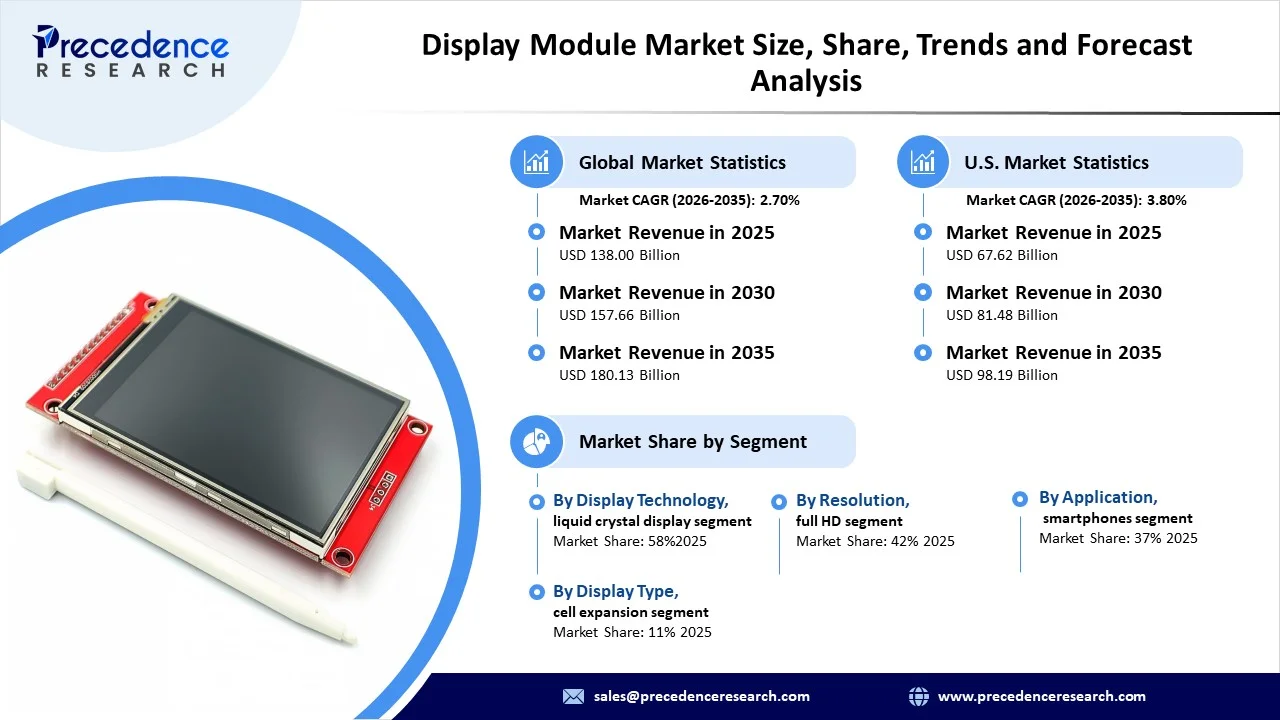
The global display module market revenue surpassed USD 138.00 billion in 2025 and is predicted to attain around USD 180.13 billion by 2035, growing at a CAGR of 2.70%. The market is driven by the rising worldwide demand for high-definition, energy-efficient, and flexible display modules in consumer electronics, including smartphones, tablets, televisions, and wearables, and the rapid penetration of OLED and microLED technology.
The Visual Interface in Contemporary Electronics
The display module market addresses the entire display module assemblies- that is, the display panels, driver integrated circuits (ICs), backlight or self-emissive films, touch sensor layers, cover glass, and the mechanical chassis. It encompasses a variety of display technologies from conventional LCD and LED backlight panels to more sophisticated OLED, microLED, cutting-edge quantum dots, and electrophoretic displays.
This market also involves standard rectangular modules and curved, flexible, foldable, rollable, and even transparent versions, from sub-inch microdisplays for AR/VR headsets to gigantic 100+ inch modules for digital signage and TV sets. Some of the key applications include consumer electronics, automotive, industrial and medical equipment, and more recent segments such as smart home appliances and AR/VR headsets. This market has been adopted by original equipment manufacturers (OEMs), original design manufacturers (ODMs), and display module integrators.
Next Generation OLED Technologies Provide Brightness and Low Power Consumption
There have been developments in display modules using next-generation OLED technology, providing better brightness and power efficiency levels. There have been recent developments in tandem devices as well as substrate materials for smartphones and other portable devices, which have set the performance standards. In 2026, Tianma Microelectronics introduced its smartphone OLED display with a maximum brightness of 8,000 nits. The display utilizes SLOD tandem device architecture and consumes 30% less energy, and provides 4 times more lifetime than normal devices. The U11 eye protection substrate material used in the display saves 95.3% blue light and gives an additional 100% lifetime.
Investments and Collaborations Impacting the Supply Chain of Display Modules
There has been an increasing use of display modules, as there are strategic partnerships being made and investments to develop capacities in their production and development of supply chains. Such investments have been driven by the increasing demand for display modules manufactured locally in emerging economies. In 2025, Dixon Technologies and HKC Overseas entered into a USD 42.3 million joint venture to produce LCD and TFT-LCD modules for TVs, phones, monitors, and car displays in India. This collaboration seeks to reduce reliance on imports and also increase local manufacturing capabilities.
Programs at the National Level Promote Local Manufacturing of Display Modules
Governments across the globe have adopted measures and launched programs aimed at enhancing their domestic display module manufacturing and minimizing imports. Such programs may take the form of customs duty changes, incentive-based manufacturing programs, and the development of future generations of display technologies. In 2025, the South Korean government announced a USD 350 million investment in the development of next-generation inorganic light-emitting diode (ILED) display technology up to 2032. This measure seeks to keep South Korea ahead in the global display industry through the development of advanced technologies.
BOE Unveils World’s First Gen 8.6 LTPO OLED Line With a USD 8.65 Billion Investment
BOE achieved a significant milestone by producing the first-ever display module on its new Gen 8.6 (2290 by 2620mm) LTPO OLED production line at its plant in Chengdu, China, five months ahead of schedule in December, 2025. The entire project is worth USD 8.65 billion with an expected monthly capacity of 32,000 glass substrates, and thus it is the first and largest industrial project of this kind in China.
Market Segmentation Overview
- By display technology, the liquid crystal display (LCD) segment led the display module market with a 58% share in 2025, due to the prevailing technology for many decades now, with huge manufacturing capabilities on a global level, an established supply chain, and lower production costs compared to other technologies. This helps explain why it is the natural choice for mass production of televisions, computer monitors, laptops, and low-budget smartphones.
- By display technology, the micro-LED segment is expected to expand at the highest CAGR of 18.4% during the forecast period, owing to the performance benefits that they offer over existing technologies in the market, which include high brightness, improved energy efficiency, increased lifespan, and even the ability to produce flexible and transparent displays.
- By resolution, the full HD (FHD) segment dominated the market with a 42% share in 2025, since it strikes the perfect equilibrium between picture quality and cost of manufacturing, which makes it the standard resolution for most mass-market consumer electronic devices, from low-end laptops and budget phones to mid-range TVs.
- By resolution, the 8K and above segment is expected to grow at the fastest CAGR of 10.9% from 2026 to 2035, as it is considered the state-of-the-art in display technology and offers 4 times the pixels as those found in 4K, delivering a degree of visual clarity that is necessary in large screen formats for premium television sets, digital signage, and other professional uses.
- By application, the smartphones segment led the market with a 37% share in 2025, because they account for the largest volume of applications for display modules worldwide, where more than 1.2 billion units are shipped each year, and they use very sophisticated display technology.
- By application, the automotive displays segment is expected to expand at the highest CGR of 8.9% during the forecast period, because of the ongoing transition towards electric and autonomous cars that involves re-designing the whole vehicle interior, replacing the old-fashioned gauges and mechanical controls with large high-resolution digital screens. Such technology is used in the instrument cluster, infotainment, navigation, and entertainment of passengers.
- By display type, the flat display modules segment dominated the market with a 78% share in 2025, due to its high level of maturity, efficiency, and wide adoption across all kinds of display products, as well as its well-established manufacturing facilities and supply chain networks. This segment has been widely adopted in TVs, monitors, laptops, smartphones, and digital display applications in which the conventional rectangular form factor perfectly fits all requirements of functionality and ergonomics.
- By display type, the flexible display modules segment is expected to grow at the fastest CAGR of 9.4% from 2026 to 2035, since they offer a range of new products that rigid flat displays do not allow for, such as foldable smartphones, rollable TVs, curved automotive displays, and wearable gadgets.
- By end user industry, the consumer electronics segment led the market with a 67% share in 2025, owing to the fact that it has the highest volume of display shipments across the globe due to the sheer volume of phones, television sets, laptop computers, and wearable devices manufactured annually.
- By end user industry, the automotive segment is expected to expand at the highest CAGR of 8.2% during the forecast period, because the shift towards electric vehicles and self-driving cars is causing a revolution in automotive interior designs. The conventional mechanical gauges and controls are being replaced by larger high-definition displays used for instrument panels, infotainment, navigation, and entertainment purposes.
Regional Analysis
Asia-Pacific dominated the market with a 49% share in 2025 and is expected to grow at the fastest CAGR of 3.8% from 2026 to 2035 because it is the manufacturing center of the world, where a huge chunk of global display panels and modules for all types of displays are produced. China led the market in the Asia-Pacific as it invested heavily in the development of next-generation OLED lines and has the largest consumer base of smartphones, TV sets, and other products using display panels. South Korea and Taiwan are significant contributors to the market due to significant impetus on the development of technology, especially OLED and microLED technology, and good manufacturing capabilities for LCD and driver integrated circuits.
Europe held the second-largest market share of 20% in 2025, due to the significant presence of prominent electronics companies and an extensive automotive and industrial display sector that requires premium display modules for cars, healthcare devices, and other applications. Germany dominated the market in Europe owing to its excellent engineering and manufacturing expertise, dominance in automotive displays, and its position as a center for display-making equipment and materials, helped by a good industrial base and research and development focus on display technologies. The U.K. witnessed notable market growth because of its advanced research and development ecosystem, leadership in various display technologies like flexible electronics, quantum dots, and AR/VR display systems, and its significant importance in the European electronics supply chain.
North America held the third-largest market share of 18% in 2025 because of its leadership in high-value, specialty display modules such as medical imaging display modules, defense and aerospace instrumentation modules, high-end automotive cockpit modules, and AR/VR display modules. The U.S. has led the market in North America since it has state-of-the-art research organizations, dynamic startups in the microLED and quantum dot display industry, as well as being an essential market in consumer electronics, automotive, and healthcare industries. Canada is a significant contributor to the market because of its growing expertise in flexible and transparent display technologies and significant investment in research and development of quantum dots and printed electronics.
Display Module Market Coverage
| Report Attribute | Key Statistics |
| Market Revenue in 2025 | USD 138.00 Billion |
| Market Revenue by 2035 | USD 180.13 Billion |
| CAGR from 2026 to 2035 | 2.70% |
| Quantitative Units | Revenue in USD million/billion, Volume in units |
| Largest Market | North America |
| Base Year | 2025 |
| Regions Covered | North America, Europe, Asia-Pacific, Latin America, and the Middle East & Africa |
Top Companies in the Display Module Market
Samsung Display, LG Display, BOE Technology Group, and AUO Corporation are some of the key players that focus on advanced OLED, LCD, and flexible display technologies. TCL CSOT, Innolux Corporation, Tianma Microelectronics, and Japan Display Inc. (JDI) are major LCD and OLED panel producers. Liantronics, Leyard, Unilumin, Absen, and Daktronics are some of the suppliers of display modules for outdoor advertising, sports, and commercial purposes.
Segments Covered in This Report
By Display Technology
- Liquid Crystal Display (LCD)
- TFT-LCD
- IPS-LCD
- VA-LCD
- LTPS-LCD
- Organic Light Emitting Diode (OLED)
- AMOLED
- PMOLED
- Flexible OLED
- Mini-LED Display Modules
- Micro-LED Display Modules
- Electronic Paper (E-paper) Display Modules
By Panel Size
- Less than 5 Inches
- 5-10 Inches
- 10020 Inches
- 20-40 Inches
- Above 40 Inches
By Resolution
- HD
- Full HD (FHD)
- Quad HD (QHD)
- Ultra HD (4K)
- 8K and Above
By Application
- Smartphones
- Tablets
- Laptops and Notebooks
- Desktop Monitors
- Televisions
- Automotive Displays
- Industrial Displays
- Medical Displays
- Wearable Devices
- Digital Signage
- Gaming Devices
- Others
By Display Type
- Flat Display Modules
- Curved Display Modules
- Flexible Display Modules
- Transparent Display Module
By End User Industry
- Consumer Electronics
- Automotive
- Healthcare
- Industrial Manufacturing
- Retail and Commercial
- Aerospace and Defense
- Education
- Others
By Distribution Channel
- OEMs
- Aftermarket
By Region
- North America
- Latin America
- Europe
- Asia-pacific
- Middle and East Africa
Get this report to explore global market size, share, CAGR, and trends, featuring detailed segmental analysis and an insightful competitive landscape overview @ https://www.precedenceresearch.com/sample/8544
You can place an order or ask any questions. Please feel free to contact us at sales@precedenceresearch.com |+1 804 441 9344