



Display Module Market Trends, Companies, Revenue / Sales Performance, Manufacturing Yield, Fab Capacity, Export & Import Dynamics, Supply Chain Analysis, Competitive Landscape, and Growth Forecast
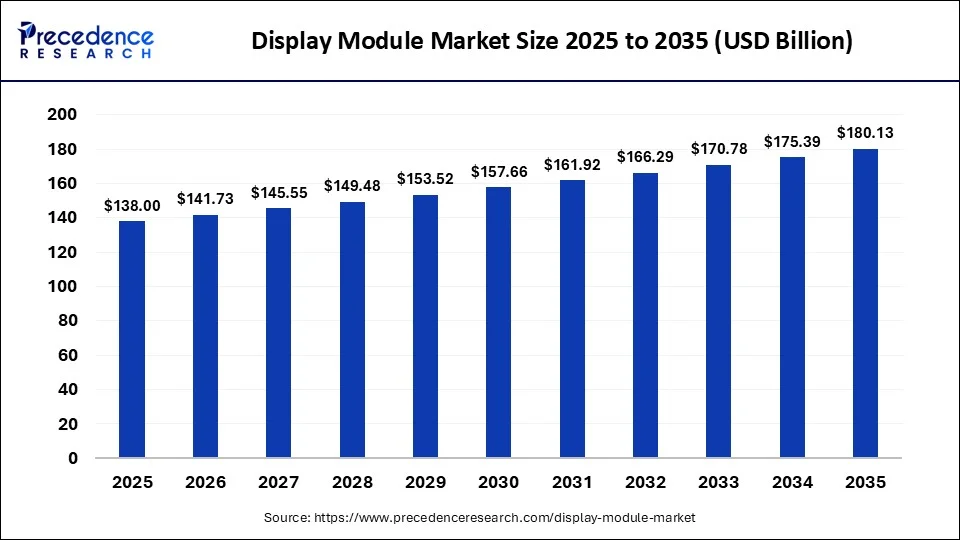
According to semiconductor and electronics specialist Laxmi Narayan, the display module market is valued at USD 141.73 billion in 2026 and is forecast to reach USD 180.13 billion by 2035, reflecting a CAGR of 2.70%. Leading display module market companies, including Samsung Display, LG Display, BOE Technology Group, are strengthening their presence across key segments such as display technology, panel size, resolution, application, display type, end user industry, distribution channel, region.
Source: https://www.precedenceresearch.com/display-module-market
 Get a Sample
 Table Of Content


Display Module Market Size and Forecast 2026 to 2035
The global display module market size accounted for USD 138.00 billion in 2025 and is predicted to increase from USD 141.73 billion in 2026 to approximately USD 180.13 billion by 2035, expanding at a CAGR of 2.70% from 2026 to 2035. The market is driven by the rising consumer and industrial need for high-resolution visual experiences across televisions, smartphones, and smart devices.
Key Takeaways
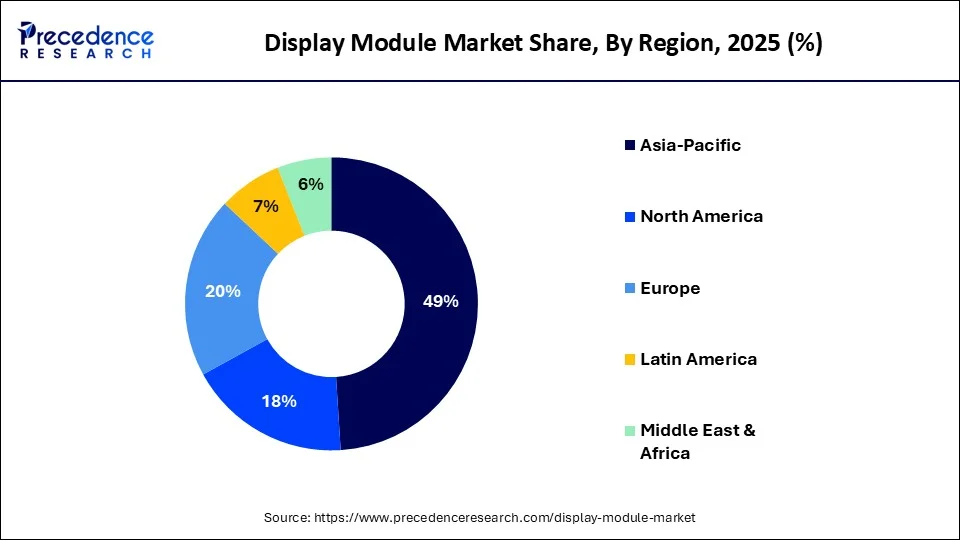
- Asia-Pacific dominated the display module market with a share of 49% in 2025 and is expected to grow at the fastest CAGR of 3.8% in the coming years.
- Europe held the second-largest share of 20% in 2025 and is expected to grow at a notable CAGR of 1.9% during the projection period.
- By display technology, the liquid crystal display (LCD) segment held a dominant position in the market with a 58% share in 2025.
- By display technology, the micro-LED display modules segment held a 2% share of the market in 2025 and is expected to grow at the fastest CAGR of 18.4% during the projection period.
- By resolution, the full HD (FHD) segment held a dominant position in the market with a 42% share in 2025.
- By resolution, the 8K and above segment held a 3% share of the market in 2025 and is expected to grow at the fastest CAGR of 10.9% during the projection period.
- By application, the smartphones segment dominated the market with a 37% share in 2025.
- By application, the automotive displays segment held a 7% share of the display module market in 2025 and is expected to grow at the fastest CAGR of 8.9% during the projection period.
- By display type, the flat display modules segment led the market with a 78% share in 2025.
- By display type, the flexible display modules segment held an 11% share of the market in 2025 and is expected to grow at the fastest CAGR of 9.4% during the projection period.
- By end user industry, the consumer electronics segment held a dominant position in the market, with a 67% share in 2025.
- By end user industry, the automotive segment held a 10% share of the market in 2025 and is expected to grow at the fastest CAGR of 8.2% during the projection period.
Market Overview
The display module industry refers to the production, supply, and sale of integrated visual display components. The main driving factor for the market is the increasing consumer and commercial need for high-performance displays featuring higher resolutions, faster refresh rates, and even slimmer form factors in smart devices.
Display Module Market Trends
- Intense market competition is expanding beyond traditional LCD, with rapid mainstream acceptance of OLED, AMOLED, and Mini-LED. Meanwhile, Micro-LED is seeing the highest expansion, benefiting from mass-transfer innovations and smart-city infrastructure.
- Integrated digital cockpits in electric vehicles, along with autonomous vehicles, represent the fastest-growing application segment. Touchscreen penetration in new vehicles is radically shifting dashboard designs.
Market Report Coverage and Key Metrics
| Report Coverage | Details |
| Market Size in 2025 | USD 138.00 Billion |
| Market Size in 2026 | USD 141.73 Billion |
| Market Size by 2035 | USD 180.13 Billion |
| Market Growth Rate from 2026 to 2035 | CAGR of 2.70% |
| Dominating Region | Asia Paicfic |
| Fastest Growing Region | Europe |
| Base Year | 2025 |
| Forecast Period | 2026 to 2035 |
| Segments Covered | Display Technology, Display Technology, Resolution, Application, Display Type, End User Industry, Distribution Channel, and Region |
| Regions Covered | North America, Europe, Asia-Pacific, Latin America, and Middle East & Africa |
Market Dynamics
Drivers
Surging Consumer and Industrial Demand for High-Performance Displays
Surging demand for high-performance displays is a main driver for the market because end-users increasingly expect slimmer form factors, faster refresh rates, higher resolutions, and greater energy efficiency in their devices. Moreover, vehicles increasingly demand multiple high-resolution screens for advanced driver-assistance systems (ADAS) and even digital infotainment clusters. These applications need displays with high durability, brightness, and reliability.
Restraint
High Cost and Complexity of Integrating Advanced Technologies
The high cost and complexity of integrating advanced technologies act as major restraints in the display module market because they demand vast upfront R&D investments, suffer from low production yields, and drastically raise final consumer prices. Advanced technologies, like micro-LED and next-gen OLEDs, demand sub-micron precision assembly, specialized semiconductor packaging, and complex optical materials. This manufacturing complexity thus results in high defect rates, which significantly inflate production expenses. Further, the heavy upfront R&D investments needed to solve these scaling difficulties elevate overall system pricing, limiting affordability in price-sensitive segments such as standard consumer electronics.
Opportunity
Advanced Display Technologies
Advanced display technologies represent a major growth opportunity for the market because they meet the booming user demand for higher-resolution, energy-efficient, and visually immersive screens. Modern vehicles are thus increasingly equipped with advanced digital dashboards and smart infotainment systems. The automotive and industrial sectors need durable yet high-performance display modules. OLED and Mini-LED technologies meet these needs, opening a vast new revenue stream for module producers outside traditional consumer electronics.
Market Segmentation Analysis
Display Technology Insights
Why Did the Liquid Crystal Display (LCD) Segment Lead the Display Module Market?
The liquid crystal display (LCD) segment dominated the market with a 58% share in 2025, driven by mature technology with broad consumer electronics adoption. LCDs do not emit light themselves. Instead, they utilize a small electric field to change the orientation of liquid crystals, which blocks or enables ambient light to pass via polarizing filters. This eliminates the demand for battery-draining backlights, thus making them ideal for compact devices.
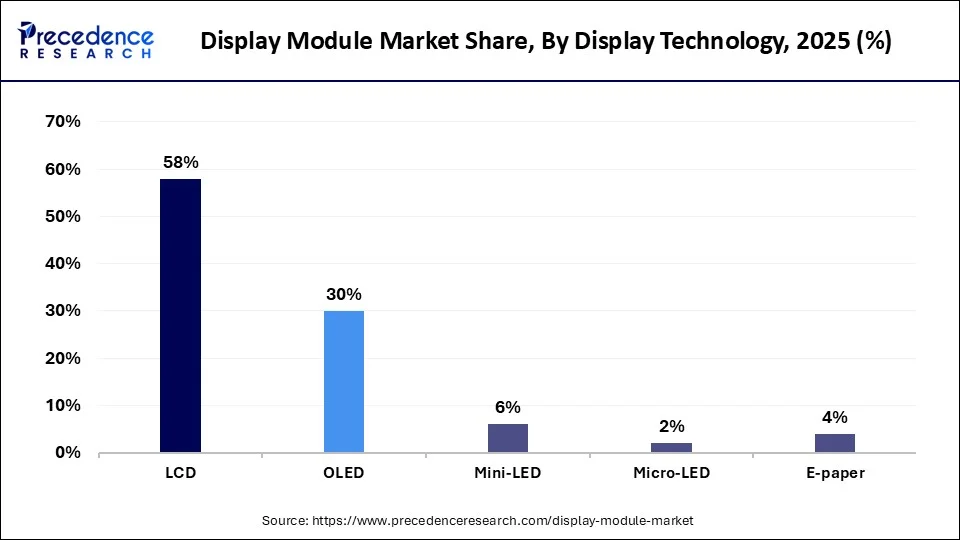
The micro-LED display modules segment held a 2% share of the market in 2025 and is expected to grow at the fastest CAGR of 18.4% during the projection period. This is mainly due to the commercialization of next-generation display technology. They can deliver remarkably higher luminance than traditional OLED screens without risking screen burn-in. As individual pixels can be turned off completely, micro-LEDs thus produce true blacks and infinite contrast ratios.
The organic light emitting diode (OLED) segment held a 30% share of the market in 2025 and is expected to grow at a CAGR of 6.5% during the projection period. This is due to rising penetration in premium smartphones and automotive displays and their self-illuminating pixels, which eliminate the demand for bulky backlights. This self-emissive property delivers superior visual performance, thinner form factors, and the flexibility required for modern smart devices and automotive displays.
Resolution Insights
Why Did the Full HD (FHD) Segment Lead the Display Module Market?
The full HD (FHD) segment led the market, with a 42% share in 2025, driven by its remaining mainstream across multiple applications. FHD remains the mainstream resolution for notebook displays, consumer monitors, and commercial signage. In these applications, the difference between FHD and UHD is barely noticeable, thus making FHD the most practical and demanded option.
Display Module Market Share, By Resolution, 2025 (%)
| Resolution | 2025 | 2035 | CAGR (%) |
| HD | 18 | 10 | -0.50% |
| Full HD (FHD) | 42 | 34 | 1.40% |
| Quad HD (QHD) | 17 | 19 | 4.60% |
| Ultra HD (4K) | 20 | 30 | 6.80% |
| 8K & Above | 3 | 7 | 10.90% |
The 8K and above segment held a 3% share of the market in 2025 and is expected to grow at the fastest CAGR of 10.9% during the projection period. This is mainly due to the increasing adoption of premium TVs and professional displays. Film editors, gamers, and medical imaging technicians require exceptional detail, color accuracy, and high pixel counts, thus making 8K panels the future-proof standard. The spread of huge screen sizes necessitates higher resolutions to manage an ideal pixel density, driving the need for 8K.
The ultra HD (4K) segment held a 20% share of the market in 2025 and is expected to grow at a CAGR of 6.8% during the projection period. This is due to the rising need for high-resolution displays. The widespread availability of native 4K media from major subscription services such as Netflix and Disney+ eliminated the content bottlenecks of previous years, thus pushing consumers and businesses to upgrade their hardware. The boom in next-generation consoles and competitive e-sports accelerated the demand for high-refresh-rate 4K screens. Furthermore, advancements in AI-driven upscaling enabled these displays to convert lower-resolution content into near-4K quality.
Application Insights
How the Smartphones Segment Dominated the Display Module Market?
The smartphones segment held the largest market share of 37% in 2025, driven by the largest display module consumption segment. Smartphones act as the main testing ground for advanced display technologies, like OLED, AMOLED, and foldable displays. Consumer need for brighter, energy-efficient screens alongside faster refresh rates pushes manufacturers to consistently upgrade their display modules.
The automotive displays segment held a 7% share of the market in 2025 and is expected to grow at the fastest CAGR of 8.9% during the projection period. This is mainly due to digital cockpit and infotainment expansion. EVs are leading the charge in accepting massive infotainment touchscreens, such as those championed by Tesla. Autonomous systems demand larger digital canvases to visualize real-time data; driver assistance (ADAS) feeds, along with mapping.
The televisions segment held an 18% share of the market in 2025 and is expected to grow at a CAGR of 2.4% during the projection period. This is due to replacement demand and premium TVs. Display advancements, like the transition to OLED, Quantum Dot, and Mini LED backlighting, drive industry upgrade cycles. The display module sets the pace for these innovations, which the TV business then packages and markets.
Display Type Insights
Which Display Type Segment Dominated the Display Module Market?
The flat display modules segment contributed the biggest market share of 78% in 2025, driven by standard display configuration across industries. Innovations in OLED and MicroLED technologies have further boosted revenue, offering better color accuracy and even faster refresh rates for premium devices.
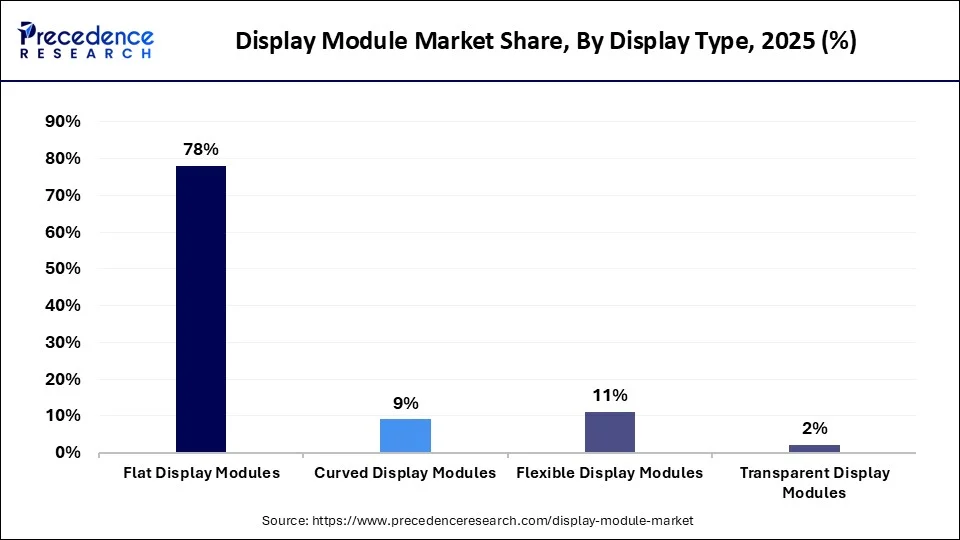
The flexible display modules segment held an 11% share of the market in 2025 and is expected to grow at the fastest CAGR of 9.4% during the projection period. This is mainly because of foldable smartphones and automotive interiors. Flexible modules enable the creation of curved, cylindrical, and irregularly shaped screens. They conform to architectural structures or wearable apparatus without compromising visual quality. Flexible modules, particularly in LED setups, usually feature magnetic backings, making them easy to snap onto custom frames and significantly decreasing setup or front-maintenance time.
The curved display modules segment held a 9% share of the market in 2025 and is expected to grow at a CAGR of 2.2% during the projection period. This is due to premium monitor and TV applications. Moreover, curving a display matches the natural curvature of the human eye. This guarantees that all parts of the screen are at a nearly equal distance from the viewer, which reduces eye strain and creates a highly immersive experience, mainly in gaming monitors and televisions.
End User Industry Insights
Why Did the Consumer Electronics Segment Lead the Display Module Market?
The consumer electronics segment accounted for the highest market share of 67% in 2025, driven by smartphones, TVs, and computing devices dominating demand. Integrating touch layers into the module turned passive viewing into intuitive, gesture-driven interactions, as famously introduced with the iPhone. Pre-assembled modules, thus combining the panel, driver ICs, and backlight, enabled brands to mass-produce complex gadgets efficiently and scale up.
The automotive segment held a 10% share of the market in 2025 and is expected to grow at the fastest CAGR of 8.2% during the projection period. This is mainly because of smart cockpit and EV display integration. Screens display vital feeds such as backup cameras, driver-assistance (ADAS) alerts, and even navigation clearly without forcing the driver to look too far away from the road. Digital clusters let drivers prioritize what they see, whether it is speed, battery, fuel range, or media controls.
The industrial manufacturing segment held a 7% share of the market in 2025 and is expected to grow at a CAGR of 3.9% during the projection period. This is due to industrial automation and control panels. Display modules translate complex machine data into simple, intuitive graphical or touch interfaces, enabling operators to quickly adjust settings and respond to alerts. Industrial modules are programmed for continuous 24/7 operation, with product lifecycles usually spanning 5 to 10 years, ensuring consistency for heavy machinery without the demand for constant redesigns.
Market Regional Analysis: North America, Europe, Asia-Pacific
Asia Pacific Data Center Battery Market Size and Growth 2026 to 2035
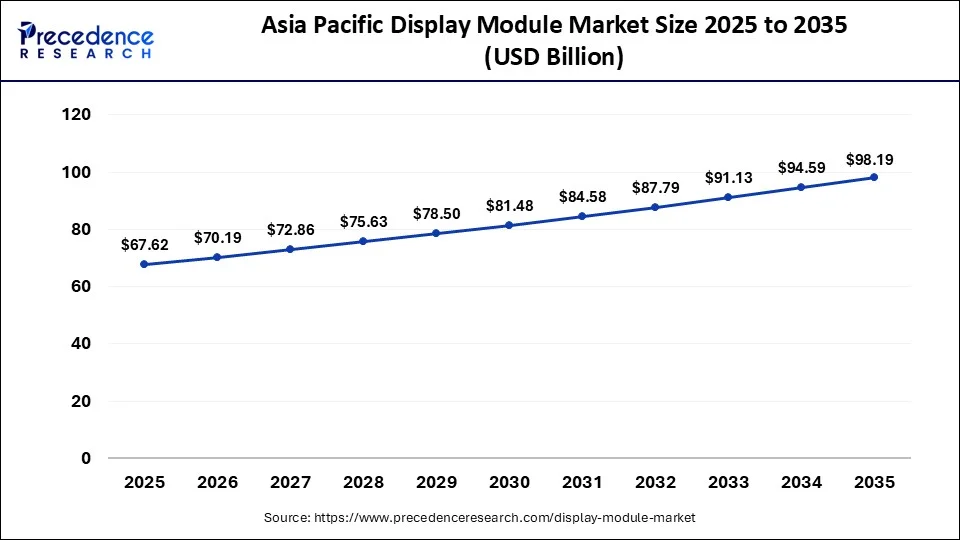
The Asia Pacific data center battery market size was evaluated at USD 67.62 billion in 2025 and is projected to reach around USD 98.19 billion by 2035, growing at a CAGR of 3.80% from 2026 to 2035.
Which Factors Drive the Display Module Market in Asia-Pacific?
Asia-Pacific dominated the market with a share of 49% in 2025 and is expected to grow at the fastest CAGR of 3.8% in the coming years. This is due to the region's status as a global manufacturing hub for display panels and consumer electronics. The rapid rise in electric vehicle manufacturing and even the integration of digital cockpit displays demand massive volumes of display modules. In addition, smart city projects and digital signage infrastructure heavily drive regional demand.
China Market Analysis
China dominates the global display module market due to its massive economies of scale, aggressive state-backed investments in manufacturing, and vertically integrated supply chains. This ecosystem enables Chinese producers to produce cutting-edge LCD, OLED, and LED displays at highly competitive price points.
Europe: The Second-Largest Market
Europe held the second-largest market share of 20% in 2025 and is expected to grow at a notable CAGR of 1.9% during the projection period, driven mainly by growth in automotive and industrial display applications. Heavy integration in the automotive sector, aggressive push, and strict energy-efficiency regulations for Industry 4.0 automation. Countries such as Germany are worldwide leaders in automotive manufacturing. The transition toward EVs and connected vehicles has spiked the demand for multi-screen, high-definition dashboard configurations and heads-up displays.
UK Market Analysis
The UK is a major hub for the display module industry due to its engineering expertise in high-barrier sectors such as automotive, medical, and defense technology. The region leads in custom optical bonding along with vertically integrated manufacturing, enabling it to build rugged, sunlight-readable screens suited for extreme environments.
How is North America Growing in the Display Module Market?
North America held 18% of the market share in 2025 and is expected to grow at a CAGR of 2% during the forecast period, due to demand from consumer electronics and automotive sectors. The region's automotive sector is undergoing rapid digital transformation, with luxury and electric vehicle models increasingly accepting advanced infotainment and cockpit displays. Moreover, commercial digital signage is expanding rapidly in retail storefronts, airports, and entertainment arenas, depending on large-scale tiled video walls and interactive displays.
U.S. Market Analysis
The U.S. is home to a robust and highly innovative market. It is popular for medical tech, consumer wearables, and automotive applications due to its exceptional contrast, broader viewing angles, and low power consumption. Top U.S. origin manufacturers, like Displaytech, Truly USA, and LXD Incorporated, specialize in high-value, ruggedized, and even customizable AMOLED and TFT-LCD modules.
What Drives the Display Module Market in Latin America?
Latin America held a 7% share of the market in 2025 and is expected to grow at a significant CAGR of 2.1% during the projection period, driven by increasing consumer electronics adoption. Smartphones and connected TVs are considered the largest drivers of the regional display market. With fast internet penetration and an expansive, digital-first online population, consumers need high-resolution LCD, OLED, and smart display modules in their daily devices.
Brazil Market Analysis
Brazil is highly popular in the display module industry as the largest and most dynamic consumer electronics market in Latin America. The country is thus celebrated for having a massive base of tech-savvy users who drive a high need for both commercial digital signage and residential display technologies.
How is the Opportunistic Rise of the Middle East and Africa in the Display Module Market?
The Middle East and Africa held a 6% share of the market in 2025 and are expected to grow at a notable CAGR of 2.6% during the projection period, driven by expansion of commercial display installations. Specialized, high-resolution diagnostic monitors are now proliferating. Saudi Arabia is the regional heavyweight, commanding over a third of the MEA medical display market because of state-sponsored hospital modernization programs. In addition, interactive flat panels are considered highly popular within regional education systems.
Saudi Arabia Market Analysis
Saudi Arabia is highly popular for LED display modules because of the nation's massive investments in large-scale entertainment, futuristic architecture, and smart city projects. High-profile event hubs such as Boulevard World in Riyadh utilize massive creative display clusters, which include some of the world's largest LED spheres and ceilings.
Market Competitive Landscape: Leading Companies and Strategies
The display module market is highly competitive, with global players aiming on technological innovation, manufacturing scale, and cost efficiency. Leading firms invest in advanced OLED, Mini-LED, AMOLED, and Micro-LED technologies to meet growing needs from smartphones, consumer electronics, automotive displays, and industrial applications. Strategic partnerships, mergers, and even capacity expansions strengthen market positions, while continuous R&D enhances energy efficiency, display performance, and durability.
Asian manufacturers, mainly from South Korea, China, and Japan, dominate production due to established supply chains and large-scale manufacturing capabilities. Competition is further driven by pricing, customization, product quality, and the ability to support emerging applications like foldable devices and smart wearables.
Display Module Market Companies
- Samsung Display
- LG Display
- BOE Technology Group
- AUO Corporation
- Innolux Corporation
- Sharp Corporation
- Japan Display Inc.
- Visionox
Recent Developments
- In May 2026, LG Display declared that it is unveiling its next-generation OLED technologies at SID Display Week 2026, strengthening its OLED leadership. SID Display Week is the world's largest display event, where global firms and researchers gather to present research papers alongside showcasing mid- to long-term future technologies and new products.(Source: https://news.lgdisplay.com)
- In January 2026, Sharp Display Solutions America declared the upcoming launch of its EC Series dvLED displays, thus expanding its E Series category with advanced Chip-on-Board (COB) construction that offers enhanced image quality and also greater durability than traditional surface-mounted devices (SMD).(Source: https://news.sharpusa.com)
Segments Covered in the Report
By Display Technology
- Liquid Crystal Display (LCD)
- TFT-LCD
- IPS-LCD
- VA-LCD
- LTPS-LCD
- Organic Light Emitting Diode (OLED)
- AMOLED
- PMOLED
- Flexible OLED
- Mini-LED Display Modules
- Micro-LED Display Modules
- Electronic Paper (E-paper) Display Modules
By Panel Size
- Less than 5 Inches
- 5-10 Inches
- 10020 Inches
- 20-40 Inches
- Above 40 Inches
By Resolution
- HD
- Full HD (FHD)
- Quad HD (QHD)
- Ultra HD (4K)
- 8K and Above
By Application
- Smartphones
- Tablets
- Laptops and Notebooks
- Desktop Monitors
- Televisions
- Automotive Displays
- Industrial Displays
- Medical Displays
- Wearable Devices
- Digital Signage
- Gaming Devices
- Others
By Display Type
- Flat Display Modules
- Curved Display Modules
- Flexible Display Modules
- Transparent Display Module
By End User Industry
- Consumer Electronics
- Automotive
- Healthcare
- Industrial Manufacturing
- Retail and Commercial
- Aerospace and Defense
- Education
- Others
By Distribution Channel
- OEMs
- Aftermarket
By Region
- North America
- Latin America
- Europe
- Asia-pacific
- Middle and East Africa
For inquiries regarding discounts, bulk purchases, or customization requests, please contact us at sales@precedenceresearch.com
Frequently Asked Questions





Ask For Sample
No cookie-cutter, only authentic analysis – take the 1st step to become a Precedence Research client
 Get a Sample




 sales@precedenceresearch.com
 Schedule a Meeting
