



DNA-Based Non-Viral Technologies Market Revenue to Attain USD 27.85 Bn by 2035
Published: 06 May 2026
Author: Precedence Research



DNA-Based Non-Viral Technologies Market Revenue and Trends 2026 to 2035
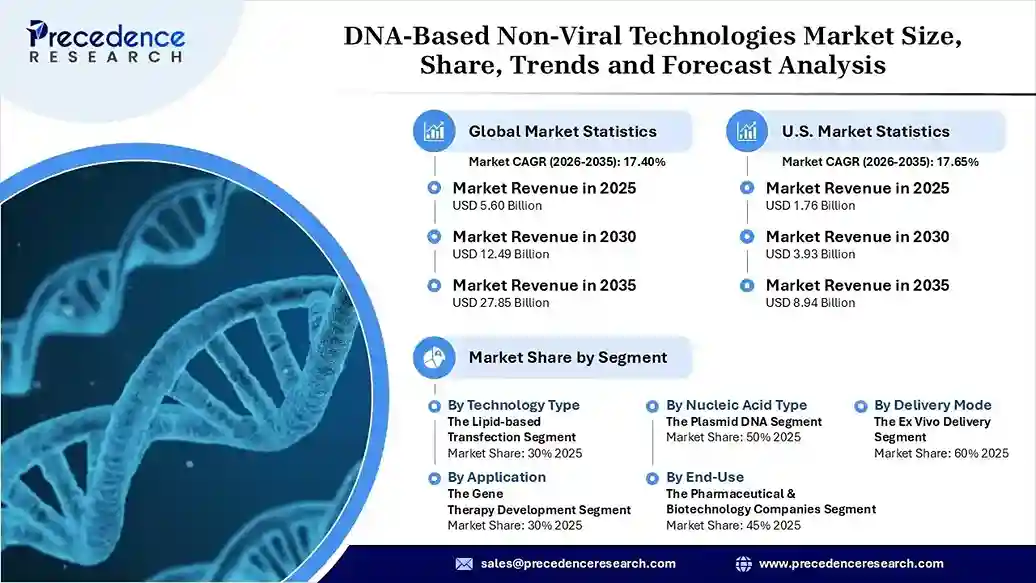
The global DNA-based non-viral technologies market revenue surpassed USD 5.60 billion in 2025 and is predicted to attain around USD 27.85 billion by 2035, growing at a CAGR of 17.40%. The market is driven by the increasing demand for effective and safe alternatives to viral vectors that could deliver genes into cells and organisms.
Market Overview
The DNA-based non-viral technologies market includes various methodologies and delivery systems that can deliver DNA molecules into the cells without using modified viruses. This technique involves physical delivery methods such as electroporation and microinjection, as well as chemical delivery methods involving liposomes, polymer nanoparticles, plasmid DNA, and minicircle DNA.
These technologies are widely used in gene therapy and genome editing applications, including the delivery of CRISPR/Cas9 components into target cells, as well as in cell therapies that involve ex vivo modification of patient cells. The market caters to a broad range of end users, including pharmaceutical and biotechnology companies developing gene-based treatments, along with academic and research institutions focused on genetic and translational research.
What Drives the DNA-Based Non-Viral Technologies Market?
- Development of Novel Technologies: The market is driven by the development of DNA origami technology, where very long single strands of DNA are manipulated by folding them up with hundreds of synthetic DNA strands called staples. This results in the formation of three-dimensional structures of cubes, tubes, and triangles, and customized baskets capable of delivering therapeutics right to their target cells. The DNA origami technique allows for the development of nanoparticles with a high level of control over desired structure and chemical composition. In 2025, DNA Nanobots Corporation raised USD 3.5 million in seed funding from a well-known family office to boost the development of its DNA origami platform for delivering genetic medicine to the targets currently considered undeliverable.
- Adoption of Cell-Free Enzymatic DNA Synthesis for Better DNA Production: There is a rapid adoption of cell-free enzymatic DNA synthesis platforms that eliminate the need for bacterial fermentation processes by providing pure DNA products free from endotoxins and antibiotic-resistant bacteria. Plasmids produced by E.coli need stringent quality control measures since they involve bacterial products, but enzymes produce high-fidelity DNA without any bacterial contamination issues. In 2026, New England Biolabs partnered with Touchlight to launch the EnClose Cell-Free dbDNA Synthesis Kit, facilitating the enzyme-driven synthesis of linear covalently closed DNA in a single day. This product eliminates the need to use bacterial fermentation.
- Government Investments Boosting the Development of Non-Viral Gene Delivery Platforms: Governments across the world have initiated various grant programs to help develop non-viral gene delivery platforms because non-viral systems are relatively cheap to manufacture, possess low immunogenicity, and can be dosed multiple times, unlike viral platforms. Non-viral delivery is a focal area of research in many research organizations to address various bottlenecks, such as delivery specificity, cellular trafficking, and manufacturing capabilities for clinical use. In 2025, Nanocell Therapeutics won a Eurostars Grant from the European Union under the Horizon Europe and Eureka Program for its QUIET-CAR project. This project focuses on the development of targeted Lipid Nanoparticles carrying novel DNA sequences for in vivo delivery of CAR-T cells.
- Amplifold Gets USD 5.8 Million for Its DNA Origami Diagnostic Technology: In December 2025, German biotech firm Amplifold secured USD 5.8 million through its successful seed funding round. This funding was led by venture capital firms such as Matterwave Ventures and Xista Science Ventures to commercialize its DNA origami technology for the lateral flow assay technique. This technique is capable of offering up to 100 times more sensitive analysis than any other existing rapid test, all while maintaining its cost of production.
Market Segmentation Overview
- By Technology Type: The lipid-based transfection segment led the DNA-based non-viral technologies market with a 30% share in 2025, owing to the extensive clinical usage of lipid nanoparticles in mRNA vaccines and gene therapy. This segment provides reliable delivery of diverse forms of nucleic acids, an efficient production process, and better regulatory compliance.
- By Technology Type: The nanoparticle-mediated delivery segment is expected to expand at the highest CAGR during the forecast period, because of its versatility and applicability to deliver various genetic cargos such as plasmid DNA, mRNA, siRNA, and CRISPR components.
- By Application Type: The gene therapy development segment dominated the market with a 30% share in 2025, as most research projects focus on the treatment of hereditary diseases like Duchenne muscular dystrophy, hemophilia, cystic fibrosis, and Huntington’s disease, where non-viral technologies offer significant benefit.
- By Application Type: The cell therapy (CAR-T, Stem Cells) segment is expected to grow at the fastest rate from 2026 to 2035, due to its ability to perform ex vivo modification of patient cells outside the body. This gives researchers the chance to employ non-viral techniques such as electroporation and liposomes.
- By Nucleic Acid Type: The plasmid DNA segment led the DNA-based non-viral technologies market with a 50% share in 2025, because of its widespread adoption as a nucleic acid platform for gene transfer, since it is the basic component for the development of gene therapies and cell engineering products.
- By Nucleic Acid Type: The synthetic DNA constructs segment is expected to expand at the highest CAGR during the forecast period, due to the absence of bacterial sequences associated with conventional plasmid DNA in this segment, including linear covalently closed DNA, minicircles, and doggybone DNA.
- By End-Use: The pharmaceutical & biotechnology companies segment led the market with a 45% share in 2025, owing to the fact that they are major producers of gene therapy, DNA vaccines, cell therapy, and gene editing solutions that need non-viral delivery systems.
- By End-Use: The CROs/CDMOs segment is expected to grow at the highest CAGR during the forecast period, since pharmaceutical and biotechnology companies engaged in the development of non-viral gene and cell therapies increasingly rely on external contract firms for their manufacturing needs and research and development support.
- By Delivery Mode: The ex vivo delivery segment dominated the market with a 60% share in 2025, due to its ability to isolate the cells from the host, perform genetic modification through electroporation, and return the genetically modified cells to the host.
- By Delivery Mode: The in vivo delivery segment is expected to grow at the fastest rate from 2026 to 2035, because of the advancements in targeted therapies and nanoparticle technologies. This segment does not involve costly and time-consuming methods of cell extraction, engineering, quality assessment, and re-infusion, thereby significantly bringing down the cost of treatment.
Regional Analysis
North America led the DNA-based non-viral technologies market with a 42% share in 2025, as it has a significant presence of prominent biotechnology companies, pharmaceutical corporations, and research and development centers dedicated to the development of gene therapies. The U.S. dominated the market in North America due to significant government funding for the research of advanced gene delivery technologies, along with the contribution of venture capital companies, which have made substantial investments in the development of non-viral technologies. Canada is a significant contributor to the market owing to its extensive public funding framework, coupled with the establishment of cell and gene therapy manufacturing centers in the country.
Asia Pacific is expected to expand at the highest CAGR during the forecast period, due to rising governmental support for gene therapy research, and a significant number of patients suffering from genetic disorders and cancer that cannot afford gene therapy based on viral vectors. China led the market in Asia Pacific because of government initiatives to develop gene editing technology and non-viral vector development, and favorable regulations for firms to develop and produce clinical products. Japan has held a notable market share since it boasts a highly developed pharmaceutical industry and national programs that focus on innovative medical technologies.
DNA-Based Non-Viral Technologies Market Coverage
| Report Attribute | Key Statistics |
| Market Revenue in 2025 | USD 5.60 Billion |
| Market Revenue by 2035 | USD 27.85 Billion |
| CAGR from 2026 to 2035 | 17.40% |
| Quantitative Units | Revenue in USD million/billion, Volume in units |
| Largest Market | North America |
| Base Year | 2025 |
| Regions Covered | North America, Europe, Asia-Pacific, Latin America, and the Middle East & Africa |
Top Companies in the DNA-Based Non-Viral Technologies Market
Thermo Fisher Scientific Inc., Lonza Group AG, Bio-Rad Laboratories Inc., and Promega Corporation are key players in the non-viral DNA transfection reagents and electroporation systems market, offering a broad range of tools for gene delivery and cell engineering. Qiagen N.V. and Mirus Bio LLC focus on lipid- and polymer-based transfection technologies for efficient delivery of DNA and siRNA into cells.
Polypus Transfection SA and MaxCyte Inc. specialize in advanced electroporation and flow electroporation platforms, enabling high-efficiency gene transfer for research and clinical applications. Meanwhile, Takara Bio Inc. provides both retroviral and non-viral gene delivery solutions along with DNA transfection reagents, while Agilent Technologies Inc. and STEMCELL Technologies Inc. develop integrated non-viral delivery tools supporting gene editing, cell biology, and translational research workflows.
Segments Covered in the Report
By Technology Type
- Electroporation-based Delivery
- Lipid-based Transfection (Lipofection)
- Polymer-based Delivery Systems
- Nanoparticle-mediated Delivery (LNPs, Gold Nanoparticles)
- Physical Methods (Microinjection, Gene Gun)
By Application
- Gene Therapy Development
- Cell Therapy (CAR-T, Stem Cell Engineering)
- DNA Vaccines
- Genetic Research & Functional Genomics
- Genome Editing (CRISPR/Cas Systems)
By Nucleic Acid Type
- Plasmid DNA
- Synthetic DNA Constructs
- Oligonucleotides
By End-Use
- Pharmaceutical & Biotechnology Companies
- Academic & Research Institutes
- Contract Research & Manufacturing Organizations (CROs/CDMOs)
By Delivery Mode
- In Vivo Delivery
- Ex Vivo Delivery
By Region
- North America
- Latin America
- Europe
- Asia-pacific
- Middle and East Africa
Get this report to explore global market size, share, CAGR, and trends, featuring detailed segmental analysis and an insightful competitive landscape overview @ https://www.precedenceresearch.com/sample/8374
You can place an order or ask any questions, please feel free to contact us at sales@precedenceresearch.com |+1 804 441 9344