



Duchenne Muscular Dystrophy Therapeutics Market Revenue to Attain USD 26.88 Bn by 2035
Published: 08 Jun 2026
Author: Precedence Research



Duchenne Muscular Dystrophy Therapeutics Market Revenue and Trends 2026 to 2035
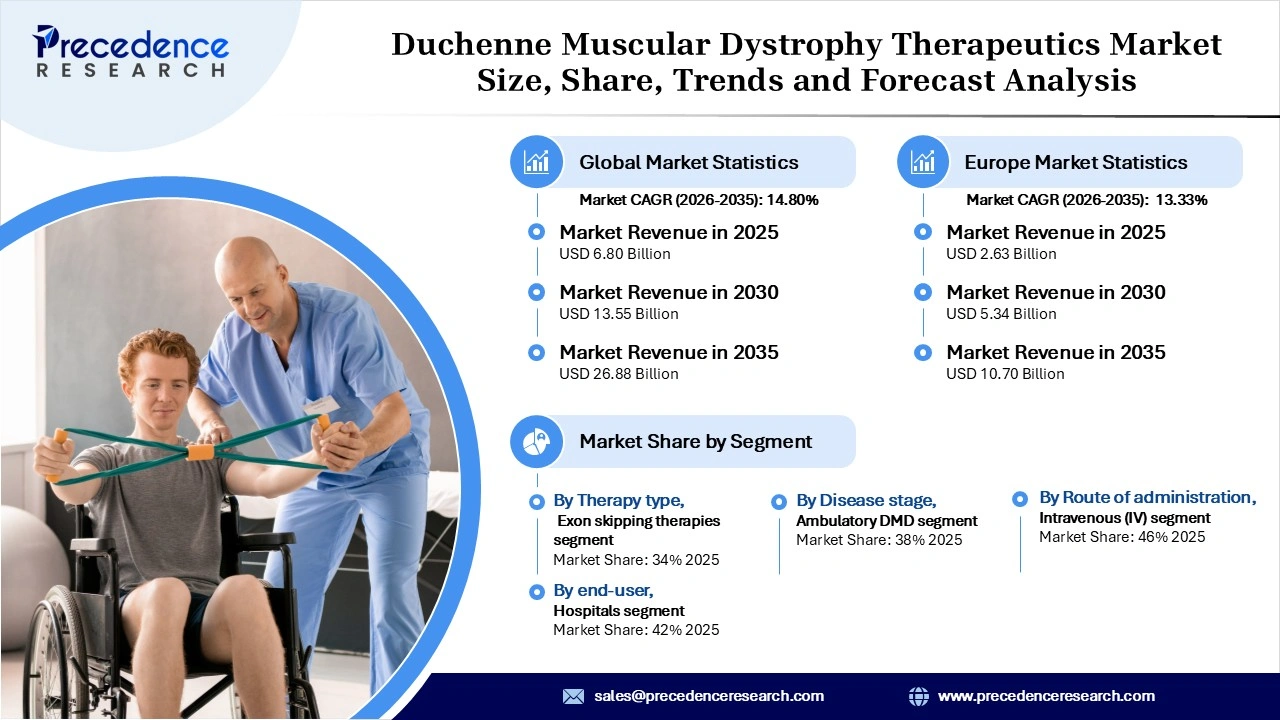
The global duchenne muscular dystrophy therapeutics market revenue was valued at USD 6.80 billion in 2025 and is expected to attain around USD 26.88 billion by 2035, growing at a CAGR of 14.80% during forecast period. The market for therapeutics targeting Duchenne muscular dystrophy is expanding, and gene therapies, exon-skipping medications, and improved genetic screening are progressively replacing conventional supportive care. This evolution is transforming a once palliative sphere into an industry of disease-modifying therapies with tremendous promise for transformative impact.
Market at a Glance
The Duchenne muscular dystrophy therapeutics market is the worldwide market of medical treatments targeting the deceleration, management, or repair of muscular degeneration resulting from dystrophin gene mutations. It comprises corticosteroids, exon-skipping, gene replacement strategies, and new approaches for RNA and cell-based therapy. Motivated by incentives associated with rare disease patterns, along with the growing emphasis on the adoption of precision medicine, this market is transforming from a focus primarily on the management of symptoms to one dedicated to those that could be used to specifically target the disease itself, ultimately improving survival, mobility, and overall quality of life.
The present therapeutic field covers both primary and secondary disease spectra and is not restricted to pediatric treatment; however, it has also extended across other populations, such as adolescents and adults with dystrophin deficiency, targeting adolescent and adult dystrophin deficiency by using gene therapy, exon-skipping, and other medications and supportive treatments.
Market Forecast for the Duchenne Muscular Dystrophy (DMD) Therapeutics Market
- Rising Demand for High-Value Orphan Drug: Gene therapies in DMD have demonstrated multi-million-dollar pricing models (often exceeding USD 2-3 million per patient), reinforcing strong revenue potential per treatment cycle. Despite safety and reimbursement challenges, payers are gradually adopting outcome-linked reimbursement frameworks, enabling broader access.
- Ultra-High-Cost Therapies are Driving the Market: Duchenne Muscular Dystrophy (DMD) treatment is one of the most expensive therapies available globally, and at its peak, treatment costs are sometimes upwards of $2-3 million per single-instance gene therapy. Despite such financial constraints, reimbursement systems are increasingly integrating elements of value and outcome-based payment with progressive measures for broader adoption. This is the imperative move if demand is to increase for more than a dedicated early-access population of clients.
Advancements in Duchenne Muscular Dystrophy Treatment
- Sarepta Therapeutics announced that ELEVIDYS, its DMD gene therapy, demonstrated sustained motor-function benefit three years after treatment in ambulatory patients aged 4-7 years.
- Trial data showed treated patients achieved more than 70% slower disease progression in functional assessments such as time-to-rise and the 10-meter walk/run versus untreated external controls.
- The late-stage EMBARK study observed that children receiving ELEVIDYS maintained better balance, hopping ability, and lower-limb coordination compared with untreated patients over the three-year evaluation window.
- Sarepta stated that the therapy continued delivering measurable clinical durability despite prior regulatory scrutiny surrounding liver-related safety concerns linked to gene therapies in DMD treatment.
- Positive long-term efficacy outcomes are expected to strengthen physician confidence and accelerate commercial uptake within the Duchenne muscular dystrophy therapeutics market.
Market Segmentation Overview
- By therapy type, the exon skipping therapies segment accounted for a considerable revenue share of 34% in the Duchenne muscular dystrophy (DMD) therapeutics market in 2025, due to strong adoption of mutation-specific DMD treatment approaches and growing regulatory approvals for RNA-targeted therapies. Increasing physician familiarity with exon skipping approaches is strengthening their adoption and growth in the market.
- By therapy type, the gene therapy segment is expected to grow at the fastest CAGR of 24.5% in the market between 2026 and 2035, due to rapid advancement in one-time genetic treatment approaches and increasing clinical success of micro-dystrophin therapies. Rising investments in next-generation gene therapy platforms are accelerating the adoption of gene therapy.
- By disease stage, the ambulatory DMD segment held a major revenue share of 38% in the market in 2025, as corticosteroids and exon-skipping therapies were primarily prescribed during early mobility-preserving stages of the disease. With the growing rehabilitation programs and sustained clinical monitoring efforts, treatment became increasingly accessible, especially to younger patients, for whom the issue of remaining mobile takes center stage in therapeutic endeavors.
- By disease stage, the early-stage DMD segment is steadily growing with a CAGR of 17.5% in the market between 2026 and 2035, due to increasing newborn and early genetic screening programs. Healthcare systems are increasingly emphasizing intervention before irreversible muscle degeneration begins, while precision medicine approaches are expected to improve long-term clinical outcomes through earlier therapeutic initiation.
- By route of administration, the intravenous (IV) segment held the largest revenue share of 46% in the Duchenne muscular dystrophy (DMD) therapeutics market in 2025, because most exon-skipping therapies and advanced gene therapies relied heavily on infusion-based delivery systems. Hospitals and specialty centers expanded biologic infusion capabilities over recent years, supported by the growing adoption of advanced targeted therapies that required controlled clinical administration and post-treatment safety monitoring.
- By route of administration, the subcutaneous segment is expected to expand rapidly in the market with a CAGR of 17.2% in the coming years, as developers increasingly focus on patient-friendly biologic formulations. Demand for self-administered therapies is expected to rise steadily, particularly in chronic neuromuscular disease management, where convenience, long-term adherence, and reduced hospital dependency are becoming commercially important factors.
- By end-user, the hospitals segment led the market with a share of 42% in the market in 2025, due to high utilization of infusion-based therapies and multidisciplinary neuromuscular care programs, and increasing availability of pediatric neuromuscular treatment centers. Moreover, with the increasingly integrated genetic diagnostics and therapy administration into hospital practices, these facilities now perform crucial functions in the management of complex DMD treatments and in patient monitoring.
- By end-user, the homecare settings segment is expected to grow at the fastest CAGR of 18.8% in the market between 2026 and 2035, as oral therapies, telehealth monitoring, and self-administered treatment models continue gaining traction. Families are increasingly choosing to provide home-based management of chronic diseases to reduce frequent hospital visits, and developments in remote monitoring tools are expected to increase long-term repeat use of therapies and patient convenience.
Regional Analysis
North America dominated the global Duchenne muscular dystrophy (DMD) therapeutics market with a share of 44% in 2025, due to early adoption of exon-skipping therapies and new gene therapeutics. Its strong incentives for orphan drugs, an advantageous reimbursement environment, and substantial investment in rare disease research have allowed increasing access to these therapies from specialized neuromuscular centers. By focusing on major developers working on DMD therapies and in making FDA approvals faster, the U.S. leads this regional market. At the same time, Canada extends market growth via increasing genetic testing programs, and with a corresponding expansion of financing for publicly funded healthcare systems for managing rare pediatric diseases.
Asia-Pacific holds a market share of 18% in 2025 and is expected to grow at the fastest CAGR of 20.5% in the market during the forecast period, as this exponential growth includes more attention paid to rare diseases, better genetic screening programs, availability of biologics, and access to gene-based medicines. Such countries, among others, are increasingly promoting precision medicine and pediatric programs against rare diseases through programs to modernize healthcare infrastructure. Japan is anticipated to be able to act as a major engine for growth due to its advanced regenerative medicine landscape, and also its favorable framework for orphan drugs, whereas China is expected to make rapid progress driven by increased spending in healthcare, a boom in trials and development of innovation in biotechnology.
Duchenne Muscular Dystrophy Therapeutics Market Coverage
| Report Attribute | Key Statistics |
| Market Revenue in 2025 | USD 6.80 Billion |
| Market Revenue by 2035 | USD 26.88 Billion |
| CAGR from 2026 to 2035 | 14.80% |
| Quantitative Units | Revenue in USD million/billion, Volume in units |
| Largest Market | North America |
| Base Year | 2025 |
| Regions Covered | North America, Europe, Asia-Pacific, Latin America, and the Middle East & Africa |
Top Companies in the Duchenne Muscular Dystrophy (DMD) Therapeutics Market
Sarepta Therapeutics has carved out a leading position in the industry with its exon-skipping platform and the commercialization of Elevidys gene therapy. Meanwhile, Pfizer Inc. and Roche Holding AG have gained a competitive advantage through investments in advanced research in neuromuscular diseases and worldwide infrastructure development to treat rare conditions. Newcomers, such as Solid Biosciences Inc., Wave Life Sciences, Dyne Therapeutics, Avidity Biosciences, and PepGen Inc., are setting the pace for next-generation oligonucleotide therapies and precision RNA treatments to better muscle targeting in a sustained manner. NS Pharma Inc. has bolstered its market position through therapies utilizing exon 53 skipping techniques.
Segments Covered in the Report
By Therapy Type
- Exon Skipping Therapies
- Eteplirsen
- Golodirsen
- Viltolarsen
- Casimersen
- Gene Therapy
- Corticosteroids
- Stop Codon Read-through Therapies
- Cell-based Therapies
- Combination Therapies
- Supportive Care Therapies
By Disease Stage
- Early-stage DMD
- Ambulatory DMD
- Non-ambulatory DMD
- Advanced-stage DMD
By Route of Administration
- Intravenous (IV)
- Oral
- Intramuscular
- Subcutaneous
By End-User
- Hospitals
- Specialty Neuromuscular Clinics
- Homecare Settings
- Rehabilitation Centers
- Research and Academic Institutes
By Distribution Channel
- Hospital Pharmacies
- Specialty Pharmacies
- Online Pharmacies
By Region
- North America
- Latin America
- Europe
- Asia-pacific
- Middle and East Africa
Get this report to explore global market size, share, CAGR, and trends, featuring detailed segmental analysis and an insightful competitive landscape overview @ https://www.precedenceresearch.com/sample/8456
You can place an order or ask any questions. Please feel free to contact us at sales@precedenceresearch.com |+1 804 441 9344