



Electrophoresis Reagents Market Revenue to Attain USD 3.44 Bn by 2035
Published: 23 Apr 2026
Author: Precedence Research



Electrophoresis Reagents Market Revenue and Trends 2026 to 2035
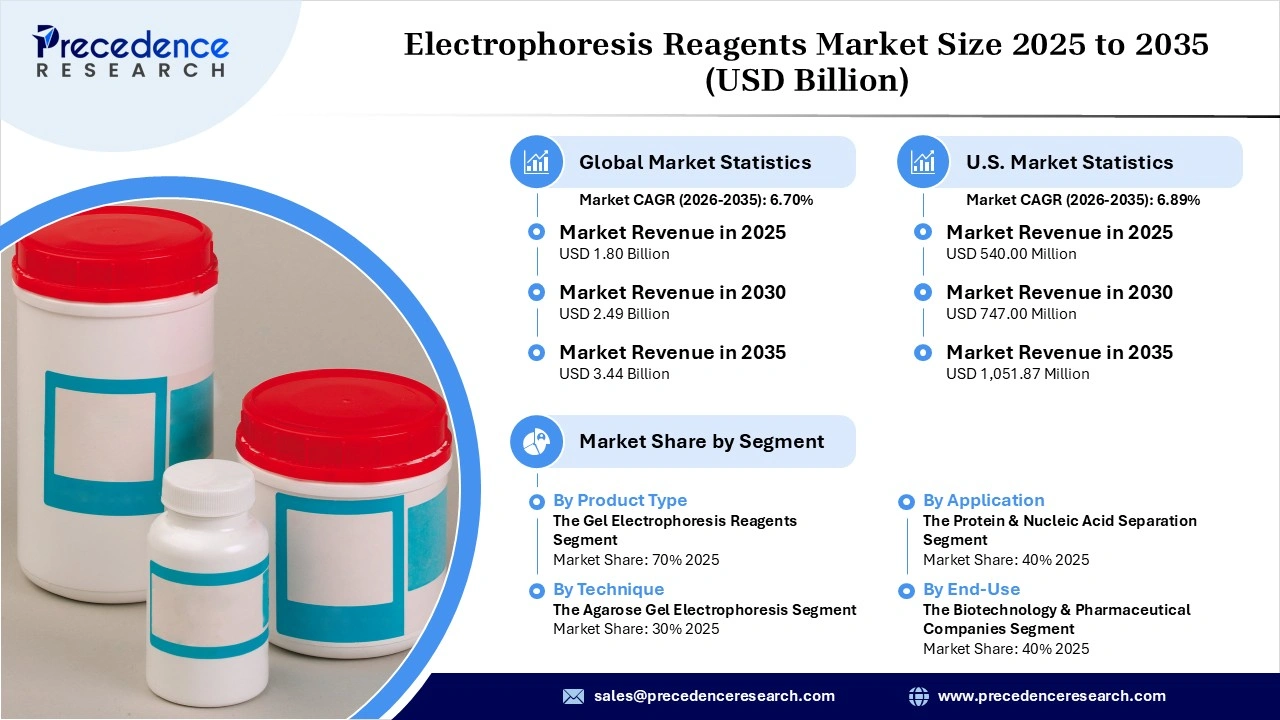
The global electrophoresis reagents market revenue surpassed USD 1.80 billion in 2025 and is predicted to attain around USD 3.44 billion by 2035, expanding at a CAGR of 6.70% from 2026 to 2035. The market is driven by sustained demand across genomics, proteomics, and routine diagnostic applications, where electrophoresis reagents serve as essential, high-frequency consumables, generating consistent and recurring usage across laboratory workflows.
Market at a Glance
The electrophoresis reagents market refers to the global industry that produces and supplies essential chemicals such as buffers, gels, stains, and molecular markers, which are essential for the effective separation of biomolecules. These reagents play a critical role in laboratory workflows, enabling the analysis of DNA, RNA, and proteins across research, diagnostic, and biopharmaceutical applications.
The electrophoresis reagents market spans a wide range of end users, from academic laboratories to biopharmaceutical manufacturing facilities, supporting applications such as DNA sequencing, protein analysis, and clinical diagnostics. It includes both routine consumables and specialized high-sensitivity reagents, with demand driven not only by the complexity of applications but also by the high frequency of use, as electrophoresis remains an integral part of daily laboratory workflows.
What are the Major Trends Influencing the Electrophoresis Reagents Market?
Adoption of Molecular Diagnostics: The growing adoption of molecular diagnostics and disease detection is significantly increasing the demand for electrophoresis reagents. As electrophoresis becomes embedded in routine clinical workflows, particularly in protein and biomarker analysis, hospitals and diagnostic laboratories are emerging as consistent, high-frequency users.
Automation Trend: The shift toward automated and high-throughput laboratory systems is further accelerating reagent consumption, with some laboratories reporting annual increases of approximately 15%, particularly for pre-cast gels and optimized buffer solutions. Rather than reducing usage, improved efficiency is enabling higher sample throughput, thereby increasing overall dependency on electrophoresis reagents.
Market Segmentation Overview
- By product type, the gel electrophoresis reagents segment held a major share of 40% in the electrophoresis reagents market in 2025, as they are widely used in nucleic acid and protein separation. Their familiarity, reproducibility, and compatibility in routine workflow made them the preferred choice in both research benches and diagnostic setups.
- By product type, the capillary electrophoresis reagents segment is expected to grow at a significant CAGR of 7% in the market between 2026 and 2035, as laboratories lean toward efficiency and higher resolution. Their suitability for automated systems and their capability to provide quicker, more precise separations make them ideally suited for clinical diagnostics, where accuracy is paramount.
- By technique, the agarose gel electrophoresis segment led the electrophoresis reagents market by holding a 30% share in 2025, as it is the most trusted method specifically for nucleic acid separation. Its extensive applicability across academic institutions, clinical settings, and biotechnology fields has rendered it essential due to its reliability.
- By technique, the capillary electrophoresis segment is expected to grow at a CAGR of 8% in the market between 2026 and 2035 because of its rapid speed, high accuracy, and excellent resolution, making it the preferred option in diagnostic laboratories. It aligns well with evolving lab expectations where high throughput matters.
- By application, the protein & nucleic acid separation segment accounted for a revenue share of 40% in the electrophoresis reagents market in 2025, as electrophoresis reagents are primarily used for separating proteins and nucleic acids in a variety of research applications, including genomics and proteomics. The segment’s dominance is also reinforced by the need to repeatedly verify, compare, and characterize biomolecules.
- By application, the biopharmaceutical production & quality control segment is expected to expand rapidly with a CAGR of 7.5% in the coming years, as it is a crucial part of pharmaceutical manufacturing and is especially important for protein characterization, drug quality assurance, and maintaining the purity of biologics. As biologics need more extensive validation, these reagents are moving beyond becoming supporting tools to turning into critical checkpoints within manufacturing workflows.
- By end-use, the biotechnology & pharmaceutical companies segment held a 40% market share in 2025, as these companies serve as the primary end-user for electrophoresis reagents associated with drug discovery, protein profiling, and quality control. Their routine use depended almost exclusively on these reagents in general as part of current experimental treatments and not as occasional additives, as in this case.
- By end-use, the contract research organizations segment is expected to grow at the fastest CAGR of 7% between 2026 and 2035, driven by the increasing outsourcing of research and clinical trial activities. As pharmaceutical and biotechnology companies shift more R&D functions to external partners, CROs are emerging as significant and consistent consumers of electrophoresis reagents, supported by higher testing volumes across diverse laboratory workflows.
Regional Analysis
North America dominated the global electrophoresis reagents market with a share of 40% in 2025, driven by high research expenditure, a well-established biotechnology sector, and an extensive network of diagnostic laboratories. The U.S. held the majority of the regional market share, supported by sustained funding in genomics and proteomics, while Canada contributed through strong academic research and public health initiatives. The region’s leadership is characterized not by rapid expansion, but by a mature ecosystem that supports continuous experimental activity and steady reagent consumption.
Asia Pacific held a market share of 20% in 2025 and is expected to grow at the fastest CAGR of 8.5% during the forecast period, driven by improving R&D infrastructure, expanding pharmaceutical activity, and sustained healthcare investment across the region. China is expected to lead this expansion, driven by large-scale biotechnology development and strong government-backed R&D initiatives. Meanwhile, India is emerging as a key contributor due to its growing clinical research sector and cost-effective laboratory expansion.
Electrophoresis Reagents Market Coverage
| Report Attribute | Key Statistics |
| Market Revenue in 2025 | USD 1.80 Billion |
| Market Revenue by 2035 | USD 3.44 Billion |
| CAGR from 2026 to 2035 | 6.70% |
| Quantitative Units | Revenue in USD million/billion, Volume in units |
| Largest Market | North America |
| Base Year | 2025 |
| Regions Covered | North America, Europe, Asia-Pacific, Latin America, and the Middle East & Africa |
Top Companies in the Electrophoresis Reagents Market
Thermo Fisher Scientific and Bio-Rad Laboratories are market leaders due to their integrated product ecosystems that include reagents, gels, and instrumentation, creating end-to-end solutions that become deeply embedded in laboratory workflows. Once adopted, their platforms often become standard components of routine operations, ensuring sustained product usage.
Agilent Technologies focuses on precision-based workflows, particularly in capillary electrophoresis applications, supporting high-resolution analytical techniques. Meanwhile, Cytiva (formerly GE Healthcare Life Sciences) specializes in separation and bioprocess solutions that support downstream processing in biopharmaceutical manufacturing. Merck KGaA (Sigma-Aldrich) and QIAGEN offer a broad portfolio ranging from basic buffers to advanced genomic kits, making them widely used suppliers for routine laboratory and research applications.
Segments Covered in the Report
By Product Type
- Gel Electrophoresis Reagents
- Capillary Electrophoresis Reagents
- Blotting Reagents (Western Blotting, Northern Blotting, Southern Blotting)
- Electrophoresis Buffers
- Other Reagents
By Technique
- Agarose Gel Electrophoresis
- Polymerase Chain Reaction (PCR) Electrophoresis
- Capillary Electrophoresis
- Two-Dimensional Gel Electrophoresis (2D-GE)
- Immunoelectrophoresis
- Isoelectric Focusing (IEF)
By Application
- Protein & Nucleic Acid Separation
- Genetic Research & Diagnostics
- Immunology & Clinical Diagnostics
- Biopharmaceutical Production & Quality Control
- Forensic Science & Environmental Analysis
- Others
By End-Use Industry
- Biotechnology & Pharmaceutical Companies
- Research & Academic Institutes
- Diagnostic Laboratories
- Contract Research Organizations (CROs)
- Forensic Laboratories
By Region
- North America
- Latin America
- Europe
- Asia-pacific
- Middle and East Africa
Get this report to explore global market size, share, CAGR, and trends, featuring detailed segmental analysis and an insightful competitive landscape overview @ https://www.precedenceresearch.com/sample/8332
You can place an order or ask any questions. Please feel free to contact us at sales@precedenceresearch.com |+1 804 441 9344