



Endpoint Security Market Revenue to Attain USD 47.23 Bn by 2035
Published: 08 Jul 2026
Author: Precedence Research



Endpoint Security Market Revenue and Trends 2026 to 2035
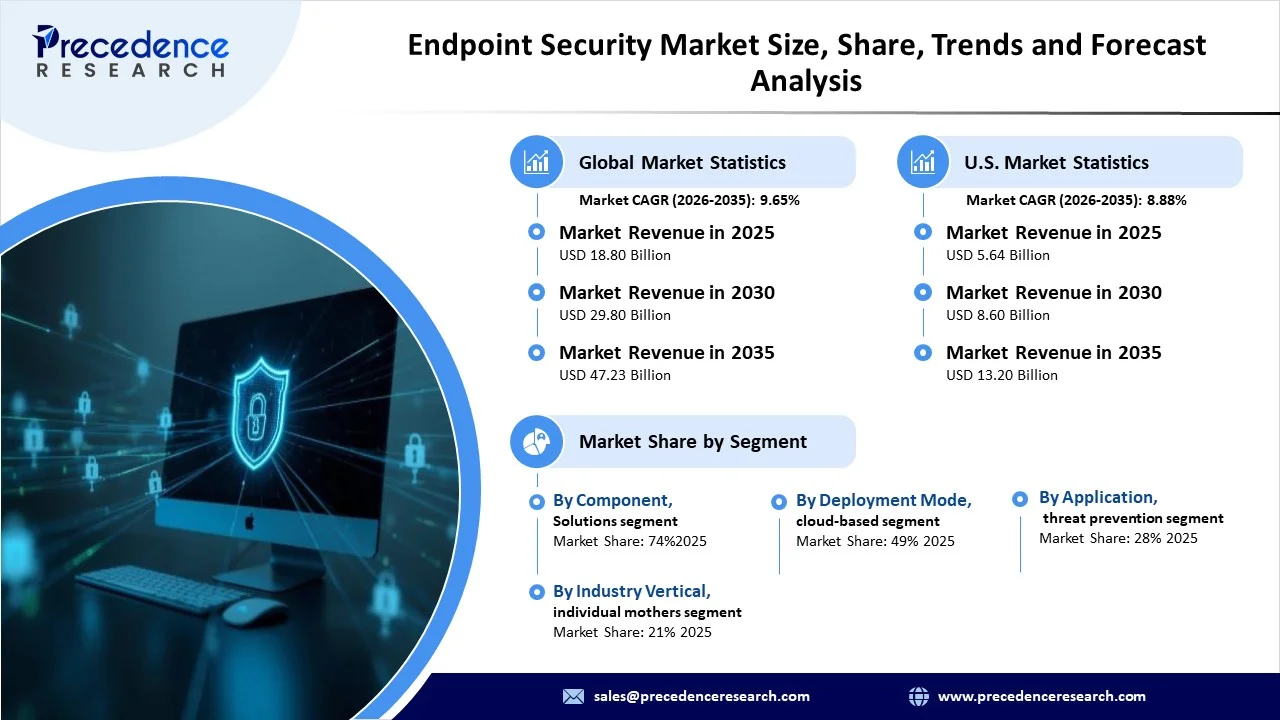
The global endpoint security market revenue surpassed USD 18.80 billion in 2025 and is predicted to attain around USD 47.23 billion by 2035, growing at a CAGR of 9.65%. The market is driven by the increasing adoption of remote and hybrid working models, the rise in ransomware and other cybersecurity attacks on endpoints, and the need for AI-based threat detection and response.
Protecting the Digital Boundaries Using Advanced Technologies
The endpoint security market consists of cybersecurity technologies using software, platforms, and services, developed for the protection of end-user devices such as desktops, laptops, mobile phones, tablets, servers, and Internet-of-Things devices. These technologies shield devices from various threats like malware, ransomware, phishing, and zero-day attacks. The techniques used to achieve these goals include traditional antivirus solutions, next-generation endpoint protection platforms (EPP), endpoint detection and response (EDR), extended detection and response (XDR), and mobile threat defense.
This market encompasses managed endpoint security services, consulting, and incident response solutions. The adoption of such technologies facilitates real-time threat monitoring, behavioral analysis, machine-learning-based detection, automated response, and vulnerability management. This market has been adopted by enterprise IT firms, healthcare facilities, financial organizations, and small and medium-sized businesses.
AI-Powered Prevention Enhances Safety Against Threats
The market is evolving to adopt AI-powered preventive security solutions that prevent attacks before execution. These solutions incorporate dynamic behavioral analysis, real-time threat intelligence, and memory protection to prevent ransomware and living-off-the-land attacks. These solutions improve dwell time and provide better performance than an antivirus solution. Bitdefender released the GravityZone PHASR platform in 2025, which employs behavioral analysis and real-time threat intelligence to prevent ransomware and fileless attacks. These solutions block the malicious activity through behavioral anomalies instead of signature-based detection.
Unified Security Platforms Increase Usage of Endpoint Protection Tools
The endpoint security market is experiencing growing acceptance of unified AI-based platforms that offer protection, detection, and response services. Companies are adopting a consolidated approach where point solutions give way to platforms that help lower the chance of breaches, maintain stable operating expenses, and accommodate distributed workforces. In 2025, Arctic Wolf stated that Aurora Endpoint Security, which it had introduced 6 months before, had become an integral part of the Aurora Platform due to its growing global momentum and acceptance. The firm currently provides services to more than 10,000 customers worldwide and obtained a 100% willingness-to-recommend score in Gartner Peer Insights Voice of the Customer for Endpoint Protection Platforms.
National Cybersecurity Strategies Drive Demand for Endpoint Security Solutions
Governments across the globe are making cybersecurity laws and rules more stringent to provide cybersecurity in the critical infrastructure of nations and their governmental networks from ransomware and cyber threats. Policies and guidelines enforce security audits, deployment of EDR (endpoint detection and response) solutions, and elimination of outdated technology. The Indian Computer Emergency Response Team (CERT-In), in 2025, released a set of Guidelines on Comprehensive Cyber Security Audit Policy. These policies mandate annual audits in the domain of cybersecurity for all organizations, including those that fall into the category of critical infrastructure.
Koi Secures USD 48 Million for Modern Endpoint Blindspot Protection
Koi raised USD 48 million through seed and Series A rounds in 2025. The Series A funding round raised USD 38 million and was led by Battery Ventures and Team8. The firm was launched following a proof of concept where Koi was able to infect more than 300 organizations using a fraudulent VSCode extension in just one week. Koi currently secures over 500,000 endpoints for Fortune 50 companies and financial organizations.
Market Segmentation Overview
- By component, the solutions segment led the endpoint security market with a 74% share in 2025, since they provide the main software infrastructure through which the value proposition is delivered. This segment is important to facilitate real-time detection, response, and management of vulnerabilities. These features address the security challenges faced by organizations generating the most recurring revenue through subscriptions and licenses.
- By component, the services segment is expected to expand at the highest CAGR of 10.8% during the forecast period, due to the fact that enterprises are facing the problem of not having the required technical skills to implement, customize, and maintain complicated EDR and XDR systems. This helps explain why they are opting to use third parties for implementation, MDR, and incident response services.
- By deployment mode, the cloud-based segment dominated the market with a 49% share in 2025 and is expected to grow at the fastest CAGR of 12.8% from 2026 to 2035, as it offers fast deployment of security agents within the workforce and does not require any expensive infrastructure to do so. Another factor is that cloud-based services always have access to global threat intelligence and updates in real-time.
- By deployment mode, the on-premises segment held the second-largest market share of 36% in 2025, since institutions in vertical markets like government, defense, financial services, and healthcare have strict regulations for data sovereignty and compliance. These organizations prefer to perform security workloads and endpoint telemetry within their own organizations' campuses.
- By application, the threat prevention segment led the endpoint security market with a 28% share in 2025 because it represents the critical first line of defense against any malware, exploits, and phishing attacks. This segment is completely automated, needs no additional staffing effort, and is included with every endpoint protection license.
- By application, the endpoint detection and response (EDR) segment is expected to expand at the highest CAGR of 12.5% during the forecast period, due to its effectiveness when it comes to the highest level of threat protection against all modern dangers such as ransomware, fileless malware, and living-off-the-land attacks. EDR facilitates real-time visibility, investigation, and containment, which cannot be provided by conventional antivirus and vulnerability management applications.
- By industry vertical, the IT and telecommunications segment dominated the market with a 21% share in 2025, as they have the most expansive workforce and operate with the most essential network and cloud infrastructures. They require the most extensive endpoint security implementations to defend company resources and customer-facing systems. This segment benefits from its technical prowess and large funds allocation for cybersecurity, which facilitates the implementation of advanced EDR and XDR services.
- By industry vertical, the healthcare segment is expected to grow at the fastest CAGR of 11.5% from 2026 to 2035, since there is fast digitization of patient information and other sensitive information, coupled with the fact that the data in this segment is considered high-value data on the dark web. This helps explain why there is an uptick in ransomware attacks that are causing hospitals to invest in endpoint protection and incident response systems.
- By distribution channel, the direct sales segment led the market with a 42% share in 2025, as endpoint protection is a sophisticated and critical decision-making process that requires tailored installation, demonstration of its value, and a multi-year business agreement, all of which can be best achieved by means of sales engineers and account managers.
- By distribution channel, the managed security service providers (MSSPs) segment is expected to expand at the highest CAGR of 12.8% during the forecast period, since small and medium businesses cannot afford both budgets and personnel who are capable of deploying such sophisticated solutions as EDR and XDR. Another factor is the problem of cybersecurity skills shortage around the world, which results in millions of unfilled cybersecurity roles worldwide, prompting companies of any scale to turn to outsourcing their endpoint security.
Regional Analysis
North America dominated the endpoint security market with a 40% share in 2025 because of the significant presence of prominent companies with huge budgets for cybersecurity, early adoption of cloud-based EDR and XDR systems, and the regulatory environment demanding high standards of data protection in crucial sectors. The U.S. led the market in North America due to its position as the base of operations for the world’s biggest vendors of security operations, active funding of venture capital, and active programs of the federal government requiring agencies to adopt advanced EDR solutions. Canada is a significant contributor to the market because of the presence of strict data protection laws (PIPEDA) and the rapid modernization of the financial services and telecommunications sectors, demanding the use of endpoint protection.
Asia-Pacific is expected to grow at the fastest CAGR of 12.4% from 2026 to 2035, due to a high digital transformation rate with millions of businesses, both small and big businesses, moving to cloud and hybrid computing, in addition to a sharp increase in the number of cyberattacks on companies in the region. China dominated the market in Asia-Pacific because of its huge enterprise and governmental digital infrastructure, which is being quickly replaced by indigenous security systems from the old foreign ones, along with the strict cybersecurity regulations of China. India witnessed notable market growth due to the fast-growing IT services industry, significant efforts of the government to digitize the country, and the rising risk of ransomware attacks against government and healthcare networks.
Europe held the second-largest market share of 27% in 2025 because of the existence of a robust regulatory environment, especially in relation to GDPR and NIS-2, which necessitate stringent data privacy and cybersecurity standards from organizations and critical infrastructure players. Germany led the market in Europe due to the fact that it is a powerhouse in manufacturing, automotive, and industrial sectors, where conventional networks need specific endpoint security solutions and the presence of highly evolved data privacy laws. The UK is a significant contributor to the market as it has highly evolved financial services and telecom sectors, and the government’s National Cyber Strategy that ensures better endpoint security for its critical national platforms.
Endpoint Security Market Coverage
| Report Attribute | Key Statistics |
| Market Revenue in 2025 | USD 18.80 Billion |
| Market Revenue by 2035 | USD 47.23 Billion |
| CAGR from 2026 to 2035 | 9.65% |
| Quantitative Units | Revenue in USD million/billion, Volume in units |
| Largest Market | North America |
| Base Year | 2025 |
| Regions Covered | North America, Europe, Asia-Pacific, Latin America, and the Middle East & Africa |
Top Companies in the Endpoint Security Market
Microsoft, CrowdStrike, and Palo Alto Networks are some of the key players that offer cloud-native and AI-based endpoint protection solutions. SentinelOne, Trend Micro, and Sophos provide endpoint security solutions. Broadcom, Trellix, and IBM focus on endpoint security solutions used in enterprises. Fortinet, Cisco, and Check Point specialize in network and endpoint security platform technologies.
Segments Covered in This Report
By Component
- Solutions
- Endpoint Protection Platform (EPP)
- Endpoint Detection and Response (EDR)
- Extended Detection and Response (XDR)
- Mobile Threat Defense (MTD)
- Endpoint Encryption
- Application Control
- Device Control
- Data Loss Prevention (DLP)
- Services
- Professional Services
- Managed Security Services
By Deployment Mode
- On-premises
- Cloud-based
- Hybrid
By Enterprise Size
- Large Enterprises
- Small and Medium-sized Enterprises (SMEs)
By Operating System
- Windows
- macOS
- Linux
- Android
- iOS
- ChromeOS
- Others
By Organization Type
- Commercial Enterprises
- Government Organizations
- Educational Institutions
- Healthcare Organizations
- Non-profit Organizations
By Application
- Threat Prevention
- Endpoint Detection and Response (EDR)
- Incident Response
- Device Management
- Compliance Management
- Identity and Access Security
- Data Protection
By Industry Vertical
- BFSI
- IT and Telecommunications
- Government and Defense
- Healthcare
- Manufacturing
- Retail and E-commerce
- Energy and Utilities
- Education
- Media and Entertainment
- Transportation and Logistics
- Others
By Distribution Channel
- Direct Sales
- Value-Added Resellers (VARs)
- Managed Security Service Providers (MSSPs)
- Cloud Marketplaces
By Region
- North America
- Latin America
- Europe
- Asia-pacific
- Middle and East Africa
Get this report to explore global market size, share, CAGR, and trends, featuring detailed segmental analysis and an insightful competitive landscape overview @ https://www.precedenceresearch.com/sample/8538
You can place an order or ask any questions. Please feel free to contact us at sales@precedenceresearch.com |+1 804 441 9344