



Enterprise Collaboration Market Revenue to Attain USD 178.22 Bn by 2035
Published: 18 Jun 2026
Author: Precedence Research



Enterprise Collaboration Market Revenue and Trends 2026 to 2035
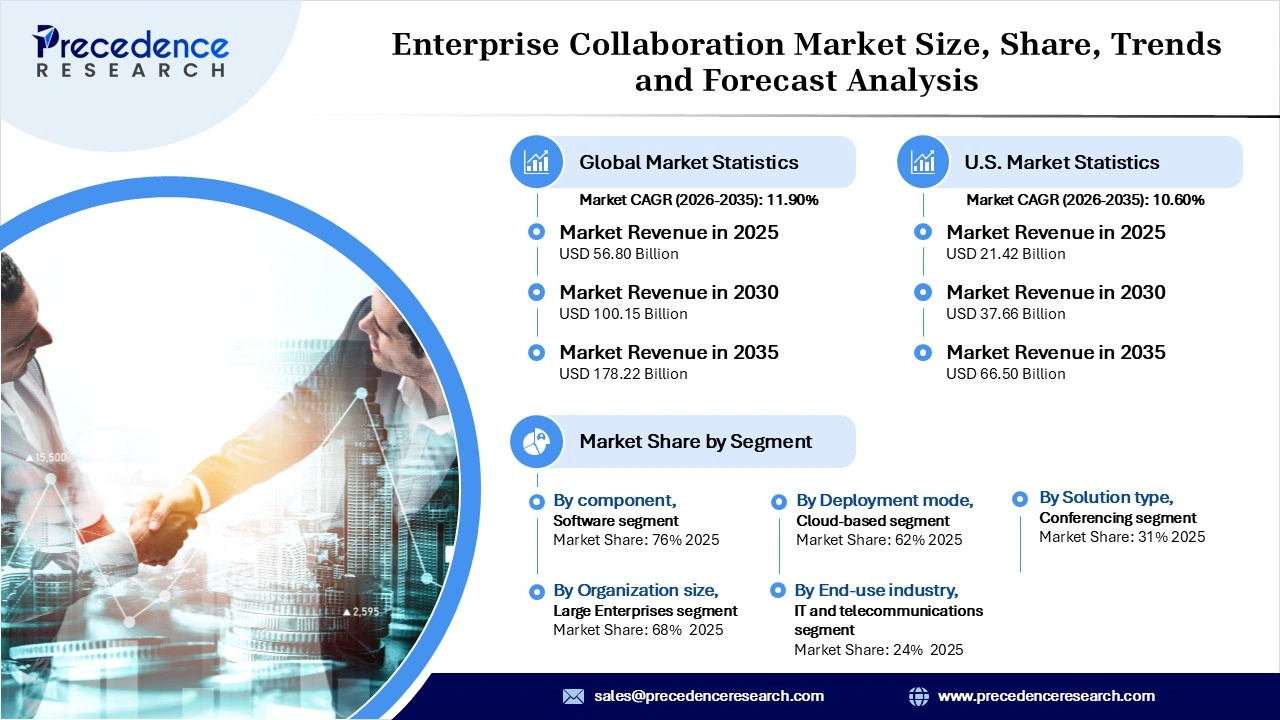
The global enterprise collaboration market revenue was valued at USD 56.80 billion in 2025 and is expected to attain around USD 178.22 billion by 2035, growing at a CAGR of 11.90% during forecast period. The market is driven by the rapid adoption of hybrid and remote working models, the requirement for real-time interaction and collaboration within project management activities among dispersed teams, and the implementation of AI-based capabilities that enable automation and increased efficiency.
Connecting Teams and Unifying Workflows
The enterprise collaboration market comprises technologies that help employees in an organization communicate, exchange information, manage projects, and coordinate tasks in real-time, regardless of where they are physically located. This market includes instant messaging applications such as Slack and Microsoft Teams, video conferencing applications such as Zoom and Webex, document editing platforms such as Google Workspace and Microsoft 365, and project and task management platforms such as Asana, Trello, and Jira.
This market also involves integrated software suites that comprise chat, virtual meeting, file sharing, and third-party application integrations. Such applications provide chat functionality, screen sharing capability, calendar integrations, and file version control. This market has been adopted by small businesses, large enterprises, governmental institutions, and remote and hybrid employees from different verticals, including IT, finance, healthcare, and manufacturing.
Autonomous AI Co-Workers in Enterprise Workflow Processes
Collaboration tools for enterprises have moved from basic chatbot functionality to becoming agentic AI programs, serving as autonomous co-workers. These AI co-workers can participate in group chats, watch over emails and calendars, and complete tasks such as rescheduling meetings, drafting replies, and following up on tasks without prompts. The actions carried out by these AI co-workers are based on organizational intelligence obtained through real-time enterprise data. At the Build 2026 event, Microsoft introduced Scout, which is an always-on AI agent designed to work across Teams, Outlook, OneDrive, SharePoint, and the calendar application. This AI coworker joins group chats and email conversations and is a full participant with its own Entra ID and Work IQ intelligence layer.
Chat Apps of Yesteryear Fade Out With Rise of Holistic Collaboration Solutions
As the era of integrated solutions prevails, the enterprise collaboration market has taken a decisive turn towards collaborative suites that include messaging, video conferencing, file exchange, and AI-equipped workflows. The old and separate applications for messaging have become redundant due to the development of integrated communication channels and software. In 2025, Microsoft officially discontinued its Skype application as the firm dedicated its resources to developing and maintaining Teams, with approximately 320 million monthly users across all categories. Skype was gradually phased out in favor of a centralized solution such as Microsoft Teams, which integrates seamlessly with Microsoft 365 applications and AI-assisted Copilot features.
Government Mandates Boost Demand for Collaboration Technologies
Governments across the world have introduced regulations requiring face-to-face working arrangements, which require cutting-edge collaboration technologies. In order to comply with government mandates, organizations need to provide a platform through which both employees who work in the office and those who work remotely can collaborate via video conference calls and other collaborative features. In 2025, the U.S. President’s Memorandum was signed along with the Office of Personnel Management’s subsequent guidelines by government agencies to end remote work and compel all their employees to work at least part-time in person unless it is due to a disability. Agencies need to cope with the logistics of getting over 2 million employees back to work, which will drive their need for collaboration technologies.
Dust Gets USD 40 Million Series B for Collaborative Multiplayer AI Platform
In 2026, Dust, a startup from Paris, revealed that it had received USD 40 million Series B funding, which was led by Abstract and Sequoia, making its total capital exceed USD 60 million. The company has more than 3,000 customers and 41,000 monthly active users who have deployed 300,000 AI agents. The company plans to leverage the investment in building self-learning agents.
Market Segmentation Overview
- By component, the software segment led the enterprise collaboration market with 76% share in 2025, due to the nature of collaborative platforms, which are purely software-driven and provide functionalities including messaging, video conferencing, document management, and workflow automation.
- By component, the services segment is expected to expand at the highest CAGR of 13.6% during the forecast period, because of the increased demand for consultancy services as companies adopt sophisticated platforms that use AI agents and customized integrations. These organizations need to be guided on how to implement the solutions efficiently.
- By deployment mode, the cloud-based segment dominated the enterprise collaboration market with 62% share in 2025, and is expected to grow at the fastest CAGR of 14.2% from 2026 to 2035, because it did away with the requirement for the firms to buy, install, and take care of on-premise servers. This segment offers a pay-as-you-go cost structure and auto-updates with easy remote access anywhere.
- By deployment mode, the hybrid segment held the second-largest market share of 21% in 2025, since there are many companies that require their sensitive data and specific tasks to be executed only through their on-premise servers, but they still use the cloud for non-sensitive processes. Such a strategy is widely implemented by industries that have regulatory constraints, like finance and healthcare.
- By solution type, the unified communication and conferencing segment led the enterprise collaboration market with 31% share in 2025, because instant communication, whether through instant messaging, voice calls, and video conferences, is the most direct and common use of collaboration platforms. It provides the core functionality that is used daily by any team.
- By solution type, the team collaboration platforms segment is expected to expand at the highest CAGR of 13.4% during the forecast period, due to its direct link with the need for proper project organization, assigning tasks, and tracking workflows, which is necessary as companies are becoming more decentralized. Collaboration platforms act as virtual spaces that are ready for use and make work more efficient.
- By organization size, the large enterprises segment dominated the market with 68% share in 2025, because it comprises many employees in different geographical locations; thus, they need collaboration software that is scalable, secure, and able to comply with regulations. Large enterprises can afford high-end services provided by the software firms, as well as the ability to obtain enterprise-wide licenses.
- By organization size, the small and medium enterprises (SMEs) segment is expected to grow at the fastest CAGR of 14.5% from 2026 to 2035, because small businesses are adopting collaboration solutions in the cloud without the initial setup cost, making it possible for them to match up with the bigger companies when it comes to productivity.
- By end-use industry, the IT and telecommunications segment led the market with 24% in 2025 and is expected to expand at the highest CAGR of 13.5% during the forecast period, since it has a distributed nature due to its workforce of engineers, developers, and field technicians. It has a culture of quick and asynchronous communication that requires collaboration software.
- By end-use industry, the BFSI segment held the second-largest market share of 14% in 2025, since banks and insurance firms hold a huge amount of customer information, which is highly sensitive and hence requires strict compliance with regulatory frameworks such as GDPR, SOX, and PCI-DSS. This segment comprises many workers who work from different locations, ranging from corporate offices to branches across the country.
Regional Analysis
North America led the enterprise collaboration market with 38% share in 2025, because of early transition to hybrid working practices, the high rate of cloud adoption, and the availability of collaboration platforms such as Microsoft Teams, Zoom, and Slack. The U.S. dominated the market in North America due to a well-developed enterprise technology ecosystem, heavy investments in AI-powered collaboration applications, and federal programs that promote digital transformation. Canada is a significant contributor to the market owing to the increased use of advanced communication technologies for finance, healthcare, and public service applications, coupled with significant government investments in the development of digital infrastructure.
Asia-Pacific is expected to expand at the highest CAGR of 14.6% during the forecast period, due to significant government investments in cloud infrastructure and hybrid working systems in order to boost their economies and increase their production capabilities. China led the market in Asia-Pacific because of an enormous domestic consumer base, use of local collaboration tools like Alibaba DingTalk, Tencent WeChat Work, and compulsory provision of digital public services by the government, which need enterprise collaboration tools. India witnessed notable market growth owing to its thriving software industry and startup culture, extensive usage of smartphones and internet connectivity, and cost-conscious consumers looking for scalable collaboration solutions.
Europe held the second-largest market share of 27% in 2025, because of its well-developed enterprise landscape, strict data protection policies (GDPR), and the significant prevalence of hybrid work culture. Germany dominated the market in Europe due to its mature manufacturing and professional services industries, which require collaboration platforms for their cross-border operations. The UK is a significant contributor to the market owing to its well-established finance and technology sectors, as well as extensive adoption of cloud collaboration tools in various industries.
Enterprise Collaboration Market Coverage
| Report Attribute | Key Statistics |
| Market Revenue in 2025 | USD 56.80 Billion |
| Market Revenue by 2035 | USD 178.22 Billion |
| CAGR from 2026 to 2035 | 11.90% |
| Quantitative Units | Revenue in USD million/billion, Volume in units |
| Largest Market | North America |
| Base Year | 2025 |
| Regions Covered | North America, Europe, Asia-Pacific, Latin America, and the Middle East & Africa |
Top Companies in the Enterprise Collaboration Market
Microsoft, Cisco Systems, Zoom Communications, and Google are some of the key players that specialize in unified communications and collaboration, with all-inclusive solutions that combine messaging, video conferencing, file-sharing capabilities, and live document editing. Salesforce, Atlassian, Miro, and Monday.com offer team collaboration and digital whiteboard solutions. Slack connects communication and workflow automation. Asana, Dropbox, Box, and Zoho Corporation provide project management and secure file collaboration platforms.
Segments Covered in This Report
By Component
- Software
- Services
By Deployment Mode
- Cloud-Based
- On-Premises
- Hybrid
By Solution Type
- Unified Communication and Conferencing
- Team Collaboration Platforms
- Content Collaboration and Document Management
- Project and Workflow Collaboration
- Enterprise Social Collaboration
By Organization Size
- Large Enterprises
- Small and Medium Enterprises (SMEs)
By End-use Industry
- BFSI
- IT and Telecommunications
- Healthcare
- Retail and E-commerce
- Manufacturing
- Government and Public Sector
- Education
- Others
By Region
- North America
- Latin America
- Europe
- Asia-pacific
- Middle and East Africa
Get this report to explore global market size, share, CAGR, and trends, featuring detailed segmental analysis and an insightful competitive landscape overview @ https://www.precedenceresearch.com/sample/8494
You can place an order or ask any questions. Please feel free to contact us at sales@precedenceresearch.com |+1 804 441 9344