



Enterprise Collaboration Market Trends, Companies, Revenue / Sales Performance, Subscriber Growth, Pricing Strategies, Cloud Adoption, Infrastructure Expansion, Competitive Landscape, and Industry Outlook
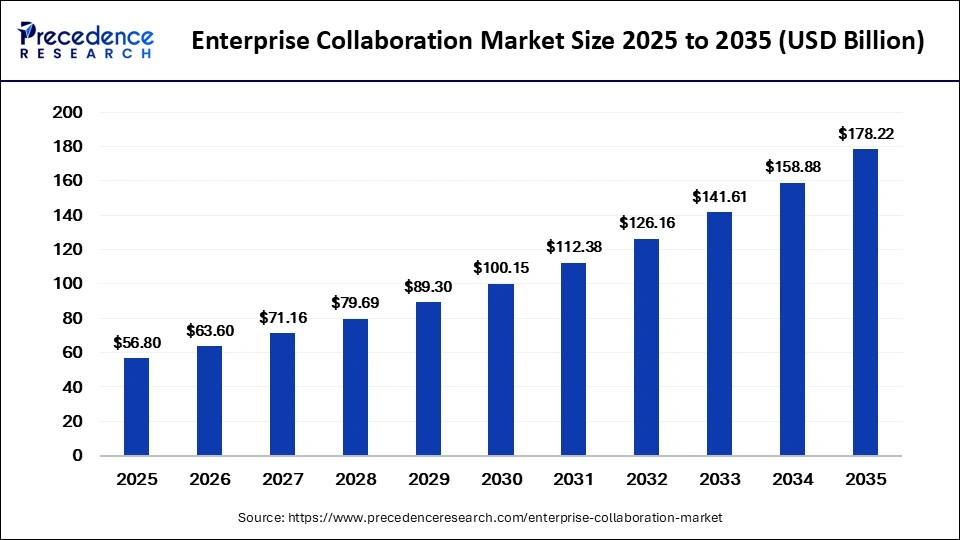
ICT industry specialist Shivani Zoting estimates the enterprise collaboration market at USD 63.60 billion in 2026, with continued technology adoption expected to take the market to USD 178.22 billion by 2035 at a CAGR of 11.90%. Leading enterprise collaboration market providers such as Microsoft, Cisco Systems, Zoom Communications are expanding their capabilities across segments including component, deployment mode, solution type, organization size, end-use industry, region.
Source: https://www.precedenceresearch.com/enterprise-collaboration-market
 Get a Sample
 Table Of Content


Enterprise Collaboration Market Size and Forecast 2026 to 2035
The global enterprise collaboration market size accounted for USD 56.80 billion in 2025 and is predicted to increase from USD 63.60 billion in 2026 to approximately USD 178.22 billion by 2035, expanding at a CAGR of 11.90% from 2026 to 2035. The market is driven by widespread, permanent acceptance of remote and hybrid work models.
Key Takeaways
- North America dominated the global enterprise collaboration market with a share of 38% in 2025.
- Asia-Pacific is expected to grow at the fastest CAGR of 14.6% during the forecast period.
- By component, the software segment led the global market with a share of 76% in 2025.
- By component, the services segment held the second-largest share of 24% in 2025 and is expected to grow at the fastest CAGR of 13.6% between 2026 and 2035.
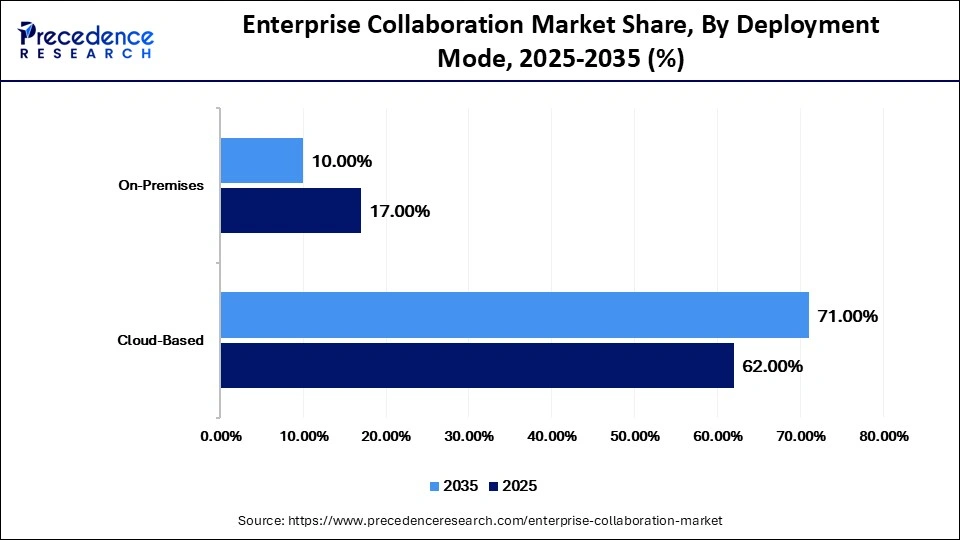
- By deployment mode, the cloud-based segment accounted for a revenue share of 62% in the market in 2025.
- By deployment mode, the hybrid segment is expected to grow at the fastest 10.7% CAGR between 2026 and 2035.
- By solution type, the unified communication and conferencing segment accounted for a revenue share of 31% in the enterprise collaboration market in 2025.
- By solution type, the team collaboration platforms segment is expected to grow at an 13.4% CAGR between 2026 and 2035.
- By organization size, the large enterprises segment accounted for a revenue share of 68% in the market in 2025.
- By organization size, the small and medium enterprises (SMEs) segment is expected to grow at the highest CAGR of 14.5% between 2026 and 2035.
- By end-use industry, the IT and telecommunications segment held the largest revenue share of 24% in the market in 2025 and is expected to sustain its dominance with a CAGR of 13.5% over the studied period.
- By end-use industry, the BFSI segment held the second-largest market share of 14% in 2025.
Market Overview
The enterprise collaboration industry encompasses the software, platforms, and services that large organizations use to enable seamless communication, file sharing, and project management. It serves as a unified digital workspace designed to boost productivity, share knowledge, and even streamline workflows across geographically distributed teams. It is mainly driven by the permanent shift to remote and hybrid work models, the growing need for real-time communication, and the integration of advanced technologies such as cloud-based services and artificial intelligence.
How is AI Influencing the Enterprise Collaboration Market?
AI is reshaping the enterprise collaboration industry by shifting tools from passive communication systems into active, digital teammates. Major trends include automating administrative burdens, blending human-AI creativity to accelerate workflows, and even creating multi-agent AI systems that streamline cross-departmental operations. Platforms transcribe conversations, generate action items, and offer real-time translation for global teams. Basic features such as meeting summarization are becoming standard baseline offerings across unified communication platforms. Tools increasingly aim to augment human creativity and intuition rather than replacing them. AI acts as an editorial partner or brainstorming aid, where humans maintain final judgment and oversight.
Enterprise Collaboration Market Trends
- AI-powered assistants automate routine tasks, transcribe meetings, draft messages, and offer smart scheduling. This is moving collaboration platforms from simple communication tools into active, intelligent workspaces.
- Cloud deployment decreases IT overhead while allowing scalable, real-time access to file sharing and project management.
- Organizations are shifting away from fragmented tools. They favor consolidated, centralized platforms that integrate video, messaging, and even document collaboration into one interface.
- Platforms are incorporating drag-and-drop tools that enable non-technical employees to customize team workflows, along with integrating third-party business apps.
Market Report Coverage and Key Metrics
| Report Coverage | Details |
| Market Size in 2025 | USD 56.80 Billion |
| Market Size in 2026 | USD 63.60 Billion |
| Market Size by 2035 | USD 178.22 Billion |
| Market Growth Rate from 2026 to 2035 | CAGR of 11.90% |
| Dominating Region | North America |
| Fastest Growing Region | Asia Pacific |
| Base Year | 2025 |
| Forecast Period | 2026 to 2035 |
| Segments Covered | Component, Deployment Mode, Solution Type, Organization Size, End-Use Industry, and Region |
| Regions Covered | North America, Europe, Asia-Pacific, Latin America, and Middle East & Africa |
Market Dynamics
Drivers
Rising Integration of AI in Communication Platforms
AI integration is the primary driver for the market because it transforms basic communication tools into intelligent workspaces. By automating routine tasks and streamlining workflows, organizations recover significant productivity, enabling employees to focus on high-value strategic initiatives while navigating complex, distributed work environments. Next-generation features such as real-time language translation, sentiment analysis, and smart noise cancellation make cross-border and hybrid work seamless. This empowers global talent pools to collaborate without friction.
Restraint
Data Privacy & Cybersecurity
Data privacy and cybersecurity act as a primary restraint in the market because organizations inherently fear data sprawl, intellectual property leakage, and even regulatory fines. Strict global mandates make sharing sensitive corporate information across digital platforms a high-stakes liability, forcing firms to delay or restrict broad platform adoption. Collaboration apps are prime targets for cybercriminals. Attackers routinely use these platforms as conduits to distribute malicious links or gain unauthorized access to internal corporate networks.
Opportunity
Hybrid Work Solutions
Hybrid work solutions are a major opportunity for the market because they necessitate digital-first infrastructures. Flexible models demand technology that unites scattered teams, bridging the physical and even virtual divide to maintain productivity. Because hybrid workers split time between home and the office, organizations must shift from localized, on-premises systems to agile, cloud-driven architectures. The cloud segment accounts for the highest market growth, as it enables seamless access to files and tools from any location.
Market Segmentation Analysis
Component Insights
The Software Segment Held the Largest Market Share of 76% in 2025
The software segment dominated the enterprise collaboration market with a share of 76% in 2025, owing to its growth in AI-enabled workplace productivity tools along with rising cloud-based collaboration adoption. Increased reliance on cloud infrastructure enables workers to access centralized project management tools and share files in real time from anywhere using mobile devices.
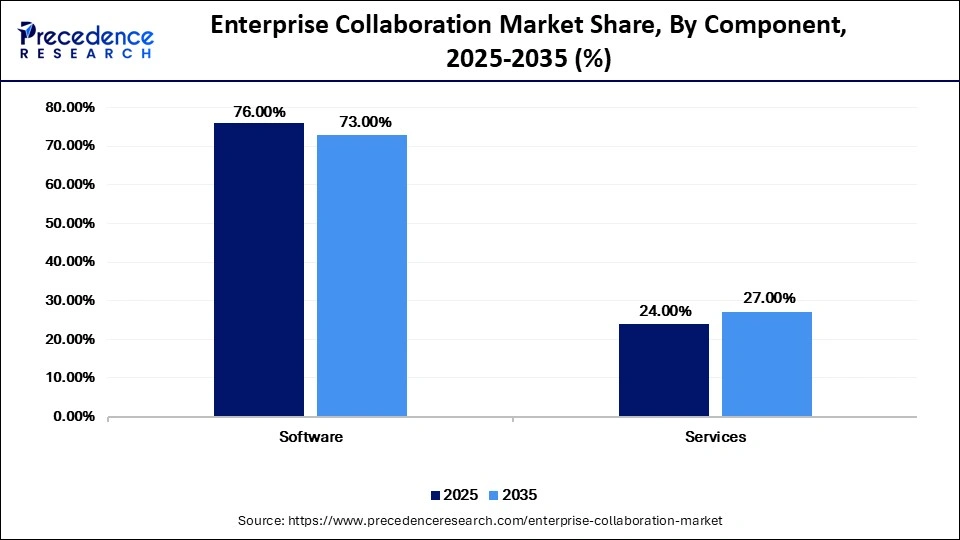
The services segment held a 24% share of the market in 2025 and is expected to grow at the fastest CAGR of 13.6% during the projection period. This is mainly due to the rising need for implementation services, increasing integration complexity across platforms, and growing adoption of managed collaboration services. High smartphone penetration and a mobile-first mindset enable employees to collaborate, share data, and thus, engage in real-time, regardless of their location.
Deployment Mode Insights
The Cloud-Based Segment Held 62% of the Enterprise Collaboration Market Share in 2025
The cloud-based segment dominated the market with a share of 62% in 2025 and is expected to sustain its dominance with a CAGR of 14.2% during the forecast period, owing to the growing remote, hybrid workforce requirements, lower infrastructure ownership costs, and even enhanced scalability and accessibility. Organizations are actively replacing expensive legacy on-premises servers with flexible, cloud-hosted applications that can easily scale as team sizes and enterprise needs fluctuate.
The hybrid segment held a 21% share of the market in 2025 and is expected to grow at a CAGR of 10.7% during the projection period. This is mainly due to growing multi-environment collaboration strategies and improved business continuity planning. With a massive percentage of the white-collar workforce permanently operating on hybrid schedules, organizations depend on unified digital ecosystems to bridge the gap between in-office and remote employees, prevent workflow bottlenecks, and thus, maintain seamless communication.
The on-premises segment held a 17% share of the market in 2025 and is expected to grow at a CAGR of 5.4% during the projection period. This is due to demand from highly regulated industries, internal communication control preferences, and legacy system compatibility requirements. On-premises models enable enterprises to completely own, manage, and customize their digital workspaces. Large corporations with ample IT budgets prefer the ability to manage system upgrades, integrations, and server maintenance strictly on their own timetables.
Solution Type Insights
Why Did the Unified Communication and Conferencing Segment Lead the Market?
The unified communication and conferencing segment held a dominant position in the enterprise collaboration market, with a share of 31.00% in 2025, driven by rising video conferencing adoption, growth in hybrid work environments, and increasing need for integrated communication tools. Modern platforms bring video, voice, team messaging, and even file-sharing into a single, cohesive hub, streamlining complex workflows.
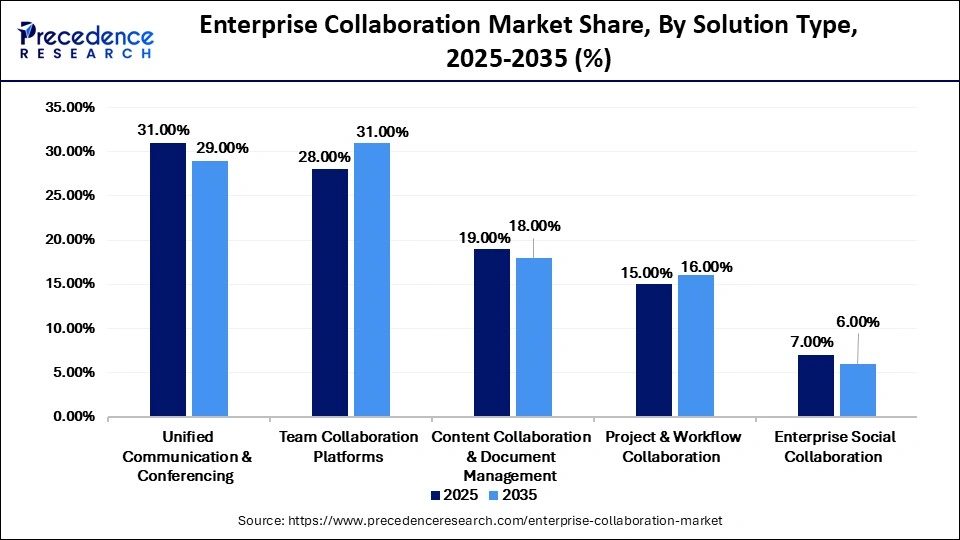
The team collaboration platforms segment held a 28% share of the market in 2025 and is expected to grow at the fastest CAGR of 13.4% during the projection period. This is mainly due to the expansion of distributed workforce models, increasing workplace productivity initiatives, and the adoption of AI-powered collaboration features. The sustained adoption of distributed and global teams demands platforms that enable seamless digital teamwork regardless of physical location.
The content collaboration and document management segment held a 19% share of the market in 2025 and is expected to grow at a CAGR of 10.6% during the projection period. This is due to increasing digital document workflows, the growing need for secure file sharing, and expansion of cloud content platforms. With teams spread across offices, homes, and global locations, organizations demand centralized digital environments to prevent operational bottlenecks and information silos.
Organization Size Insights
Why Did the Large Enterprises Segment Dominate the Enterprise Collaboration Market?
The large enterprises segment dominated the global market with the largest share of 68% in 2025. This is due to complex multi-location operations, strong investments in digital workplace technologies, and the need for integrated collaboration ecosystems. Platforms now utilize AI for smart task delegation, automated meeting transcripts, language translation, and predictive data analytics, turning basic messaging apps into comprehensive digital workspaces.
Enterprise Collaboration Market Share, By Organization Size, 2025-2035 (%)
| Organization Size | 2025 | 2035 | CAGR (%) |
| Large Enterprises | 68.00% | 61.00% | 10.5% |
| Small & Medium Enterprises (SMEs) | 32.00% | 39.00% | 14.5% |
The small and medium enterprises (SMEs) segment held a 32% share of the market in 2025 and is expected to grow at the fastest CAGR of 14.5% during the projection period. This is mainly due to the increasing adoption of SaaS collaboration tools, cost-effective cloud deployment models, and the rising digitalization of business operations. SMEs usually operate with tighter financial constraints. Centralized collaboration and project management platforms streamline workflows, reduce administrative overhead, and enable businesses to adapt quickly to market shifts.
End-Use Industry Insights
How the IT and Telecommunications Segment Dominated the Enterprise Collaboration Market?
The IT and telecommunications segment dominated the global market with the largest share of 24% in 2025 and is expected to expand rapidly with a CAGR of 13.5% during the predicted timeframe. This is due to the highly distributed workforce structures, growing software development collaboration needs, and the expansion of digital workplace initiatives. Platforms such as Microsoft Teams and Google Workspace have embedded AI copilots and also automated intelligence features. These tools summarize meetings, handle schedules, and automate workflows, significantly boosting team productivity.
Enterprise Collaboration Market Share, By End-Use Industry, 2025-2035 (%)
| End-Use Industry | 2025 | 2035 | CAGR (%) |
| BFSI | 14.00% | 13.00% | 10.6% |
| IT & Telecommunications | 24.00% | 25.00% | 13.5% |
| Healthcare | 11.00% | 12.00% | 12.8% |
| Retail & E-commerce | 12.00% | 13.00% | 12.7% |
| Manufacturing | 13.00% | 13.00% | 11.5% |
| Government & Public Sector | 10.00% | 9.00% | 10.1% |
| Education | 9.00% | 10.00% | 13.2% |
| Others | 7.00% | 5.00% | 9.8% |
The education segment held a 9% share of the market in 2025 and is expected to grow at a CAGR of 13.2% during the projection period. This is mainly due to the growing adoption of digital learning platforms, the growth of virtual classroom environments, and increasing faculty and student collaboration needs. Universities and schools use these platforms to streamline cross-departmental operations, enabling faculty, IT staff, and administrative teams to share files, track projects, and communicate seamlessly.
The BFSI segment held a 14% share of the market in 2025 and is expected to grow at a CAGR of 10.6% during the projection period. This is mainly due to the growing demand for secure communication platforms, rising remote banking operations, and rising compliance and governance requirements. The migration to cloud-based solutions has reduced infrastructural and operational costs while providing greater scalability and even availability for enterprise collaboration software.
Market Regional Analysis: North America, Europe, Asia-Pacific
U.S. Enterprise Collaboration Market Size and Growth 2026 to 2035
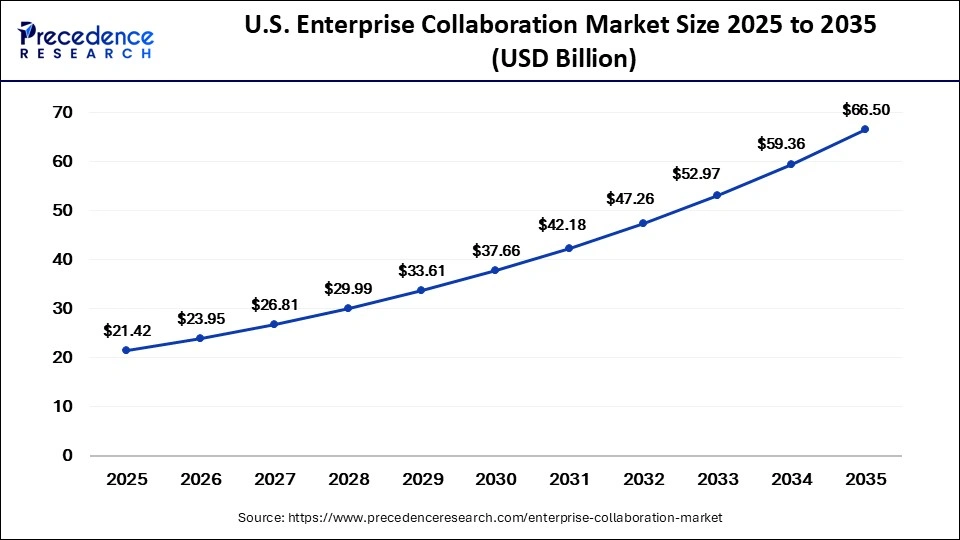
The U.S. enterprise collaboration market size was evaluated at USD 21.42 billion in 2025 and is projected to reach around USD 66.50 billion by 2035, growing at a CAGR of 10.60% from 2026 to 2035.
What Led the Global North America Enterprise Collaboration Market Grow in 2025?
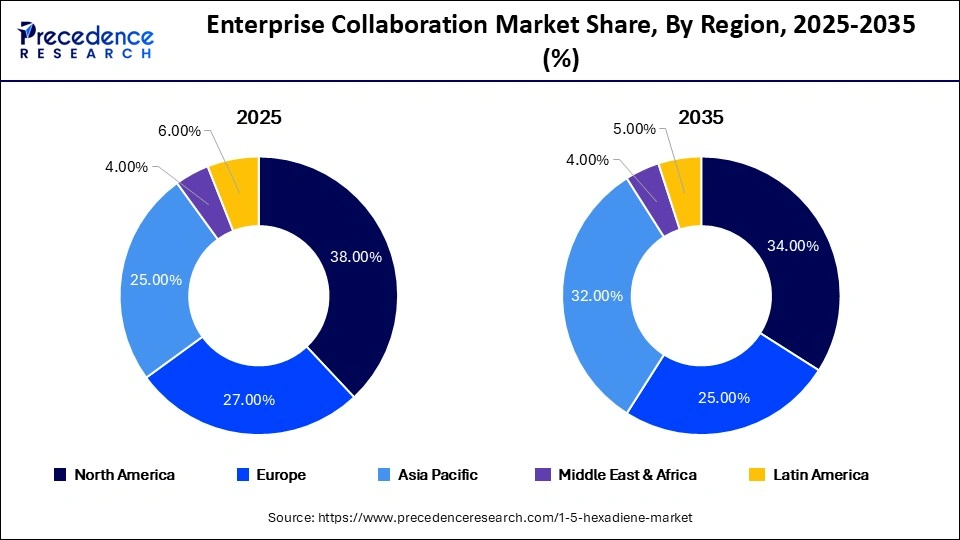
North America held a major market share of 38% in 2025. This is due to strong enterprise digital transformation initiatives, the growing need for unified communication platforms, and increasing AI-powered workplace productivity tools. The transition to scalable, cloud-based collaboration solutions enables businesses to reduce upfront IT costs while facilitating real-time data access for distributed workforces.
U.S. Market Analysis
The U.S. market is mainly driven by the permanent shift toward hybrid work models, massive advancements in generative AI, and the continuous push for digital transformation. The surge in cloud computing allows firms to scale resources instantly and even reduce operational overhead compared to legacy on-premises systems.
Europe: The Second-Largest Market
Europe held the second-largest enterprise collaboration market share of 27% in 2025 and is expected to grow at a notable CAGR of 10.9% during the projection period, driven mainly by increasing cloud collaboration deployment, rising enterprise productivity investments, and the growth of cross-border workforce collaboration. The normalization of remote and hybrid workforces has made seamless communication platforms indispensable, enabling geographically dispersed teams to stay connected and productive.
UK Market Analysis
The UK market grew due to widespread hybrid work adoption, a push for public sector modernization, and a highly developed tech ecosystem. The integration of AI and cloud-based tools has drastically improved productivity and even scalability for British businesses.
Asia-Pacific: The Fastest-Growing Region
Asia-Pacific held a 25% share of the enterprise collaboration market in 2025 and is expected to grow at the fastest CAGR of 14.6% during the projection period, driven by the rapid digital workplace transformation and the growing SME adoption of collaboration platforms. The widespread deployment of cloud-based collaboration platforms allows seamless access to documents and applications from any location, leading to higher scalability and lower operational costs.
China Market Analysis
The Chinese market has experienced rapid expansion driven by government initiatives such as the Digital China policy, massive 5G infrastructure investments, and a widespread shift toward remote and hybrid work models. Furthermore, the growth of AI-driven productivity tools and the deep integration of unified communication systems across massive manufacturing and service sectors have accelerated adoption.
What Drives the Enterprise Collaboration Market in Latin America?
Latin America held a 6% share of the market in 2025 and is expected to grow at a significant CAGR of 10.8% during the projection period, driven by a growing remote work culture, increasing enterprise digitization efforts, and rising cloud collaboration platform adoption. Platforms are incorporating advanced AI, automation, and real-time transcription, assisting in streamlining workflows and lowering administrative burdens for Latin American enterprises.
Brazil Market Analysis
The Brazilian market is expanding due to a permanent shift toward remote or hybrid work models, the integration of AI, and robust enterprise digital transformation. Companies are increasingly digitizing their workflows to enhance operational agility and maintain a competitive edge in a tech-focused marketplace.
Will the Middle East and Africa Grow in the Enterprise Collaboration Market?
The Middle East and Africa held a 4% share of the market in 2025 and are expected to grow at a notable CAGR of 11.1% during the projection period, driven by the growing enterprise cloud adoption, the growth of smart workplace initiatives, and the increasing need for business communication tools. Heavy investments in cloud-based software enable organizations to improve team productivity, streamline workflows, and even scale operations seamlessly. Early adoption of robust IT infrastructure along with 5G networks facilitates seamless file transfers, real-time messaging, and high-quality video solutions.
Saudi Arabia Market Analysis
The Saudi Arabian market is mainly driven by the government's digital transformation agenda under Vision 2030, a nationwide shift toward cloud-based services, and the permanent adoption of remote and hybrid work models across major business sectors.
Market Competitive Landscape: Leading Companies and Strategies
The enterprise collaboration market is highly competitive, led by major technology companies such as Microsoft, Cisco, Zoom, Google, Salesforce, and Atlassian. Competition centers on integrated communication, video conferencing, project management, AI-powered productivity, security, and hybrid-work capabilities. Vendors are expanding their ecosystems via partnerships, acquisitions, and cloud-based innovations to improve user experience and workflow efficiency. The growing adoption of remote and distributed workforces is intensifying competition, encouraging providers to differentiate through advanced collaboration features, scalability, seamless integrations, and industry-specific solutions while maintaining cost-effectiveness and data security.
Enterprise Collaboration Market Companies
- Microsoft
- Cisco Systems
- Zoom Communications
- Salesforce
- Atlassian
- Slack Technologies
- Dropbox
- OpenText
- Box
- Zoho Corporation
- Miro
- Asana
- Monday.com
- RingCentra
Recent Developments Enterprise Collaboration Market (2025-2026)
- In June 2026, KPMG and Microsoft Corp. declared an expansion of their global relationship to help clients deploy AI at scale. Under the agreement, KPMG will harness Microsoft 365 to improve the KPMG Trusted AI framework and assist clients in managing, monitoring, and securing AI agents across their organizations. (Source: https://news.microsoft.com)
- In March 2026, Zoom Communications, Inc. declared the expansion of its enterprise agentic AI platform, introducing new workflow orchestration capabilities across Zoom Phone, Zoom Workplace, and Zoom CX. The updates extend Zoom's system of action for modern work, allowing organizations to automate tasks, trigger cross-system workflows, and turn meetings, calls, and even customer interactions into completed business outcomes.(Source: https://news.zoom.com)
Segments Covered in the Report
By Component
- Software
Services
By Deployment Mode
- Cloud-Based
- On-Premises
- Hybrid
By Solution Type
- Unified Communication and Conferencing
- Team Collaboration Platforms
- Content Collaboration and Document Management
- Project and Workflow Collaboration
- Enterprise Social Collaboration
By Organization Size
- Large Enterprises
- Small and Medium Enterprises (SMEs)
By End-use Industry
- BFSI
- IT and Telecommunications
- Healthcare
- Retail and E-commerce
- Manufacturing
- Government and Public Sector
- Education
- Others
By Region
- North America
- Latin America
- Europe
- Asia-pacific
- Middle and East Africa
For inquiries regarding discounts, bulk purchases, or customization requests, please contact us at sales@precedenceresearch.com
Frequently Asked Questions





Ask For Sample
No cookie-cutter, only authentic analysis – take the 1st step to become a Precedence Research client
 Get a Sample




 sales@precedenceresearch.com
 Schedule a Meeting
