



Gene Amplification Technology Market Revenue to Attain USD 10.04 Bn by 2035
Published: 30 Apr 2026
Author: Precedence Research



Gene Amplification Technology Market Revenue and Trends 2026 to 2035
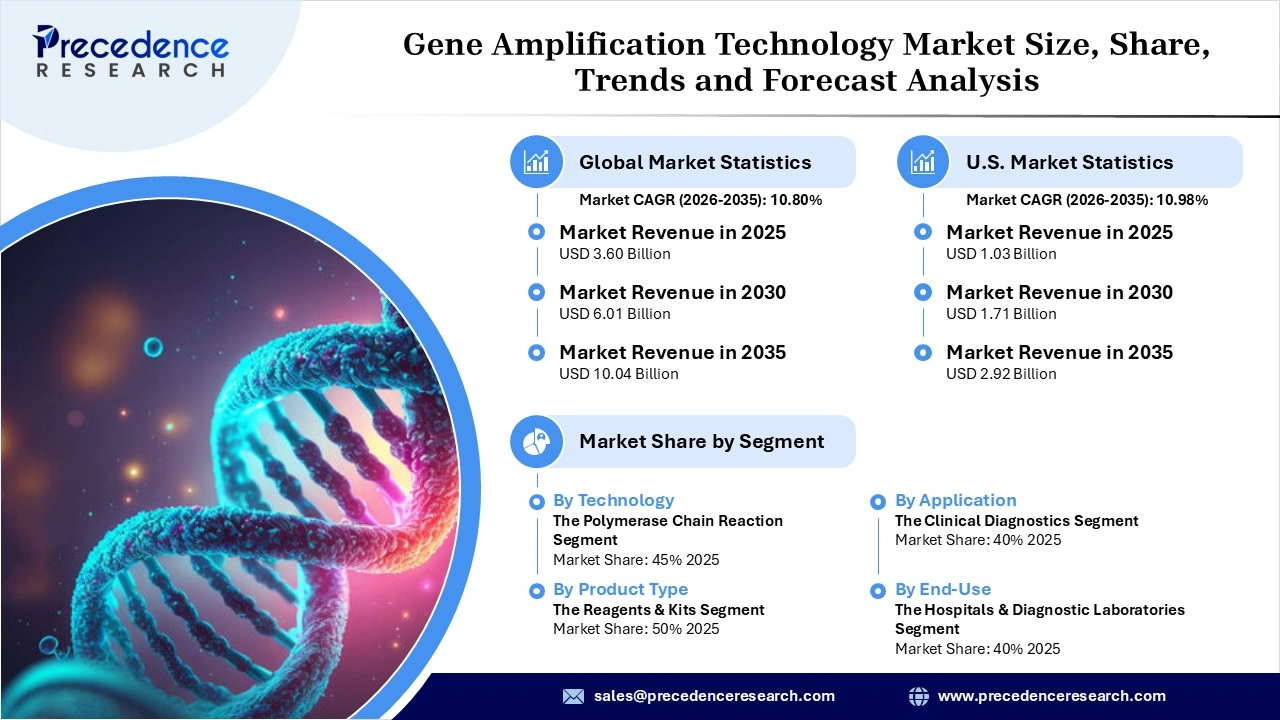
The global gene amplification technology market revenue reached USD 3.60 billion in 2025 and is predicted to attain around USD 10.04 billion by 2035 with a CAGR of 10.80%. The market is witnessing substantial growth driven by advancements that enable the detection of previously undetectable genetic elements. These developments are transforming applications across cancer diagnostics, infectious disease detection, and broader clinical research. The rise of precision medicine, rapid diagnostic techniques, and decentralized laboratory infrastructure has shifted gene amplification from a specialized laboratory method to a routine clinical tool.
Market at a Glance
The market for gene amplification technology centers on methods that selectively amplify DNA or RNA fragments so their presence can be detected and studied efficiently. This includes PCR, isothermal, and hybrid strategies, as well as the instruments, reagents, and analytical tools needed to perform these procedures. Amplification functions as more than a technical method; it becomes a vital bridge between raw biological specimens and diagnosis, and in research, to more advanced, more directed drug development.
Beyond its technical role, gene amplification serves as a critical link between biological samples and actionable insights. In clinical settings, it supports accurate diagnosis, while in research, it enables targeted drug development and biomarker discovery.
What are the Major Trends Impacting the Gene Amplification Technology Market?
- Growing Demand for Precision Medicine: Gene amplification is becoming integral to precision medicine, particularly in oncology and rare disease management. In 2023, over 320 clinical trials in the U.S. incorporated PCR-based amplification technologies, reflecting their importance in therapeutic development. As genomics becomes increasingly embedded in healthcare systems, amplification techniques are transitioning into routine clinical practice.
- Rising Adoption of Isothermal Amplification Technologies: Isothermal amplification methods, such as loop-mediated isothermal amplification (LAMP), are gaining traction due to their rapid turnaround times and minimal equipment requirements. These features make them highly suitable for point-of-care diagnostics. Additionally, automated real-time amplification systems have enhanced laboratory efficiency, with approximately 45% of facilities reporting improved turnaround times and diagnostic accuracy.
Quantitative Insights into Gene Amplification Adoption
- Approximately 92.2% of laboratories utilize PCR-based amplification for infectious disease detection, underscoring its role as a standard tool in molecular diagnostics rather than a niche technology.
- Multiplex PCR techniques enable the simultaneous detection of multiple gene targets with high accuracy, significantly improving testing efficiency and throughput.
- Amplification-based assays can detect as few as ~10 gene copies, highlighting their critical importance in cases where conventional methods lack sufficient sensitivity.
- Studies involving multiple clinical isolates (e.g., 50+ samples per assay) demonstrate that scalability and high-throughput processing are already embedded in routine workflows, driving sustained market demand.
Market Segmentation Overview
- By technology, the polymerase chain reaction (PCR) segment accounted for 45% of the gene amplification technology market in 2025, driven by its widespread use across diagnostics, research, and molecular biology. Its high sensitivity, accuracy, and reproducibility have established PCR as the benchmark technology for gene amplification.
- By technology, the isothermal amplification technologies segment is expected to grow at the fastest CAGR of 13.5% in the market between 2026 and 2035. This is driven by advantages such as rapid turnaround times, portability, and suitability for point-of-care diagnostics, as these methods eliminate the need for complex thermal cycling. Increasing demand for speed and operational simplicity is accelerating adoption.
- By product type, the reagents & kits segment held a major revenue share of 50.0% in the gene amplification technology market in 2025, supported by consistent and recurring demand in both diagnostics and research applications. As testing volumes continue to rise globally, consumable-based products remain a stable and significant revenue source.
- By product type, the consumables segment is steadily growing with a CAGR of 9.5% in the market between 2026 and 2035. Increasing use of molecular diagnostics and research activities is driving steady demand for essential components such as tubes, plates, and microfluidic chips.
- By application, the clinical diagnostics segment accounted for a major revenue share of 40.0% in the market in 2025, driven by rising demand for molecular testing in infectious diseases, oncology, and genetic disorder identification. Gene amplification technologies have become integral to routine diagnostic workflows.
- By application, the drug discovery & development segment is expected to expand rapidly in the market with a CAGR of 11.0% in the coming years, as pharmaceutical companies increasingly utilize amplification technologies for biomarker identification, clinical trials, and drug development processes. These tools are becoming essential across both early-stage research and late-stage validation.
- By end-use, the hospitals & diagnostic laboratories segment accounted for a revenue share of 40.0% in the gene amplification technology market in 2025, supported by high testing volumes and the widespread adoption of molecular diagnostics. Amplification technologies are now embedded in standard diagnostic infrastructure for disease detection and monitoring.
- By end-use, the pharmaceutical & biotechnology companies segment is expected to grow at the fastest CAGR of 12.0% in the market between 2026 and 2035. This growth is driven by increasing R&D investments and the expanding focus on precision medicine, where amplification technologies support target identification and therapy optimization.
Regional Insights
North America dominated the global gene amplification technology market, accounting for 38.0% of the total share in 2025. This leadership is supported by advanced healthcare infrastructure, strong research and development investments, and rapid adoption of innovative molecular technologies. The United States remains the primary contributor due to its extensive clinical research activities and diagnostic capabilities, while Canada continues to strengthen the regional market through sustained funding in genomics and public health initiatives.
Asia Pacific held a 24.0% market share in 2025 and is expected to grow at the fastest CAGR of 13.5% during the forecast period. Growth in this region is driven by expanding healthcare infrastructure, increasing accessibility to molecular diagnostics, and rising research activity. China is expected to lead growth through large-scale biotechnology investments, while India is likely to see increased demand driven by cost-effective diagnostics and expanding healthcare access. Japan will continue to advance precision medicine, collectively positioning the region as a high-growth market.
Gene Amplification Technology Market Coverage
| Report Attribute | Key Statistics |
| Market Revenue in 2025 | USD 3.60 Billion |
| Market Revenue by 2035 | USD 10.04 Billion |
| CAGR from 2026 to 2035 | 10.80% |
| Quantitative Units | Revenue in USD million/billion, Volume in units |
| Largest Market | North America |
| Base Year | 2025 |
| Regions Covered | North America, Europe, Asia-Pacific, Latin America, and the Middle East & Africa |
Top Companies in the Gene Amplification Technology Market
Leading players such as Thermo Fisher Scientific Inc. and F. Hoffmann-La Roche Ltd. have established a strong market position by providing comprehensive PCR platforms, reagents, and clinical systems that effectively integrate amplification services instead of treating them as isolated tools. QIAGEN N.V. focuses on improving sample preparation and workflow efficiency, while Agilent Technologies, Inc. and Bio-Rad Laboratories, Inc. are recognized for their advanced instrumentation and expertise in digital PCR technologies.
Segments Covered in the Report
By Technology
- Polymerase Chain Reaction (PCR)
- Isothermal Amplification Technologies (LAMP, NASBA, RPA)
- Digital PCR (dPCR)
- Rolling Circle Amplification (RCA)
- Multiple Displacement Amplification (MDA)
By Product Type
- Instruments (Thermal Cyclers, PCR Systems, dPCR Systems)
- Reagents & Kits (Enzymes, Master Mixes, Primers, Probes)
- Consumables (Tubes, Plates, Microfluidic Chips)
By Application
- Clinical Diagnostics (Infectious Diseases, Oncology, Genetic Disorders)
- Research & Academic Applications
- Forensic Testing
- Agricultural & Food Testing
- Drug Discovery & Development
By End-Use
- Hospitals & Diagnostic Laboratories
- Academic & Research Institutes
- Pharmaceutical & Biotechnology Companies
- Forensic Laboratories
- Others
By Region
- North America
- Latin America
- Europe
- Asia-pacific
- Middle and East Africa
Get this report to explore global market size, share, CAGR, and trends, featuring detailed segmental analysis and an insightful competitive landscape overview @ https://www.precedenceresearch.com/sample/8356
You can place an order or ask any questions, please feel free to contact us at sales@precedenceresearch.com |+1 804 441 9344