



Generative AI in Testing Market Revenue to Attain USD 439.81 Mn by 2035
Published: 17 Mar 2026
Author: Precedence Research



Generative AI in Testing Market Revenue and Trends 2026 to 2035
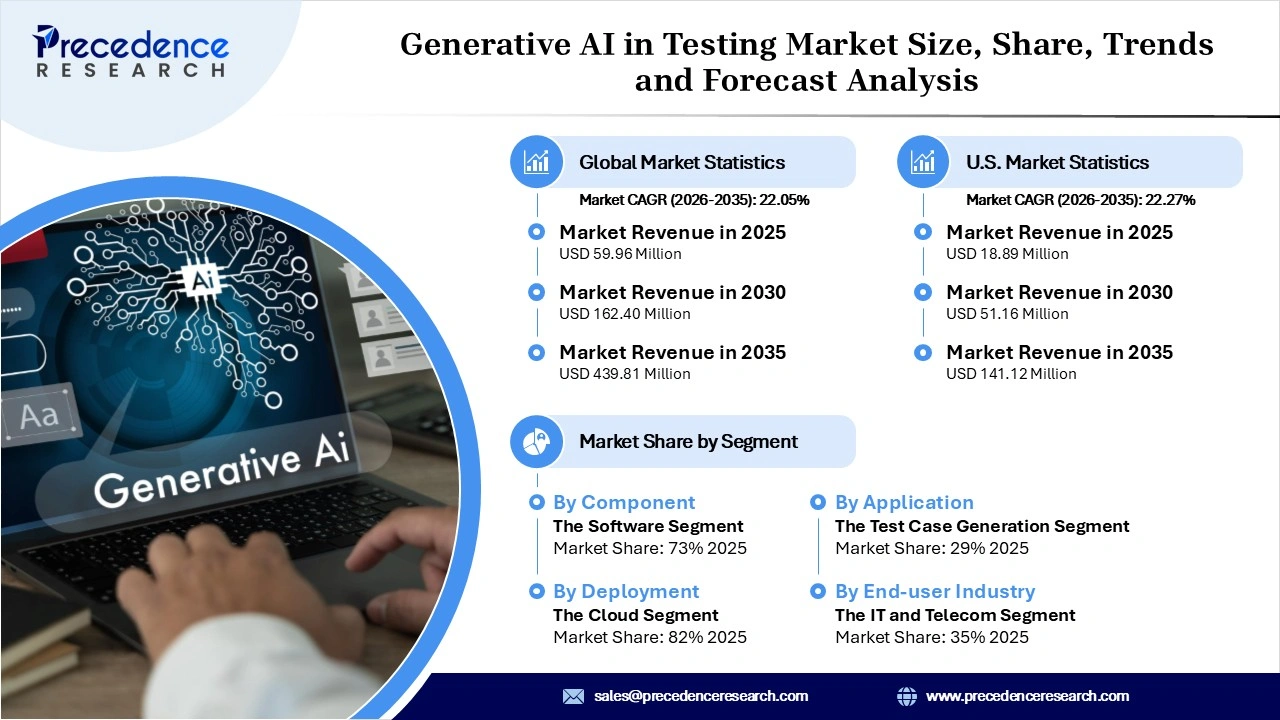
The global generative AI in testing market revenue reached USD 59.96 million in 2025 and is predicted to attain around USD 439.81 million by 2035 with a CAGR of 22.05%. The growth of the market is driven by growing digitalization and the demand for automated test case generation, faster software development cycles, and improved quality assurance through AI-powered testing solutions.
What Drives the Generative AI in Testing Market?
There is a rapid shift toward autonomous quality engineering, which is accelerating growth. Large language models are being used for natural language–based test creation, enabling requirements to be automatically converted into generative test code, while self-healing mechanisms repair broken scripts during UI updates. Additionally, the use of synthetic data generation and predictive defect analysis helps address bottlenecks in CI/CD pipelines and improves testing efficiency. Growing focus on software resilience and the mitigation of AI model hallucinations is further driving the adoption of generative AI in testing solutions.
Segment Insights
- By component, the software segment dominated the market in 2025 due to its ability to transform machine learning outputs into actionable quality gates within testing workflows. It interprets user interactions to build automation suites that evolve alongside code changes, enabling autonomous remediation and the generation of high-fidelity synthetic datasets that mirror production environments. Additionally, software solutions synchronize risk assessments with automated regression testing, ensuring greater reliability and stability in continuous delivery pipelines.
- By deployment, the cloud segment held the biggest market share in 2025, as it provides scalable infrastructure for processing machine learning models while enabling collaboration and real-time distribution. Cloud platforms allow organizations to execute large test suites and generate synthetic data without relying on local hardware, offering enhanced scalability and resource optimization. Additionally, these solutions integrate seamlessly with established DevOps pipelines to deliver continuous intelligence and analytics for modern software development and delivery.
- By application, the test case generation segment maintains its dominance by holding the largest share in 2025. It bridges business requirements with verification processes by leveraging deep learning to explore application workflows and automatically generate test scenarios. These AI-generated cases act as reusable testing assets, reducing manual effort while improving automation quality assurance. This proactive testing approach enhances software integrity, optimizes resource allocation, and accelerates the overall testing process.
- By end-use industry, the IT and telecom segment led the market in 2025, as IT and telecom companies heavily leverage generative AI for autonomous network validation, managing interdependencies in 5G, edge computing, and virtual functions. It automates protocol simulations and distributed traffic models to ensure continuous software updates and high service levels, enabling operational resilience and reducing costs through a self-healing quality framework.
Regional Insights
North America dominated the generative AI in testing market by holding the largest market share in 2025, driven by rapid technological advancements and increasing adoption of autonomous testing ecosystems by enterprises. Supportive government policies and strong investments in digital transformation further accelerate the adoption of AI-driven testing solutions across industries. Additionally, the region’s highly skilled talent pool and well-established regulatory frameworks facilitate the integration of generative AI into mission-critical software development and delivery systems, reinforcing North America’s leadership in the market.
Asia Pacific is anticipated to grow at the fastest CAGR during the forecast period due to the rapid shift toward intelligent automation across industries. The expansion of digital economies and the growing software engineering workforce, particularly in mobile and fintech ecosystems, are accelerating the adoption of generative AI testing solutions. Additionally, the development of domestic language models and AI-augmented quality engineering practices is helping establish new standards for software resilience and reliability in the region.
Generative AI in Testing Market Coverage
| Report Attribute | Key Statistics |
| Market Revenue in 2025 | USD 59.96 Million |
| Market Revenue by 2035 | USD 439.81 Million |
| CAGR from 2026 to 2035 | 22.05% |
| Quantitative Units | Revenue in USD million/billion, Volume in units |
| Largest Market | North America |
| Base Year | 2025 |
| Regions Covered | North America, Europe, Asia-Pacific, Latin America, and the Middle East & Africa |
Recent Development
- In February 2026, Tata Group and OpenAI announced a collaboration to build next-generation AI infrastructure across the enterprise and consumer sectors. The multi-dimensional partnership focuses on building industry-specific agentic AI solutions and AI transformation. (Source: https://www.tata.com)
Get this report to explore global market size, share, CAGR, and trends, featuring detailed segmental analysis and an insightful competitive landscape overview @ https://www.precedenceresearch.com/sample/8062
You can place an order or ask any questions, please feel free to contact us at sales@precedenceresearch.com |+1 804 441 9344