



Healthcare Facilities Management Market Revenue to Attain USD 889.60 Bn by 2035
Published: 06 May 2026
Author: Precedence Research



Healthcare Facilities Management Market Revenue and Trends 2026 to 2035
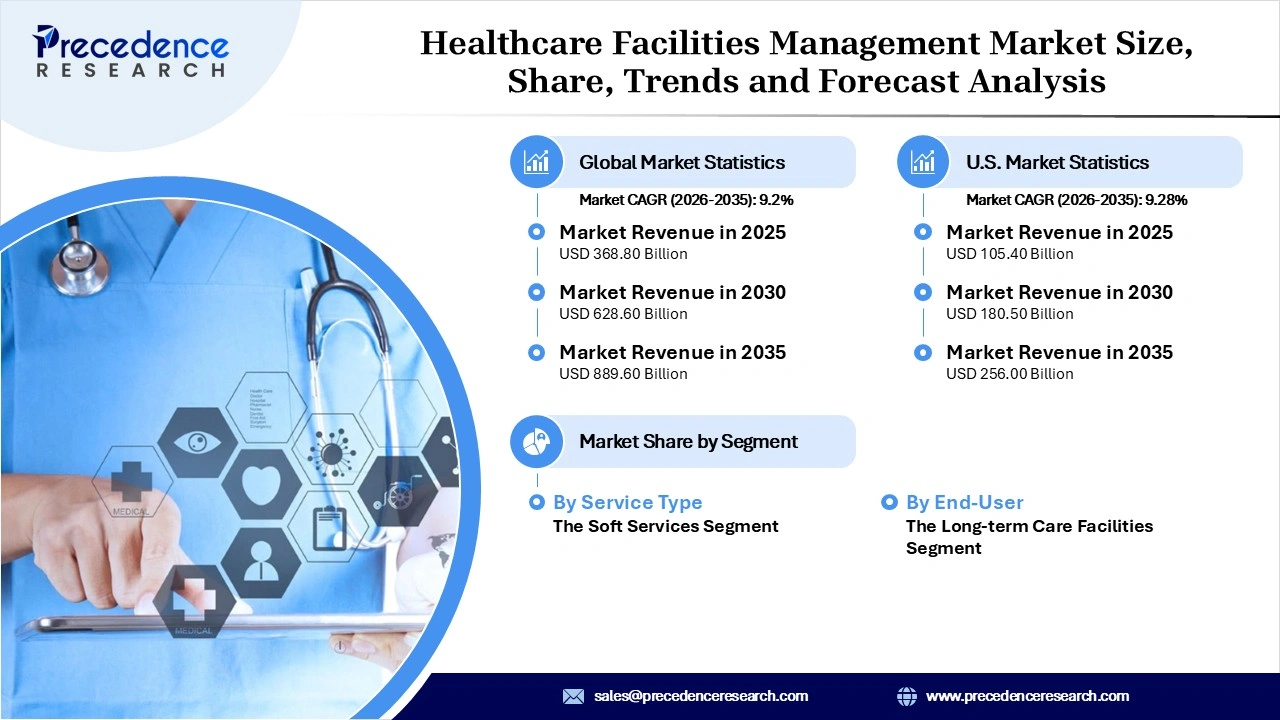
The healthcare facilities management market size was valued at USD 368.80 billion in 2025 and is projected to increase from USD 417.60 billion in 2026 to approximately USD 889.60 billion by 2035, expanding at a CAGR of 9.2% from 2026 to 2035. The healthcare facilities management market deals with the effective functioning, upkeep, and improvement of healthcare infrastructure, including safety, compliance, environment of care, and patient care quality. The factors such as growing healthcare infrastructure development, increasing demand for operational efficiency in facilities management, stringent regulations, and the high adoption of outsourcing and digital solutions are expected to fuel the growth in this market.
Market at a Glance
Broadly, the healthcare facilities management industry includes services such as maintenance, cleaning, security, waste management, and technical assistance to ensure the proper running of hospitals, clinics, and other healthcare organizations. It covers both your “hard” services, such as mechanical and electrical engineering, building fabric maintenance, cleaning, and security, and your “soft” services, such as catering, help desk, health and safety, administration, waste management, patient entertainment, transport, and laundry. The market is broadly categorized into public and private health care services, which include hospitals, ambulatory centres, and long-term care facilities. Market Expansion Based on Technology. There is a rising focus on patient safety, regulatory compliance, and operational efficiency; the market is being shaped by smart technologies, automation, and integrated service models.
Market Forecast
The Ayushman Bharat Digital Mission (ABDM) the government scheme promoted the article is reshaping the market of healthcare facility management by boosting the went digital infrastructure in hospitals. Complex health management information systems (HMIS) and electronic health records (EHRs) need to be integrated with modern facility management software, IT solutions, and smart hospital solutions. Meanwhile, persisting concerns about integration, training and compliance are fuelling needs for outsourced FM and consulting services. While this extension of compliance deadlines addresses short-term operational challenges, it supports long-term industry growth by encouraging productivity, harmonization, and movement toward the digitally enabled, connected healthcare facilities. (Source: timesofindia.indiatimes.com)
The Telangana government has formulated the modified policy for Integrated Hospital Facility Management System(IHFMS) where non-clinical hospital services such as sanitation, security, pest control and patient help are brought under one roof in the name of unified and standardized system. The strategy calls for increasing staffing levels, per-bed expenditures, workforce training and infrastructure upkeep to fill in deficits in sanitation and facilities. This is a very positive move for the healthcare facilities management market as it will escalate the demand for facility management service providers, and manpower. In that sense, by systematizing and scaling facility operations, it generates new revenue models for vendors and incentivizes the use of structured, technology-enabled management models. Overall, the policy serves as a powerful investment driver, contributing to productivity, service quality, and sustained industry growth. (Source: timesofindia.indiatimes.com)
Secondary Data
| Region | Annual growth rate | Total population | Pregnancies = Birth | Births |
| Arusha | 2.74% | 1,694,310 | 71,161 | 71,161 |
| Dar es Salaam | 5.76% | 4,364,541 | 130,936 | 130,936 |
| Dodoma | 2.12% | 2,083,055 | 87,488 | 87,488 |
| Iringa | 1.11% | 1,643,335 | 69,020 | 69,020 |
| Kagera | 3.25% | 2,773,054 | 122,014 | 122,014 |
Population estimates/denominators
A useful approach to estimate the number of births is to multiply the population of an area by the most accurate estimate of the Crude Birth Rate (CBR). Regardless of the estimation method selected, the denominators used for calculating coverage of antenatal care, institutional deliveries, post-natal care, and childhood immunization need to be consistently defined: For calculating coverage with first antenatal care visits before 16 weeks of gestation, use the count of early pregnancies which is the number of births plus total pregnancy losses. Total pregnancy loss can be estimated as approximately 10% of total births. For computing coverage with later antenatal visits, use the number of late pregnancies, which is the number of births plus the number of stillbirths. The number of stillbirths can be estimated to be around 2% of total births. For the calculation of coverage concerning institutional deliveries and post-natal care coverage for mothers, consider the number of deliveries, which is the number of births minus the number of twins. The number of twins can be roughly estimated at 1% of the total number of births. For calculating the coverage of children receiving post-natal care, use the total count of births. For determining coverage in childhood immunization, utilize the number of surviving infants, which equals the number of births minus the number of infant deaths. The number of infant deaths can be approximated as the Infant Mortality Rate multiplied by the total population divided by 1,000.
Segmental Insights
Service
By service type, the soft service segment held the largest market share of 82% in 2025, owing to the growing utilization of digital platforms for tracking, scheduling, and optimizing the operations of the facility. These solutions improve all aspects of data collection, predictive maintenance, and resource management, resulting in better overall operations. The growing focus on smart hospitals and integrated facility management systems will continue to boost the proportion of software-based services.
Hard services are fastest growing in the market, keeping a certain CAGR, as these services deal with essential infrastructure services such as HVAC, electrical, plumbing, and building services. The increasing demand for continuous healthcare services and stringent regulatory compliance is propelling the need for efficient maintenance solutions. In addition, the growth of the healthcare infrastructure worldwide is driving the growth of this segment.
End User
By end-user, the hospitals and clinics segment held the largest market share in 2025; these spaces need to be controlled with solutions that keep them clean, safe, functioning, and compliant with regulations. Increased patient numbers and the complexity of healthcare delivery are also driving demand in this market segment.
Long-term care facilities are the fastest-growing in the market, keeping a certain CAGR, due to the expanding elderly population and growing demand for assisted living, rehabilitation, and other services. These homes need specialized facility management to maintain comfort, safety, and uninterrupted care for the patients. The increasing emphasis on quality of life and long-term patient care is driving the growth of this segment.
Regional Insights
North America dominates the healthcare facilities management market due to its well-established healthcare infrastructure and high healthcare expenditure. The region has a strong presence of advanced hospitals and healthcare institutions that require comprehensive facility management services. Increasing adoption of digital technologies, such as IoT and AI, is enhancing operational efficiency and driving market growth. Additionally, strict regulatory standards and compliance requirements are encouraging healthcare providers to invest in professional facility management solutions.
Europe represents a significant market for healthcare facilities management, supported by strong public healthcare systems and an increasing focus on quality and sustainability. Governments across the region are investing in modernizing healthcare infrastructure and improving facility standards. The adoption of energy-efficient systems and sustainable building practices is a key trend driving market growth. Additionally, stringent regulations related to hygiene, safety, and environmental standards are pushing healthcare providers to adopt advanced facility management solutions.
Top Companies in the Healthcare Facilities Management Market
- ABM Industries Inc.: A leader in healthcare-focused facility solutions, prioritizing patient-centered cleaning and infection control.
- ISS World Services A/S: A prominent Danish facility management company providing integrated services on a global scale.
- Jones Lang LaSalle (JLL) IP, Inc.: A global commercial real estate and facility management firm.
- Sodexo: A leading French company focusing on on-site services, including catering and facility management.
- Compass Group plc: The world's largest food services company, providing cleaning and maintenance services.
- Aramark Corporation: A major American provider of food, facilities, and uniform services.
- Ecolab, Inc.: A leader in infection prevention and specialized cleaning services.
- Medxcel Facility Management: Specialized in providing tailored facility services for healthcare organizations.
- Mitie Group plc: A major UK-based facilities management firm.
- OCS Group: Provides a range of facility management services.
- Secro Group plc (Serco): Offers specialized services for public and private sectors, including health.
- Manutencoop Facility Management S.p.A. (MFM): A key player in integrated facility services.
- Vanguard Resources: Focused on hospital and healthcare facilities management.
- UEM Edgenta Berhad: A leading management firm with a strong presence in healthcare support services
Segments Covered in the Report
By Service Type
- Hard Services
- Mechanical and Electrical Maintenance
- Plumbing, Air Conditioning Maintenance
- Fire Protection Systems
- Others
- Soft Services
- Laundry
- Waste Management
- Cleaning & Pest Control
- Catering
- Security
- Others
By End User
- Hospitals and Clinics
- Long-Term Healthcare Facilities
- Others
Get this report to explore global market size, share, CAGR, and trends, featuring detailed segmental analysis and an insightful competitive landscape overview@ https://www.precedenceresearch.com/checkout/1026
You can place an order or ask any questions, please feel free to contact at sales@precedenceresearch.com | +1 804 441 9344