



Hexanal Market Revenue to Attain USD 412.98 Bn by 2035
Published: 26 Jun 2026
Author: Precedence Research



Hexanal Market Revenue and Trends 2026 to 2035
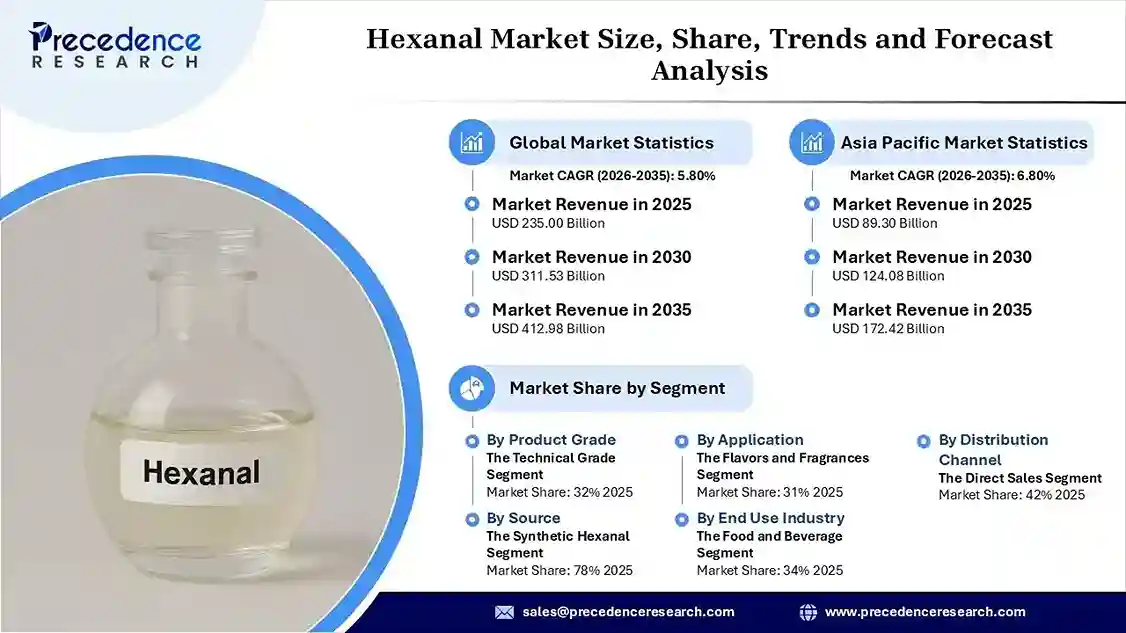
The global hexanal market revenue reached USD 235.00 billion in 2025 and is predicted to attain around USD 412.98 billion by 2035 with a CAGR of 5.80%. The market is driven by its extensive applications in food and beverages as a natural flavoring ingredient due to its characteristic fresh, green, and fruity flavor, as an important intermediate in fragrances and fine chemical manufacturing processes, and the increased demand for natural ingredients from consumers.
Fresh Notes, Green Chemistry
The hexanal market involves the production, purification, and worldwide supply of hexanal, which is a six-carbon aldehyde (C6H12O), which is a colorless liquid characterized by a fresh, grassy, green, and fruity smell. It is naturally found in many fruits and vegetables, and is extensively utilized as a flavorant in food and beverage industries and in the manufacture of perfumes and fragrances.
The market comprises both natural (obtained through plant extraction or oxidation of linoleic acid enzyme) and synthesized hexanal (hydroformylation of 1-pentene or oxidation of hexanol). Major applications of hexanal include usage in food flavorants, beverage preparations, fragrances, and as agrochemical intermediates for the production of herbicides and fungicides. This market has been adopted by flavor and fragrance manufacturers, food and beverage producers, agrochemical companies, and specialty chemical manufacturers.
Nanofiber Encapsulation to Preserve Fresh Produce
The market is developing owing to modern encapsulation methods, which counter the volatile nature of hexanal by allowing its controlled and sustained release in food preservation processes. Modern electrospinning technology permits hexanal to be encapsulated in water-sensitive polymer systems for the purpose of gradual release upon a change in humidity levels. In 2025, scientists created a hexanal nanofibers matrix (HNFM) using electrospinning. In this study, the shelf life of commercially ripe green tomatoes was prolonged to 32 days as opposed to 18 days of unmodified green tomatoes. Fibers had an average diameter ranging from 151.2 nm to 345.8 nm, and gas chromatography proved hexanal vapor diffusion from the matrix.
Formulation Technology Prolongs Softening in High-Value Fruit
The hexanal market is making progress using enhanced freshness formulations incorporating hexanal and antioxidants to prolong the storage life of climacteric fruits. The technology inhibits cell wall-degrading enzymes and preserves polysaccharide structures in cells, thus effectively postponing softening of fruit in cold storage. A 2025 research article published in the International Journal of Fruit Science examined a hexanal-based enhanced freshness formulation (EFF) effect on ‘Y368’ kiwifruits collected at two different maturation stages (7% and 9% TSS). In week 9 of storage, non-treated fruit had a firmness of about 5N, whereas 0.02% EFF-treated fruit had a firmness of 10N. Mass loss was reduced by 22% to 27%, and EFF-treatment preserved cell wall polysaccharides while inhibiting polygalacturonase, beta-galactosidase, and cellulase activities.
Government Initiatives to Improve National Post-Harvest Infrastructure
Governments across the globe are implementing funding schemes to ensure a reduction in post-harvest loss in fruits, vegetables, and other perishables through support to infrastructure, processing centers, and storage facilities. Such national programs facilitate the provision of grants-in-aid to business enterprises and create an enabling environment for the implementation of hexanal-based fruit preservation technology on an industrial scale. In 2025, the Ministry of Food Processing Industries of India provided USD 1.06 billion in grants-in-aid in the Pradhan Mantri Kisan Sampada Yojana (PMSKY) in 1,601 projects in the nation.
Innovative Spray Method to Reduce Hexanal Content in Leather by Approxmately 50%
An innovative spray technique that reduces hexanal content in leather from 41.8 microgram/gram to 20.8 microgram/gram was invented in 2026 by researchers using polyethyleneimine spray. Optimal conditions (400g/m2 spray and 1.5% concentration at pH 4) were provided. The spray treatment method made the leather odor “slight but perceptible” from being “strongly offensive”.
Market Segmentation Overview
- By product grade, the technical grade segment led the hexanal market with 32% share in 2025, since it satisfies the purity criteria for most of the high-volume applications, such as flavoring agents, fragrance intermediates, and agricultural chemical production, where economical efficiency is a priority over ultra-high-purity. This segment has been widely adopted in various industrial uses, ranging from food processing to leather processing.
- By product type, the high purity grade segment is expected to expand at the highest CAGR of 7.4% during the forecast period, owing to the increasing need for extremely pure ingredients in novel applications, including use in pharmaceutical intermediates and fine chemicals. These applications require extremely high purity in order to guarantee safety, adherence to regulations, and consistency between batches.
- By source, the synthetic hexanal segment dominated the market with 78% share in 2025, due to its manufacture through the use of reliable, economical petrochemical processes, allowing the delivery of adequate volumes at much lower prices than natural extraction. It is a preferred source for industrial uses such as agrochemicals, polymer processing, and leather production.
- By source, the natural hexanal segment is expected to grow at the fastest CAGR of 8.4% from 2026 to 2035, because of the growing consumer inclination towards clean-label, plant-based, and natural ingredients in food, beverages, and cosmetics. Better extraction processes and greater emphasis on producing natural hexanal are leading to increased availability and reduced prices.
- By application, the flavors and fragrances segment led the market with 31% share in 2025, due to the fact that hexanal is used as a flavor compound to impart green and fruity flavor, providing a distinct taste of fresh apples and citrus fruits. It is used for the preparation of fruit flavors in beverages, candies, and bakery products, and also to provide freshness to premium quality perfumes.
- By application, the food preservation segment is expected to expand at the highest CAGR of 7.2% during the forecast period, since post-harvest losses associated with fruits and vegetables are significant, which leads to significant impetus being put on developing methods to preserve fresh produce. Hexanal-based processes have proven their efficiency in significantly reducing losses related to harvest.
- By end use industry, the food and beverage segment dominated the hexanal market with 34% share in 2025 and is expected to expand at the fastest CAGR of 6.9% from 2026 to 2035, because hexanal is used in numerous food products like beverages, confectionery, bakery, and dairy items. It has been widely adopted by almost all food producers and flavoring houses globally.
- By end use industry, the chemicals segment held the second-largest market share of 25% in 2025, since hexanal is a chemical that is utilized as an intermediate and as a raw material in the production of several derivatives, including hexanoic acid, hexyl esters, and higher aldehydes, which are further used in making plasticizers, lubricants, and specialty chemicals.
- By distribution channel, the direct sales segment led the market with 42% share in 2025, since hexanal is a specialized industrial chemical that usually needs to be bought in bulk by large flavor and fragrance companies, food manufacturers, agrochemical, and chemical companies.
- By distribution channel, the online platforms segment is expected to expand at the highest CAGR of 10.1% during the forecast period, because it facilitates easy purchase for small and medium-sized flavor companies, food processing industries, and laboratories, who need hexanal in lesser amounts without the need to sign any long-term contract or minimum quantity purchase rules.
Regional Analysis
Asia-Pacific dominated the hexanal market with 38% share in 2025 and is expected to grow at the fastest CAGR of 6.8% from 2026 to 2035, because it accounts for the maximum global production and consumption of fruits, vegetables, and processed food products, which drives the demand for hexanal as a flavor enhancer and post-harvest preservative. China led the market in Asia-Pacific because of a well-established food processing industry, extensive manufacturing of synthetic hexanal using petrochemical pathways, and its role as a major source of hexanal for the global flavor and fragrance market. India is a significant contributor to the market owing to the fast-paced growth of the processed food products sector, an increase in the usage of natural flavors in the beverages and confections industry, and increased utilization of hexanal-based preservation technologies to reduce post-harvest losses in tropical fruits like mangoes and bananas.
Europe held the second-largest market share of 25% in 2025, because of its highly developed flavor and fragrance industry, which is among the biggest consumers of hexanal in order to produce flavors and fragrances with fresh and fruity notes in drinks, confectionery, and premium perfumes. Germany led the market in Europe due to the fact that it is the biggest chemical and flavor manufacturing center on the continent, owing to its state-of-the-art flavor houses, advanced food processing industry, and significant capability to produce synthetic hexanal. France witnessed notable market growth owing to its well-developed perfume and flavor industry located in the city of Grasse, and high usage of natural hexanal in premium fragrances and food products due to its stringent regulatory environment.
North America held the third-largest market share of 22% in 2025, due to its strong leadership in high-quality products and FDA and EPA-regulations-compliant hexanal grades that have significant applications in pharmaceuticals, food, and fragrance industries. The U.S. dominated the market in North America owing to its significant advanced flavor and fragrance industry, strict policies regarding various pharmaceutical and agrochemical products, and the ongoing trend of clean-labelling that has made it one of the largest consumers of natural hexanal for organic and natural foods. The Canadian market is growing because of its long-standing food processing and flavor industry, significant focus on natural and sustainable ingredients, and its involvement in research and development of post-harvest technology using hexanal.
Hexanal Market Coverage
| Report Attribute | Key Statistics |
| Market Revenue in 2025 | USD 235.00 Billion |
| Market Revenue by 2035 | USD 412.98 Billion |
| CAGR from 2026 to 2035 | 5.80% |
| Quantitative Units | Revenue in USD million/billion, Volume in units |
| Largest Market | North America |
| Base Year | 2025 |
| Regions Covered | North America, Europe, Asia-Pacific, Latin America, and the Middle East & Africa |
Top Companies in the Hexanal Market
BASF SE, Merck KGaA (Sigma-Aldrich), and Tokyo Chemical Industry Co., Ltd. are some of the key players that are global manufacturers and distributors of hexanal with very high purity levels for use in medicines, flavors, and research purposes. Alfa Aesar (Thermo Fisher Scientific), Acros Organics (Thermo Fisher Scientific), and Merck Life Science distribute hexanal under a vast range of fine chemicals produced by them for research and industrial purposes. Parchem Fine and Specialty Chemicals is an important distributor and trading company for hexanal, along with other aldehyde compounds, in the flavor and fragrance industry. Central Drug House (CDH), Loba Chemie Pvt. Ltd., Otto Chemie Pvt. Ltd., and Sisco Research Laboratories (SRL) are some of the key Indian suppliers of hexanal.
Segments Covered in This Report
By Product Grade
- Technical Grade
- Food Grade
- Pharmaceutical Grade
- Fragrance Grade
- High Purity Grade
By Source
- Synthetic Hexanal
- Natural Hexanal
By Application
- Flavors and Fragrances
- Food Preservation
- Agrochemicals
- Chemical Intermediates
- Pharmaceuticals
- Research and Laboratory Applications
- Others
By End Use Industry
- Food and Beverage
- Chemicals
- Agriculture
- Pharmaceuticals
- Personal Care and Cosmetics
- Research Institutions
- Others
By Distribution Channel
- Direct Sales
- Chemical Distributors
- Specialty Ingredient Suppliers
- Online Platforms
By Region
- North America
- Latin America
- Europe
- Asia-pacific
- Middle and East Africa
Get this report to explore global market size, share, CAGR, and trends, featuring detailed segmental analysis and an insightful competitive landscape overview @ https://www.precedenceresearch.com/sample/8523
You can place an order or ask any questions. Please feel free to contact us at sales@precedenceresearch.com |+1 804 441 9344