



Inflammatory Disease Market Revenue to Attain USD 241.34 Bn by 2035
Published: 22 Apr 2026
Author: Precedence Research



Inflammatory Disease Market Revenue and Trends 2026 to 2035
The global inflammatory disease market revenue was valued at USD 125.00 billion in 2025 and is expected to attain around USD 241.34 billion by 2035, growing at a CAGR of 6.80% during forecast period. The market is driven by the rising prevalence of chronic immune disorders driven by aging, lifestyle changes, and environmental factors, while advances in molecular-level therapies are enabling more precise and effective treatment.
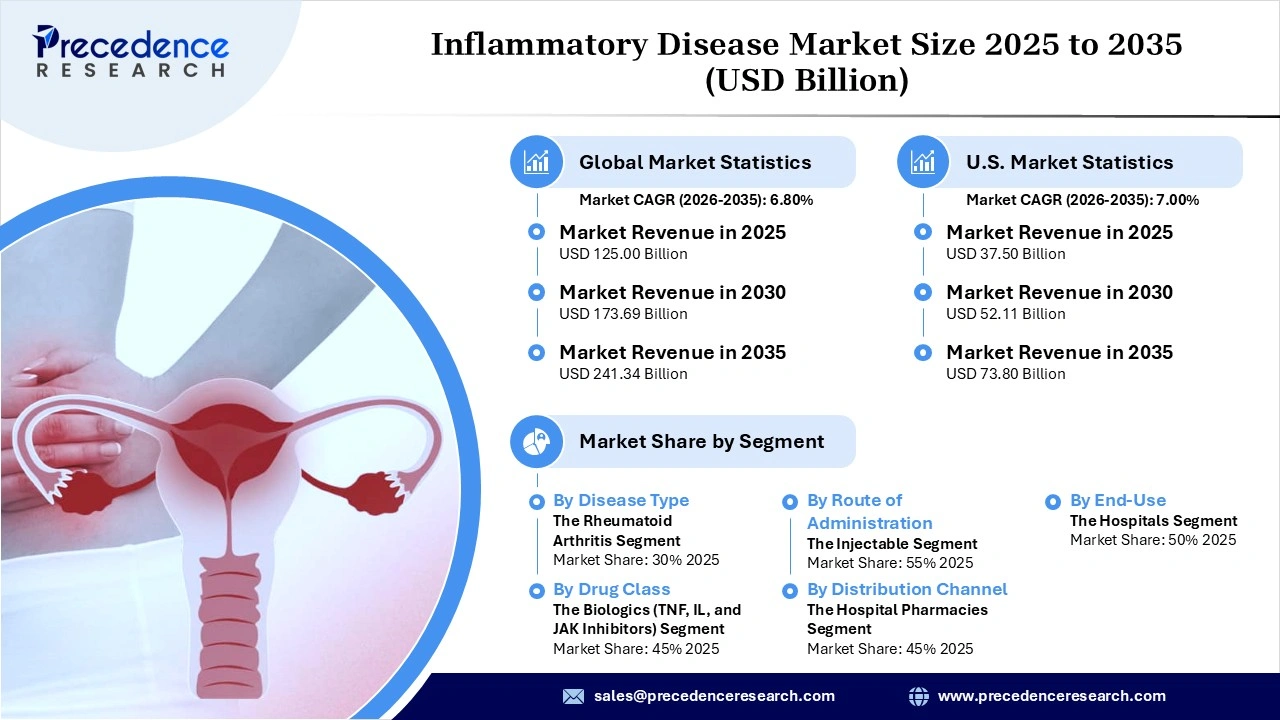
Market at a Glance
The inflammatory diseases market encompasses therapeutic, diagnostic, and clinical solutions aimed at managing conditions caused by persistent and dysregulated immune responses that can damage the body. It includes a range of advanced treatments such as biologics, targeted small molecules, and diagnostic technologies used for diseases like rheumatoid arthritis, psoriasis, and inflammatory bowel disease. The market is growing due to a strong emphasis on long-term disease management rather than complete cures.
What Drives the Inflammatory Disease Market?
- Development of Autoimmune Therapies: The rising development of autoimmune therapies is a major factor driving the market. Eli Lilly and Company entered a $1.93 billion partnership to advance precision autoimmune therapies, focusing on reprogramming the immune system rather than broadly suppressing it. This reflects a broader industry shift in which drug development pipelines are increasingly built through collaborations, licensing agreements, and platform-based innovations rather than relying solely on internal R&D.
- Growing Focus on Early Diagnosis and Disease Management: Improved diagnostic technologies and greater awareness are enabling earlier detection of inflammatory diseases. Early intervention helps reduce disease severity and progression, increasing demand for ongoing therapeutic solutions.
How are Government Initiatives Supporting the Market?
- Government initiatives are supporting the market by increasing funding for research and development, enabling the creation of innovative therapies, diagnostics, and advanced healthcare technologies. Public-private partnerships and international collaborations are also accelerating the commercialization of new solutions and expanding access to cutting-edge treatments.
- In Jan 2026, the Technology Development Board (TDB), under the Department of Science & Technology, Government of India, partnered with Drstore Healthcare Service India Pvt. Ltd. to support a collaborative R&D project on a multivital continuous glucose monitoring (CGM) device integrated with cardiovascular biomarkers. Backed by the Indo-Canada Collaborative Industrial R&D Programme and developed in collaboration with Nanospeed Diagnostics Inc., the initiative aims to enable early detection and remote monitoring of cardio-metabolic conditions. The project supports preventive healthcare, digital health adoption, and the development of affordable, indigenous medical technologies.
- The U.S. government is actively supporting early detection of inflammatory diseases through targeted funding, strategic research initiatives, and public-private partnerships focused on autoimmune, rare, and neurodegenerative conditions. The NIH-Wide Strategic Plan for Autoimmune Disease Research (FY2026–2030) prioritizes identifying the prodromal (pre-symptomatic) phase of disease, enabling earlier intervention and improved long-term outcomes.
Market Segmentation Overview
- By disease type, the rheumatoid arthritis segment held a 30% share in the inflammatory disease market in 2025 because of its high global prevalence and early, widespread adoption of biologics and targeted therapies. Its chronic and progressive nature necessitates continuous long-term treatment, making it a stable revenue contributor for the market.
- By disease type, the inflammatory bowel disease segment is expected to grow at the fastest CAGR of 7.8% in the market between 2026 and 2035. This is mainly due to the rising incidence rates and improved diagnostic capabilities. Increasing adoption of biologic therapies, along with greater disease awareness, is expected to accelerate segmental growth.
- By drug class, the biologics segment held a major revenue share of 45.0% in 2025 due to their high efficacy in targeting specific inflammatory pathways compared to traditional drugs. Their crucial role in chronic disease management, especially in moderate to severe cases, positioned them as the backbone of modern inflammatory disease treatment strategies.
- By drug class, the biosimilars segment is expected to grow at the fastest CAGR of 9.5% in the market between 2026 and 2035, owing to their cost advantage over branded biologics and a steady rise in global regulatory approvals. As healthcare systems look for affordability without compromising efficacy, biosimilars are likely to unlock wider patient access across regions.
- By route of administration, the injectable segment led the inflammatory disease market in 2025 with a 55% share, driven by the widespread use of biologics delivered via subcutaneous or intravenous routes. Their proven efficacy and extensive use in managing moderate to severe chronic inflammatory conditions, particularly in hospital and specialty care settings, have established injectables as the standard of care.
- By route of administration, the oral segment is expected to expand rapidly with a CAGR of 6.0% in the coming years, supported by strong patient preference for convenience and ease of administration. Oral therapies are increasingly being adopted for mild to moderate conditions and long-term maintenance treatment, gradually reducing reliance on hospital-based injectable therapies.
- By distribution channel, the hospital pharmacies segment accounted for a significant share of 45% in 2025, owing to the need for clinical supervision during the administration of biologics and other specialty drugs. The complexity of these therapies and the requirement for patient monitoring have reinforced hospitals as a central point for drug dispensing and disease management in severe cases.
- By distribution channel, the online pharmacies segment is expected to grow at the fastest CAGR of 9.0% in the market between 2026 and 2035, driven by growing digital adoption and the convenience of home delivery services. As patients with chronic conditions increasingly prioritize continuity of care, online channels are reshaping the distribution landscape for inflammatory disease therapies.
- By end-use, the hospitals segment held a major revenue share of 50% in the inflammatory disease market in 2025 due to their critical role in administering advanced biologics and managing severe inflammatory diseases. The presence of specialized infrastructure, trained professionals, and emergency care capabilities ensures hospitals remain central to high-value treatment delivery.
- By end-use, the specialty clinics segment is expected to grow at a CAGR of 7.5% in the market between 2026 and 2035, driven by their focused approach to managing chronic inflammatory diseases through personalized and continuous care. With shorter waiting times and specialized expertise, these clinics are increasingly preferred by patients seeking targeted treatment and improved healthcare experiences.
Regional Analysis
North America dominated the global inflammatory disease market with a major share of 40% in 2025, driven by early and widespread adoption of biologics, a well-established healthcare system capable of supporting high-cost therapies, and strong ongoing research and development activities. The U.S. serves as the primary growth hub due to high biologics uptake, favorable reimbursement frameworks, and a robust clinical pipeline. Canada also contributes to the regional market through structured healthcare access and steady adoption of advanced therapeutic options.
Asia Pacific held a market share of 25% in 2025 and is expected to grow at the fastest CAGR of 8.5% during the forecast period, driven by the rising prevalence of inflammatory diseases, expanding healthcare access initiatives, and increasing pharmaceutical investments. China and India are expected to lead this growth, with China benefiting from rapid biologics adoption and strong domestic manufacturing capabilities, while India is driven by improved diagnosis rates and the growing availability of cost-effective biosimilar therapies.
Inflammatory Disease Market Coverage
| Report Attribute | Key Statistics |
| Market Revenue in 2025 | USD 125.00 Billion |
| Market Revenue by 2035 | USD 241.34 Billion |
| CAGR from 2026 to 2035 | 6.80% |
| Quantitative Units | Revenue in USD million/billion, Volume in units |
| Largest Market | North America |
| Base Year | 2025 |
| Regions Covered | North America, Europe, Asia-Pacific, Latin America, and the Middle East & Africa |
Top Companies in the Inflammatory Disease Market
AbbVie Inc. has established a strong presence in the immunology space, while Johnson & Johnson and Pfizer Inc. leverage their scale and diversified portfolios to maintain significant roles in inflammatory care. Novartis AG and Amgen Inc. focus on precision-driven strategies, emphasizing targeted biologics and advanced therapies. Meanwhile, Roche Holding AG and Sanofi S.A. continue to advance in immunology, delivering therapies that are increasingly recognized as global standards of care.
Segments Covered in the Report
By Disease Type
- Rheumatoid Arthritis
- Inflammatory Bowel Disease (Crohn’s Disease, Ulcerative Colitis)
- Psoriasis & Psoriatic Arthritis
- Asthma & Chronic Inflammatory Respiratory Diseases
- Multiple Sclerosis & Neuroinflammatory Disorders
By Drug Class
- Biologics (TNF Inhibitors, IL Inhibitors, JAK Inhibitors)
- Nonsteroidal Anti-inflammatory Drugs (NSAIDs)
- Corticosteroids
- Immunosuppressants
- Biosimilars
By Route of Administration
- Injectable (Subcutaneous & Intravenous)
- Oral
- Topical
By Distribution Channel
- Hospital Pharmacies
- Retail Pharmacies
- Online Pharmacies
By End-Use
- Hospitals
- Specialty Clinics
- Homecare Settings
By Region
- North America
- Latin America
- Europe
- Asia-pacific
- Middle and East Africa
Get this report to explore global market size, share, CAGR, and trends, featuring detailed segmental analysis and an insightful competitive landscape overview @ https://www.precedenceresearch.com/sample/8327
You can place an order or ask any questions, please feel free to contact us at sales@precedenceresearch.com |+1 804 441 9344