



Intelligent Data Pipelines Market Revenue to Attain USD 123.73 Bn by 2035
Published: 04 Jun 2026
Author: Precedence Research



Intelligent Data Pipelines Market Revenue and Trends 2026 to 2035
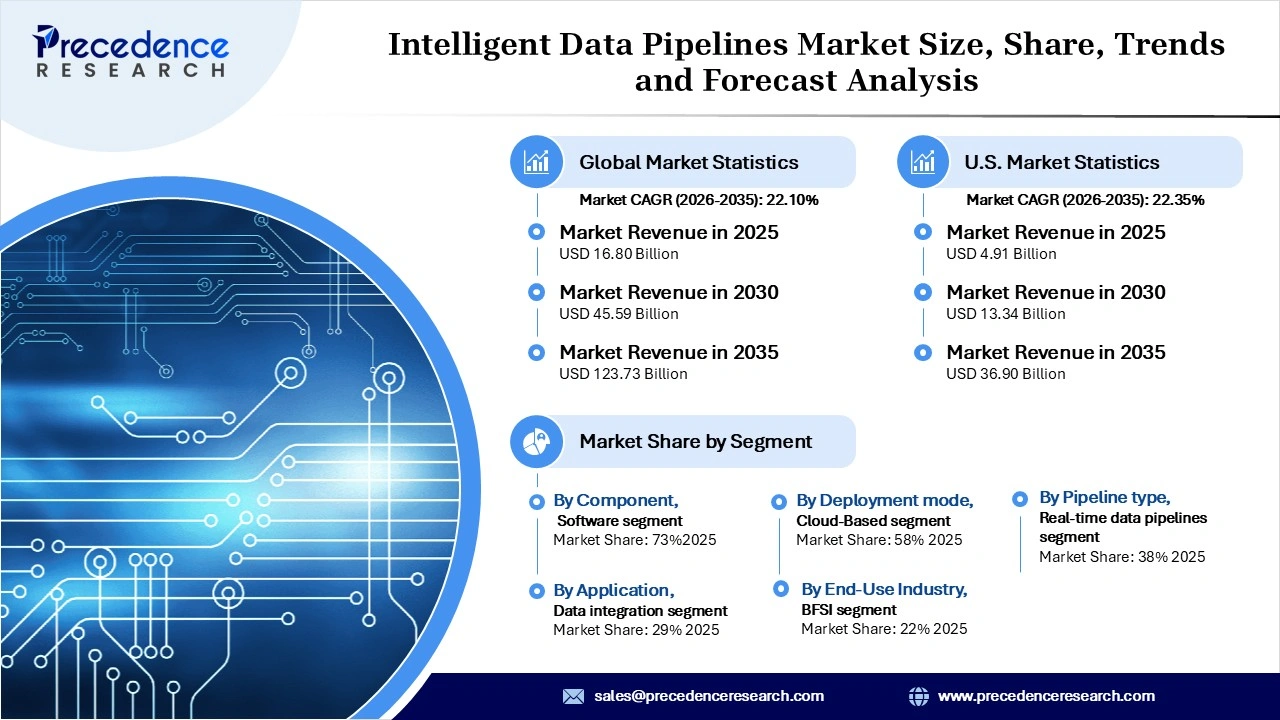
The global intelligent data pipelines market revenue surpassed USD 16.80 billion in 2025 and is predicted to attain around USD 123.73 billion by 2035, growing at a CAGR of 22.10%. The market is driven by the rapid increase in data generation through cloud apps, Internet of Things (IoT), and AI, which need intelligent data pipelines for ensuring the timely delivery of information along with its quality and governance.
Market Overview
The intelligent data pipelines market comprises software solutions, platforms, and services that automate the process of ingesting, transforming, and moving data from various sources to target systems using intelligence capabilities. These capabilities include machine learning and predefined rules for self-optimization and anomaly detection purposes. While legacy ETL (extract, transform, load) processes require developers manual intervention, intelligent data pipelines make use of automation, push-down optimization, and real-time monitoring based on metadata.
Cloud-native and hybrid data pipelines are widely used in real-time analytics, AI and machine learning model training, data lakehouse ingestion, and operational data ingestion, enabling organizations to process and analyze data at scale with greater speed and flexibility. These pipelines typically include key components such as data connectors, stream processing engines, data quality and cleansing modules, observability platforms, and data lineage management capabilities to ensure reliable and transparent data workflows. There is a strong adoption of intelligent data pipelines across industries such as finance, retail, telecommunications, and manufacturing, where organizations rely on scalable and efficient data infrastructure to support data-driven decision-making.
What are the Major Trends Influencing the Market?
Adoption of Generative AI Agents
There is a rising trend of incorporating generative AI agents that facilitate users to design, modify, and comprehend sophisticated data pipelines using conversational language. This technology eliminates the necessity for technical expertise in the area of data management by allowing industrial players to easily transfer data from machines to cloud-based analytics without coding. Generative AI agents use large language models in order to interpret natural language instructions to build up a pipeline configuration. In 2026, HighByte introduced Pipeline AI Agent in its Intelligence Hub version 4.4, which facilitates manufacturers to set up their industrial data pipelines via natural language prompts with any large language model.
Enterprise Adoption Gains Speed as AI Native Data Pipelines Take Hold
With the help of AI, vendors of intelligent data pipelines are automating intricate data integration and security telemetry processing workflows. Companies have acknowledged that enterprise AI cannot succeed without a solid foundation of automated data pipelines that ensure “AI readiness” of data. In 2026, Databahn made an announcement that 50% of its clients consist of Fortune 500 companies, many of them being Fortune 10, 50, and 100 companies. The company saw a 400% increase in its annual revenue due to a rapid growth in AI pipeline adoption.
Government Initiatives
Governments worldwide are increasingly launching data platform initiatives and programs aimed at eliminating data silos to build AI-ready digital infrastructure. These efforts are driving demand for intelligent, automated, governed, and scalable data pipelines that can seamlessly integrate and manage large volumes of distributed data across systems. In 2025, the White House announced the Genesis Mission through an executive order, under which the U.S. Department of Energy will develop the American Science and Security Platform (ASSP), a unified AI platform integrating federal supercomputers, scientific databases, and laboratories into a single ecosystem.
Market Segmentation Overview
- By component, the software segment led the intelligent data pipelines market with a 73% share in 2025. This is mainly due to the rising demand for advanced data management platforms that enable real-time processing, automation, and seamless integration across complex data environments. Additionally, organizations are prioritizing software-based solutions to enhance data quality, governance, and operational efficiency across industries.
- By deployment mode, the cloud-based segment led the market with a 58% share in 2025 and is expected to expand at the highest CAGR of 25.1% during the forecast period. This is due to its scalable nature, reduced up-front investment in infrastructure, and easy integration with contemporary data sources.
- By deployment mode, the hybrid segment held a market share of 21% in 2025, owing to the fact that there are many organizations, especially those in regulated industries like banking and healthcare, that demand on-site data processing while simultaneously utilizing the cloud to handle other non-sensitive computations.
- By pipeline type, the real-time data pipelines segment dominated the intelligent data pipelines market with a 38% share in 2025, driven by the growing need for ultra-fast data processing in applications such as fraud detection, IoT systems, recommendation engines, and advanced analytics, where sub-second response times are critical and traditional batch pipelines are insufficient.
- By pipeline type, the streaming data pipelines segment is expected to grow at the fastest CAGR of 27.1% from 2026 to 2035, owing to the fact that it allows for real-time data processing of limitless data from devices like IoT sensors, clickstreams, and logs in order to deliver timely analysis and automation.
- By application, the data integration segment led the intelligent data pipelines market with a 29% share in 2025, as intelligent data pipelines enable organizations to efficiently collect, integrate, and transform data from multiple disparate sources into a unified format for downstream analytics and enterprise-wide use, including AI applications. This capability is essential for ensuring consistent, high-quality data availability across systems and supporting data-driven decision-making at scale.
- By application, the machine learning & AI workloads segment is expected to expand at the highest CAGR of 30.4% during the forecast period, driven by the need for continuous ingestion of large datasets, real-time feature engineering, and automated model retraining. These requirements are accelerating the adoption of intelligent data pipelines that can support dynamic, high-volume, and low-latency AI operations.
- By end-use industry, the BFSI segment dominated the market with a 22% share in 2025 because of the need for smart data pipelines for real-time fraud detection, compliance reports, risk analysis, and an all-around view of customers, wherein accuracy, latency, and auditability are very important.
- By end-use industry, the healthcare & life sciences segment is expected to grow at the fastest CAGR of 24.8% from 2026 to 2035, owing to a high rate of adoption of electronic health records, genomics, wearable equipment, and patient monitoring systems, which produce vast quantities of data that need to be processed and analyzed.
Regional Analysis
North America led the intelligent data pipelines market with a 39% share in 2025 because of the early adoption and significant prevalence of cloud-based technologies, matured ecosystem of AI and big data suppliers, and the increased need for real-time analysis across various sectors like finance, retail, and technology. The U.S. dominated the market in North America due to the significant presence of prominent cloud providers such as AWS, Azure, Google Cloud, an active ecosystem of AI startups, and large volumes of venture capital investments in data infrastructure firms. Canada is a significant contributor to the market owing to its increasing AI research facilities, such as the Vector Institute and Mila, and government initiatives aimed at advancing data innovation.
Asia Pacific is expected to expand at the highest CAGR of 26.5% during the forecast period, driven by the high rates of digital transformation in various industries, huge amounts of data generated by the increasing use of cloud and mobile platforms, and heavy government spending on the development of their own data infrastructure. China leads the market in Asia Pacific owing to the launch of the “National Data Infrastructure” initiative, extensive use of real-time analytics in the e-commerce and fintech sectors, and the significant presence of local prominent cloud companies that need automation of their data pipelines, such as Alibaba and Tencent. India witnessed notable market growth due to its Digital India strategy, growing number of transactions conducted via UPI that require real-time data processing, and the presence of the IndiaAI Datasets Platform (AIKosh).
Intelligent Data Pipelines Market Coverage
| Report Attribute | Key Statistics |
| Market Revenue in 2025 | USD 16.80 Billion |
| Market Revenue by 2035 | USD 123.73 Billion |
| CAGR from 2026 to 2035 | 22.10% |
| Quantitative Units | Revenue in USD million/billion, Volume in units |
| Largest Market | North America |
| Base Year | 2025 |
| Regions Covered | North America, Europe, Asia-Pacific, Latin America, and the Middle East & Africa |
Top Companies in the Intelligent Data Pipelines Market
Informatica, IBM, Oracle, and Microsoft are some of the key players that provide data integration ETL platforms featuring AI-based metadata discovery and low-code orchestration. SAP and Talend concentrate on the delivery of data pipeline solutions tightly coupled with ERP and open-source technologies. SnowFlake, Databricks, and Teradata deliver embedded data pipeline solutions. Confluent and StreamSets provide data stream processing solutions and data drift management. Cloudera and Qlik are data pipeline management software vendors.
Segments Covered in the Report
By Component
- Software
- Services
By Deployment Mode
- Cloud-based
- On-premises
- Hybrid
By Pipeline Type
- Batch Data Pipelines
- Real-time Data Pipelines
- Streaming Data Pipelines
By Application
- Data Integration
Data Migration - Data Analytics & Business Intelligence
- Machine Learning & AI Workloads
- Data Governance & Compliance
By End-use Industry
- BFSI
- Healthcare & Life Sciences
- Retail & E-commerce
- IT & Telecommunications
- Manufacturing
- Government
- Others
By Region
- North America
- Latin America
- Europe
- Asia-pacific
- Middle and East Africa
Get this report to explore global market size, share, CAGR, and trends, featuring detailed segmental analysis and an insightful competitive landscape overview @ https://www.precedenceresearch.com/sample/8447
You can place an order or ask any questions. Please feel free to contact us at sales@precedenceresearch.com |+1 804 441 9344