



Low Code AI Platform Market Revenue to Attain USD 56.82 Bn by 2035
Published: 14 May 2026
Author: Precedence Research



Low Code AI Platform Market Revenue and Trends 2026 to 2035
The global low code AI platform market revenue reached USD 6.30 billion in 2025 and is predicted to attain around USD 56.82 billion by 2035 with a CAGR of 24.60%. The market is gaining rapid momentum as organizations race to build applications, automate operations, and deploy AI-driven solutions faster than traditional development models can deliver, while reducing costs and easing the shortage of skilled software talent.
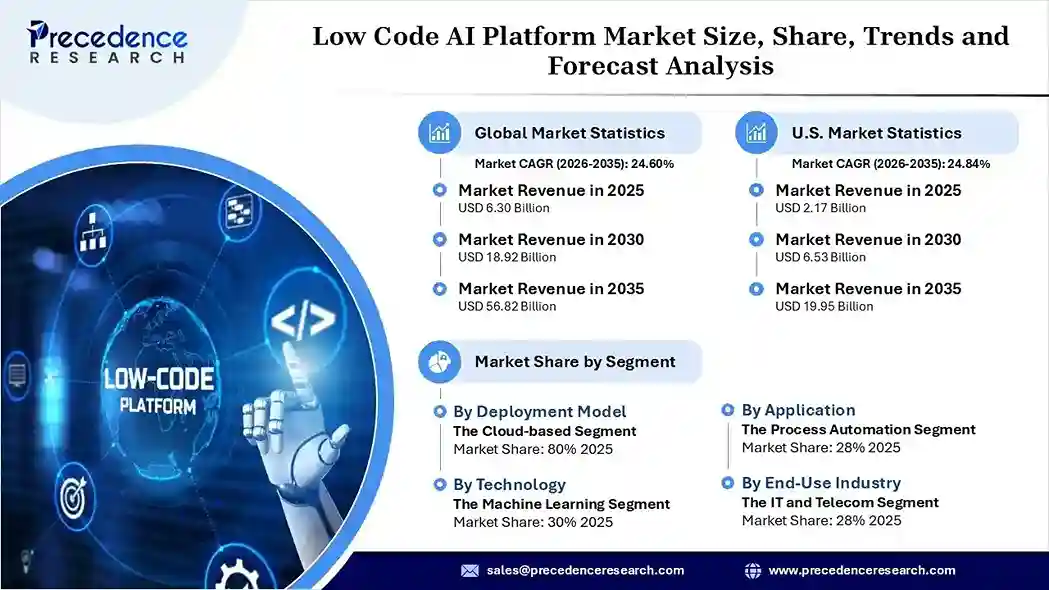
Market at a Glance
The low code AI platform market includes software solutions that combine visual application development tools with AI capabilities. These platforms allow users to build applications, increase operational efficiency, analyze data, and achieve business improvements with minimal manual coding. This is used by organizations, developers, etc, who are trying to bring speed to digital efforts, reduce development cost, and shorten deployment times.
This market consists of cloud-based services as well as on-premise and hybrid software available to different sectors worldwide. AI platform solutions are part of a large low-code platform field comprising application development software, workflow automation tools, AI copilots to assist users in coding tasks or decision-making processes related to technology implementation, data integration platforms, and product or service solutions.
Market Forecast for the Low Code AI Platform Market
Rising Demand for Low-Code AI Environment
Organizations are beginning to shift from standalone AI pilots. They now want end-to-end platforms as an answer to developing applications, optimizing workflows, and managing AI all under one roof, all in one interface. ServiceNow launched its new AI Platform in May 2025, which would integrate AI capabilities, manage data, and workflow processes by using a low-code AI system.
Demand for Faster Operations
Companies want faster software delivery without proportionally increasing developer headcount. Microsoft’s Power Apps Copilot enables users to create apps through natural-language prompts, reflecting demand for fast software creation with fewer technical issues. This trend is expected to accelerate SME adoption globally.
Developer AI Adoption Trends Supporting Low Code AI Platform Market Growth
- Today, 90% of developers are using AI tools for their work, demonstrating the quick and easy adoption of software development systems, especially those that use AI, at ease in normal practice. This trend, therefore, provides a fertile ground for low-code AI platforms that reduce the time it takes to create applications for technical and non-technical teams alike.
- 65% of all software developers rely heavily on AI software tools, and this demonstrates that businesses feel comfortable integrating AI solutions. This shift of confidence usually benefits automated and internal purposes of low-code AI platforms.
- Developers spend, on average, two hours every day interfacing with AI, which mirrors a need for faster build times. Low-code AI platforms are the goldmine for this productivity transition.
- About 80% have seen improvements in productivity from using AI tools.
- 59% said code quality improved, reinforcing the business case for AI-enabled low-code development tools.
Market Segmentation Overview
- By component, the platform segment dominated the low code AI platform market with a 82% market share in 2025 and is expected to maintain its leading position with a CAGR of 25.5% in the coming years, because of its core AI platform usage. Users prefer comprehensive platforms instead of disparate tools due to their ability to reduce complexity, shorten project timelines, and enhance operational oversight.
- By deployment model, the cloud-based segment dominated the market with a 80% market share in 2025 and is expected to maintain its leading position with a CAGR of 28.5% in the coming years. As the primary delivery model due to quicker onboarding processes and reduced infrastructure demands, cloud solutions have also facilitated easier software updates and remote collaboration among distributed business teams while enabling seamless AI feature deployments.
- By technology, the machine learning platforms segment accounted for a considerable revenue share of 30% in the market in 2025, due to its fundamental AI capabilities. Organizations had made investments in these technologies in the past because their advantages were measurable across areas ranging from operational efficiencies to fraud prevention and customer insights.
- By technology, the generative AI integration segment is expected to grow at the fastest CAGR of 32.5% in the low code AI platform market between 2026 and 2035, as the growth in this area comes from organizations looking for copilots to help in the production for automation of content generation, writing of code, and streamlined conversational processing. As industry advocates for productivity enhancements and customer applications on a large-scale look to these areas, demand is expected to shoot up at a rapid pace.
- By organization size, the large enterprises segment held a major revenue share of 65% in the market in 2025, due to complex AI deployment. Their early investments in digital transformation programs had created sustained demand for low-code AI platforms across global operations.
- By organization size, the small and medium enterprises (SMEs) segment is expected to grow steadily with a CAGR of 29.5% in the market between 2026 and 2035, due to the democratization of AI. SMEs are expected to leverage low-code AI solutions for automating tasks, fast response times, and maintaining competitiveness.
- By application, the process automation segment accounted for a considerable revenue share of 28% in the low code AI platform market in 2025, as numerous companies adopted low-code AI platforms in their everyday operations. The immediate reductions in costs, along with quicker implementation, have positioned automation as one of the most substantial early applications on a large scale.
- By application, the customer experience management segment is expected to expand rapidly in the market with a CAGR of 27.5% in the coming years, as businesses invest in personalization. Competitive pressure is likely to push brands toward digitally enhanced customer journeys.
- By end-use industry, the IT and telecom segment accounted for a considerable revenue share of 28% in the market in 2025, because of their early adoption of automation for services including service management, network operations, internal tools, and customer support systems. Their more sophisticated technology and steady demand for software created an accelerated pace of platform acquisitions relative to other industries.
- By end-use industry, the retail and e-commerce segment is expected to grow at the fastest CAGR of 28.5% in the market between 2026 and 2035, as companies seek AI-driven merchandising, customer analytics, and rapid storefront innovation. Changing consumer expectations are likely to keep digital investment levels high across this segment.
Regional Analysis
North America dominated the global low code AI platform market with a market share of 46% in 2025, due to the presence of hyperscalers such as Microsoft, Amazon Web Services, and Google Cloud, which accelerated enterprise access to scalable AI tools and low-code infrastructure. Banking, healthcare, and telecommunications have also seen their demand in these fields pick up with the rapid integration of automation software. The U.S. is the biggest winner relative to the region, bolstered by heavy reliance on software and an innovation culture.
Asia-Pacific held a market share of 20% in 2025 and is expected to grow at the fastest CAGR of 30.5% in the market during the forecast period, as the region is heavily involved in both digital transformation initiatives and the migration of cloud products to improve software delivery speeds as developer needs grow. Many organizations rely on low-code AI tools to address their talent shortage and are working to shorten the timeline to bring applications to market sooner rather than later. With a large employee base in IT accounting for the majority, India now also stands ready to play a major role in accelerating this trend due to a growing startup ecosystem and a large infusion of enterprise automation technology.
Low Code AI Platform Market Coverage
| Report Attribute | Key Statistics |
| Market Revenue in 2025 | USD 6.30 Billion |
| Market Revenue by 2035 | USD 56.82 Billion |
| CAGR from 2026 to 2035 | 24.60% |
| Quantitative Units | Revenue in USD million/billion, Volume in units |
| Largest Market | North America |
| Base Year | 2025 |
| Regions Covered | North America, Europe, Asia-Pacific, Latin America, and the Middle East & Africa |
Top Companies in the Low Code AI Platform Market
Microsoft, Google Cloud, and Amazon Web Services have leveraged hyperscale infrastructure and developer ecosystems to expand AI-assisted low-code offerings. IBM, Oracle, and SAP have focused on enterprise modernization, workflow intelligence, and integration with legacy systems. Salesforce and ServiceNow have strengthened their positions through customer workflow automation and AI-driven business operations. Pure-play specialists such as Appian, OutSystems, and Mendix have remained influential in enterprise-grade rapid application development. Zoho has built traction among cost-conscious mid-sized businesses, while DataRobot and H2O.ai have emphasized accessible machine learning and model deployment.
Segments Covered in the Report
By Component
- Platform
- Services
By Deployment Model
- Cloud-based
- On-premise
By Technology
- Machine Learning Platforms
- Natural Language Processing (NLP)
- Computer Vision
- Predictive Analytics
- Generative AI Integration
By Organization Size
- Large Enterprises
- Small & Medium Enterprises (SMEs)
By Application
- Customer Experience Management
- Process Automation
- Fraud Detection
- Predictive Maintenance
- Sales & Marketing Automation
By End-Use Industry
- BFSI
- IT & Telecom
- Healthcare
- Retail & E-commerce
- Manufacturing
- Government
By Region
- North America
- Europe
- Asia Pacific
- Middle East & Africa
- Latin America
Get this report to explore global market size, share, CAGR, and trends, featuring detailed segmental analysis and an insightful competitive landscape overview @ https://www.precedenceresearch.com/sample/8403
You can place an order or ask any questions. Please feel free to contact us at sales@precedenceresearch.com |+1 804 441 9344