



Ocular Hypertension Market Revenue to Attain USD 9.37 Bn by 2035
Published: 10 Apr 2026
Author: Precedence Research



Ocular Hypertension Market Revenue and Trends 2026 to 2035
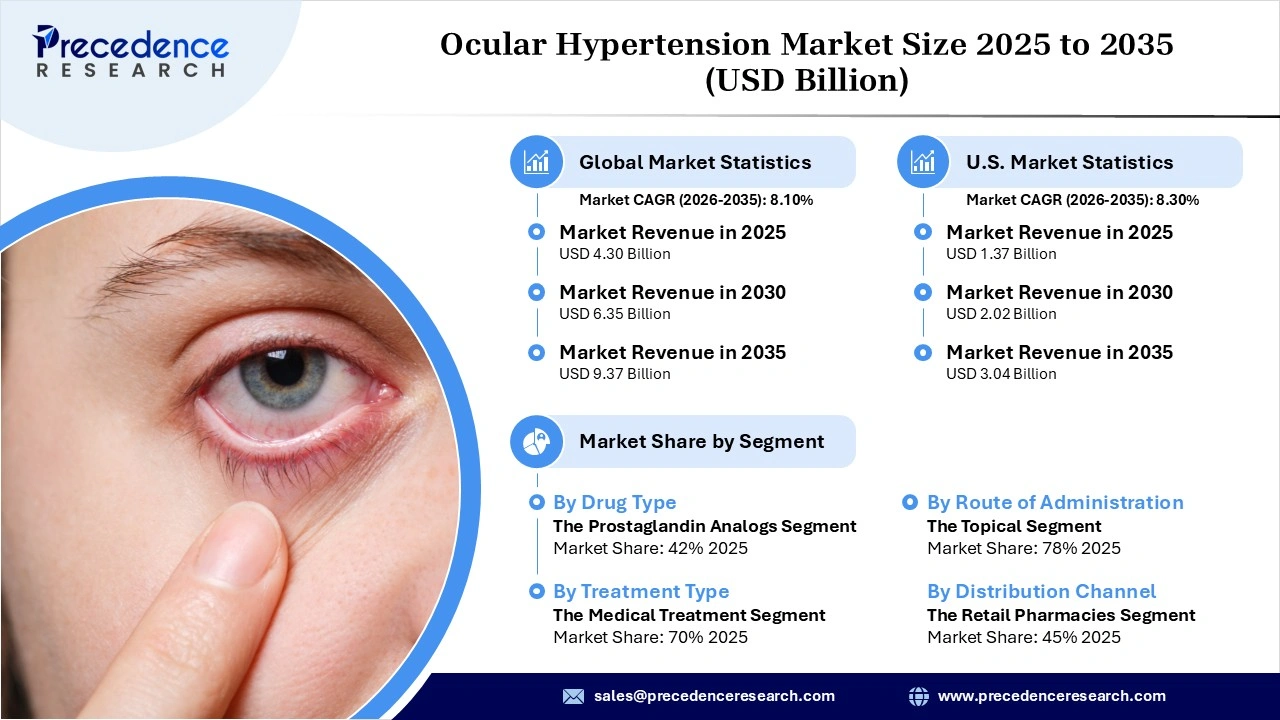
The global ocular hypertension market revenue reached USD 4.30 billion in 2025 and is predicted to attain around USD 9.37 billion by 2035 with a CAGR of 8.10%. The market is expanding due to an increasing number of individuals being informed about their potential risk. This trend is driven by enhanced screening methods, a growing elderly population, spikes in eye pressure associated with steroid use, and a gradual transition toward preventative treatment aimed at avoiding irreversible vision impairment.
Market at a Glance
The ocular hypertension market refers to the sector focused on the detection, monitoring, and management of elevated intraocular pressure (IOP) in patients who do not yet show optic nerve damage or vision loss. It includes pharmaceutical treatments, diagnostic tools, and monitoring systems aimed at preventing the progression from ocular hypertension to glaucoma, thereby reducing the risk of long-term vision impairment.
The scope of the market extends beyond simple treatment, encompassing continuous monitoring through advanced screening tools, long-term medication regimens, innovations in sustained-release drugs, and minimally invasive surgical options. Market growth is driven by aging populations and an increased focus on preventive care, making intraocular pressure management a consistent, lifelong effort for many patients rather than an occasional intervention.
What are the Major Factors Driving the Ocular Hypertension Market?
- Growing Aging Population: The ocular hypertension market is expanding due to a rising prevalence of elevated intraocular pressure, particularly among older patients with chronic conditions like diabetes. In major markets, this patient pool represents a substantial treatment opportunity, with approximately 13 million diagnosed cases. The market continues to grow steadily, increasing incrementally with each aging patient entering the care system.
- Shift Toward Advanced Treatments: There is a rapid shift from traditional daily eye drops to advanced drug delivery methods. Innovative treatments, including rho-kinase inhibitors and nitric oxide–donating medications, focus on enhancing fluid drainage in the eye. Next-generation investigational drugs such as NCX-470, QLS-111, and STN1012600 aim to improve therapeutic mechanisms rather than simply combining multiple agents.
Treatment Distribution Landscape in Ocular Hypertension Management
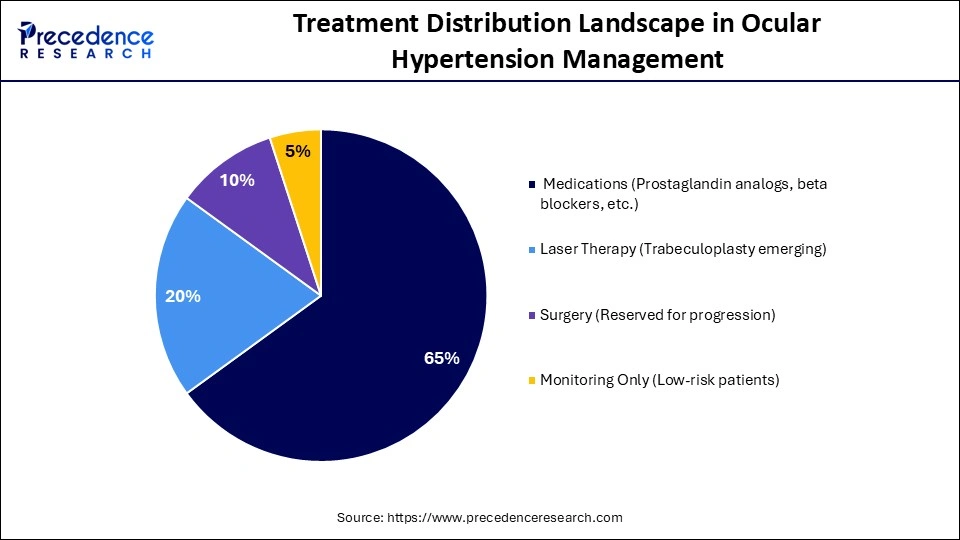
The diagram shows that ocular hypertension management is largely dominated by medications, which account for 65% of treatments. Laser therapy follows with 20%, while surgical interventions are used sparingly at 10%. Only 5% of cases rely solely on monitoring, indicating that non-intervention is mostly reserved for low-risk patients.
Market Segmentation Overview
- By drug type, the prostaglandin analogs segment held a 42% share of the ocular hypertension market in 2025. This is because of their convenience, including once-daily dosing, reliable intraocular pressure reduction, and minimal systemic side effects, which made them the preferred first-line therapy for healthcare providers.
- By drug type, the beta-blockers segment held the second-largest market share of 30% in 2025. Despite the emergence of newer drug classes, they remain widely used due to their long-standing clinical trust, affordability, and suitability for patients with specific medical considerations that limit switching.
- By treatment type, the medical treatment segment led the market with the largest share of 70% in 2025. This is because medical treatments, primarily eye drops and oral medications, allow patients to manage intraocular pressure over time, providing a minimally disruptive, convenient, and effective first-line option in routine healthcare.
- By treatment type, the surgical treatment segment was the second-largest shareholder, holding a 20% share in 2025. This is due to the growing demand for minimally invasive surgical options. Surgery is generally employed when medications fail to control pressure, offering long-term management benefits, though it is more invasive and requires higher clinical precision.
- By route of administration, the topical segment accounted for the largest share of 78% in the market in 2025 because eye drops provide targeted treatment directly to the eyes, minimizing systemic side effects and integrating easily into patients’ daily routines. Their convenience and habit-forming nature improve adherence, making them the preferred first-line therapy for long-term intraocular pressure management.
- By route of administration, the oral segment was the second-largest shareholder, holding a 15% market share in 2025. This is because oral medications serve as an important adjunct when topical treatments are insufficient to control intraocular pressure. They allow for systemic pressure reduction, offering an alternative for patients who cannot tolerate or respond adequately to eye drops, despite their potential for greater systemic side effects.
- By distribution channel, the retail pharmacies segment dominated the ocular hypertension market with a share of 45% in 2025, as they offer easy and convenient access for patients who require long-term, chronic treatment. Frequent refills, familiar locations, and minimal dependence on clinical visits make pharmacies the primary channel for ongoing medication management.
- By distribution channel, the hospitals & clinics segment was the second-largest shareholder, holding a 40% share in 2025 because they are the primary point for diagnosis and initiation of treatment. Patients rely on these facilities for clinical evaluations, prescription issuance, and monitoring early disease progression, making them central to the management of ocular hypertension.
Regional Insights
North America dominated the global ocular hypertension market with a major share of 42.50% in 2025. This dominance is due to its robust healthcare infrastructure, which emphasizes routine eye examinations and early detection programs. High rates of diagnosis in the U.S., combined with widespread access to advanced treatment options, ensure timely management of elevated intraocular pressure. In Canada, structured care pathways and increasing public awareness further contribute to the region’s strong market presence and steady growth.
Europe was the second-largest shareholder, holding a 30% share of the market in 2025, supported by healthcare systems that emphasize standardized, accessible care rather than urgent interventions alone. Germany and the UK led through rigorous screening programs and reimbursement policies, ensuring early detection and consistent treatment. Meanwhile, France and Italy contributed significantly as aging populations grew, making intraocular pressure management a routine aspect of elderly healthcare rather than an exceptional measure.
Ocular Hypertension Market Coverage
| Report Attribute | Key Statistics |
| Market Revenue in 2025 | USD 4.30 Billion |
| Market Revenue by 2035 | USD 9.37 Billion |
| CAGR from 2026 to 2035 | 8.10% |
| Quantitative Units | Revenue in USD million/billion, Volume in units |
| Largest Market | North America |
| Base Year | 2025 |
| Regions Covered | North America, Europe, Asia-Pacific, Latin America, and the Middle East & Africa |
Top Companies in the Ocular Hypertension Market
Key players in the market include AbbVie Inc. and Novartis AG, which dominate through extensive ophthalmic franchises and continuous R&D on pressure-lowering therapies. Pfizer Inc. and Merck & Co., Inc. maintain influence through brand recognition and collaborative development of new products, while Johnson & Johnson expands by integrating vision care technologies into its pharmaceutical offerings. Specialist ophthalmology companies like Santen Pharmaceutical Co., Ltd. and Bausch Health Companies Inc. focus on surgical precision and patient adherence, strengthening their positions in eye disorder management.
Segments Covered in the Report
By Drug Type
- Prostaglandin Analogs
- Latanoprost
- Bimatoprost
- Beta-Blockers
- Timolol
- Betaxolol
- Alpha Agonists
- Brimonidine
- Carbonic Anhydrase Inhibitors
- Dorzolamide
- Brinzolamide
- Combination Drugs
- Fixed-dose combinations
By Treatment Type
- Medical Treatment
- Topical Drugs
- Oral Drugs
- Surgical Treatment
- Laser Surgery
- Trabeculectomy
- Implantable Devices
- Others
- Lifestyle Modifications
By Route of Administration
- Topical
- Eye Drops
- Oral
- Oral Medications
- Others
- Injectable
By Distribution Channel
- Hospitals & Clinics
- Ophthalmology Clinics
- Hospitals
- Retail Pharmacies
- Chain Pharmacies
- Independent Pharmacies
- Online Pharmacies
By Region
- North America
- Latin America
- Europe
- Asia-pacific
- Middle and East Africa
Get this report to explore global market size, share, CAGR, and trends, featuring detailed segmental analysis and an insightful competitive landscape overview @ https://www.precedenceresearch.com/sample/8283
You can place an order or ask any questions, please feel free to contact us at sales@precedenceresearch.com |+1 804 441 9344